Showing posts with label friendship. Show all posts

Sunday, 7 February 2016

The London Bookshop Crawl 2016

I love book shopping. I know, what a shocker! But nice as it is going book shopping on my own, it's so much better going with friends, to make an event of it, where we all enable each other to buy ALL the books and spend too much money on additions to our towering to-read piles. Last year I went on three book shopping trips with online friends and also went to Hay on Wye for a couple of days with a friend from the Isle of Wight. Yesterday was The Big One, the London Bookshop Crawl Bex has spent months organising for friends, family and anyone else who wanted to come along.

It was an early start for me. Ordinarily for an event like this I would stay overnight at my sister's flat in South-West London and travel from there, but she was very inconsiderately away for the weekend, so I decided to make a day trip of it. The weather forecast was not promising, predicting gale-force winds and non-stop heavy rain for Saturday, so I found myself awake until the early hours worrying and making contingency plans just in case the passenger ferry from Cowes were to be cancelled. When it came to it, although it was a little drizzly and a little blustery, I had a very calm and uneventful crossing, and I got up to London at around ten.

We met in the cafe at Foyle's, where two tables had been reserved for the party, and several people were sitting around chatting, with coffee, cakes and pastries. Other members of the group had gone off around the shop. I was particularly excited to meet Ellie (from Bournemouth) and Ellie (from London), who I've known online and whose blogs I've been reading for years, but had never met, and Erica turned up not long afterwards. Erica reviews bookshops, rather than books, and her blog is a rather handy directory of recommendations which I check out every time I go to a new town or plan a London trip.

Once we'd got everyone together in one place, we set off down the road to Orbital Comics, a friendly and not at all Big Bang Theory-esque comic book shop. We had a mixture of comic book newbies and devotees in the group - I'm more of a newbie, and prefer short series or stand-alone titles to those which have been running for decades. Several members of the group had copies of Lumberjanes, which was a series I've been vaguely aware of through following the author Noelle Stevenson on social media, so that was my first purchase.

After Orbital we headed back to Charing Cross Road and Cecil Court, the bookshop centre of London. The shops were somewhat smaller in that area, so we broke up into smaller groups. My first stop was Any Amount of Books, which, although I didn't recognise it by name, is one of my old favourite Charing Cross Road haunts from my student days. I found several "maybe" books in there, but didn't want to load up too soon, so I left  The Incredible Adventures of Cinnamon Girl, Fannie Flagg's Standing in the Rainbow and a children's adventure book set at the Isle of Wight's very own Blackgang for another time. (I kind of regret not buying the Blackgang book though; I've never seen it before.) If anyone's read these books, do let me know what you think! I bought What She Left by T. R. Richmond, a book I've vaguely had my eye on at work, and went back to the till a second time after Nnedi Okorafor's Lagoon caught my eye and shouted "Buy me! Buy me!" How can you refuse such a call?


Cecil Court is full of bookshops of all sorts, though many specialised in collectors' editions. Marchpane is the children's bookshop (and wasn't it once in the Goldsboro premises?) It had Enid Blyton hardbacks, Chalet School books, including one of the few I've never been able to get hold of (for good reason, looking at the price!) I ran into Bournemouth Ellie and some other people - I'm sorry I can't remember exactly who as I hadn't learned everyone's names yet, but I think Louise was one, and possible Katherine too (and apologies if I've spelled your name wrong or assigned you the wrong Twitter identity) - in Goldsboro Books where we sighed over a £7500 set of first editions of Lord of the Rings. Goldsboro prides itself on being "The Home of Signed First Editions.) Not everything was out of our price range though; all the expensive books were of course locked in glass cabinets, but signed first editions of brand-new books sold at their retail price. I treated myself to Ali Smith's new book Public Library, it being National Library day and all.


Out in the street I found a poor lost and lonely Laura and, after a bit of window-shopping, took her on a little detour to Forbidden Planet, feeling slightly treacherous as I did so, as she and Bex had been arguing for ages about whether that ought to be part of the Crawl or not. I hold my hands up Bex, it really was my suggestion. We stopped off for lunch at Laura's favourite little noodle place in Leicester Square, before rejoining the group and trekking up to Persephone Books, where a very lovely member of staff was expecting us. I think, however, she was not expecting quite so many of us as we filed in... and filed in... and filed in until we were packed into the little shop like sardines in a can. The bookseller, whose name I think was Lydia, gave as a tour of the "backstage" area; office and storeroom and packing area, because Persephone is mostly a mail-order company and everything happens on site. She also talked us through what Persephone publishes (out-of-print books mostly from women writers of the early 20th century) and recommended some titles for different tastes and genres. She was an excellent hostess, really knew her stock, and it looked like we came away with multiple copies of all her recommendations between us. I bought The Home-Maker by Dorothy Canfield Fisher, which is my friend Sharon's favourite Persephone publication, as well as Harriet by Elizabeth Jenkins, one of the bookseller's suggestions. Persephone had a 3 for £30 deal (normally their books cost £12 each) so many of the group teamed up with other people buying one or two books to make the most of that offer. You also get a free bookmark with each purpose, matching the books' colourful vintage endpapers, which are prints from fabrics made in the year of first publication.


Next we traipsed down to the London Review Bookshop. This shop selects its stock on its merits over than bestseller quality, meaning that the books on display aren't necessarily what you would find in every branch of Waterstone's and WH Smith. By this point my shoulders were starting to ache from my rucksack and all my shopping bags, so Ailsa, who I'd got chatting with, and I squeezed into a corner of the busy cake shop for a mid-shopping snack. While we were in there, the group agreed to miss out Daunt Books, which was due to be the next stop, as we were running over time, and most of them headed off to our final bookshop, the massive Piccadilly branch of Waterstone's. Ailsa and I stayed at the LRB a while longer, and I was sorely tempted to stock up on many of the fiction hardbacks on the recommendations table (and that's before we even get onto the paperback shelves) but limited myself to one: Yuki Chan in Bronte Country by Mick Jackson. We stopped off at the craft shop next door (and now I know where I can stock up on sealing wax when I run out of the stuff that came with my Harry Potter stationery box) and met up with the group at Waterstone's. I then proceeded to hand out copies of The Long Way to a Small Angry Planet to everyone who'd expressed an interest in sci-fi. Tina and I had kept on running into each other deliberating over whether or not to buy Loney, winner of the Costa First Novel prize. I did, she didn't. My last purchases of the day were Gracekeepers author Kirsty Logan's short story collection The Rental Heart... and another copy of Anne of Green Gables. Yes, that makes four. Not including the colouring book, the journal, all the Anne stationery, and other books in the series. It's the luscious little Collectors' library edition, pocket-sized with gold-edged pages and illustrations, and all for the price of a trade paperback.


Many members of the group began heading off homewards around that point, and Laura, Bex and I ("the founding members") found some comfy chairs up on the fourth floor and sat down to rest our feet and chat about how the day had gone. It went AMAZINGLY. I don't think I've ever been with so many like-minded bookish people, even when I was at university studying books. Everyone was a kindred spirit, easy to join a conversation with, even though we didn't all know each other to begin with. I'm just sorry I didn't get to talk to everyone. Those of us who were left at 6ish had a table booked at Pizza Express, a really lovely end to a fantastic day. It was a long journey home, with a slight delay on the Southampton line, so I took a slightly earlier and faster train than the one I'd initially intended. I got a taxi from the station and arrived at the Red Jet terminal with plenty of time to spare. The journey across the Solent was a little choppy, but hardly the chaos and disruption I'd been led to believe (though that may still be to come.) I finished my day when I got home with a "special" hot chocolate (with a splash of Bailey's) and was in bed by midnight, where I stayed for the next eleven hours. A long day (and an expensive one) but such a happy one.

Thursday, 20 February 2014

Attachments - Rainbow Rowell


It looks like I'm the last book blogger to read and review Rainbow Rowell's debut novel, Attachments, so I'll try to keep it short. The plot is simple: Lincoln, IT and systems security man at a newspaper office, is responsible for reading any emails flagged as potentially inappropriate sent from company addresses. It is 1999 and the world is still getting used to the internet, and personal emails from company accounts are a definite no-no. Not that this stops Beth and Jennifer! Their names keep popping up again and again, and Lincoln knows he ought to send them a warning, but they are just so likeable and funny that he can't bring himself to do it. And then he realises he's falling in love...

I admit it: I loved Attachments because I'm nosy. Aren't we all? Who can honestly say they've never stalked an ex on Facebook, or spied on twitter-conversations between people we like. Half of Attachments gives that same feeling that we, like Lincoln, are privy to something personal between friends. Like Lincoln, we get to know Beth and Jennifer through their emails, which reveal them to be people who are a lot of fun to hang out with, sharing their relationship and family woes, quirks and insecurities, and a deep abiding friendship.

To my surprise, it was Lincoln that I found myself relating to the most. All three characters are about my age (28) but it is he who has moved back to his mother's house, is in an unsatisfying job, quiet and a bit nerdy and still not over a relationship that ended many years ago. It was part painful, part reassuring to see myself in this character, putting into words the fear that's always in the back of my mind.
"I think I missed my window," he said.
"What window?"
"My get-a-life window. I think I was supposed to figure all this stuff out somewhere between twenty-two and twenty-six, and now it's too late." 
And of course, Lincoln finds out through the course of the novel that it's not too late at all. He's a really lovely character, thoughtful, kind and well-liked by anyone who comes into contact with him. He befriends an older employee in the staff room and enjoys listening to her stories about her dogs, shares his lunch with her and helps her move house. He prefers nights in playing Dungeons and Dragons to nights out partying, and buys violet-patterned bedsheets instead of something more manly, because he likes violets.

Lincoln doesn't need to see Beth to know he's in love with her: her emails to Jennifer are full of fun, kindness and her sense of humour. And occasionally they mention "My Cute Guy," who she has seen about the offices, but whose identity is unknown. On the first mention of this mysterious stranger, I crossed my fingers that he might turn out to be Lincoln. When he did, I may have let out a girly squeal. Their romance - if you can call it a romance when the characters don't interact for most of the book - is really heartwarming and sweet, and I really enjoyed watching it play out towards its conclusion.

If you're looking for a chick lit novel for people who don't like chick lit, let me recommend Attachments. 

Monday, 20 January 2014

Fangirl - Rainbow Rowell


As soon as I heard about Rainbow Rowell's novel Fangirl, I knew I had to have it. The story of a shy and nerdy girl in her first year at university, who spends more time in the world of her favourite books than in the real world? Gimme! Ellie sent me this book as my Christmas present, and I spent a good chunk of Christmas Day reading the book, once the presents had been opened, lunch had been eaten and everyone was feeling a bit sleepy and unsociable. 

Although nerds have started to become a little more mainstream these days, with the popularity of shows such as The Big Bang Theory and the popular kids proudly wearing words like "Geek" and "Dork" on their T-shirts that were always insults when I was a kid, there isn't an awful lot of representation of girl geeks at the moment. Sure, there is the awkward Amy and brainy Bernadette in The Big Bang Theory, but I want to see girls in fandom. Girls in the comic book store. Cosplay girls. An exploration of the differences between girl-geeking and boy-geeking (broadly speaking: ie Trekkie boys obsessing over starships, Trekkie girls obsessing over relationships.) Fangirl helps to fill that gap. Protagonist Cath's method of geeking out is to write fanfiction of her favourite series of books, Simon Snow. Simon Snow is clearly based on the Harry Potter books, but from the extracts we read, takes the plot in quite different directions. I wondered how much of Simon Snow itself stemmed from Potter fanfiction, as some of its storylines could be very interesting if applied to the Potterverse.

Fangirl brought back a lot of memories of my own sixth form and university days - like Cath, I once submitted a piece of fanfiction (in my case a poem based on Lord of the Rings) as part of my application to one university's creative writing programme. I didn't get accepted onto that course, and I still wonder whether it was because my poem could have been considered, like Cath's story, "plagiarism" - or whether it just wasn't any good. It certainly wasn't subtle. When I was at uni, one of my classmates produced a poem inspired by Torchwood, but she named no names and the poem was a success. I felt annoyed with Cath's professor for failing her assignment for reasons of "plagiarism", but I wondered whether she was write to do so, depending on what the criteria was for the class. If the goal is to produce a story of publishable standard, then no matter how creative and well-written a piece of fanfiction might be, it would still be in breach of copyright.

Aside from the world of fandom, Cath faces other challenges in her new life at university. She is a twin, who up until now has always followed her sister's lead, but now Wren has got a different roommate, is living in a different dorm, leaving Cath to fend for herself. (Cather and Wren - even their names indicate that they are two halves of a whole.) Although I really enjoyed reading about Cath's early days at university, it was marred slightly by flashbacks to Rebecca Harrington's Penelope, for no other reason than the American university setting and the socially awkward protagonist. It improved once I started to get to know the characters, and I really liked Cath's roommate Reagan and her friend Levi. As well as her shyness and anxiety disorder, Cath had to deal with a lot of family issues: a father with bipolar disorder, an absent mom getting back in touch after over ten years and a sister going off the rails. Yet throughout all their ups and downs, despite the times when they seem to be drifting apart, they are kept together by their family ties. Cath, Wren and their father come across as a very believable, far from perfect but loving family.

Although there was a teased love triangle early on, ultimately it didn't go anywhere, instead focusing on a lovely and believable depiction of a first love with one party's fear and trust issues, the combined passion and shyness. The small details made it real.

Fangirl is a celebration of family, friendships, growing up, falling in love with a boy and falling in love with writing, all centred around the fandom community. A really cosy and heartwarming read.


Key Quotes
"I feel sorry for you, and I'm going to be your friend.""I don't want to be your friend," Cath said as sternly as she could. "I like that we're not friends.""Me too," Reagan said. "I'm sorry you ruined it by being so pathetic."
"You give away nice like it doesn't cost you anything. Levi laughed. "It doesn't cost me anything. It's not like smiling at strangers exhausts my overall supply.""Well, it does mine."
To really be a nerd, she'd decided, you had to prefer fictional worlds to the real one.
That was the beauty in stacking up words -- they got cheaper, the more you had of them.

Fangirl - Rainbow Rowell


As soon as I heard about Rainbow Rowell's novel Fangirl, I knew I had to have it. The story of a shy and nerdy girl in her first year at university, who spends more time in the world of her favourite books than in the real world? Gimme! Ellie sent me this book as my Christmas present, and I spent a good chunk of Christmas Day reading the book, once the presents had been opened, lunch had been eaten and everyone was feeling a bit sleepy and unsociable. 

Although nerds have started to become a little more mainstream these days, with the popularity of shows such as The Big Bang Theory and the popular kids proudly wearing words like "Geek" and "Dork" on their T-shirts that were always insults when I was a kid, there isn't an awful lot of representation of girl geeks at the moment. Sure, there is the awkward Amy and brainy Bernadette in The Big Bang Theory, but I want to see girls in fandom. Girls in the comic book store. Cosplay girls. An exploration of the differences between girl-geeking and boy-geeking (broadly speaking: ie Trekkie boys obsessing over starships, Trekkie girls obsessing over relationships.) Fangirl helps to fill that gap. Protagonist Cath's method of geeking out is to write fanfiction of her favourite series of books, Simon Snow. Simon Snow is clearly based on the Harry Potter books, but from the extracts we read, takes the plot in quite different directions. I wondered how much of Simon Snow itself stemmed from Potter fanfiction, as some of its storylines could be very interesting if applied to the Potterverse.

Fangirl brought back a lot of memories of my own sixth form and university days - like Cath, I once submitted a piece of fanfiction (in my case a poem based on Lord of the Rings) as part of my application to one university's creative writing programme. I didn't get accepted onto that course, and I still wonder whether it was because my poem could have been considered, like Cath's story, "plagiarism" - or whether it just wasn't any good. It certainly wasn't subtle. When I was at uni, one of my classmates produced a poem inspired by Torchwood, but she named no names and the poem was a success. I felt annoyed with Cath's professor for failing her assignment for reasons of "plagiarism", but I wondered whether she was write to do so, depending on what the criteria was for the class. If the goal is to produce a story of publishable standard, then no matter how creative and well-written a piece of fanfiction might be, it would still be in breach of copyright.

Aside from the world of fandom, Cath faces other challenges in her new life at university. She is a twin, who up until now has always followed her sister's lead, but now Wren has got a different roommate, is living in a different dorm, leaving Cath to fend for herself. (Cather and Wren - even their names indicate that they are two halves of a whole.) Although I really enjoyed reading about Cath's early days at university, it was marred slightly by flashbacks to Rebecca Harrington's Penelope, for no other reason than the American university setting and the socially awkward protagonist. It improved once I started to get to know the characters, and I really liked Cath's roommate Reagan and her friend Levi. As well as her shyness and anxiety disorder, Cath had to deal with a lot of family issues: a father with bipolar disorder, an absent mom getting back in touch after over ten years and a sister going off the rails. Yet throughout all their ups and downs, despite the times when they seem to be drifting apart, they are kept together by their family ties. Cath, Wren and their father come across as a very believable, far from perfect but loving family.

Although there was a teased love triangle early on, ultimately it didn't go anywhere, instead focusing on a lovely and believable depiction of a first love with one party's fear and trust issues, the combined passion and shyness. The small details made it real.

Fangirl is a celebration of family, friendships, growing up, falling in love with a boy and falling in love with writing, all centred around the fandom community. A really cosy and heartwarming read.


Key Quotes
"I feel sorry for you, and I'm going to be your friend.""I don't want to be your friend," Cath said as sternly as she could. "I like that we're not friends.""Me too," Reagan said. "I'm sorry you ruined it by being so pathetic."
"You give away nice like it doesn't cost you anything. Levi laughed. "It doesn't cost me anything. It's not like smiling at strangers exhausts my overall supply.""Well, it does mine."
To really be a nerd, she'd decided, you had to prefer fictional worlds to the real one.
That was the beauty in stacking up words -- they got cheaper, the more you had of them.

Thursday, 1 August 2013

15 Day Book Blogging Challenge: Day Three


Day 3: Who is your blogging BFF?

It's got to be Ellie the bookshop girl. Her blog is fun and informal, a mixture of book reviews, personal posts (with photos and funny gifs) and ranting about the grim reality behind the romantic ideal of running your very own bookshop. Tragically, not all bookshop customers are kindred spirits, folks!

Ellie's the only blogger I've met in real life, when I visited the Peak District earlier this year, and bought up a huge bag of books from her shop. She's just as lovely in real life as she comes across in her blog, and it's great to meet someone for the first time and feel like you've known them forever. (And she makes my book-buying habits look positively saintly!)

Wednesday, 15 May 2013

Bout of Books: Tuesday and Wednesday


Bout of Books


Apologies for the lack of update yesterday. After work I went out with friends to see the new Star Trek movie. I'm new to Star Trek, having somewhat reluctantly seen the rebooted films (once you get into Star Trek, surely there is no going back!) but it was an excellent film. As with a lot of fantasy, and increasing amount of science fiction, it appealed to my longing for exploration and adventure. I can see that I'm going to have to borrow some of my friend's original series DVDs. Oh dear. What have I done?


Yesterday lunchtime I finished The Age of Miracles. While remaining a fascinating premise, there came a point about three-quarters of the way through when it stopped being fun, and became just plain depressing. If events could go one of two ways: good or bad, bad or terrible, invariably the worst-case scenario would happen. The book was powerful, poetic and eerie, a solemn voice in an unnatural hush, but ultimately it was a relief to reach the end.

Memorable quotes:
"Amid this usual bilge now floated a different kind of gossip, its sources equally dubious. In 1562, a scientist named Nostradamus had predicted that the world would end on this exact day."
I include this quote because when I was thirteen, I remember that exact same rumour going around my middle school. (I can even tell you the date, because I wrote dismissively about it in my diary: 4th July 1999. Of course, this was the year of the Millennium Bug scares - that everything technological would fail on the stroke of midnight because it would think the year was 1900, and stop working because it would think it hadn't been invented yet.)
 "doesn't every previous era feel like fiction once it's gone?"
"Birds have always been messengers. After the flood, it was a dove holding an olive branch that told Noah the flood was over.  That's how he knew he could leave the ark. Think about that. Our birds aren't carrying any olive branches. Our birds are dying."


 As I had forgotten to take a second book to work with me to read on my lunch break, I swapped The Age of Miracles for Gavin Extence's The Universe Versus Alex Woods in the staffroom library. I liked Alex straight away, a bright but innocent teenager arrested on re-entering the country and found with an urn of the ashes of his friend, Mr Peterson, and a large quantity of marijuana. Alex narrates the events with a kind of curious detachment, before deciding to start his story from a strange event in his childhood: when he was hit in the head by a meteorite, and survived.


Readathon statistics:

Books read today: The Age of Miracles - Karen Thompson Walker, 
The Universe Versus Alex Woods - Gavin Extence
Number of pages read today: 114
Number of books read in total: 2
Books finished: 1
Today #insixwords: No updates yesterday because Star Trek
Cinema ice cream: mint choc chip

Wednesday 8.30PM

Oh, boy, it's been a long day. Work yesterday was a horrible mixture of manic panic and deadly boredom - all or nothing and everything going wrong which played havoc with my brain. Looking back, I can't think of any one thing that made it a terrible day, but a combination of little annoyances left me feeling dead on my feet, which carried on into today. I spent most of today staring into space while trying to look as though I wasn't just staring into space, but I didn't really have to pretend because we had very few customers. I welcomed the few who wanted to talk at great length about books (not so much the ones who wanted to discuss their medical issues, but even they were a distraction. I must have a face that says you can tell me all your problems. And I do like to get to know my customers as people, and some of the older ones don't have many people to talk to, so if I can lend a sympathetic ear, that's all good.)

Read a little more of Alex Woods at lunch time, where I saw his twelve-year-old self being chased by bullies into a random stranger's greenhouse, being blamed for the destruction of this greenhouse, and being forced to make amends to the stranger by doing various chores for him. Thus begins the friendship between Alex Woods and Mr Isaac Peterson, an elderly Vietnam war veteran and widower.

Mr Peterson has an extensive collection of the works of Kurt Vonnegut, who, by coincidence, is one of the authors of a book on my to-read pile, lent to me by the husband of my friend. Alex Woods has managed to push Cat's Cradle higher up the to-read pile. I love books which make me curious about other literature (also music, film or obscure subjects.)

Readathon statistics:

Books read today: The Universe Versus Alex Woods - Gavin Extence
Number of pages read today: 136
Number of books read in total: 2
Books finished: 1
Today #insixwords: Can't wait till my day off
Length of after-work nap: 40 minutes

Friday, 28 September 2012

Jenny Q, Stitched Up - Pauline McLynn

Actress Pauline McLynn is probably best known as Father Ted's Mrs Doyle. Jenny Q, Stitched Up is her first foray into writing for teenagers. The book blurb suggests that more stories are to follow about Jenny and her friends and relations in Dublin.

Jenny Q, Stitched Up is a very light read for younger teenagers, a sweeter Angus, Thongs and Full-Frontal Snogging. The greatest conflicts in Jenny's life are her mother's pregnancy, ("It's just so, well, SHAMEFUL. And now it's going to be plain for all the world to see") the agony of keeping secrets from her best friend, and the horror of her mum eating all the KitKats. The drama and humour comes from the agonies Jenny suffers over the smallest details - after all, when you are thirteen years old, everything is the most important thing in the world!

Jenny Q is full of warm, lovable characters, and despite Jenny's constant griping about how weird and embarrassing her family is, it's clear that they are actually pretty close. Her best friends, Dixie and Uggs (Eugene) form a cosy "Gang" who meet regularly to engage in craft activities, especially knitting (despite Uggs' feeble protests.) McLynn captures well the dynamics of a teen friendship group, the relentless good-natured mockery and unspoken understanding of its limits, the awfulness of not telling your friends EVERYTHING, or worse, sharing a secret with one and not the other.

At thirteen, Jenny Quinn is just discovering boys - or one boy, anyway, her elder brother's friend Stevie Lee Bolton, "who is a god, end of." There is an adorable innocence in Jenny's first crush, how new and strange she finds it all. Stevie Lee is usually surrounded by a gaggle of gorgeous older girls dubbed "the Slinkies" who Jenny and Dixie regard with a combination of hero-worship and contempt, but once you get past the love-hate-girlcrush, it is refreshing to find that SamDanandEmmyLou are quite normal and nice as well as being pretty. In fact, Stitched Up contains only one real antagonist, and that is the class bully who, coincidentally, shares a name with a boy in my high school circle who I couldn't stand. When Jenny Q and the Gang decide that enough is enough, instead of battling the bully, they try to charm him into better behaviour, attempting in a thirteen-year-old way to understand why he is so unpleasant. I found that this story, though quite sweet, was less successful than other parts of the plot. The bully didn't have quite enough of a presence to really make me sense the conflict, and his story seemed to be resolved a little too simplistically.

Jenny Q, Stitched Up is a sweet, easy read, a heartwarming story for teenagers and pre-teens, or a shameless indulgence for older readers. I borrowed this book from the library, but am tempted to buy myself a copy. A book to keep you company on a rainy autumn day, with a large mug of cocoa and a chunky knitted jumper.


Wednesday, 7 December 2011

Will Grayson, Will Grayson/Dash and Lily's Book of Dares

Will Grayson, Will Grayson: John Green and David Levithan

I'd read a lot about John Green on young adult book review blogs, and the general consensus was that I ought to go out and buy all of his books! So, gift card in hand I wandered down the road to the other bookshop and perused the shelves. Should I go for An Abundance of Katherines, about a boy who only dates Katherines - because guess what? Katie is short for Katherine. Or Looking for Alaska? In the end I was won over by Will Grayson, Will Grayson's shiny cover and the novelty of the idea of two main characters with the same name - Will Grayson.

The book is written in the first person, alternating between the two Wills, with each author taking on a particular Will Grayson. Both Wills are quite lonely individuals. The first tries to live quietly and unobtrusively, his two rules being "Don't care" and "Shut up," out of fear of getting hurt. To his dismay, his best friend, Tiny Cooper - who he isn't even sure he likes very much - is the exact opposite, big, loud and flamboyant, falling in love every other day and the writer, director and star of a school musical - about his own life!

The other Will Grayson is clinically depressed and trapped in a state of self-loathing, putting up barriers between himself and the world. I've read a lot of reviews where people have found Will 2 to be moody and unlikeable, but I felt that he was a very real character who I could identify strongly with. The two Wills meet by chance in Chicago, and their lives change and take on new directions, in a rollercoaster of a story that is at times hilarious, heartbreaking and really, really corny - but in such a way that you can't help but grin.

Despite the title of the book, it is really Tiny Cooper who is the central character, and plays a crucial role in both Wills' lives. At first seeming to be a lovable but somewhat stereotypical "gay best friend" supporting role, gradually you come to realise that this boy has a huge heart beneath all his posturing, someone who genuinely lives to try to make other people feel better about themselves. He was truly lovely.

Because both Wills were written by different authors, I found it interesting to see how the characters were alike, and how they were different. In many ways, their "journeys of self-discovery" echoed each other's, but not in a self-conscious way. There were two authors, each writing their own version of a coming-of-age story, so their characters had both similarities and differences that came across more realistically than if a single author were to assign different characteristics to the different narrators.

While reading Will Grayson. I was surprised to find a little handwritten note inside, from somebody named Alicia, advising me to look at John Green and his brother's vlog site at Youtube, and recruiting me into their "nerdfighters' army." I was ridiculously excited that someone was passionate enough about her favourite author to want to share her love of reading with random strangers in a bookshop like this, and it led me to think of reviews I had read of one of David Levithan's other co-authored books:

 Dash and Lily's Book of Dares: Rachel Cohn and David Levithan.

Dash is browsing the bookshop one Christmas vacation, when among his favourite author's books, he finds a little red notebook with messages in code from a girl named Lily. Instead of merely contacting her with his personal details, he leaves a dare for her in ret
urn, and so the game begins.

Like Will Grayson, this book is written in alternating chapters: one narrated by Lily, the other by Dash. It's a light-hearted, cheerful and hilarious festive read - I kept laughing out loud on the train and ferry - and a sweet, heartwarming romance. Dash and Lily are loveable, nerdy characters - he is a word nerd, she's a strange, lonely girl, both more or less home alone for Christmas. Their dare game takes them all across New York: through the bookshop, Santa's grotto, nightclubs and Madame Tussauds, with the aid of  friends and relations working in each place. Yes, there are a lot of unlikely coincidences and contrivances, but it is another cosy, feel-good novel for the Christmas season.

Saturday, 18 June 2011

My Sister Lives on the Mantlepiece, Annabel Pitcher (audiobook)

sister mantlepieceFive years ago, Jamie’s sister Rose was killed in a terrorist attack in London. He doesn’t really remember Rose, because he was only five at the time, but his family has never recovered. His mum left just a few weeks ago after having an affair with Nigel from the support group. Jamie’s dad drinks all the time and hates all Muslims. Rose’s twin sister Jas – now fifteen – has dyed her hair pink and got her nose pierced, an act seen as a betrayal by their parents, because she doesn’t look like Rose any more. It’s like Jas and Jamie are less visible than the urn on the mantlepiece, less present than the hole where Rose ought to be, the gap around which their whole family revolves.


After Mum’s desertion, Dad, Jas and Jamie move to a small village in the Lake District to start a new life. At his new school, Jamie doesn’t fit in. His teacher always seems to ask the very questions he can’t answer, and is frustrated by his reticence and apparent stupidity. The other kids call him “freak,” with the exception of sparky, mischievous Sunya, who recognises in him a kindred spirit, a fellow super-hero. But Jamie dreads to think how his father would react to his friendship with a Muslim girl, when he blames all Muslims for Rose’s death.

Jamie is a bright, unusual child with a vivid imagination. His narration is full of bright similes and metaphors which fit perfectly:
“I was more nervous than the most nervous person I could think of, which right now is the lion from The Wizard of Oz. My tummy had something bigger and scarier than butterflies inside it. Maybe they were eagles or hawks or something. Or, come to think of it, they could have been those monkeys with wings that kidnap Dorothy and take her to the witch that's scared of water.”
Jamie doesn’t really remember his sister Rose. Every day he sees the effect of her death on his parents, but for him that’s normal. He doesn’t remember when life was any different. For the outside reader, it is clear that something is very, very wrong. I felt intense pity for Jamie’s parents – one could never get over the loss of a child – but they are unreasonable in the way they treat their surviving children, so wrapped up in their own pain that they resent Jas and Jamie for not being Rose, or for not letting their lives revolve around her absence. When Jamie had to write a school essay about a hero, and chose footballer Wayne Rooney, his mother made him rewrite it about Rose, dictating the memories he didn’t have. Then, at a birthday party, when Jamie asked for food, his dad filled a plate – to put on the mantlepiece beside Rose’s urn. Jamie is such an optimistic child, but his hope is painful to an older, wiser reader (or listener listener) because of the awareness of the crushing disappointment that is to come when his wishes don’t come true, or if they do, they aren’t what he had hoped. At times the story just seems to be disappointment after disappointment, and Jamie has to learn the difficult lesson that adults don’t always get it right, don’t have all the answers and do let you down. But they get there, slowly, until Jamie concludes:


If OFSTED inspected my family, then I know what grade we'd get: Satisfactory. OK, but not brilliant, but that's fine by me.
I downloaded the audio version of this book when I was struck by a bad migraine attack. I couldn’t sleep for the whole time but wasn’t up to reading, so I let David Tennant read this to me instead. Although he is a talented voice actor, seemingly able to imitate any accent he tries, in this case his reading is simple and understated, letting the story do the work, narrating with the right amount of innocent hope, eagerness and subdued sadness. I bought the audiobook from Audible.co.uk, but was quite disappointed that it came as one six-hour track, so I couldn’t burn it to CD to wake me up in the morning. In future I think I’ll stick to buying  audio books as CDs.

Thursday, 3 March 2011

The Truth About Forever, Sarah Dessen

Since her father died, Macy has been struggling to hold everything together. On the surface everything looks perfect: perfect grades, perfect boyfriend, perfect life - but underneath she's falling apart. It's the summer before her last year of high school, and everything counts towards going to a good university. Her boyfriend's gone away to "brain camp" and left her his job at the library - but she hates it. Her colleagues sneer at her, and at home her workaholic mother is too busy with her job as some sort of estate agent/party host who shows off the new houses. At one of her mother's functions, she befriends the kind-hearted but chaotic caterers and takes on a second job with them. Her new friends help her to see that life is not to be feared but embraced, while Macy finds herself growing closer to Wes, the boy with a Past.

Grief treats everyone in different ways, and Macy and her mother bury theirs deep inside, pretending that everything is fine. Macy's mother loses herself in her work, while Macy's coping mechanism is her pursuit of "perfection," for only when she's perfect, she reasons, will she have control. But she is not happy. Although she claims to be in love with her boyfriend, Jason, it's clear the lady doth protest too much, and that Jason is not good for her, being more interested in his university applications and that Macy covers his job adequately.

I found The Truth About Forever to be much more a character-led book than plot-driven. Dessen does a great job at bringing Macy's new friends to life: accident-prone, pregnant caterer Delia - UK readers may be amused by her name, being very unlike another Delia in food! - bickering brothers Wes and Bert, lively Kristy and her sister Monica "Monotone" whose vocabulary consists of "Mmm-hmm/Nuh-uh," "Don't even..." and "Better quit."

I wasn't so convinced by the "villains" of the piece, if I may so call them. Jason acted more like he was Macy's middle-aged, humourless boss than her boyfriend, and her mother was a monster. Yes, I know she was grieving and stressed, but the way she treated Macy was disgraceful. One evening she came home to find Macy had invited her friends in to watch TV - whatever next? Offering them coffee? Playing music? - and she acted as if Macy had staggered home drunk at three in the morning and thrown up over the new carpet. If Macy's aim of perfection was unhealthy, her mother's pushing her was far, far worst. Any time Macy spent on her summer holiday not studying or working - and only the library job counted - just wasn't good enough. Only perfect was good enough. She's seventeen years old! Let her live!

But what is the truth about forever? The subject popped up throughout the book, but I wasn't quite sure what message Dessen was trying to get across. Kristy contradicts herself by saying at different times, "Life is long," and "Life is short." In short, nothing lasts forever. A few weeks of summer might feel like forever at the beginning, but it's gone before you know it.

Although I quite enjoyed this book, it took me a few days to get through as it was quite similar to some other books for teenagers, and not a lot ultimately happened. I felt the need to read something a bit more challenging; this was nice but too light and fluffy for my taste at the time of reading.


If you enjoyed this you may like:

Tiger Eyes - Judy Blume

Saturday, 29 January 2011

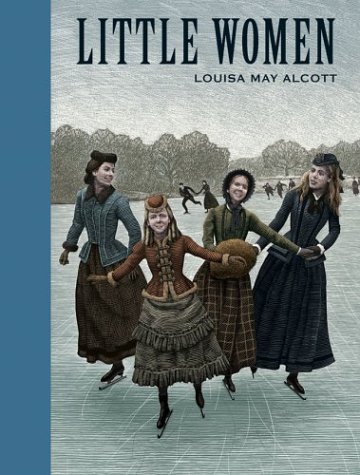
Little Women, Louisa May Alcott

I used to be confused and a bit annoyed when film and stage adaptations of this classic story would be titled Little Women but contain the story both of Little Women and the "sequel" Good Wives. It was not until relatively recently that I discovered that Good Wives is merely the UK title for what was originally, and still is elsewhere, the second half of Little Women itself. Upon discovering this, and not being overly fond of the twee Good Wives as a title, I determined to buy my own copy of the complete text. Previously I had never got past volume one, but having a book all-in-one would get me past the usual stopping point. It seemed that a Penguin paperback would be my best bet, but in Foyle's I found a lovely hardback for a lower price.

Little Women was never one of my absolute favourite books, although I've read it a fair few times, seen the 1990s film and a West End play. It's a strange thing, but every time I read this book I seem to come to it with a different attitude, and take different things away from the reading. As a child I viewed it as similar to What Katy Did, but a bit more grown-up - possibly because I was a bit more grown-up when I first read it. I came back to it a year or two ago, intending to read the whole series, but stopped at the end of Little Women [volume one] after feeling bogged down by all the moralising. Frustrated, I found the girls too good to be true, their faults only there to be overcome and an over-keenness to be lectured by their "Marmee."

That was just about a year ago. This time around I wondered if I was reading the same book, because Meg, Jo, Beth and Amy were refreshingly real, made up not of a single fault there just to be overcome, but flesh-and-blood teenagers with understandable struggles against hot tempers, jealousy, discontent, crippling shyness among others. The girls' friendship with the boy next door, Theodore "Laurie" Laurence was refreshing for the era, a cosy, platonic companionship full of fun, games and silliness that you just don't get in Victorian literature. I noticed scenes and chapters I must have only skimmed before, because they felt quite new to me. Perhaps these were the scenes omitted from the film, of which I may have retained more memories.

That's not to say I didn't find the moralising a little heavy-handed at times. In the chapter Meg Goes to Vanity Fair, Meg is rebuked first in the text, then by Laurie and finally by Marmee, for allowing herself to be made-over by her rich friend-of-a-friend for a party, and acting the part. Looking at it one way I felt quite cross, asking "What's wrong with dressing up once in a while?" and wondering if the moral here was that one shouldn't act above one's station, an idea that appalled the twenty-first century English girl who - until very recently - had an idea that class boundaries were fairly fluid. Looking at it the other way and I know quite well what Alcott's point was. After all, I tut when watching Grease to see Sandy dressing up in her leather catsuit and smoking cigarettes just to gain the respect of someone who isn't worth it. Here, Meg is doing just the same thing (I'm just picturing her in that tight catsuit!) by pretending to be someone who she isn't, just to try to fit in. We see the same in enough high school dramas nowadays.

Similarly, I was riled in part two when Professor Bhaer - and Miss Alcott - preach about the evils of writing and reading gothic thrillers and sensational stories. (Maybe I'm just horribly degenerate.) On the other hand, Alcott satirises Jo's attempts to write the sort of sickly, moralistic Victorian fiction that makes Little Women look positively riotous, the lesson being that Jo should write for herself, write what she knows and loves, and not merely what sells - something that still holds true for writers today.

I, as well as probably most girl readers of Little Women, and certainly Alcott herself, identify best with tomboy Jo, the independant woman, the writer with the hot temper and burning ambition. As a small girl I had some sympathy with shy Beth, but nowadays she comes across not as a human being, but that device of the sicklier Victorian literature: the good girl who essentially dies of being too angelic and insipid. I have to confess I've never liked Amy very much, finding her spoilt and a bit of a snob.
Read as Children's Classic for the
Back to the Classics Challenge
 
When it comes to the love stories, I'm not quite satisfied. I'm certainly not Laurie/Jo "shipper," but it seems to me that Laurie ends up with Amy simply as the next best thing, if he can't marry Jo. Jo's eventual husband Professor Bhaer is a very pleasant character, but being about twice her age, very plain and having a rather distancing title, just isn't the dashing hero I'd wish for the heroine. Meg's marriage to John Brooke, on the other hand, is portrayed very realistically with two young people as poor as the proverbial church mouse, living in the house about the size of a shoe box, madly in love, but still experiencing conflict as the honeymoon period comes to an end, with Meg accidentally neglecting her husband when being overwhelmed with coping with twins, and John happening to bring a friend home for supper on the one day Meg is having a disaster in the kitchen. Marmee steps in to offer some very wise advice, and in this context it doesn't come across as preachy, but as the calm voice of experience. Marmee is the steady force in the family, always with the right answers, but with the sympathy that comes from having been in the same fixes as her girls in her own youth.


Saturday, 22 January 2011

My Best Friend's Girl, Dorothy Koomson

When Kamryn Matika wakes up on her thirty-second birthday, her only plans for the day are to dress up in a spangly gold dress and high heels. One birthday present she does not expect is the responsibility for 5-year-old Tegan, the daughter of her former best friend Adele - and Kamryn's ex-fiance Nate. But Adele is dying of leukemia, and begs Kamryn to adopt her daughter. Kamryn had never intended to have children and struggles to forgive Adele and Nate for their betrayal of her, but she can't abandon Tegan to live with Adele's cruel father and stepmother.

I've always had the idea that Dorothy Koomson was a chick-lit author, which is a genre I rarely indulge in, and tend to be disappointed with when I do. Judging by the covers in pastel pinks and yellows, her books are certainly marketed as such, but reading My Best Friend's Girl got me thinking about what Chick Lit really is. Light, popular fiction by and for women? Sweet, shallow, fluffy romance? Sex and shopping in London, New York or LA, or perhaps a holiday in Paris or Venice?

My Best Friend's Girl is certainly a women's book, with its emphasis on relationships between friends, family and romantic partners, but I think to class it as "chick-lit" is too simple. "Chick-lit" always has negative connotations to me, though at the same time I acknowlege this to be unfair. Books certainly shouldn't be considered inferior because they are about women's issues, while books about men's issues are just called "general fiction." Unfortunately, I've found many books in the "Chick-lit" genre to be somewhat shallow and unoriginal, though that ought to be put down to the individual writers and not a judgement on the entire genre. My Best Friend's Girl uses many of the conventions of "chick-lit," such as a pastel-coloured cover, a love triangle and an overuse of adjectives, especially describing clothes and hairstyles, but Koomson creates sympathetic, well-rounded characters and explores issues of trust, forgiveness, friendship and parenthood with tact and sensitivity. Adele is a bubbly, outgoing rich girl, genuinely kind and friendly, but whose seemingly perfect childhood was in fact one of neglect and abuse. Kamryn, on the other hand, appears to be a tough, independent woman, but is full of insecurites. After years of bullying, she refused to let people come close to her - and those who she did let in betrayed her, undoing all the hard work. Though Adele's story was more obviously tragic, I really felt for Kamryn, as I could identify first-hand with the damage caused by the more commonplace betrayal.
Read as part of the Support Your Local
Library challenge

I did, however, enjoy the first half of the book better than the second, wherein we were introduced to Kamryn's new boss, Luke. Kamryn denies that she hates him because she secretly wants to sleep with him - but from that moment on I had a good idea where the story was going. Koomson left enough twists and questions to not make the ending predictable, but the addition of romance didn't interest me as much as the story of Kamryn, Adele and Tegan.


If you enjoyed this, you might like:

Friday, 17 December 2010

Getting Revenge on Lauren Wood, Eileen Cook

When she was in eighth grade, Helen's best friend Lauren humiliated and betrayed her in order to start high school in the popular group. Helen moved away with her family for three years, but now she's back and she wants revenge.

I started reading this book a little bit on my moral high horse: Revenge is bad, forgiveness is good, and at first that interfered a little with my enjoyment of Lauren Wood. On the other hand, there was that little dark side of me that remembered being bullied in school and appreciated seeing the nasty kid getting her comeuppance, quite safely within the pages of a book.

I wasn't quite convinced by the realism of this book. Firstly I debated whether it was believable for a seventeen- or eighteen-year-old girl to still be obsessing over an event that happened when she was fourteen. And it is obsession - in her three years away from her old school she stalks Lauren through her Facebook (that girl seriously needs to sort out her privacy settings on her profile page!) She is unable to put this event behind her and move on. Then again, she was fourteen, a very vulnerable age at which anything that happens is the most important thing in the world, and Lauren had been her best friend for her whole life up to that point. I know from experience that it is harder to get over trust issues caused by a supposed friend than a known enemy, because you've let that person inside the walls that keep others out, making it a more devastating sabotage to your life.

But we are expected to believe that Helen has changed enough over three years to make her unrecogniseable, by losing some weight, cutting her hair and having a nose job, so that she can call herself by her middle name (Claire) and mother's maiden name. I didn't think so, but was quite willing to suspend my disbelief to watch the drama unfold. The plot was fairly predictable, and although Helen-Claire, the boy she liked, and Brenda, the friendly girl who wasn't part of the in-crowd and therefore had to be befriended in secret, were pretty well realised, Lauren could quite easily be Regina George from Mean Girls and her two closest friends, Bailey and Kyla (why are there always two cheerleader/popular girl minions?) looked in my mind like Brittany and Santana from Glee!

All in all, Getting Revenge on Lauren Wood was a trashy but enjoyable guilty-pleasure read. And it has a brilliant cover.


If you enjoyed this, you might like:

Pink - Lili Wilkinson
Just As Long As We're Together - Judy Blume
Film: Mean Girls

Sunday, 31 October 2010

Make Lemonade and True Believer, Virginia Euwer Wolff

These two books
make up a story about LaVaughn
LaVaughn is fourteen at the start of Make Lemonade
and turns sixteen at the end of True Believer.
There is a third book out now,
but I haven't read it yet.

She lives with her Mom,
no Dad,
he was killed when she was a little girl.
LaVaughn and her mom live in a rough neighborhood.
The kids have to go through metal detectors to get into school
and six of her classmates have died since she was in fourth grade.
LaVaughn wants to get out of this place.
She's going to college,
which no one else in her apartment ever did before.

It's not easy for LaVaughn.
She has to earn her way through babysitting for Jolly's two kids.
Jolly is even worse off than LaVaughn,
seventeen, two kids and no husband,
no education and now no job.

While she's working hard, LaVaughn can't let her grades slip
or there's no point in getting the college money
if she can't get herself into college.
She needs to save up her money,
she can't afford to work for free,
but she thinks how unfair it is that she's working
for Jolly so she doesn't end up like Jolly.

And Jolly can't afford to pay LaVaughn
she can't manage on her own.
LaVaughn tries to help Jolly to get herself out of this rut,
get herself back to school so she can get a decent job,
and provide for her family
and learn first aid
which saves her littlest baby's life.

Meanwhile LaVaughn's best friends are growing away from her,
and her childhood friend Jody
whose mom moved him away to give him a better life,
is back and beautiful, and he's going to college too, 
and LaVaughn thinks,
wouldn't it be good if Jody likes her like she likes Jody?

I first read True Believer when it was brand new,
several years after its predecessor,
and Make Lemonade wasn't in the shops any more.
It worked on its own and I didn't really need to have read Make Lemonade.

LaVaughn is a bright girl defying her circumstances
trying to understand about life and love, friendship and faith,
a likeable teenager with whom it is easy to identify.
She tells her story in free verse,
with simplicity and at the same time enough colour
that I realise I have a much fuller picture of her world and her life
than the story states in just the words.
The hints in True Believer of her back story,
are not expanded any more, or much
in Make Lemonade, (which came first.)

I like a book that tells you so much more than it seems to,
where a few words make up an entire world,
and the story seems to exist outside and beyond the pages.

True Believer was one of my favourite books
when I was a teenager.
Perhaps I even wrote my name in it.

I'm waiting for the third book,
This Full House
to be published in paperback so it matches the others in the collection.
I have been waiting for this book for nine years,
since I was sixteen.
Back then it said, "coming soon," but it never was published
and I started to think it would never be finished.
I moved on to other books

and sadly I donated True Believer a couple of years later
to a friend or a charity shop.

I regretted it, and got a second copy
and Make Lemonade at last,
(Thank you to Amazon UK, the books cost me a penny each
plus postage and packaging,)
and the books are every bit as good as I can remember.


Related Posts Plugin for WordPress, Blogger...