Showing posts with label 4*. Show all posts

Tuesday, 29 October 2013

Perfect - Rachel Joyce


In 1972, two seconds were added to time. Could this be to blame for what happened next? Eleven-year-old Byron Hemming thinks so. Byron is a bright, imaginative child, and he worries about the effects that could come of humans meddling with something so constant as time. When his mother, running late on the school run, takes them on a detour, something terrible happens, and with his friend's help, Byron hatches Operation Perfect, a plan to put everything right. But can perfection be achieved - and if so, at what cost?

Viewed from the outside, Byron's family life might appear perfect. He lives in a big house, is sent to an exclusive public school, and his father has just bought his mother a swanky new Jaguar. But money cannot buy happiness. Rachel Joyce presents the Hemming family as viewed through the eyes of a child on the edge of adolescence, narrating what he sees and leaving the reader to understand what is shown and not told. Byron's father, Seymour, lives away from home during the week, working hard to earn piles of money, shower his wife Diana with gifts which he then uses as power over her. Diana acts the part of the dutiful wife, but this fancy lifestyle is not suited to her nature. We see Diana only from her son's perspective, but her character is brought to life as much by what is concealed as what is shown: the hints and secrets of the past of which she can never quite let go.

Perfect is a very British novel, examining attitudes towards class and social mobility, and making the reader think very carefully about their own preconceptions. We see this in the aftermath of the accident, when Diana befriends Beverley from the dreaded Digby Road, who seems to be exploiting Diana's feelings of guilt for her own gain. But I didn't feel quite comfortable to accept this interpretation of Beverley's behaviour, expecting the author to throw in a plot twist that declared: "Aha! You're just as prejudiced as Seymour and Diana and the other mothers!" On the other hand, is it completely patronising to refuse to accept that a lower-class person can be a scheming, conniving piece of work just as much as a wealthy person? Either way, the relationship between Beverley and Diana is completely toxic, and as the book progressed, I felt the absolute certainty that the plot was building up to something dreadful. Rachel Joyce teases us with the idea that a conflict was resolved, more or less, before opening up another can of worms.

Between the chapters about Byron's summer of 1972 are those of another story. Set in the present day, this other story follows a man called Jim, who has spent his entire adult life in hospital being treated for obsessive-compulsive disorder and possibly other mental disorders. Jim is now in his fifties, living in a van and working in a supermarket cafe cleaning tables. His days are dictated by rituals, and he still lives in the shadow of a terrible event of his youth, which could be connected to the something dreadful of Byron's summer. It seems clear where Jim's story fits beside Byron's, if not the details of how, but somewhere near the end started to question my assumption. The story as I understood it did not quite gel, and there came a powerful dawning realisation before the big revelation came. The novel is made all the more poignant by the joining of the two halves. I cried.

Deceptively simple in style, Rachel Joyce's prose is powerful and hard-hitting, yet it is not without hope or beauty. Perfect leaves the reader with a lot to think about and to feel, concerning family, class and mental illness, the power of friendship, the nature of time and the struggle for an impossible perfection.


Tuesday, 9 August 2011

Villette, Charlotte Bronte

I first encountered Charlotte Bronte as a pre-teen, when for some reason or other I watched the Lowood scenes in rehearsal at the local theatre. Being at the time fascinated with boarding school stories, the play encouraged me to try out the novel, but it was only on my fourth attempt when I was about fourteen that I actually read past Jane's childhood and onto the end. This novel has been described as an essential part of any girl's journey to womanhood, but little is known about Charlotte Bronte's other works. As part of the Bronte Sisters challenge, I decided to read Villette, a novel I knew little about other than it was supposed to be Charlotte's best work.

The novel follows the fortunes of Lucy Snowe, a young woman with no money and no family. What Lucy does have by the bucketload is resilience, strength of character, and courage, possibly to the point of recklessness. A Victorian young lady leaves England for the fictional city of Villette, unaccompanied, with no knowledge of French and no job, friends or relations when she gets there (as far as she knows.) Is she insane? Nevertheless, she quickly finds herself a position at a private school, first teaching the younger girls, then becoming English teacher for the whole school.

Lucy is a fascinating, but not always likable protagonist. It took me a good part of the book to be able to establish what her character is; she is quiet but forceful, often compared to a shadow. She is secretive even from the reader, more than once knowing more than she lets on until she decides to make a revelation. Lucy takes no nonsense and very sure of her own rightness. Her attitudes can come across as arrogant and judgemental, and she is particularly anti-Catholic which adds to her isolation as the only Protestant in the school.

Despite it being quite a challenging read, I got through Villette quickly. It is full of complex characters: the vain, coquettish Ginevra Fanshawe - who, despite all her faults, one can't quite bring oneself to dislike - sweet, precocious Polly and the devious, underhanded headmistress Madame Beck. There are two potential love interests in Lucy's life. Dr John, AKA Graham Bretton, son of Lucy's godmother, is the more conventional romantic hero: handsome, charming, friendly and generally decent. His relationship with his mother is heartwarming and amusing, full of good-natured banter. The other is M. Paul Emmanuel, a far more complex character: quick-tempered, passionate, opinionated and frequently rude, but he is full of compassion for the poor, the lowly, the underdog. He and Lucy clash frequently, but she is his equal and won't let him walk over her. He is a good character, yet I found his rudeness quite shocking, especially when I tried to imagine his modern-day equivalent. If he sees Lucy talking to another man, or dressing prettily - read, in a pale pink dress, rather than grey - he calls her all sorts of names, flirt, coquette, vain - Lucy Snowe, one of the most puritanical characters in literature! Imagine how well that would go down in real life, today. It would be considered abusive rather than eccentric foreign outspokenness, surely?


The book is quite hard-going, not least because there are large portions of untranslated French dialogue. I studied the language until I was 18, so I could follow most of it, but it might be better to read a Penguin or Oxford World Classics edition, as these tend to have footnotes or endnotes. It is a somewhat melancholy book, a tale of loneliness, disappointment and hope, and Victorian repression. Charlotte Bronte vividly describes the workings of a mind under attack from depression, of the physical pain from emotional turmoil, and the scenes in which Lucy ventures out at night after being drugged with opiates take on a surreal, fairylike tone, in which which her senses are intensified until everything seems brighter and more real than day-to-day life. Quite apart from subplot about a local ghost story that seems to fit better into an Ann Radcliffe romancethe narration is filled with the borderline-gothic atmosphere that is characteristic of Jane Eyre and Wuthering Heights. Take this scene in which Lucy reflects upon a former unrequited love:
"Was this feeling dead? I do not know, but it was buried. Sometimes I thought the tomb unquiet, and dreamed strangely of disturbed earth, and of hair, still golden and living, obtruded through coffin-chinks."
Read for the Bronte Sisters challenge
Villette's ending is ambiguous and comes upon the reader suddenly and hard. Once more, Lucy Snowe conceals the full story from the reader, leaving it open to interpretation whether it she has her happy-ever-after or not. I've a pretty good idea which is the true ending, but either way, it seems quite a let-down to have followed this character from childhood, through 650 pages of hardship, happiness, despair and hard-earned reward, only to have this ending withheld, and wrapped up in a handful of sentences. Yet, it seems a remarkably modern conclusion, and not actually out of place in this clever, thoughtful piece of literature. If Jane Eyre has been helping girls to come of age, Villette is its sadder, wiser and more mature sister.

Sunday, 17 July 2011

Mini-Reviews: Forever & Amy and Roger's Epic Detour

Forever - Maggie Stiefvater:

In Shiver, Grace fell in love with a boy with golden eyes, who was a wolf in winter. The book ended with his cure. In Linger, the werewolf virus that had lain dormant in Grace for so many years kicked into life, and we were left staring after her as she shifted and ran off into the night.

Now Grace and her friend Olivia are, for all intents and purposes, missing. Sam, Cole and Isabel know the truth, but who else would believe it? And when Olivia turns up dead, Isabel's father Tom Culpeper makes plans for the extermination of the Mercy Falls wolves. Even when Grace is in her human form, she can't go home, so this book is much more pack-based than its predecessors. I had a sense of the loneliness of living a life that no one else can be told about. Grace can't even let her friends and family know she's alive, and it seems like survival must be impossible. If Tom Culpeper and his cronies killed her while she was in wolf form, her disappearance would never be explained. Sam, Grace and Cole are faced with the near impossible task of moving the wolves out of the woods to a safe place.

This volume is more of a werewolf race-against-time than the love story of the previous two volumes, and I kept turning the pages with a desperation for everything to turn out all right, but a dread of the more likely outcome. Forever is a beautiful end to a simple but exceptional story.


Amy and Roger's Epic Detour - Morgan Matson


I bought this book after having seen a lot of reviews on other people's blogs, and, I confess, because it has a pretty cover. After her father's death, Amy Curry is charged with bringing the family car from California to their new home in Connecticut, but she won't drive any more. Enter Roger, an old family friend, and the pair decide to make a proper road trip of the journey, taking the scenic route.

I found the plot of Amy and Roger to be fairly standard for a real-issues teenage novel. I'd read too many books with the main character dealing with bereavement and family upheaval (Fixing Delilah, The Sky Is Everywhere, Tiger Eyes, Hold Still, The Truth About Forever to name but a few) for this to really stand out as a story. It was the travel that made this book different. I loved reading about the different places Amy and Roger visited: Yosemite National Park, America's Loneliest Highway, Graceland, Utah and there was a scrapbook effect with photos, ticket stubs, receipts and iPod playlists, which added to the feeling of being a passenger in the car. Along the way, Amy and Roger meet up with some lovely supporting characters, who open their homes and hearts to strangers. When Amy visited Graceland, a trip she'd always been meaning to take with her Elvis-mad father, I found myself close to tears and realised this story had drawn me deeper in than I'd previously thought.

Friday, 17 June 2011

Rainbow Valley and Rilla of Ingleside, L. M. Montgomery


I've decided to review the concluding two books in the Anne of Green Gables series in a single post, as I've already said a lot about Rilla of Ingleside three years ago. (You can read the original post here. Caution: It's long and full of spoilers.)

Rainbow Valley follows on from Anne of Ingleside, but by this point the Anne books aren't really about Anne Blythe, nee Shirley, any more. Rainbow Valley isn't even a Blythe family book, but instead is centred on a new family, the Merediths. John Meredith is the new Presbyterian minister, a young widower with four children. Although academically brilliant, Mr Meredith is completely at a loss when it comes to bringing up his children, and Jerry, Faith, Una and Carl cause scandal in the community by their wild behaviour.

I found Rainbow Valley to be much more enjoyable than Anne of Ingleside. The Blythe children, who befriend the Merediths, are a little older, and their escapades are less cutesy-poo and more heartfelt. Under the children's silly scapes is their real longing to get their father's attention, and to become respectable members of the community. Although I didn't feel that I got to know the boys very well - I would get Jerry Meredith confused with Jem Blythe, both being the eldest of their respective families, and having similar names - there was real character in the girls: impulsive, big-hearted Faith, and shy, thoughtful Una. We also got to know Walter Blythe better, who is growing to be an extraordinary, unearthly boy with his own battles.

Then there's Mary Vance, a runaway orphan "adopted" by the Merediths. Mary's story has strong parallels with Anne's own childhood, but a very different character - maybe an insight into what Anne could have been like without her imagination? Mary's language and attitude horrifies the minister's children, and even after she is being "brought up properly," she has a sharp tongue and too high an opinion of herself. I don't exactly like Mary Vance, but there is no denying she is a living character.

Perhaps I felt more interested in Rainbow Valley than its predecessor because L. M. Montgomery herself was more interested. Ingleside and Windy Willows, which are less of a joy for me to read, were written at a later date when I understand Montgomery had fallen out of love with Anne, and it shows. In Rainbow Valley there is stronger characterisation, with some newcomers who are more than gossippy old women and match-making subjects, but who take on a valuable role in the story. We meet intelligent, argumentative Norman Douglas, the West sisters imprisoned by their own vows to each other, and of course Mary and the Merediths, all of whom are as knowable as the Avonlea residents of old.


Anne's story concludes in Rilla of Ingleside, when her children are grown up, and so has the story. For the first time the timeless, slightly other-worldly, other-time classic is brutally placed into an exact place in history: World War One. I found it interesting to read about Canada as part of the British empire and the characters' patriotism towards a country most of them had never seen. I felt uncomfortable noticing that Rilla, who was so set against her brothers going to war, addressed a meeting about dying for one's country being glorious, and helping to persuade young lads to join up.

But this book does not allow idealism to overshadow the ugliness of war. We don't get to see the action first-hand - although one of Jem's letters home was reminiscent of some of war poet Wilfred Owen's writing - but Montgomery focuses in on the agony and helplessness of the people on the home front; the families, friends and lovers of the soldiers. Though full of comic and heartwarming scenes, through Rilla, Anne and Rilla's friend Gertrude, we feel the relentless agony of life, love and loss at such an unpredictable time, the fear that must underscore every aspect of life "Till the boys come home." And, of course, many never would return, including one of the Blythes' most beloved friends-and-relations. To Gertrude, Rilla, Una Meredith and me as a reader, it seemed that such loss could not be borne, but of course they survive and carry on. They must. But Rilla of Ingleside made it clear that for all who lived through the fateful years, the world had changed forever in a way that one can never quite get over.

Rilla of Ingleside is a guaranteed tearjerker, a bittersweet ending to the story that started off as such sweet escapism. In some ways I am glad that Anne retreated into the background in the later stories, as it seems so terrible that her story should take such a turn. By this point, this is far more than just a children's story, but a unique piece of World War One literature that deserves a place in the canon.

Friday, 22 April 2011

Lament, Maggie Stiefvater

Lament is the first novel from Maggie Stiefvater, author of Shiver and its sequel Linger, but it has only been published in the UK this year. The story is familiar to a connoisseur of teen fantasy fiction. Teenage girl starts a romance with a strange and handsome boy, only to discover that there's more to her new boyfriend -and the world - than meets the eye. Her new boyfriend has a dark and dangerous past that is catching him up and the teenage girl finds that a lot of people want to kill her. Stripped down to the basic plot outline, this could be Hush, Hush, or Twilight or one of many other dark fantasy romances. It might have been vampires, or angels, or werewolves. In this case it's the fair folk - the faeries.

The power of Lament is in the details. Ms Stiefvater writes with humour and lyrical prose which is highlighted by the theme of music throughout the novel. Heroine Deirdre is a skilled harpist, and it seems that her musical genius is more than just a talent. Dee is a "cloverhand" - one who can see faeries, and who has some magical, psychic abilities of her own. Music is no earthly art here.

I found that the first half of the book read as a fairly generic teen novel with an Interchangeable Magical Boyfriend Creature, and the platonic childhood best friend of the opposite sex who could be the third corner of a potential love triangle. As is often the way, I felt more inclined to wish for James the Best Friend to win Dee's heart rather than the more glamorous, troubled Luke with his faerie background.

I was rather taken aback that after Dee discovered the details of Luke's terrible past, she seemed more concerned that he had expressed his love for her than that he had been sent to assassinate her! After her initial anger, I thought Dee was too forgiving too soon, but it is to Ms Stiefvater's credit that she evoked sympathy for the couple even if I rolled my eyes a little.

Despite his otherworldly ways, uncanny knowledge of Dee's life and his habit of calling her "pretty girl," Luke is - or was once - human. When we get to meet the fair folk themselves, the book seemed to shift from YA "paranormal romance" to a more traditional, mythical fantasy genre. The fair folk are not interchangeable with the un-vampiric vampires and fallen angels that are in many books; these are definitely the faeries of old: amoral and fascinated by the humans with their funny notions of good and evil. They are majestic, dangerous, very inhuman and mischievous - from an era long ago when the word "mischief" had far more sinister connotations than it does now. These faeries are of the race of Oberon and Titania, whose quarrels put nature in turmoil. When I was at university much of my creative writing was influenced by the tales of the fair folk of old - not Tinker Bell and the cute little pixies that people tend to think of when they hear the word "fairies." Maggie Stiefvater's fair folk were of the same sort, and so well-written that I half wondered if the author had faerie blood herself, or was a cloverhand like Dee. Certainly she seems to be able to create any kind of art she tries her hand at: creative writing, painting and music.

Lament is a powerful, enchanting novel that, like the four-leaf clovers that play their part in awakening Dee's powers, opens the reader's eyes to that beautiful, deadly other realm.


If you enjoyed this, you might like:
The Bitterbynde trilogy by Cecelia Dart-Thornton
Ash by Malinda Lo

Sunday, 10 April 2011

Anne's House of Dreams


After three years of waiting, Anne finally fulfils all her friends's prophecies and marries Gilbert Blythe. Gilbert is now qualified as a doctor and has taken a position sixty miles from their home town of Avonlea. The newlyweds move to a tiny village called Glen St Mary which overlooks the Four Winds Harbour, and set up their "house of dreams" in a tiny cottage with a beautiful seaview. If you think of the Anne series primarily as a romance, it makes a nice change to see the couple after the wedding, and the ups and downs of "happily ever after."

Anne's House of Dreams comes as a welcome return to the cosy, familiar Anneishness that makes the series more than just a friend but a "kindred spirit." We don't get to see much of our old friends - Marilla, Rachel Lynde and Diana - but when we do they are just as alive as ever. In Windy Willows, I realised retrospectively that the Avonlea scenes weren't quite alive, the characters described as from a distance but not captured upon the page. Though three years have passed, it picks up where Island left off, and I think it wouldn't do any harm to skip Windy Willows altogether.

It could have been all to easy to find Anne's new home to be a poor imitation of the old one, but Glen St Mary and Four Winds have their own, very distinct, feel. In Avonlea, "although [Anne] had lived in sight of the sea, it had not entered intimately into her life. In Four Winds it surrounded her and called to her constsantly." With Montgomery's word-perfect descriptions, I could almost hear the crash of the waves in the background, smell the salt in the air and feel the coolness of a sea breeze. Four Winds Harbour is a busy port, with fishermen constantly coming and going, guarded over by the lighthouse and its faithful keeper, Captain Jim Boyd. I loved Captain Jim immediately, an old sailor, rough in appearance and speech, but a true gentleman, a captivating storyteller and a hero.

Anne's House of Dreams is situated rather out of the way, just outside the village itself, and as such there are not too many new characters, meaning that each one is properly fleshed out, and that there is more of a continuous plot in this book than in its predecessors. Beside Captain Jim, we meet the stubborn and outspoken Marshall Elliot and Miss Cornelia  Bryant. If you're a Methodist or worse, a man, don't expect Miss Cornelia to have a good word for you. From tactlessness to tantrums to dying at an inopportune moment, Miss Cornelia's catchphrase is, "isn't that like a man?"

And then there is Leslie Moore. Leslie forms a strange, hostile friendship with Anne, but although Anne knows they could be "kindred spirits," there is a barrier between them. Leslie's life is like the photo-negative of Anne's, for while Anne is perfectly happy (even with her red hair) with a wonderful husband and joyful life, Leslie has experienced tragedy after tragedy, ending up trapped in a loveless marriage. The barrier between the women comes down later, but at such a cost!

Although marketed as children's books, it is clear that this is no longer a kids' series. Anne's House of Dreams is full of adult themes - unhappy marriage and the moral dilemma of whether a doctor's duty is worth heaping more suffering onto a life already full of pain. And Anne and Gilbert suffer such a heartbreak that changes their lives forever. Afterwards, "there was something in the smile that had never been in Anne's smile before and would never be absent from it again." This marks a turning-point in the tone of the series. Sorrow has touched upon a care-free, happy-go-lucky world. There can be no going back from that. The end of the book depicts Anne and Gilbert leaving their House of Dreams for a bigger house, better for raising a family in, but it happens so suddenly, in the space of a few pages, that neither the reader nor Anne is quite resigned to it. Although Anne will grow to love her new home, at the time of leaving the House of Dreams, and this volume, she hasn't yet done so, and I found it quite a melancholy note to end on.

Friday, 1 April 2011

Major Pettigrew's Last Stand, Helen Simonson

Major Ernest Pettigrew is an old-fashioned gentleman living in a quiet Sussex village. On the day of his brother's death, Mrs Ali from the mini-supermarket turns up for the newspaper money, and the two begin a warm friendship. Major Pettigrew is retired from the army, a bit of a "grumpy old man" with a biting wit, but a heart of gold. Mrs Jasmina Ali is a widow of Pakistani descent, fifty eight years old and resisting her family's attempts to retire her off and pass the running of the shop onto her nephew. They share a love of literature, and meet up to discuss books and drink tea, but as their friendship turns to love, Major Pettigrew and Mrs Ali have to contend with the judgements of their neighbours and families.

The village Major Pettigrew calls home, Edgecombe St Mary, is the sort of old-fashioned English community where everyone knows everyone else. A circle of gossipy ladies are the unofficial organisers of the village, as they run the social events and volunteer people to make themselves useful. Time and time again, Major Pettigrew finds himself in places and doing things he had never planned or wanted to do. Daisy the Vicar's wife and her gaggle of friends could be related to the knitting circles found in the later Anne books.

These awful women, as well as some of Major Pettigrew's relatives, can make for somewhat cringeworthy reading, with their snobbery and (perhaps) well-intentioned ignorance. Daisy et al make a career out of walking all over their neighbours and causing offense, spreading an epidemic of Foot-In-Mouth disease. While the main characters are realistic, three-dimensional people, the antagonists can verge on caricatures; surely no one can be that backward and insensitive all the time? Major Pettigrew observes the thoughtless comments towards Mrs Ali and her family, who seem to forgive and shrug it off, but careless-but-well-meant words mount up reveal a deeper prejudice, culminating in a disastrous dinner-dance.

Major Pettigrew's Last Stand is, despite the nastiness in some people's hearts, generally a "nice" book, written in a style reminiscent of Alexander McCall Smith, but with a caustic edge. It is a beautiful love story between an older man and woman, witty but sensitive, old-fashioned but still very relevant in its treatment of English society's attitudes to age, class and race.

Major Pettigrew's Last Stand is the last selection from the Richard and Judy Book Club for Spring 2011.


If you liked Major Pettigrew you may enjoy:
The Help - Kathryn Stockett
The No. 1 Ladies' Detective Agency or Sunday Philosophy Club - Alexander McCall Smith
The Guernsey Literary And Potato Peel Pie Society - Mary Ann Schaffer and Annie Barrows

Wednesday, 9 March 2011

Norwegian Wood, Haruki Murakami

Whenever Toru Watanabe hears his favourite Beatles song, “Norwegian Wood,” his mind is taken back to the late 1960s, when he was a student in Tokyo. In particular he relives his relationships with two girls: vulnerable, damaged Naoko, the girlfriend left behind by his best friend Kizuki, who took his own life aged 17, and lively, curious Midori who is Naoko’s opposite in every way.

Norwegian Wood is first and foremost a story about memory. It’s quite difficult to comment on the prose, as being a book in translation, I’m not sure whether to credit the author Murakami, or translator Jay Rubin. Still, the narration is beautiful and poetic. In the descriptions, I felt the effect of a lazy, sultry summer afternoon, as if lying in a meadow and watching the world go by. There is a haunting sense of the sadness of time gone by, lost loves and missed opportunities.

In Watanabe we have a protagonist who is drifting, unsure of what he wants to do with his life. He is an ordinary youth at a time of revolution: he watches his fellow students protest about the “established order,” then slink back to class so as not to fail their course. Watanabe is a student of drama, more out of a vague curiosity than because he has any passion for the subject, a rather world-weary, bored character who describes university as “a period of training in techniques for dealing with boredom.” He is somewhat of a loner, going through to high school making up a third with Kizuki and Naoko. After Kizuki’s death, he and Naoko clung together as if for safety, but when they have spent only one year at university, Naoko takes “leave of absence” and is taken to a sanatorium for mental health.

When compared with Naoko, Watanabe himself, or anyone else, Midori stands out as someone fully alert and alive amongst a cast of sleepy drifters. She is rather a breath of fresh air, a childlike character in her curiosity and frankness. Despite being rather sex-obsessed and starting horribly inappropriate conversations at the worst times, there is a sort of innocence about Midori that is very endearing in a world of “phonies.”

Immediately after I jotted down that thought, a throwaway line from Midori jogged my suspicions as it echoed from another character’s history, and I expected a plot twist that never came to pass – much to my relief, for it would have completely changed my feelings towards one of the most central characters, and not for the better.
Read for the Support Your Local
Library 2011 challenge

Usually, love triangles bore me, and I have little patience with a character torn between two people. If it’s not obvious who you should be with, I reason, then should you be with either? In Norwegian Wood, however, I felt sympathy with Toru Watanabe’s dilemma. Naoko and Midori were so different, yet both were such important parts of his life. His choice seemed so impossible.

Norwegian Wood is the first book I have read by Haruki Murakami, and it is described as being very different from his usual style – a coming-of-age novel and a romance – or several romances. I understand that most of his books have more surreal or supernatural elements to them – but this is something I would be perfectly happy to find out for myself.

4 stars

Norwegian Wood has been made into a film which is released in the UK on Friday.

Sunday, 20 February 2011

South Riding, Winifred Holtby

I wouldn’t have heard of Winifred Holtby’s South Riding if it hadn’t been for the new 3-part BBC adaptation masterminded by Andrew Davies of Pride and Prejudice and Bleak House fame and due to start airing in the UK tonight. A largely forgotten work, it has been compared with George Eliot’s Middlemarch, being a portrait of an entire community at a difficult time – in this case, the 1930s, between two world wars and an era of depression. South Riding has been hailed by novelist Sarah Waters as “a twentieth century classic,” so I have chosen it for Sarah’s Back to  the Classics challenge.

Although there is a large cast of central, viewpoint characters, the main protagonist is Miss Sarah Burton, who is newly appointed as headmistress of a girls’ high school in the South Riding, Yorkshire. At thirty nine, Sarah was much younger than her competition for the job, and a very modern woman. She is full of idealism and a love for life, and full of ambition to encourage her girls to realise their potential, not to be held back by their sex or poverty.

Holtby also shows us the details of the local government trying to do their best at a time of financial crisis, covering themes and issues that are all too familiar to a modern reader, and it’s sad to see how little has changed. The slums of the South Riding may be gone, but there is much that resonates – the trap and stigma of unemployment and poverty – Mr Holly, for example, is described as being two shillings a week better off when on the dole than when working as most of his wages go towards his travel. His daughter, Lydia, is an excellent student and a scholarship girl at the high school, but she can’t afford to go to college and fulfil her potential, and her responsibility to her younger siblings keeps her out of school.

"A twentieth-century classic"
- Sarah Waters
South Riding, like Middlemarch, shows everyone’s point of view in turn, good and bad. My first impression of Councillor Huggins was the tired old stereotype of religious hypocrisy, preaching fire and brimstone from the pulpit and in his spare time ogling pretty ladies in their swimming costumes on the beach. But we get to know him as a compassionate man, with a good heart and an agonising awareness of his own weaknesses. It’s painful to watch him trying and trying to make amends and digging himself deeper into trouble. Then, there is sad, tormented farmer and landowner Robert Carne, who is as good as widowed with a mad wife who doesn’t recognise him. He is on the verge of financial ruin and fears that his teenage daughter Midge will go the same way as his wife. Midge, herself, is a bratty, spoilt kid, but underlying is loneliness and a desperate longing to be popular.

With such a large cast of viewpoint characters, it’s inevitable that some get only a little page space, but this does not mean that they’re not fleshed-out properly. Holtby brings her characters to life in a chapter or two, then they pop up a bit later in the background with an update on a situation you can quite believe has been carrying on away from the readers’ eyes.

The casting of the BBC adaptation features several familiar actors, faces who seem to pop up everywhere, such as Anna Maxwell Martin, (Bleak House) David Morrissey (Blackpool) and Penelope Wilton (Doctor Who’s Harriet Jones Former Prime Minister (Yes We Know Who You Are) and Downton Abbey.) All are actors I admire and enjoy watching, and this as much as anything else persuaded me that South Riding is a book and series that might be worth a look at.

There is of course a little bit of romance – name me a book without it! – or at least the hope of romance between Sarah and Carne. This came as no surprise: Sarah is the heroine after all, and Carne is a brooding, tortured soul – as well as being played by the rather handsome David Morrissey. Their relationship was clearly meant to be a Pride and Prejudice- style hatred which reveals itself to be a disguise for attraction. Yet in the book, Sarah’s first realisation of being in love seemed to come from the blue, prompted by a few grumpy encounters in which I, at least, noticed no signs of attraction. No doubt on the screen their scenes will be slow-paced to allow for many long, smouldering looks, supported by appropriate music. But we’ll see.

4 stars 

For UK viewers, the first episode of South Riding is on BBC1 at 9PM tonight.
In the USA, PBS have scheduled part 1 for May 1st this year.

If you enjoy this, you may like:
Middlemarch - George Eliot
Brideshead Revisited - Evelyn Waugh
Bleak House - Charles Dickens
TV: Cranford (or the book by Elizabeth Gaskell)
TV: Lark Rise to Candleford (or the book by Flora Thompson)

Sunday, 6 February 2011

Middlemarch, George Eliot

I'm not fussy when it comes to books and I read a variety of genres for different reasons: romance when I'm feeling squishy and in need of cheering up, fantasy for escape, crime and adventure stories for the excitement, kids' and teen fiction for nostalgia's sake, to recapture the innocence (or not) of days gone by. But most importantly of all, I read about people. Sometimes that's all I want in a story. The other day I found it very difficult to find a film in the DVD shop that was just about people - not romance, not the sort of adventures that don't tend to happen in real life, just a story about ordinary people doing ordinary things.

Middlemarch is very much a character-based story, focusing on various residents of a small English town at a time of social and political change. Although the country may be a very different place in twenty first century, where people travel further afield as a matter of course, and technology is the world's defining feature, Middlemarch's characters could quite well be living among us. Eliot deftly brings her characters to life and allows us to see everyone's motivations and thought processes, so that even as we recognise their foolish or self-deluding motivations, we have, if not always sympathy, an in-depth understanding of even the most unpleasant characters seen from both outside and within.

First, there's Dorothea Brooke, a very modern woman for the nineteenth century: good-hearted and intelligent, if rather naive, with a scientific mind. She chooses to marry an older man, Mr Casaubon, in the hopes of assisting his great works as an equal. Mr Casaubon, in theory, is keen on the idea of a beautiful young wife who understands his life's work, but both he and Dorothea are doomed to disappointment and frustration. When it comes down to it, Mr Casaubon finds that his wife's beauty draws unwanted attention from younger men, provoking his jealousy. Her understanding of his work is a nuisance to him, because she might have her own ideas about it, which don't suit him.

Then we have Fred Vincy, university-leaver who is full of good intentions, but ultimately doesn't know what he wants to do with his life. In Vincy I was reminded of Richard in Dickens' Bleak House, trying out one profession after another, but I was also reminded of many of my contemporaries - as well as myself - trying to find our place in the world. And we meet Dr Lydgate, who is new to Middlemarch and whose unfamiliarity, high ideals and new methods are met with distrust from his patients. Lydgate's marriage to the spoilt Rosamund is strained by their spending what they cannot afford, and even more by the persistant lack of communication between husband and wife, who each go their merry way without thought for the other. All too familiar are the consequences of such a relationship.

A contemptible character is a money-lender named Bulstrode, a self-righteous, self-justifying hypocrite whose attempts to keep an unsavoury past buried become increasing desperate throughout the novel. Not that we have any modern examples of such corruption in people who hold positions of power over others(!)

I decided to read Middlemarch after watching the first part of a BBC adaptation several years ago, as I generally prefer to read books before watching film or TV adaptations. Although it took me about three years to get around to starting, and many months to finish Middlemarch, reading just a few chapters between lighter works, this isn't through lack of enjoyment so much as a wish to savour the novel, and it has always been easy to pick up where I've left off the last time. Now I've finished, I'm going to feel quite at a loss without it on my desk, where it has lived since the summer.

Saturday, 29 January 2011

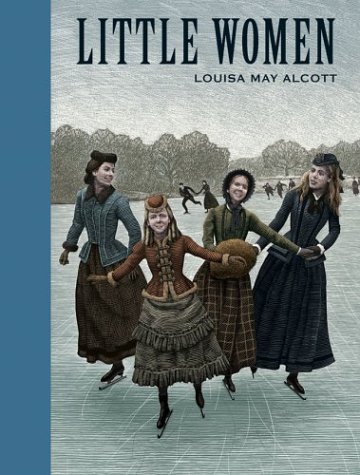
Little Women, Louisa May Alcott

I used to be confused and a bit annoyed when film and stage adaptations of this classic story would be titled Little Women but contain the story both of Little Women and the "sequel" Good Wives. It was not until relatively recently that I discovered that Good Wives is merely the UK title for what was originally, and still is elsewhere, the second half of Little Women itself. Upon discovering this, and not being overly fond of the twee Good Wives as a title, I determined to buy my own copy of the complete text. Previously I had never got past volume one, but having a book all-in-one would get me past the usual stopping point. It seemed that a Penguin paperback would be my best bet, but in Foyle's I found a lovely hardback for a lower price.

Little Women was never one of my absolute favourite books, although I've read it a fair few times, seen the 1990s film and a West End play. It's a strange thing, but every time I read this book I seem to come to it with a different attitude, and take different things away from the reading. As a child I viewed it as similar to What Katy Did, but a bit more grown-up - possibly because I was a bit more grown-up when I first read it. I came back to it a year or two ago, intending to read the whole series, but stopped at the end of Little Women [volume one] after feeling bogged down by all the moralising. Frustrated, I found the girls too good to be true, their faults only there to be overcome and an over-keenness to be lectured by their "Marmee."

That was just about a year ago. This time around I wondered if I was reading the same book, because Meg, Jo, Beth and Amy were refreshingly real, made up not of a single fault there just to be overcome, but flesh-and-blood teenagers with understandable struggles against hot tempers, jealousy, discontent, crippling shyness among others. The girls' friendship with the boy next door, Theodore "Laurie" Laurence was refreshing for the era, a cosy, platonic companionship full of fun, games and silliness that you just don't get in Victorian literature. I noticed scenes and chapters I must have only skimmed before, because they felt quite new to me. Perhaps these were the scenes omitted from the film, of which I may have retained more memories.

That's not to say I didn't find the moralising a little heavy-handed at times. In the chapter Meg Goes to Vanity Fair, Meg is rebuked first in the text, then by Laurie and finally by Marmee, for allowing herself to be made-over by her rich friend-of-a-friend for a party, and acting the part. Looking at it one way I felt quite cross, asking "What's wrong with dressing up once in a while?" and wondering if the moral here was that one shouldn't act above one's station, an idea that appalled the twenty-first century English girl who - until very recently - had an idea that class boundaries were fairly fluid. Looking at it the other way and I know quite well what Alcott's point was. After all, I tut when watching Grease to see Sandy dressing up in her leather catsuit and smoking cigarettes just to gain the respect of someone who isn't worth it. Here, Meg is doing just the same thing (I'm just picturing her in that tight catsuit!) by pretending to be someone who she isn't, just to try to fit in. We see the same in enough high school dramas nowadays.

Similarly, I was riled in part two when Professor Bhaer - and Miss Alcott - preach about the evils of writing and reading gothic thrillers and sensational stories. (Maybe I'm just horribly degenerate.) On the other hand, Alcott satirises Jo's attempts to write the sort of sickly, moralistic Victorian fiction that makes Little Women look positively riotous, the lesson being that Jo should write for herself, write what she knows and loves, and not merely what sells - something that still holds true for writers today.

I, as well as probably most girl readers of Little Women, and certainly Alcott herself, identify best with tomboy Jo, the independant woman, the writer with the hot temper and burning ambition. As a small girl I had some sympathy with shy Beth, but nowadays she comes across not as a human being, but that device of the sicklier Victorian literature: the good girl who essentially dies of being too angelic and insipid. I have to confess I've never liked Amy very much, finding her spoilt and a bit of a snob.
Read as Children's Classic for the
Back to the Classics Challenge
 
When it comes to the love stories, I'm not quite satisfied. I'm certainly not Laurie/Jo "shipper," but it seems to me that Laurie ends up with Amy simply as the next best thing, if he can't marry Jo. Jo's eventual husband Professor Bhaer is a very pleasant character, but being about twice her age, very plain and having a rather distancing title, just isn't the dashing hero I'd wish for the heroine. Meg's marriage to John Brooke, on the other hand, is portrayed very realistically with two young people as poor as the proverbial church mouse, living in the house about the size of a shoe box, madly in love, but still experiencing conflict as the honeymoon period comes to an end, with Meg accidentally neglecting her husband when being overwhelmed with coping with twins, and John happening to bring a friend home for supper on the one day Meg is having a disaster in the kitchen. Marmee steps in to offer some very wise advice, and in this context it doesn't come across as preachy, but as the calm voice of experience. Marmee is the steady force in the family, always with the right answers, but with the sympathy that comes from having been in the same fixes as her girls in her own youth.


Tuesday, 28 December 2010

Liar, Justine Larbalestier

Hi everyone! Sorry about the lack of updates in the last week or so. Life has been so busy in the run-up to Christmas that I haven't even had much time for reading. There have been carol services, Christmas parties, musical rehearsals and a heap of overtime at work that have kept me from my beloved books. But I aten't dead* - although for the second Christmas in a row I've had my worst cold of the year - and hopefully there will be regular updates again from now on. I've also merged this blog with my film and TV review site, because I didn't update that one often enough to justify having a separate blog.

I preordered the paperback of Liar on Amazon a couple of months ago, and it turned up at home on Christmas Eve, by which time I'd all but forgotten about it, so it really was a surprise Christmas present from myself to me.

Micah is a compulsive liar, always has been. When she started high school she passed for a boy for a little while, with a boy's name, short hair and underdeveloped figure. Lies lead to more lies until no one knows what to believe about her. But when her sort-of boyfriend dies suddenly, it is time for her to tell her story. The truth. Or at least her truth.

The clue is there in the title: Liar. Micah vows again and again to tell the truth in her story, and then contradicts herself: okay, that was a lie but everything I say from here on is true. Well... except that bit. Oh, and that.
I wanted to see if you would buy it. And you did.
You buy everything, don't you?
You make it too easy.
You find yourself wondering what, if anything, you have been told is the "truth" - and what, after all is the true version of a work of fiction? The narrator's account, even if she is a pathological liar? After all, Micah is the only narrator we have. Are we supposed to read between the lines to understand what the author wants us to believe really happened? Many works of literature give you clues towards an alternative interpretation, but Larbalestier doesn't give us anything to go by except Micah's words, and as we have established, these can't be trusted. Instead, the reader has to draw their own conclusions, so that the book has as many meanings as it has readers.

It seems straight-forward enough at first, a contemporary crime story set among New York high school students. Halfway through, there is a sudden shift in genre which led me to think, "this is ridiculous! Surely we're not meant to believe that in this story?" It seems clear, at first, when Micah is telling the truth and when she is lying, then everything is shaken up and you're not sure what's what any more. Micah argues that she lies because we wouldn't believe the truth, and "maybe I lie because the world is better the way I tell it." We're left with a choice. We can accept her final version of her story, discard the parts she's confessed to be untrue and accept her story at face value. Or we can wonder, speculate and come to our own conclusions. I think I know my version of events, but to say more would be straying into spoiler territory.

A very intelligent read that will end up asking more questions than it answers.

*Terry Pratchett

Friday, 17 December 2010

Film: The Voyage of the Dawn Treader

Contains spoilers

I was both wary and childishly excited to see the film version of The Voyage of the Dawn Treader, because it has been one of my favourite books since my dad sat me down, opened a book and read: "There was a boy called Eustace Clarence Scrubb, and he almost deserved it." Of course the film adaptation was never going to be the movie that has been in my head since that day, but it wasn't bad for someone else's vision.

The opening scenes, in England, set the scene for us. It seems that a few years have passed since the events of Prince Caspian. In the books it is only one year, but here it seems to be about three, to account for the aging of the child actors into teenagers. It is still wartime, a detail which is only mentioned briefly in the books, and only in The Lion, the Witch and the Wardrobe, but which provides continuity, as well as a reason for Edmund and Lucy to be staying with Eustace's family. Lucy is no longer the little girl who causes a universal "awww," but a young woman. Edmund is trying to pass for eighteen to join the armed forces. After all, he has plenty of battle experience, if the sword-and-shield variety.

The dialogue starts off a little clunky in places as the film establishes how things have changed for the characters since Prince Caspian, but we are introduced to the wonderful character of Eustace Scrubb. Played by Will Poulter, Eustace is every bit as obnoxious as he is in the book, but amusingly so, full of inflated ideas of his own brilliance. In my review of the book, I wrote that Eustace is rather a caricature until his experience on Dragon Island, but that being said, he is certainly more fun as such. The events of the book are jiggled around a bit and put into a different order, but this doesn't matter as it is an episodic book, with each island holding its own adventures, in stand-alone mini-stories that make up a bigger picture.

In my review of the book, I wrote that what I liked about The Voyage of the Dawn Treader was that it was an adventure for the sake of it, exploration and searching for missing family friends, but not a life-and-death, world-saving quest. Alas, that was lost in the film by the introduction of an Evil, manifested in a green mist, which is infecting Narnia and the rest of the world. For some reason, this can be banished by the swords of Caspian IX's missing friends, Lords Bern, Restimar, Rhoop and the rest. This means that the narrative is chopped up and shuffled around like a jigsaw, and some new plotlines added to make it a more linear narrative - evidently the film-makers didn't like the episodic nature of the book, or felt it wasn't quite film material. Most of the ingredients for the plotline were taken from the book, small moments taken and expanded into subplots. In the book, Lucy is tempted to recite a spell to make her beautiful, because she is jealous of Susan being "the pretty one." Here, this is taken a step further, and Aslan shows her of the consequences of her being Susan in an It's A Wonderful Life sort of scenario.

The valiant mouse warrior Reepicheep, voiced now by Simon Pegg, is a wonderful character, who has come straight from the pages of the book, fearless, pure-hearted and chivalrous, and the scenes between him and Eustace are some of the best, whether they be amusing ("Nobody. Touches. The Tail.") or heartwarming, and frequently both.

The Voyage of the Dawn Treader is a looser adaptation of the C. S. Lewis book than Prince Caspian and The Lion, the Witch and the Wardrobe, and a less perfect film than Lion, at least. Still, as the credits rolled (over the original Pauline Baynes illustrations from the books, a fact that made me squeal like a preteen!) I begged, "can we see it again?" I will certainly be going to see the film again before it leaves the cinemas.


Saturday, 11 December 2010

Fixing Delilah, Sarah Ockler

Fixing Delilah isn't even available to buy in the UK yet, but thanks to the wonders of the internet I was able to order a US copy of the book. I commented in my review of Ockler's first novel, Twenty Boy Summer, that the US paperback has a different texture to it than a UK one. Fixing Delilah is a hardback book, but I still found enough little differences that interested me: the copyright page has more information in it. Under the heading of Library of Congress Cataloguing-in-Publication Data a twitter-sized synopsis and hashtag or blog-label-style details of the book's contents, such as Secrets, Family problems and Vermont.

Delilah Hannaford is a troubled teenager who doesn't seem to know who she is any more. We get to see her inner turmoil first:
"Despite all evidence to the contrary, I'm really not the car-denting kind of girl. I'm also not the lipstick-stealing, school-skipping, off-in-the-woods-with-someone-I-barely-know kind of girl, or the kind who loses all of her dignity over a scandalous cell phone picture on a trashy blog."
Like Twenty Boy Summer, this is a holiday book, and we don't get to see Delilah at school. We get an idea of what her school life is, though, and I have an impression of a character I probably wouldn't sympathise with if I didn't get to know her from the inside out, so to speak. If portrayed through the eyes of someone else, or possibly even with a third-person narrator, I would probably see her as one of the popular kids, maybe a bit shallow, messed up, one of the cool kids who I'd probably have nothing to do with if I were in their class. But because Ockler presents Delilah as narrator, I found her, if not always likeable, identifiable. Because I know well enough what it is like to appear like one person and feel like another, to find myself doing things I really don't want to. And reading Fixing Delilah, I found myself thinking, "maybe we're not so different after all," the "cool" kids and the outsiders, the "good" girls and the "bad."

Not only does Delilah feel lost, but her relationship with her mother is a mess. Claire Hannaford sees that Delilah is "seeking attention" but won't give her any, doesn't try to understand why her daughter's gone off the rails; she is far too caught up being an efficient businesswoman, successful but stressed, to think of family. Alternatively, perhaps it is too painful - if Delilah's relationship with her mother is strained, it is nothing compared with the extended family. Eight years ago, Claire, her sister Rachel, and her mother Elizabeth had such an argument that they have never spoken since, and now Elizabeth, Delilah's grandmother is dead. Delilah, Claire and Rachel return to Red Falls, Vermont, to sort through Elizabeth's belongings and make her house ready to put on the market. While there, Delilah starts trying to find out the secrets in the family's past, secrets that appear to be focused on Claire and Rachel's youngest sister, Stephanie, who died before Delilah was born.

Family is the main theme of Fixing Delilah. There are many parallels with Delilah and her dead aunt Stephanie. They look alike, Delilah was Stephanie's middle name, Delilah was conceived not long after Stephanie was buried. Though as far as I noticed there was no hint of a throwaway remark on the subject of reincarnation, the idea flitted across my mind. More realistically, there was the threat of history repeating itself. Delilah worries that perhaps the problems with the family are inescapable, that perhaps her relationship with her mom is doomed to go the same way as Claire's with her mother. But ultimately, this is a story about reconciliation, and taking responsibility for one's own future and relationships. I didn't like all of the characters all the time, especially Delilah's mom, or the memory of her Nana, but ultimately we are presented with a story about realistic, flawed characters who, like Delilah (and like myself) aren't always the person they seem to be, despite all the evidence.

Sarah Ockler excels in setting the scene, in writing simple description that captures a scene, a sound or a moment perfectly. In Twenty Boy Summer, it is the sound of the sea: Shhh, ahhh. Shhh, ahhh. Here we have the cool, robotic voice of the Sat-Nav system: Left turn in four. Hundred. Feet. Like Twenty Boy Summer this is a holiday story, but instead of the California beaches we are treated to a trip to Red Falls, Vermont. Now, Vermont is a state I know nothing about. I imagine it cold and sweet, probably because it  is the home of Ben and Jerry's ice cream. Red Falls is certainly sweet, flavoured with maple syrup candy from the trees that no doubt give the town its name. Cold - not so much. It is a summer story, after all. Reading it in a chilly English December, it took a bit of brain-adjustment to get my head around Delilah's romantic interest Patrick working on the house shirtless, or taking her kayaking and swimming on the lake. That aside, I had a vivid image of a small, rather quaint lake town that is increasingly becoming a tourist-trap in summer. I'd quite happily visit it, minus, of course, the Hannaford family troubles.


If you liked this book, you might enjoy:

Twenty Boy Summer - Sarah Ockler
The Sky is Everywhere - Jandy Nelson
Hold Still - Nina LaCour
The Book of Tomorrow - Cecelia Ahern
Related Posts Plugin for WordPress, Blogger...