Showing posts with label magical. Show all posts

Thursday, 15 September 2011

The Particular Sadness of Lemon Cake, Aimee Bender

Today I bring to you another selection from the Richard and Judy Book Club. This week's review title has been on my to-read pile for a while.

Jusst before her ninth birthday, Rose Edelstein discovers she can taste the emotions of everyone who has had a hand in making her food - a weird quirk that is much more of a curse than it sounds, because like food, humans are a complex creation with far more going on inside them than it appears on the outside. The worst thing for Rose is when she eats homemade food as she finds out far more than she ought about her closest loved ones. The lemon cake of the title, baked by her jolly and creative mother, tastes empty. Incomplete. 

The book follows Rose through her childhood as she tries to live a normal life with this curse. Too many people   contribute towards the simplest sandwich, which means every bite Rose eats is a whirlwind of conflicting feelings. It's heartbreaking to see such an essential and normally enjoyable part of life being a burden to a small girl. She also has to deal with her family's secrets. To an outsider, they are a rather average family, each member having their "little ways" but nothing out of the ordinary. Her dad is a very normal, all-American family man and businessman, her brother Joseph showing signs of something like Autism/Asberger's - a scientific genius who has no social skills and does not get the recognition at school he deserves. Mom, the main cook of the family, despite her cheerful exterior, is unfulfilled, disappointed, and Rose can tell instantly from the taste of her cooking when she embarks upon an affair with a colleague. 

I found the first half of the novel to be very readable magic realism, a fascinating concept that was written in such a way as to make you really appreciate food, family and feelings. These things are portrayed as varied, sometimes contradictory, all mixed up together to give a great impression of the unique way in which Rose views the world - an impressive feat. 
In part two of the novel, when our characters are several years older, Bender focuses more upon Joseph, Rose's elder brother. He is still unsocial to the point of reclusiveness, and now he has his own apartment, gives the family much cause for concern by frequently disappearing without explanation. When his mystery is solved, I felt that the book became something else, moving away from the magical realism to become just plain surreal, and I found it difficult to suspend my disbelief. I came to understand what Aimee Bender was aiming for, but did not think she was entirely successful.

Still, The Particular Sadness of Lemon Cake is a fascinating, original concept which explores what it means to be human. The small cast is brought to life well, leaving me really feeling that I had got to know Rose, her family and friends inside out. The writing is beautiful and rich, but I was left feeling as though something was missing from the story, that I couldn't quite place.


Friday, 22 July 2011

50 Greatest Harry Potter moments.

Next week, ITV1 will be showing a compilation of the top 50 moments from the Harry Potter films. This got me wondering about what my top 50 moments were, in both film and book. Contains plot details of the whole series.

50. The Sorting Hat. (Philosopher's Stone)
49. The Time-turner. "If all goes well, you will be able to save more than one innocent life tonight." (Prisoner of Azkaban)
48. "This is what Dumbledore sends his defender. A songbird and an old hat!" A hat containing the sword of Gryffindor, which will only present itself to the most loyal Gryffindors. And the phoenix, whose tears heal any wound. Just what Harry needed. (Chamber of Secrets)
47. Hermione the rebel. "I don't know what's got into you lately!" said Ron, astounded. "First you hit Malfoy, then you walk out on Professor Trelawney - " Hermione looked rather flattered. (Prisoner of Azkaban,)
46. Professor McGonagall: "I always wanted to use that spell!" (Deathly Hallows, Part 2 - film.)
45. Ron: "Why couldn't it have been 'follow the butterflies?'" (Chamber of Secrets, film)
44. The Weasley Twins' attempt at fooling the age line around the Goblet of Fire - and the consequences. (Goblet of Fire)


43. Neville Longbottom.  Dumbledore: "It takes a great deal of bravery to stand up to our enemies, but just as much to stand up to our friends." (Philosopher's Stone)
42. The flying Ford Anglia. (Chamber of Secrets)


41. Quirrell's true allegiance. After spending the first book thinking that Professor Snape hates Harry - true - and is trying to kill him - false - we discover that ineffectual, timid Professor Quirrell is not only after Harry, not only trying to bring Lord Voldemort back - but Voldemort is living on the back of his head! And Snape is trying to protect Harry. The first, but by no means the last of such twists in this series. (Philosopher's Stone)
40. The Triwizard Tournament. All of it. (Goblet of Fire.)
39. Tonks loves Lupin! Dumbledore's dead, Bill Weasley badly wounded, but his wife-to-be Fleur is sticking by him. I turned the page - and all of a sudden, two of my favourite characters are in love with each other! Where did that come from? (It is foreshadowed in the book, but I did not suspect a thing. Lovely couple.) (Half-Blood Prince)
38. Luna Lovegood's Quidditch commentary. (Half-Blood Prince.)
37. Tom Riddle's true identity. Hands up who saw that coming first time around? (Chamber of Secrets)
36. Umbridge vs McGonagall. "You are raving," said Professor McGonagall, superbly disdainful. Don't try to outsmart McGonagall, Dolores. You will lose. (Order of the Phoenix.)
35. The duelling club. It is testament to how irritating Gilderoy Lockhart is, that I found myself cheering on Snape before I ever liked him as a character. (Chamber of Secrets)


34. First sight of Hogwarts. This really is a magical world. If only my school had been like this. (Philosopher's Stone.)
33. Owl post. You can run and hide, Dursleys, but there's no escaping Harry's magical identity. He will be a wizard, like it or not. (Philosopher's Stone.)
32. The Shrieking Shack. Sirius is an animagus! And Lupin is his friend! And Lupin is a werewolf! And Sirius is innocent! And Ron's pet rat is the real villain! Shock after shock, revelation after revelation, and everything you think you know is turned upside-down. (Prisoner of Azkaban)
31. "I don't think you're a waste of space." ("Coming from Dudley that's like "I love you.") (Deathly Hallows.)
30. Harry, Ron and Hermione battle a troll. In the girls' bathroom. Aged eleven. And survive. There are some things you can;t share without ending up liking each other, and knocking out a twelve-foot mountain troll is one of them. (Philosopher's Stone)


29. Harry's first broomstick ride. Harry stands up to the class bully, disobeying orders and ends up, not expelled as threatened, but the youngest quidditch player for a century. (Philosopher's Stone.)
28. Snape: "Your head is not allowed in Hogsmeade. No part of your body has permission to be in Hogsmeade." (Prisoner of Azkaban)
27.  'I want to fix that in my memory forever,' said Ron, his eyes closed and an uplifted expression on his face. 'Draco Malfoy, the amazing bouncing ferret ...' (Goblet of Fire)


26. That wonderful scene in the Goblet of Fire film, where the kids are talking about Yule Ball partners when they are supposed to be doing homework. Fred's mimed invitation to Angelina is hilarious, but the best part is Snape who, when hitting them with his book proves ineffective, forces their heads forward. It's the twitch of his sleeves that does it for me! (Goblet of Fire, film)
25. The Mirror of Erised, and how it helps Harry outwit Voldemort for the first time. Dumbledore:"It was one of my more brilliant ideas, and between you and me, that's saying something. Only one who wanted to find the Stone - find it, but not use it - would be able to get it, otherwise they'd just see themselves making gold or drinking Elixir of Life. My brain surprises even me sometimes..." (Philosopher's Stone)
24. The Marauder's Map. "I solemnly swear that I am up to no good." Bonus points for insulting Severus Snape. (Prisoner of Azkaban.)


23. Harry under the influence of Felix Felicis, the lucky potion - especially the film. Daniel Radcliffe clearly enjoyed hamming it up in that scene. (Half-Blood Prince)
22. Dobby to the rescue. Though I didn't like Dobby particularly, his rescue of Harry et al from Malfoy Manor is brilliant, and his death scene so sad. (Deathly Hallows)
21. The Seven Potters. Fred and George: "Wow! We're identical!" (Deathly Hallows)
20. Ron and Hermione finally get together. (Deathly Hallows)
19. Snape: "Do you remember me telling you we are practising non-verbal spells, Potter?"
"Yes," said Harry stiffly. 
"Yes sir."
"There's no need to call me 'sir', Professor." (Half-Blood Prince)
18. Molly Weasley vs Bellatrix Lestrange, and I quote: "NOT MY DAUGHTER, YOU BITCH!" (Deathly Hallows.)
17. Dumbledore's Army. Despite the best efforts of Dolores Umbridge, a group of students continue practising Defence against the Dark Arts in secret, right under her nose. (Order of the Phoenix)
16. In the Ministry for Magic, we see just why Albus Dumbledore was the only wizard Voldemort ever feared. (Order of the Phoenix)
15. Ron's return and the destruction of the Slytherin Locket. (Deathly Hallows)


14. Platform 9 3/4. Harry's first introduction to the Weasley family, who promptly adopt him as one of their own. (Philosopher's Stone)
13. The Weasley Twins' exit from Hogwarts. They make sure that Umbridge is left with as much chaos as possible, and the staff and students do all they can to help. Best line comes from McGonagall to Peeves the Poltergeist. "It unscrews the other way." (Order of the Phoenix.)
12. "Look... at... me." Severus Snape was never going to survive the series, but his death scene was a shock, so sudden. It seemed a bit anticlimactic on the first reading, but then, with a bit more information, it all makes sense and is so very sad. An addition to the film makes it more obvious. "You have your mother's eyes." *sniffle, sob* (Deathly Hallows.)
11. Neville Longbottom faces Voldemort, survives and kills the Dark Lord's last horcrux, his snake Nagini. (Deathly Hallows)


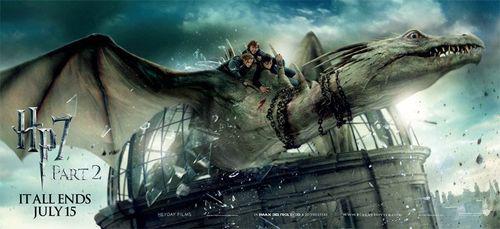
10. Escape from Gringotts. On a dragon. (Deathly Hallows.)
9. Expecto Patronum! And then it hit him - he understood - he hadn't seen his father - he had seen himself. (Prisoner of Azkaban.)
8."I am not worried, Harry," said Dumbledore, his voice a little stronger despite the freezing water. "I am with you." Throughout this book, Dumbledore has trusted Harry with more and more, treating him as an equal, until their roles are reversed. This is the moment in which Harry comes of age. (Half-Blood Prince) 
7. "King's Cross." Harry's near-death experience, in which he meets Dumbledore once more, and finally - finally - understands everything. Dumbledore: "Of course it is happening inside your head, Harry, but why on earth should that mean that it is not real?" (Deathly Hallows)


6. Priori Incantatem: Lord Voldemort has returned, and he will kill Harry Potter. Harry is just fourteen years old, he knows nothing of duelling. He's toast. But he's not giving in without a fight, and with an expelliarmus - the disarming spell and the only useful spell he knows - the two wands connect. (Goblet of Fire)
5. Dumbledore: "Well - it's just that you seem to be labouring under the delusion that I am going to - what is the phrase? - come quietly. I am afraid I am not going to come quietly at all, Cornelius." And sure enough, he does not. (Order of the Phoenix)
4. "The Prince's Tale." After seven books, eight films of keeping us guessing, finally J. K. Rowling's most complex creation reveals his true character, and it is heartbreaking. Excellently acted by Alan Rickman in the film. (Deathly Hallows)
3. The final confrontation between Harry and Voldemort: in which Harry survives - again - the killing curse, and defeats the most evil wizard of all time with nothing more than his favourite disarming spell. The Elder Wand recognises Harry as its true owner, and he becomes the master of death - not by becoming immortal, but by facing his own mortality and being unafraid. (Deathly Hallows)
2. The Boy Who Lived - because his mother loved him enough to die for him. (Philosopher's Stone - recurring theme)
1. Harry's sacrifice. Harry not only looks death in the face, but walks willingly towards his fate, his companions all those he has loved and lost, giving him the courage to do what must otherwise be impossible. Beautiful, beautiful scene, wonderfully written and perfectly adapted. It will give you the chills. (Deathly Hallows.)

Monday, 18 July 2011

Movie Monday: Harry Potter and the Deathly Hallows part 2

Well, there was only going to be one choice of film for today's Movie Monday review, wasn't there? 


It's been eleven years since I first started reading the Harry Potter series. When Goblet of Fire was first published, I was the same age as Harry at that point in the series, 14 years old. Seems incredible now. With the hype around the books being unprecedented, and then the film adaptations, Harry Potter has played a huge part in the lives of so many people who came of age alongside the boy wizard. After rereading the books in preparation for the final part of the final film, I decided against my usual habits, and allowed myself to be swept up in the general excitement, going to see the midnight premiere among other like-minded nutters, including one dressed as Bellatrix Lestrange, many in wizard's robes and school uniform, and one with a T-shirt bearing the sign of the Deathly Hallows. There was a great buzz of excitement and anticipation, and I hadn't felt as excited about a film since Lord of the Rings: The Return of the King was released in 2003. 


WARNING: THIS REVIEW IS FULL OF SPOILERS. IT IS RECOMMENDED THAT YOU WATCH THE FILM BEFORE READING ON.


I think by now that most Harry Potter fans will have read all of the books, but to a casual viewer I would recommend that they remind themselves of the story so far, because Deathly Hallows part 2 does not give much chance to play catch-up, repeating just the final moments of the last half before plunging us back into the story where we left off. Not many franchises could get away with that trick, but Harry Potter makes its own rules. Part 2 doesn't feel like a whole film, but is the second half of a very long one. The break-in at Gringotts Bank would ordinarily be a big, climactic scene but launching into the scene in minutes without any preamble or build-up it felt a bit rushed. Helena Bonham Carter (with Emma Watson's voice) does a great Hermione-disguised-as-Bellatrix, and her attempts at walking in Bellatrix's boots reminded me of myself wobbling on high heels.


We haven't seen Gringotts since the first film, and with its rows of smart, suited goblin clerks, I found myself reminded of Mary Poppins. Warwick Davies, who has always been present in the background as Professor Flitwick, got a moment in the spotlight - albeit under heavy prosthetics - as the goblin Griphook. Griphook was civil, polite and quietly-spoken, which coupled with the black eyes and pointy teeth was more unsettling than any cackling Labyrinth goblins one might be more likely to expect. The ride down to the vaults was a great piece of filming that was obviously designed to make the most of the 3D effects, a bumpy rollercoaster ride that hearkened back to the descriptions of Harry's first trip with Hagrid in Philosopher's Stone. The special effects continued with the replicating gold, and of course the breakout on the dragon which smashed up Gringotts and half of Diagon Alley with it. I did wonder, for a moment, how Harry located the next horcrux so easily under the circumstances, especially as he had never seen it before in the film version.

And then, all of a sudden, Harry, Ron and Hermione were headed back to Hogwarts. Already? I thought. After all the time spent on finding and destroying the locket horcrux, it seemed very sudden, and even in the book it crashes on me quicker than I expect. And we are at the three-quarter mark, with all the best bits still to come.

Back at Hogwarts, it was wonderful to see nearly everyone back from the previous films, even just in the background: Dean and Seamus, Cho, Lav-Lav (I beg her pardon, Lavender Brown) and possible Percy Weasley. But there's no time to get soppy, as the school prepares for battle, two horcruxes still left unfound. The cost of protecting one teenage boy was astounding. Of course, the good guys are fighting for more than just Harry Potter, but the fact that all Voldemort sees as standing between him and absolute power is this one young man, and the lengths he's willing to go to in order to eliminate that one threat - wow! As the battle commences, and Hogwarts turns to chaos, Professor McGonagall takes control and is awesome, raising a few laughs ("Boom!") Someone's gotta do it. It looks like certain death for all, as our heroes muster all the courage they can to face Voldemort and his masses of Death Eaters. Remus Lupin and his wife Tonks (What do we call her now? Tonks-Lupin? Nymphadora?) reach for each other's hands, and the formerly uncrushable comic relief, Fred and George Weasley, can only manage wobbly, watery smiles. Ouch.

Meanwhile, Ron and Hermione have destroyed the next horcrux - and finally kissed! (And everybody says "Awww," "Hooray!" or "At last!") Harry has located another with astonishing ease, with the help of Luna Lovegood and the beautiful ghost of Helena Ravenclaw, before Malfoy and his cronies corner him in the Room of Requirement. I had a bit of a giggle as I saw some of the props stuffed in the Room of Requirement - including a cage of blue pixies from Chamber of Secrets. But the giggles didn't last long. Goyle's (Crabbe in the book) Fiendfyre spell goes wrong, and that's another horcrux down. One more to go - then Voldemort himself! It could be such a victory, but the enormity of everything they've been through hits our central trio and they break down for a moment in a powerful, very believable scene.

There was one part of the story that fans would never have forgiven the filmmakers if they had not done it justice: the chapter called "The Prince's Tale." Thankfully, there is nothing to forgive. The scene is perfect. Alan Rickman, always outstanding as Snape, excels himself in this film and though he is only in a few scenes, is the real star of this movie. His performance as Headmaster of Hogwarts is deliciously sinister, terrifying even when one knows his true allegiances. Even I felt myself wondering briefly whether or not he could be trusted, and I knew the whole story. His death was inevitable; such a great character was never going to survive the series, I think I've always known that. The snake attack was shocking and violent, viewed from behind a blood-smeared window, and then so very, very sad! At least in the film, I got the feeling that Snape was at peace in the end, not struggling against death but facing it with courage - which is one of the main themes of the story. Then, at last, we learn Snape's story, in a heartbreaking montage of scenes from his life, the final thoughts of a dying man twisting and merging together. Key moments from his childhood spliced together with Dumbledore's revelation of his ultimate plan, clips from all the previous films and an additional, devastating scene of Snape being first on the scene of James and Lily's murder. I always found Rickman's Snape to be a much more restrained character than Book-Snape, always cold and calm and contemptuous, unreadable. At the time of Half-Blood Prince, I was disappointed by the lack of the "DON'T - CALL - ME - COWARD!" line, but that complete control throughout the series makes it all the more powerful when now, at last, he bares his soul. Rickman's portrayal of Snape's grief and undying love is perfect, beautiful, heartbreaking. Oh, Severus! 


I have to confess that when the first couple of Harry Potter films came out, I wasn't overly impressed by Daniel Radcliffe's acting, finding him awkward and wooden at times. Well, he was eleven. Not any more. He has improved steadily throughout this series, and his performance as Harry courageously walks through the forest towards his fate is flawless. He conveys just the right mix of shock, courage and determination, fear and acceptance, and the scene is perfect.

I've been using that word a lot, haven't I? I won't say the entire film was perfect, though it was a very satisfying conclusion to the series that has been enchanting children and adults alike for over ten years, and very true to the source material. If I have a complaint, it's that I felt that the filmmakers sometimes skimped on the story to devote more time to epic battle scenes. I would have preferred more of Dumbledore's backstory, and there were a couple of times where plot holes were patched over, where minor plot points were omitted from previous adaptations which would later be needed - Sirius's mirror, and Harry mentioning Lupin's son that non-readers wouldn't have known he had. As I've always said, these films are great companions to the books, but don't always flow seamlessly on their own.

Dumbledore told Harry at "King's Cross" that words are the most powerful kind of magic, which seemed to be a comment on the story itself. J. K. Rowling has certainly proved the power of words with her storytelling.

Back in Hogwarts in the battle, two characters got their moments of glory, and they were well worth the wait. I'm referring, of course, to Molly Weasley and Neville Longbottom. Dear old Neville, who started off as a squishy, inept junior wizard in Philosopher's Stone, has grown over the last few films and turned into a brave, confident hero. I've always had a soft spot for Neville, so it's wonderful to see how his character turns out. I salute you, Longbottom! He also got a lovely warming moment, not from the books but that I'm sure many people wished would happen, the pairing up of our favourite outcasts. I know I approved.

I loved the epilogue, giggling at the appearance of Harry and Ginny, Ron and Hermione, and Draco Malfoy in their mid-thirties. Albus Severus is a very good-looking kiddy who I'm sure will grow up to break many hearts, and the family relationship was lovely. Some of the other children on the train bore a remarkable similarity to Harry and co.'s classmates - I wonder whether that was deliberate.  I broke into a grin watching the Hogwarts Express chugging a new generation off to Hogwarts, a safe Hogwarts which brings us full circle, back to the magical innocence from the beginning of Philosopher's Stone. 


I left the cinema with a warm feeling of contentment and happiness. Although Deathly Hallows Part 2 won't overwrite the movie in my head, I'm very happy for the two to coexist. Congratulations to all of the cast and crew for bringing these beloved books to life. You should be very proud of yourselves.

Monday, 11 July 2011

Movie Monday: Harry Potter and the Deathly Hallows part 1

Contains spoilers

With the final installment of the Harry Potter film series released this Friday, it is only right that this week's Movie Monday brings us up-to-date with the story so far. I'm not going to recap the story here, as I've written fairly lengthy book reviews already. The film itself makes no allowances for newcomers - it's probably a safe assumption that most viewers know what's going to happen anyway, and that those who don't, have at least watched the films to date. After a brief speech from the Minister for Magic, we are plunged without any further ado into the seventeen-year-old heroes' lives as they prepare to leave their homes and venture out into a terrifying world unprotected. This is the only film to reduce me to a blubbering wreck in the first two minutes, before the title card.

As I said, this film is not very newbie-friendly, reuniting Harry and the audience with a flurry of old faces, some not seen for three or more films (Fleur, Dobby) and other characters are introduced briefly, with little to-do, and you are left to work out for yourself quite where they all fit into the equation (Bill Weasley, Mundungus Fletcher and others.) Still, I was very pleased to be introduced to the eldest Weasley boy, a tertiary character for whom I have quite a fondness, but who could conceivably have been rewritten. When I first heard that Deathly Hallows was to be split into two films, I wondered whether it was strictly necessary, but now I am very grateful for the fact. This is probably the most faithful adaptation since Chamber of Secrets, but is a far superior film, in part because the actors have come a long way, in part because there was enough imagination in the translation process from one medium to another. When reading the book, there were a couple of subplots I hadn't remembered being included in the film, but there was enough to suggest that these have not been forgotten, just probably shuffled into part 2. Just a few more days and I will know.

The previous film, Harry Potter and the Half-Blood Prince opened with a shot of the Millennium Bridge being destroyed, showing how even the muggle world was affected by the wizards' wars. Deathly Hallows Part 1 shows the continued effect, which I found the more chilling because it was more casual: a headline announcing the murder of a muggle family, the battle between the Order of the Phoenix and the Death Eaters - and Voldemort - taking place over a busy motorway and bringing down power lines,  the burnt-out caravans in the scenery without any mention of what happened.

After about half a film full of fantasy action: a discovery, the infiltration of the Ministry of Magic - but alas, no one answered my plea to assassinate Umbridge after her first giggle -  and a One Ring-like Horcrux spreading  discord between the central trio, more terror comes after a moving scene at Harry's parents' grave, when Harry and Hermione - Ron having temporarily scarpered in a huff - meet what they think is magical historian Bathilda Bagshot. Background music and the preknowledge of what is to come, but not how, build up a creepy suspense, and the gruesome horror is more implied than shown, with the buzzing in the background and a few blood spatters. There is a strange moment when, after the scenes in a gloomy old house, the wall is smashed open to reveal a bright, airy nursery for a moment or two, before returning to darkness. This uncanny, unexpected shot just heighten the chaos and panic of the scene.

 In Chamber of Secrets, when Harry discovers that he can speak the language of the snakes - without realising it! - the filmmakers were left with a dilemma: do they show the scenes as Harry sees them - implying he speaks English and then revealing that wasn't the case at all - or as they really are - alerting the audience to his uncommon skills before Harry himself finds out. They went with the latter option, and I remember thinking "that ruined it!" Somehow, this time - at least on this viewing - I thought they did a better job. It seemed that "Bathilda" was saying something I couldn't quite make out, but somehow it seemed like it wasn't clear why, whether my ears or brain weren't working properly for a moment. But maybe that was just me and just this time.

The Harry Potter actors and filmmakers have come a long way since the twinkly, magical children's film that was Philosopher's Stone, and particular credit goes to the central trio, who must have spent half their lives so far playing these roles. Emma Watson as Hermione deserves a particular mention in this film; it was thanks to her performance that I was reaching for the tissues in the first two minutes.

Oh, and of course Dobby, not seen since Chamber of Secrets, and generally disliked then, Dobby put a smile on my face when he reappeared in all his joy to see Harry Potter, his pride at being A Free Elf and general cheerful, matter-of-fact demeanor in a film so full of darkness and fear. Of course, this makes his final scenes all the more heartrending. I never would have thought nine years ago that I would shed a tear for that irritating house-elf!


I've now bought my ticket for the midnight showing - ten past midnight, if that makes any difference! - of part 2 on Thursday night/ Friday morning, and am itching to see the final part. Reading all of the books in a row recently has left me more caught up in the Pottermania than I otherwise would be, and I am particularly looking forward to seeing Neville and Mrs Weasley's greatest moments, Alan Rickman as Snape - a character sadly missing from most of the previous film - and his backstory, and of course the final showdown(s) between Harry and Voldemort. But I am in no doubt about the fact that tissues will be needed.

Sunday, 10 July 2011

Harry Potter and the Deathly Hallows, J. K. Rowling

Pottermania has been abounding in the last couple of weeks with the run-up to the final film in the series, which premiered in London on Thursday. I watched some of the live coverage, and when Alan Rickman turned up, I couldn't help singing, "Snape, Snape, Severus Snape!" from the Potter Puppet Pals online video, "A Mysterious Ticking Noise," and the tune which has popped into my head as a sort of leitmotif for Snape whenever he turned up in the books. So I nearly fell off my chair when, a couple of seconds later, I could make out what the crowd were chanting.

So, I may or may not have been persuaded to go along to the midnight showing of the final film on Thursday night/Friday morning. I've never been one for midnight anything. I'm too fond of my sleep. Instead of visibly succumbing to the Pottermania with the book releases and queuing at the bookshops, I got up early to buy my copy. But this is my last chance. It remains to be seen whether I might dress up... Expect a Movie Monday review next week.

In a way, I envy the next generation of kids. With Pottermania so strong over the last few years, I doubt there are many people who haven't read the books, seen the films or at least had important parts of the story told to them. When the fuss has begun to die down, and a new readership comes along, I envy them the opportunity to read the books unspoiled, not knowing what to expect, like (most of) my experience. But just in case there are readers who don't yet know the whole story, be warned:

This review may contain spoilers for book 7; definitely contains spoilers for books 1-6.


After six books whose major events fit into a neat little routine - Something slightly odd happening in the school holidays, a return to school, slow revelation that something odder is taking place in or out of the school, several mysteries to solve throughout the year building to a climax just before the summer holidays - Harry Potter and the Deathly Hallows breaks the pattern by not sending Harry, Ron and Hermione back to Hogwarts at all. Instead, the trio set out on their own to search for and destroy He Who Must Not Be Named's horcruxes - a collection of objects to which the Dark Lord has attached portions of his soul in his search for immortality. Considering that Harry has only the vaguest idea of what these objects might be, and no clue where in the country - or the world! - You-Know-Who has hidden them or how to destroy them, this is no easy feat.

Sometimes, in fantasy quests, the world seems very small indeed, and the near-impossible achievable with unrealistic efforts. This is averted in most of Deathly Hallows, which portrays the tensions that rise when three people are living in close quarters, away from the rest of civilisation, embarking on a hopeless quest - especially when they have as a companion a little piece of the most evil wizard of all time, shut into a locket. in addition, because the trio are no longer at school, the plot no longer has to fit into a single academic year. It does, but it's equally possible that it could take years.

After a brief respite in Half-Blood Prince, the Ministry of Magic stands once more against Harry, this time because of its being infiltrated by You-Know-Who's Death Eaters who are terrifying the rest of the ministry into submission through threat and force. Thankfully, as Harry and co spend much of the book out of contact with other wizards, the sense of oppression is less intrusive, and though we do see the horrible Umbridge again, she plays a much smaller part.

Although Deathly Hallows is exactly the same length as its predecessor, it feels like many books in one, with more action, more varied scene changes as the heroes apparate across the country, visiting friends, London, forests in the middle of nowhere, wizarding settlements, more middle-of-nowhere, wizarding businesses, being captured and escaping and eventually winding up back at Hogwarts school after all. Add to this Harry's visions back in and out of Voldemort's mind, and I wonder how this much story can be packed into just over 600 pages. No wonder Warner Brothers chose to make this story into two films instead of just one.

As if this weren't enough, we find out a lot more about Albus Dumbledore's youth, where it is revealed that the wise old wizard was not so infallible as we'd previously been led to believe. Indeed, the man had spent his whole life trying to atone for a tragic mistake from his youth. And at last, the true character of one of children's literature's most complex anti-heroes is revealed: the enigmatic Severus Snape.

I stand in awe of J. K. Rowling's storytelling, for Harry Potter's story is made from so many strands of plot and subplot, but Rowling does not lose a single thread, weaving them together perfectly in this finally installment. Everything is significant, nothing is left dangling, Rowling is truly the master of her craft. The saga culminates in an epic battle at Hogwarts which is a bit of a family reunion, reintroducing forgotten faces and old favourites. But it is rather a bloodbath! We are forced to bid farewell to some beloved characters, for in war, no one is guaranteed immunity. There were two characters, just two, that I thought were safe (and neither of them were Harry.) I was proven wrong, and it is just one cruel, devastating loss.

If the Horcrux quest seemed a little too conveniently resolved, and if the wand-politics at the end are confusing, these are small criticisms when compared to the rest of the finale. The final showdowns - for there is more than one - are poignant, beautifully written and epic, and a couple of unexpected characters get moments which I fully expect to raise a cheer in the cinemas. Harry Potter and the Deathly Hallows is an utterly satisfying conclusion to this wonderful series that has captured the hearts and imaginations of children of all ages. While rereading the series, I have been fully absorbed both while reading it and when I was not, and it's strange to have finished it now. Roll on Thursday midnight!

Friday, 8 July 2011

Harry Potter and the Half-Blood Prince, J. K. Rowling


After the stifling atmosphere of the last book, it comes as a relief to be reintroduced into the familiar, friendlier Hogwarts. Yes, the wizarding world has become a dark, dangerous place. Voldemort and his folllowers are at large and in the open, and every edition of the Daily Prophet newspaper reports more death and devastation. Even the Muggles know something strange is going on. But at least the threat is in the open. Harry and Dumbledore don't have to deal with the Ministry's opposition to their every move and wild accusations - on the contrary, the Ministry want to be best buddies. It would make them look good, because rumour has it that Harry Potter is the Chosen One destined to destroy Voldemort.

Before this book was published, it had been publicised, like the last two volumes, as being darker than ever. But, for the majority of the book, this is a return to a tone that was more reminiscent of the first half of the series. Harry, Ron and Hermione are now sixteen and a great deal of the plot focuses in on their muddled attempts at romance. There also seems to be a lot more humour, even among the dark events going on outside Hogwarts - and within, if Harry's suspicions about two of his oldest adversaries are correct.
Thankfully, Harry has grown out of the rage that was the defining point of his character in Order of the Phoenix! Professor Dumbledore plays a greater role, as he and Harry work together out of school hours, seeking the information and means to defeat Lord Voldemort once and for all. Through flashbacks, Harry learns a lot about Voldemort's backstory, from his parentage, to his childhood and adulthood, before his rise to power as the most feared wizard of all time. I found Half-Blood Prince an easier book to get through, not as emotionally taxing - and frustrating! - as its predecessor with the lack of Umbridge. There is a good balance between lessons, mystery, humour and exposition, with some significant development of some of the best-loved characters.

And then, right at the end, comes an abrupt change in tone, in the most disturbing scene of the entire series, the Cave Scene. The book comes to an end with a series of climactic events that mean that nothing can ever be the same again.

If somehow you have got through the book publication in 2005, and the film release in 2009, and still don't know what happens, be warned that plot and character spoilers follow:


While Harry has shown himself as growing in maturity throughout the book, with the increased responsibility allotted to him by Dumbledore, and in his own actions, the cave scene marks Harry's coming of age. Early in Half-Blood Prince, Dumbledore tells Harry:
"I do not think you need worry about being attacked tonight."
"Why not, sir?" 
"You are with me."
When it was first revealed,
this cover bothered me. I knew
very well that Harry was not a good
 enough Potions student to continue
studying the subject in 6th year.
But then, I'd predicted Snape would
be made Defence Against the Dark
Arts teacher in book 7 - and that he'd
be really good! It hadn't occurred to
me that this might happen  earlier,
because of the rumoured curse -
Snape was too good a character to
lose before the end of the series. But
I hadn't foreseen the changes that
happen in this book.  Clearly I'm
not a candidate for Professor
 Trelawney's class.

At the time, it seems like a typical Dumbledore thing to say, a quirky but reassuring lack of false modesty - after all, Dumbledore is the greatest Wizard alive at this point. So it's a testament to how far Harry has come, when Dumbledore says, after a terrifying ordeal that reverses his and Harry's roles,
"I am not worried, Harry [...] I am with you."
But it is not Harry's characterisation that is so fascinating as Severus Snape's. We've known since the end of Goblet of Fire that he has been a Death Eater, and that he is assuming his former role, acting undercover for Dumbledore. And he is doing a very good job. To fool either Dumbledore or Lord Voldemort would be unthinkable - but Snape is fooling one of them. But which one? All the evidence in this book paints him in a very suspicious light indeed, making an Unbreakable Vow to commit some unnamed act for Voldemort, arguing with Dumbledore and trying to back out of a deal with him, and offering assistance to the very dodgy-acting Draco Malfoy. But Dumbledore trusted Snape, and I couldn't bear to think Dumbledore could be wrong. What sort of message was that to give the kids? Besides, Snape has always been the most complex person in the story, an ally but completely unpleasant! To make him a villain after all would surely diminish him as a character. But sneaky Ms Rowling gave plenty of evidence to support either argument - Snape as villain or Snape as hero - but no definite proof either way.

Until the end, when Snape proves his true colours beyond all doubt.

I read the last chapters in disbelief, desperate for some revelation to prove that somehow, something wasn't as it appeared. I read on, and I read on, and at last I came to the understanding that I must have been mistaken, that there could be no coming back from what he had done. But still it bothered me. Surely there must be more to this man than meets the eye?

Wednesday, 29 June 2011

Harry Potter and the Order of the Phoenix, J. K. Rowling


It was the summer of 2003. My dad was the first person on the Isle of Wight to pre-order the fifth Harry Potter book, happening to be in the shop where I now work, when the publication date was – after a three-year wait – finally announced. I was in the lower sixth form (junior year of high school, to my American readers) and my friends and I spent plenty of lunchtimes and free periods rereading the initial four books and trying to figure out what clues J. K. Rowling had planted in them, discussing what we thought might happen next. We had picked up on Dumbledore’s look of “something like triumph” when he had heard that Voldemort was now protected by Lily Potter’s sacrifice. What did this mean? What was the Order of the Phoenix, and did it have anything to do with the messages Dumbledore had sent out to Professor Lupin, “the old crowd,” including a Mrs Figg – the same Mrs Figg who had babysat for Harry before he knew of his Wizard heritage? I myself wondered about Dumbledore’s throwaway line about Professor Trelawney having brought her total of real predictions up to two – what was the first, and was it plot-significant?

Order of the Phoenix was published
with a choice of covers, catering for
the growing adult readership who'd
rather not be seen reading a kids' book.
And the big question was who dies? J. K. Rowling had let slip that she had killed off a main character, and that the scene had made her cry, and it seemed that question was more interesting than the other 700-odd pages of plot development. Recently I found the old school homework planner in which I had written my shortlist of possible victims. Hagrid. Neville. Lupin – because I knew he was returning. Sirius. Ron. Was I right about any of them? If you’ve read the book, you’ll know.

I think this was the first book with a midnight release, with Ottaker’s bookshop temporarily rebranded “Pottaker’s.” (Groan!) I didn’t go to any of the bookshop events, but I did note that HMV was opening an hour early, and I went down there to buy my shiny new book, not even peeking at the back or cover-flap blurbs. In fact, the postman looked at my book before I did. He spoke to me as I was walking home, “Nice day. You’re up early. You haven’t been buying the new Harry Potter book, have you?” he asked, sounding bored. “Yeah…” I said in the same tone. “Oooh! Let’s have a look!”

It was, as the postman had said, a beautiful day, and I read in the garden. All that day, I read – it was a Saturday – but as the day came to a close I realised I’d rather savour it, draw it out a bit longer. Who knew how long we’d have to wait for another new Potter book? But then I had to go back to school on the Monday, with about a quarter of the book left to go. “Have you read the new Harry Potter book?” asked a certain little squirt in the lunch queue. I should name and shame him, but I won’t. “I’m reading it,” I said, “So don’t…” “[NAME OMITTED*] dies,” he said, before I could get my hands over my ears. Thank you very much! I wanted to believe he was just messing around, but I was watching out for the event now, and not surprised when it happened after all. This boy was in my sister’s class and friendship group at school, and apparently he made himself very unpopular both in 2003, and then in 2005, when Half-Blood Prince was published, by giving away crucial plot spoilers to people trying to savour the story. Not decent, old chap. Not cricket.

***

But onto the book itself. Perhaps it’s because I’d familiarised myself with the first four books over the previous three years, but Order of the Phoenix felt like the odd book out. It didn’t seem to fit in, somehow. And, to be honest, it’s my least favourite book in the  series. In each of the books so far there has been a sense of danger. Lord Voldemort has always been out there somewhere, plotting world domination and Harry’s murder, and now he has returned, the threat is stronger than ever. Harry, Dumbledore et al know it is only a matter of time before outright war.

But worse than the deadly fear is the opposition from the Ministry of Magic. Not only do the Minister and his supporters refuse to believe that Voldemort has returned, but they actively hinder the spreading of the unwelcome news, discrediting it as madness and lies. At Hogwarts, the Ministry is represented by the awful Dolores Umbridge, the latest Defence Against the Dark Arts teacher, who is largely responsible for ensuring that actually learning any kind of self-defence is brutally punished. As Umbridge slowly gains more power at the school, the book’s atmosphere becomes unbearably oppressive. One can’t even love to hate Umbridge, who makes Severus Snape appear a real sweetie by comparison.

As well as my least favourite character in the series, two of my favourite characters, clumsy young witch Tonks, and dippy fourth-year Luna Lovegood, are introduced in this book, and we are reunited with former Defence Against the Dark Arts teachers Remus Lupin and Alastor “Mad-Eye” Moody – the real Moody, this time. We also learn more about Sirius Black, Severus Snape and Harry’s own parents, and some shocking revelations about Harry's father come to light.

We get to see a bit of the wizarding world outside of Hogwarts: much of the action takes place in the Ministry of Magic buildings, and Rowling goes into more detail about Wizard Politics – an ugly game. There are some great plotlines – the titular Order’s covert war against Voldemort despite the Ministry’s opposition, Harry’s mysterious dreams in which he seems to be reading the mind of Lord Voldemort, the students uniting against Umbridge and the Ministry to form Dumbledore’s Army – a sort of trainee Order of the Phoenix - and we learn more about Harry's parents. Yet this book also contains are several subplots which I find less enjoyable to read about. As well as the poisonous Umbridge woman, Hagrid’s story leaves me cold, and Harry throws a year-long strop, shouting at anyone and everyone. Then again, he is fifteen. Finally, I think the scenes at the Ministry of Magic have too high a concentration of weirdness which is left  largely unexplained. I take away from the chapters in the Department of Mysteries a vague, blurry impression of sometimes overwhelming, sometimes grotesque magic all happening too fast to take in. Although the Order of the Phoenix is still a great read, it is a vast and chaotic novel which could probably have benefitted from tighter editing.

*Name omitted for COMMON DECENCY, a concept that some people might not understand. Not that I'm still sore, mind you. Not me. Nope.

Sunday, 26 June 2011

Harry Potter and the Goblet of Fire, J. K. Rowling


Harry_Potter_and_the_Goblet_of_Fire

If Azkaban was when the wizarding world of Harry Potter* started to change, Goblet of Fire marks the real turning point. After the Quidditch World Cup celebrations are ruined by Voldemort’s old supporters showing themselves and causing chaos and panic, Harry and his friends expect another school year of magic lessons, Quidditch, rule-breaking and perhaps a finale of risking their lives in some adventure. But the pattern is broken from the moment Dumbledore announces there will be no Quidditch cup this year, because there will be an even bigger event at Hogwarts: The Triwizard Tournament: a trio of challenging tasks for the champions of three wizard schools: Hogwarts, Beauxbatons and Durmstrang. Not that Harry, Ron or Hermione will be affected directly, except that they will be provided with a bit of entertainment. The Triwizard Tournament is far too complicated and dangerous, and Dumbledore has installed failsafe measures to ensure that no one under seventeen can be selected as champion…

goblet

Oh.

harry... potter

Yeah…

Somehow, Harry Potter has found himself in deep. Again. Putting one’s name into the Goblet of Fire signifies a legally binding contract – if the Goblet says you are to be a champion, champion you must be. Never mind that Harry didn’t – couldn’t – enter his own name. For the first time, there are four wizards and witches competing in the Triwizard Tournament (though they don’t change the name) and Harry’s year is devoted to finding ways to survive the Tournament. Because in all probability, the person who nominated Harry – in his own category without any competition – did so  in the hopes that he will die in the process.

But when Harry does survive – and win – the Tournament, it is only the start of his troubles. In the most horrifying, terrifying and gruesome scene so far, Voldemort, He Who Must Not Be Named, the Dark Lord is reborn. So far we’ve only seen him as a whisper, a memory, or heard about what he was like through other people’s stories. He seemed like a fairly standard memory of a children’s story’s villain, mostly harmless now. This new Voldemort puts an end to that delusion: he is terrifying. Although nearly-dying seems to be an occupational hazard for Harry at the end of the summer term, never has death felt so real – we witnessed the first on-page death of an established character moments before – and so inescapable.

In my opinion, the adaptation of Goblet of Fire is the first really good Harry Potter film, faithful to the book without being slavishly so, a good film as well as a good interpretation of the book. As such, I found on this reread  that the film had a stronger impression on me than I had realised, and that there were many wonderful moments in the book which I had completely forgotten about: the Weasley family arriving at the Dursleys’ house to collect Harry for the rest of the summer holidays, Fred and George’s Weasley Wizard Wheezes, and Hermione’s entire S.P.E.W. campaign for the better treatment of house elves. (Still not entirely convinced by the house elves, I wasn’t too sorry that they were omitted from the film.) Even in the scenes that had been filmed directly from the book, I discovered I got more pleasure from reading than watching them. The scenes of chaos at the Quidditch World Cup felt so much more intense to read on the page than to watch a load of people running and screaming in the dark on the screen. And the Graveyard scene is so much scarier in my imagination than someone else’s translated to the screen.

I wonder why that is? Perhaps what is described but unseen appeals to the individual’s own worst fears for them to imagine the worst. When it is given shape through film, there is only one way to interpret it, and that is what is shown. Maybe it’s because you can read a book at your own speed, savour the moments and take your time to let things sink in. Whatever the reason, Harry Potter and the Goblet of Fire is a fine example of the power of the imagination, and how superior books can be to the film of the same story.


*not the theme park

Thursday, 23 June 2011

Harry Potter and the Prisoner of Azkaban

Contains some spoilers (just in case you've survived this long unspoiled!)

After J. K. Rowling's first two fun and magical boarding-school adventures, Harry Potter and the Prisoner of Azkaban seems to be the point at which the series starts to assert itself as something extraordinary. The first two books worked well as connected, stand-alone stories, setting the scene for Hogwarts and the wizarding world. Although there is still much to learn and discover all the way through the series, book three is where, for me, The Story really begins.

Prisoner of Azkaban has a noticeably darker tone than its two predecessors. I will state this once, and in my reviews for the rest of the series you can just take this for granted. Each book is darker than the last. (When the last few films have been released, this information was announced by reviewers as if it were some great surprise. We all know it. Let's move on.) So far, despite events at Hogwarts, the wizarding world as a whole has been at peace. Now, there is a flutter of fear in the air. Notorious mass-murderer Sirius Black has escaped from the supposedly inescapeable Azkaban Prison - and all the evidence suggests that he's trying to kill Harry. The Dementors, shadowy prison guards who spread despair wherever they go, have been set to guard Hogwarts, but they don't seem to be doing any good, and their presence is having a serious effect on Harry. Thankfully, for the first time there is a competent Defence Against the Dark Arts teacher at Hogwarts: the mild-mannered Professor Remus Lupin, who gives Harry some valuable extra coaching. But Lupin has some dark secrets of his own...

Prisoner of Azkaban is one of my favourite books in the Harry Potter series. There is less world-building and more plot, a twisty, page-turning and very satisfying plot. We learn some of Harry's family history, about Harry's father at school, and about the circumstances leading up to their deaths. Harry starts studying two new subjects: Divination and Care of Magical Creatures. Although both of these classes are crucial to the plot of this story, it is probably Lupin's extra-curricular Patronus charm lessons that are the most valuable to Harry. In later books, the Patronus seems to come as second nature to Harry, passing it on to his fellow students, and I forget how advanced magic it is, but for Harry, aged only thirteen, to produce a Patronus is extraordinary.

Remus Lupin is one of my favourite characters in the books - and the first sympathetic werewolf I ever encountered. Rowling managed to change the way I viewed some of the typical "monsters" of fantasy and horror writing, and influenced a couple of werewolves into my own writing. Again, I was blown away by the twists and revelations that came at the end of the book, and by this point it is apparent that the books are coming together to lead up to some bigger event; that the stand-alone stories are just chapters in a seven-volume epic.

Friday, 22 April 2011

Lament, Maggie Stiefvater

Lament is the first novel from Maggie Stiefvater, author of Shiver and its sequel Linger, but it has only been published in the UK this year. The story is familiar to a connoisseur of teen fantasy fiction. Teenage girl starts a romance with a strange and handsome boy, only to discover that there's more to her new boyfriend -and the world - than meets the eye. Her new boyfriend has a dark and dangerous past that is catching him up and the teenage girl finds that a lot of people want to kill her. Stripped down to the basic plot outline, this could be Hush, Hush, or Twilight or one of many other dark fantasy romances. It might have been vampires, or angels, or werewolves. In this case it's the fair folk - the faeries.

The power of Lament is in the details. Ms Stiefvater writes with humour and lyrical prose which is highlighted by the theme of music throughout the novel. Heroine Deirdre is a skilled harpist, and it seems that her musical genius is more than just a talent. Dee is a "cloverhand" - one who can see faeries, and who has some magical, psychic abilities of her own. Music is no earthly art here.

I found that the first half of the book read as a fairly generic teen novel with an Interchangeable Magical Boyfriend Creature, and the platonic childhood best friend of the opposite sex who could be the third corner of a potential love triangle. As is often the way, I felt more inclined to wish for James the Best Friend to win Dee's heart rather than the more glamorous, troubled Luke with his faerie background.

I was rather taken aback that after Dee discovered the details of Luke's terrible past, she seemed more concerned that he had expressed his love for her than that he had been sent to assassinate her! After her initial anger, I thought Dee was too forgiving too soon, but it is to Ms Stiefvater's credit that she evoked sympathy for the couple even if I rolled my eyes a little.

Despite his otherworldly ways, uncanny knowledge of Dee's life and his habit of calling her "pretty girl," Luke is - or was once - human. When we get to meet the fair folk themselves, the book seemed to shift from YA "paranormal romance" to a more traditional, mythical fantasy genre. The fair folk are not interchangeable with the un-vampiric vampires and fallen angels that are in many books; these are definitely the faeries of old: amoral and fascinated by the humans with their funny notions of good and evil. They are majestic, dangerous, very inhuman and mischievous - from an era long ago when the word "mischief" had far more sinister connotations than it does now. These faeries are of the race of Oberon and Titania, whose quarrels put nature in turmoil. When I was at university much of my creative writing was influenced by the tales of the fair folk of old - not Tinker Bell and the cute little pixies that people tend to think of when they hear the word "fairies." Maggie Stiefvater's fair folk were of the same sort, and so well-written that I half wondered if the author had faerie blood herself, or was a cloverhand like Dee. Certainly she seems to be able to create any kind of art she tries her hand at: creative writing, painting and music.

Lament is a powerful, enchanting novel that, like the four-leaf clovers that play their part in awakening Dee's powers, opens the reader's eyes to that beautiful, deadly other realm.


If you enjoyed this, you might like:
The Bitterbynde trilogy by Cecelia Dart-Thornton
Ash by Malinda Lo

Friday, 25 March 2011

Harry Potter and the Philosopher's Stone, J. K. Rowling

Isn’t it funny how your brain makes startling revelations when it’s winding down for the night? I was planning to start this review by explaining that, due to an enormous to-read pile, I couldn’t really justify rereading a seven-book series, but compromised by listening to the audio version of Harry Potter on my CD alarm clock. I’d got as far as explaining why Stephen Fry is the perfect narrator for the series, and describing him - like Hogwarts, like the series itself, as a British national institution, when suddenly it came to me: is not Stephen Fry the nearest thing we have to a muggle Dumbledore?

Maybe I drew this conclusion because Dumbledore is the nearest character within the story to a narrator, seemingly all-knowing, all-seeing and completely in control. Do I draw the connections because Fry happens to be reading the story, or are the similarities the reasons he was chosen? After all, they share many of the same qualities; both are wise and ridiculously intelligent, impossible to dislike with a comforting air to them; old-fashioned and a bit posh in a cosy, nostalgic sort of way. You feel that everything is under control in their hands. All Fry needs is the beard, the pointy hat and about another hundred years on his age.

But onto the story. Harry Potter and the Philosopher’s Stone (or Sorcerer’s Stone in the USA) is where it all began, the first in a series of books which revolutionised children’s literature and got kids - and adults - discovering the wonder of books, who might not have done so otherwise. With the hype surrounding the release of the later books and then the films, it’s a bit strange to return to the beginning and read (or listen to Mr Fry reading) as if it were all new.

Harry Potter and the Philosopher’s Stone has a very different feel to it than the later books in the series. It is noticeably a children’s book, written in simple language, with colourful, comical characters who are sometimes more like caricatures. We discover with Harry the wizarding world, a truly magical place, brought to life by Rowling’s vivid descriptions: Harry’s surprise that people in wizard photos move - and Ron’s surprise that muggle pictures stay put at all times; the novelty of going to school in a castle with towers, dungeons, secret passageways and staircases that lead to different places on different days, the wonder of flying on a broomstick and the thrill of playing Quidditch.

In later books, the wizarding world ceases to be quite so surprising - though there is something new to discover in each volume. The description gives way to plot: a plot with so many threads and strands that I am impressed and astonished at Rowling for keeping everything under control and weaving it all together in the end. Even in The Philosopher’s Stone, when the world is not yet fully formed and characters are still taking shape, there are hints at what is to come, throwaway lines that mean nothing and are forgotten until a later installment when they gain a new significance. I stand in awe of Ms Rowling’s mastery of her story - this is a writer who knows her story inside out.

Monday, 13 December 2010

The Voyage of the Dawn Treader, C. S. Lewis

One evening, when I was seven or eight years old, my father sat me and my sister down and told us he was going to read us a bedtime story: The Voyage of the Dawn Treader. We were introduced to "a boy called Eustace Clarence Scrubb, and he almost deserved it," in one of the best opening passages of any book I'd read before or since. About a page later, my delight increased as I recognised the names of Eustace's cousins: Peter, Susan, Edmund and Lucy Pevensie, and realised that there were more Narnia stories than I had realised!

There is no doubt about it: there is no more insufferable brat than Eustace Scrubb ("His parents called him Eustace Clarence, and masters called him Scrubb. I can't tell you how his friends spoke to him, for he had none.") at least in the first half of the Dawn Treader. When he finds himself on a gorgeous ship in a magical land, he proceeds to make himself as disagreeable as possible by being selfish, lazy, greedy and a know-it-all. I can't help but think that Lewis was was  making fun of modern sensibilities of the time in the character of Eustace, whose parents were "vegetarians, non-smokers and teetotallers and wore a special kind of underclothes," radical in some ways and standing for no nonsense. Of course, as far as Lewis was concerned, a bit of nonsense is essential to the human existance (and I have to say I quite agree with him.) Eustace is rather a caricature at first, but after a rather traumatic experience, he shapes into a decent and fairly three-dimensional character, who reappears as a protagonist in two later Narnia books.

One of my favourite characters in the Chronicles of Narnia plays a major part in this story. Reepicheep was introduced in Prince Caspian and his character expanded here: a fearless warrior, pure of heart, full of adventure and chivalry, he contains all of the best character traits of any of King Arthur's knights. And he is a mouse.

The Voyage of the Dawn Treader is my very favourite book of an outstanding series of children's books, for its sheer scope of adventure and imagination. In this book, Edmund, Lucy and Eustace join King Caspian X on an epic journey to explore the lands beyond the boundaries of Narnia, and to find out what has happened to Caspian's father's greatest friends who were banished from the kingdom of Narnia by his evil uncle, King Miraz. Reepicheep has an additional adventure planned: to sail to Aslan's own country or perish in the attempt. The group visit a number of very different islands and face a variety of dangers along the way. It is a rather episodic story, with self-contained adventures on each island: Dragon Island, Deathwater, and the terrifying darkness of the Island Where Dreams Come True. (Not daydreams. Nightmares.) All are brought to life in delicious detail, full of adventure and possibility. My favourite part of all is the Island of the Voices, where Lucy must go upstairs in a magician's house and perform a spell from an enormous spellbook whose magic comes not only off its own pages, but out of the novel itself.

Most of all, I love The Voyage of the Dawn Treader best because this shows Narnia in a time of peace and prosperity. This is no life-or-death race against time to save the whole world, or protect the country; this is pure adventure for the fun of it, because they can.


The Voyage of the Dawn Treader has been made into a live action film which is showing in cinemas now. (I shall be seeing it later this week.)
Related Posts Plugin for WordPress, Blogger...