Showing posts with label teenage. Show all posts

Tuesday, 23 September 2014

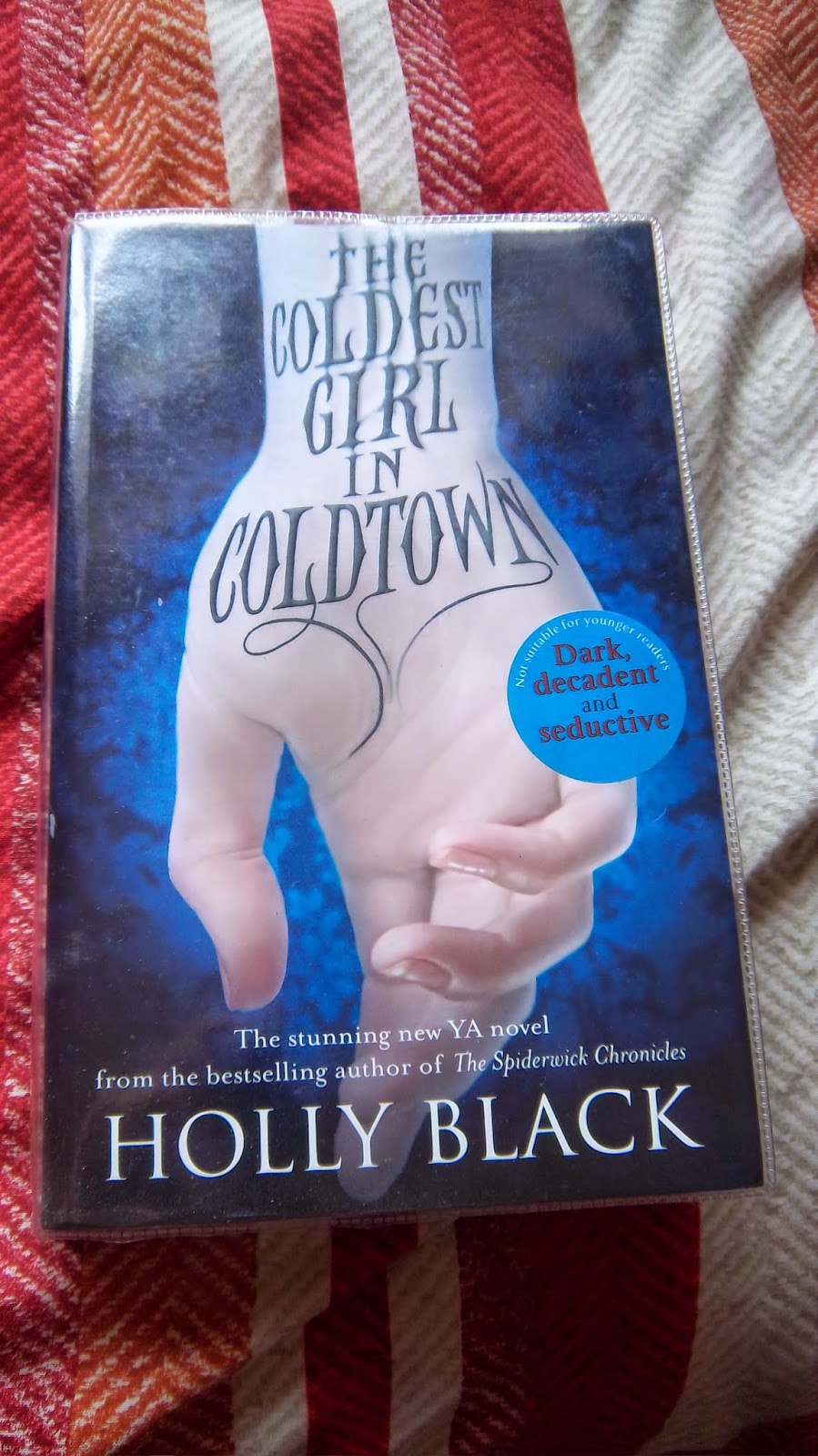
The Coldest Girl In Coldtown - Holly Black (RIP IX book 2)

People liked pretty things. People even liked pretty things that wanted to kill and eat them.
Vampires have always existed, but until recently they took great measures to keep their existence a secret. That all changed a few years ago, when a vampire named Caspar Morales got carried away, creating many more. The epidemic spread out of control, and now the vampires of the USA, and anyone infected by them, are imprisoned in Coldtowns, where they party and feast all night long. These parties form the basis of the most popular reality TV shows, are there is a significant proportion of the population who longs to join them, attracted by the glamour and the danger and the romance of being forever young.

Seventeen-year-old Tana is not one of them. She's seen the other side: when she was very young her mother was attacked by a vampire, and infected. In this world, one does not automatically become a vampire until one drinks human blood, but before you can return to your human life, you have to endure the Cold - up to eighty-eight days of desperate cravings as the infection sets in. Not many people make it through.

When Tana wakes up to find herself one of only three survivors of a vampire attack on the party she'd been at - the other two being Gavriel, an ancient vampire and her infected ex-boyfriend Aidan - she heads down with them to the nearest Coldtown, where she finds herself caught up in a strange world of death-seeking misfits, vampire politics and her own nature. Gavriel is an enigma, an oddly charming but deadly vampire with a Past. Can she trust him? Can she even trust herself?

I was impressed with Holly Black's world-building for The Coldest Girl In Coldtown, bringing a renewed sense of danger and glamour to vampire fiction. There was a classic, pre-Twilight feel to this book, of beauty and horror, and I was not at all surprised to see Anne Rice cited as one of Black's influences in the acknowledgements. The crowds of uninfected humans who made their way to Coldtown, particularly the twins known as Winter and Midnight, repulsed me in their sick fascination for the vampire lifestyle, giving up what it was to be human to be part of the undead fame game - for the gate into Coldtown is, with few exceptions, one way only. Yet they were entirely believable too, liveblogging and videoing every experience, and everyone convinced that they were safe, they were immune, that danger and death were things that happened only to other people. This is vampire fiction for the social media generation.

I read The Coldest Girl In Coldtown as part of Readers Imbibing Peril IX.


Monday, 28 July 2014

How To Build A Girl readalong: Part three

Chapters 11-15

This readalong is hosted by Emily at As The Crowe Flies (and Reads.)

When we last saw Johanna Morrigan, AKA Dolly Wilde, she had just been assigned an interview with musician John Kite, all expenses paid, in Dublin. This is her first time on a plane, first time out of the country, and she loves it. She meets Kite and finds him a real kindred spirit, someone who she can really relax around, have fun with, and she ends up besotted. John Kite seems charming enough, in a drunken-rock-star sort of way, but I don't trust him. I don't trust him at all. I feel sure that he's going to betray "Dolly" in some way and break her heart, turn out not to be the person she thinks he is.


Back in England, disaster strikes when her father receives an ominous brown envelope informing him that his claim for disability benefit is being investigated, and the family get a reduction of 11% in their income. 11% may not sound like the end of the world, but for a family with five children who have no luxuries, no savings, they just can't spare that money! "Dolly's" payment for her writing is slow to arrive, and after her first major feature turned out to be a page of gushing fangirling, the work dries up.


Her father makes another attempt at getting his music noticed, but I can't help but feel that if he is too sick to work a regular job - even a part-time one - would he be able to deal with the demands of working as a musician? I think he views "being a rock star" as an easy way out of his desperate situation, without thinking through the reality of the hard work required. Johanna is the only earner of the family: what about the mother, or the eldest brother? But it is easy to say "get a job!" yet last week we saw the extended family all made redundant by Mrs Thatcher's slashing of British industry. Just like today, the jobs just aren't there! 

Still, "Dolly" eventually gets another phone call from the magazine and she goes back to London for some more work, where she gets some gentle pointers as to where she went wrong with the Kite article. She despairs for a moment when her teenage years of musical education just don't seem to be enough, and timidly asks if she can claim expenses for borrowing CDs for the library at 20p per time.


In reply she is told that all she has to do is phone up the record companies and get as much music as a person can handle for free, and even sell the CDs on afterwards: a tidy business plan that could solve all the family's troubles - or at least help a little. Then, on to her first music-industry party, where she pulls out all the stops in making herself seem as fun and quirky and loud as possible. I was cringing on her behalf at times - there is nothing less British than obviously trying too hard.


Still, her colleagues seem to find her amusing rather than embarrassment, and as she got into the character I found myself laughing aloud. I loved the scene with her carefully calculating how to not look like a pig at the buffet table, making up a fictional friend who liked different food from herself, then leaving the loathed scotch eggs in the ladies' room with an explanation that they were dragon eggs, about to hatch! (Query: is what she did really that different from pretending you're not home alone when you order a massive pizza and lots of sides from Domino's? I suspect it isn't.)

Key Quotes:
I don't want anyone watching me change. I will do all my changing in private. In public, I am, always, the finished thing. The right thing, for the right place. A chrysalis is hung in the dark.
I am getting incredibly high on a single, astounding fact: that it's always sunny above the clouds. Always. That every day on Earth - every day I have ever had - was, secretly, sunny, after all.
The house is too small, and nothing happens, and I will never be older than twelve here.

(Minor grumble: in typing up these quotes, I found myself wondering whether Moran really needs all those commas.)

Monday, 21 July 2014

How To Build A Girl readalong: Part two

Chapters 5-10

This readalong has been organised by Emily at As The Crowe Flies (and Reads.)


Part one of How To Build A Girl ends on a very melodramatic note. After embarrassing herself on live TV, Johanna Morrigan dolefully concludes: "There are no two ways about it: I am going to have to die." Dun dun DAAAH! In part two, she is swift to clarify matters. She's not actually going to commit suicide. "I don't want to not live. I just don't want to be me any more. Everything I am is not working."

Oh man! As fiction it reads quite lightly, an amusing anti-climax: okay, I said I'm going to die but I don't actually mean die. However, it speaks to a feeling that comes right from the gut, a dissatisfaction I know all too well, and I am twice Johanna's age.


Instead, Johanna goes about reinventing her image as the dark and mysterious Dolly Wilde, named after a scandalous niece of Oscar. I'm not sure how one can use the name Dolly nowadays without bringing to mind a very specific Dolly! But Johanna, or Dolly, takes this transformation very seriously, and I really enjoyed reading about her inspiration collage on her wall. It's the sort of thing I'd have done at that age, though I was always dissatisfied with the results - they never looked as cool as the things my friends from real life, film and TV would come up with. "Dolly" is a very deliberate, studied effort at constructing a new personality, as the book's title implies. I think we all do that to a certain extent, according to where we are. Am I the earnest book-lover on a quest for knowledge, or the out-and-out geek girl? Yes.

So Johanna decides to become a music journalist - only problem being that she doesn't know a thing about music. Not that this stops her! I felt her awkwardness as she tried to get into her goth cousin's group, or browse a non-HMV record shop which seems as girl-friendly as the comic book store of The Big Bang Theory. I remember how as a teenager, your music tastes defined you, marked you out as cool or not. (Confession: I was obsessed with Boyzone.) Actually, in my experience I felt far more accepted among the goths and skaters than I did among the "ordinary" kids at school, even at fourteen, and the Hobbit in Southampton was the first pub I ever felt comfortable in.

Still, Johanna is nothing if not determined, and builds up her music knowledge with records ordered from the library and listening to John Peel on the radio, and eventually walks into the coveted job at the age of sixteen, with no qualifications.


We finally find out about Johanna's dad's disability - he was seriously injured in his work as a fireman. I wonder if Moran deliberately delayed telling us the details to challenge our reactions: though I fought against it, I did catch a treacherous thought crossing my mind: "so he's heroically disabled, that's all right then." PEOPLE ARE PEOPLE, PEOPLE! How does one earn one's right to be "deserving" poor, anyway? (Possibly not through drink-driving. These scenes made me very nervous.)


Johanna began her writing career as a means to "save" her family from poverty and disrepute, and yet even this early on I can see her getting caught up in her work and losing sight of her noble aims. Perhaps it's not surprising - she is sixteen, and probably every sixteen-year-old wants to put distance between themselves and their parents. I was cringing on her behalf when her drunken father came backstage to meet the Smashing Pumpkins with her. But I can see this independence becoming a huge source of conflict later on.


Key Quotes:


I am my own imaginary friend.
 Sometimes, and suddenly, these barrages of me-excluding noise part to reveal things I find astonishingly beautiful, and useful to me and my heart, in their current position.
We are not just poor people who have not yet evolved into something else: i.e.: people with money. We are something else - just as we are.
I can see where I have drawn Dolly Wilde on top of my own face - the two uneasily co-existing - but perhaps others can't.

Tuesday, 20 August 2013

Bout of Books 8.0: Tuesday


Bout of Books


12.10PM

Yesterday's Bout of Books did not produce amazing results for me, but at least I finally finished that Lovecraft book. I found the stories effective and creepy, once I'd got used to the prose, but this is an author who requires a lot of concentration; something I was lacking this weekend.

Today is another day off work for me, and I've had a lot more success reading Reconstructing Amelia in the garden by Kimberley McCreight. (I keep wanting to call it Finding Amelia for some reason, so if that alternative title turns up on the blog - sorry.) This book shows a mother trying to come to terms with her grief and uncover the mysteries surrounding the death of her teenage daughter. At first, it seems that Amelia committed suicide, a thing that her mother Kate can barely get her head around. And then evidence comes to light to suggest that Amelia was murdered.

McCreight uses a mixture of narrative techniques in the uncovering of the mystery, alternating between traditional third-person, past-tense scenes following Kate in November, snippets of text messages, emails and Facebook updates which are uncovered in the investigation, and flashback chapters from Amelia's point of view, which are told in the first person, as if in a diary. These last seem a bit strange to me, as the most intimate and personal voice is that of someone who is no longer around to have a voice. Still, I guess that's the point of the novel: to get posthumously reacquainted with Amelia as a person, rather than as the daughter Kate thought she was. The novel demonstrates the challenges of bringing up a daughter in the contemporary world, especially as a professional single parent, and showing how even a good mother-daughter relationship can hide secrets. Can a mother really know her daughter?

4:30 PM

Finished Reconstructing Amelia, which turned out to be a satisfying mystery (if some characters' actions were somewhat unlikely. Clues were sprinkled throughout the book like a jigsaw puzzle: you might figure out some answers before being told, but it is not until the end that you find out how they all fit together.

I used to want to have a family of my own, somewhen, but in the last few years I've sadly come to realise that I don't think I could be bear to be responsible for bringing up children with the world as it is today. Reconstructing Amelia reinforces that. The world has always been a horrifying and wild place for teenagers - see Lord of the Flies and Heathers, just as a couple of examples. But in this age of inescapable internet, smartphones, and a somewhat self-obsessed culture that encourages everyone to share everything with the world (says the blogger!) the teen's senses of immortality, independence and indiscretion, combined with perhaps not as much wisdom as one might think, can be explosive. We see the results on the news from time to time, and Reconstructing Amelia gives a fictional, extreme, but far from unprecedented example. (And I apologise if this sounds patronising to teenagers. It's not meant that way. I am just grateful that there was no such thing as Facebook when I was a kid and that my internet activities were limited to fangirling on boybands' forums, printing photos of said boyband members, and writing the occasional terrible fanfiction and angsty poetry. Who knows what might be out there if I'd had a Twitter account at fifteen?)


Monday, 15 July 2013

Divergent - Veronica Roth


In the last year or so, I've read a lot of rave reviews of Veronica Roth's teen dystopian novel Divergent, so when I found a copy in Ellie's book shop, I thought I'd see what all the fuss was about. In the wake of The Hunger Games, the YA market is full of dystopian futures: zombie apocalypses, corrupt governments and teenagers versus the world. Despite, or perhaps because of the hype, I was not convinced that Divergent would stand apart from the rest, but I wanted to be proved wrong.

The society of Divergent is split into five factions, each of which value and strive for a single character trait: Dauntless (courage), Abnegation (selflessness), Amity (kindness), Erudite (knowledge) and Candor (truth). I was very much reminded of Hogwarts houses, but turned up to eleven, and for life. Members of each faction have their own roles and contributions in this society, according to these values - but this view of humanity seemed too simplistic to convince me. People are complicated, and I could not believe in a world which dictated that a person can be either brave, or kind, or intellectual, that one quality must drive a person's every action, every thought, every decision, from the age of sixteen to the end of their days, or be outcast forever.

It took me a long time to get into Divergent, but my favourite segment of the novel was the middle, in which heroine Tris (Beatrice) trains for the initiation into the Dauntless faction. I was reminded of a school story, with new friendships and enemies made, learning and living together in dormitories, and facing up to bullies among other initiates and teachers alike. The famous knife scene was where my interest really started, which Tris shows real-world courage, as opposed to the daring stunts and tough fighting that passed for bravery in the Dauntless faction.

Fans of Divergent grow very tired of the inevitable comparisons with The Hunger Games, and between tough-girl Tris and Katniss Everdeen, and indeed they are very different stories within the genre. However, Divergent did not stand out from the other dystopian teen books. I enjoyed the Dauntless scenes fairly well, as a small group of characters getting to know each other and the workings of their new faction away from the hinted-at disturbances in their world's government. (How much of the world is factioned, and what happened to the rest of it?) However, I thought that the wider world, though full of potential, was quite weakly realised and unconvincing, and the final act was nothing exceptional. Sixteen-year-old heroine and a few friends-and-relations trying to bring down a corrupt regime? It's been done before, and better.

Friday, 26 April 2013

Tell The Wolves I'm Home - Carol Rifka Brunt


Sometimes you only have to pick up a book to know it's going to be something special. I'd never heard of Carol Rifka Brunt's novel Tell The Wolves I'm Home when I found it at work the other day, and yet I knew before I even read the cover blurb that it had the potential to be a good friend. Maybe it's the wistful dreaminess of the title, or the striking, bright green cover design. I prefer to think that it was some kind of magic inside the book itself, calling out to me, knowing that it had found a kindred spirit.

I returned to look at this book several times while working in the bookshop, and when I found a shiny new copy in the library a few days later, I knew it was meant to be. Tell The Wolves I'm Home is the story of an introverted teenage girl, June, dealing with the death of her uncle Finn, who was her closest friend and confidant, from AIDS. Through her grief, she strikes up an unlikely secret friendship with Toby, Finn's partner, and gets to know her uncle better through Toby's memories. 

Tell The Wolves is a story about love and loss, but also of finding, growing up, death and life, loneliness and jealousy, but at its heart, it is a tale of family. The book brings the reader into June's family, and gradually, although the primary relationship is between June and Finn - both living and dead - it becomes clear that the bond between June and her sister Greta is as important, or, I would argue, even more so. The sisters were close as children, but in their teenage years have grown apart. Greta appears at first as that familiar figure, the mean elder sister; the grumpy, rebellious teenager who can't help but pick on her shyer younger sister. But the reader comes to realise, long before June does, that Greta is lonely too. Greta starts off as a background figure in the novel, which is how June sees her; while she is so preoccupied with the absence of Finn, she misses the sister who is right beside her, trying in a clumsy way to reach out to her. June and Greta echo the fragile and fractured relationship between Finn and their mother Danni, who was his sister. Once close, they had let secrets, jealousy and resentment come between them, never to be fully resolved. 

Finn was once a famous artist, but one who disappeared from public life some time ago. His final work is a portrait of June and Greta, which is the object at the centre of the novel. The painting lives on as Finn's legacy, and is added to by all those who loved the artist most, becoming a collaborative work containing parts of each of them. Tell The Wolves I'm Home demonstrates how each person's life touches many others, how we are formed by the relationships we make and the people we meet. After Finn's death, June discovers that many of his quirks and traits had originated from Toby, and in turn, she sees much of Finn in Toby. Perhaps because of this, I found it a bit difficult to view Toby and Finn as separate characters, and wondered whether June was looking for a substitute Finn in her new friendship with Toby, an issue that is addressed in the novel.

June is a thoughtful girl and mature for her age, so it would come as a bit of a shock whenever I was reminded that after all, she is still very young. Fourteen is a strange age when one is part child, part adult, and sometimes the two parts don't sit well together at all. The busyness of June's parents make it easier for her to take the train from the suburbs into New York City without their knowledge, and a couple of times I wondered why the secrecy? Surely it would be better to discuss Toby, Finn and all the unresolved issues between the families as adults, though they may have to get through some unpleasantness first? And then I remembered that they aren't all adults. I remembered how powerless you are at fourteen. If adults say no, they won't discuss something, then you can't make them. They can stop you seeing someone, going somewhere, doing anything. Finn (and later Toby) was the exception in treating June as an equal.

Tell The Wolves I'm Home touched me close to the heart. June reminded me of myself as a teenager - shy and always an outsider, though I think that despite her quietness she had more confidence in herself as a person than I did at her age. The story, too, reminded me of the stories I would write in my teens - which is not in itself a recommendation, as I was inclined towards the sentimental and the morbid. Carol Rifka Brunt avoids crossing the line into sentimentality with her lyrical prose and strong characters and relationships. Tell The Wolves I'm Home is a very beautiful, very human story, and I closed the book with reluctance. The best new book I've read this year so far. I will be buying my own copy of this book, and it will take its place on my "favourites" shelf.


If you enjoyed this, you might like:

When God was a Rabbit - Sarah Winman
A Place of Secrets - Rachel Hore
Paper Towns - John Green

Eve Green - Susan Fletcher
The Earth Hums in B Flat - Mari Strachan

Friday, 28 September 2012

Jenny Q, Stitched Up - Pauline McLynn

Actress Pauline McLynn is probably best known as Father Ted's Mrs Doyle. Jenny Q, Stitched Up is her first foray into writing for teenagers. The book blurb suggests that more stories are to follow about Jenny and her friends and relations in Dublin.

Jenny Q, Stitched Up is a very light read for younger teenagers, a sweeter Angus, Thongs and Full-Frontal Snogging. The greatest conflicts in Jenny's life are her mother's pregnancy, ("It's just so, well, SHAMEFUL. And now it's going to be plain for all the world to see") the agony of keeping secrets from her best friend, and the horror of her mum eating all the KitKats. The drama and humour comes from the agonies Jenny suffers over the smallest details - after all, when you are thirteen years old, everything is the most important thing in the world!

Jenny Q is full of warm, lovable characters, and despite Jenny's constant griping about how weird and embarrassing her family is, it's clear that they are actually pretty close. Her best friends, Dixie and Uggs (Eugene) form a cosy "Gang" who meet regularly to engage in craft activities, especially knitting (despite Uggs' feeble protests.) McLynn captures well the dynamics of a teen friendship group, the relentless good-natured mockery and unspoken understanding of its limits, the awfulness of not telling your friends EVERYTHING, or worse, sharing a secret with one and not the other.

At thirteen, Jenny Quinn is just discovering boys - or one boy, anyway, her elder brother's friend Stevie Lee Bolton, "who is a god, end of." There is an adorable innocence in Jenny's first crush, how new and strange she finds it all. Stevie Lee is usually surrounded by a gaggle of gorgeous older girls dubbed "the Slinkies" who Jenny and Dixie regard with a combination of hero-worship and contempt, but once you get past the love-hate-girlcrush, it is refreshing to find that SamDanandEmmyLou are quite normal and nice as well as being pretty. In fact, Stitched Up contains only one real antagonist, and that is the class bully who, coincidentally, shares a name with a boy in my high school circle who I couldn't stand. When Jenny Q and the Gang decide that enough is enough, instead of battling the bully, they try to charm him into better behaviour, attempting in a thirteen-year-old way to understand why he is so unpleasant. I found that this story, though quite sweet, was less successful than other parts of the plot. The bully didn't have quite enough of a presence to really make me sense the conflict, and his story seemed to be resolved a little too simplistically.

Jenny Q, Stitched Up is a sweet, easy read, a heartwarming story for teenagers and pre-teens, or a shameless indulgence for older readers. I borrowed this book from the library, but am tempted to buy myself a copy. A book to keep you company on a rainy autumn day, with a large mug of cocoa and a chunky knitted jumper.


Friday, 2 September 2011

Miss Peregrine's Home for Peculiar Children, Ransom Riggs

With its simple cover illustrated with an old black-and-white photograph, Miss Peregrine's Home for Peculiar Children can be immediately identified as a strange, spooky book. Apart from the lack of fancy artwork or graphics, there seems to be something a bit uncanny about the girl. Perhaps it's just the obvious oldness of the picture, being blurry, unfocused, not sharp like modern photography. Maybe it's the title. Perhaps it's the fact that the little girl's feet are not quite touching the ground...

Miss Peregrine is a unique book in that author Ransom Riggs has illustrated his eerie fantasy story with real vintage photographs found and rescued by collectors; photographs that, like the girl on the cover, seem not quite right. The photographs themselves are fascinating, and I would have happily bought this book for them alone. But around the photo collection, Riggs has woven a dark, twisted narrative based around an orphanage that is not as it seems.

After the death of his beloved grandfather, American teenager Jacob goes to an island off Wales. He hopes to see the children's home where his grandfather spent the war years after his escape from the Nazis in mainland Europe. What Jacob discovers, at first, is a ruin. No one has lived in Miss Peregrine's Home for decades. As he explores deeper, he discovers stranger truths about Miss Peregrine and the children in her care than he could ever have dreamed of.

This book drew me in straight away, with a strong character in Jacob's grandfather, and the mystery of his death, and his past life. The ruined orphanage is a classic gothic ruined house, thick with atmosphere and unfinished business, on the borderline between uncanny-unexplained and fantasy. I felt that the book was at its best at this point, before the secret of Miss Peregrine's was made clear. Even when the truth began to unfold, I was impressed with the originality and unexpected explanation of a ghostly situation.

However, once the scene had been set and the story started to get under way, I confess I found myself losing interest. I felt that Miss Peregrine became less remarkable when the danger, the villains and monsters, were identified. The genre seemed to switch from atmospheric ghost story (of a sort) to a much more generic teen fantasy adventure, and it lost its grip on me. It is set up for the possibility of a sequel, but I feel it would be more effective if it were kept concise and unique.

Thursday, 28 July 2011

Specials, Scott Westerfeld

Sorry for the sparsity of book reviews at the blog recently. After the thrill of getting really immersed into the Harry Potter world once more, reading one book after another, I've taken my reading a bit slower than usual, as well as reading many books at once - and subsequently taking longer to finish any one.

If you come to Specials after reading the prequel books, Uglies and Pretties, you'll probably have a good idea of the patterns the story takes. It starts off, some time after Tally Youngblood and her friend Shay have had yet more operations to make them "Special:" Employed as government agents and set to crushing the rebellions among the ordinary Pretty folk, Tally and Shay have had their faces redesigned to intimidate the "bubbleheaded" pretties, senses finely-tuned to track and outsmart miscreants, and radio antennae implanted into their skin so they can communicate from afar. Their minds are made coldly logical, and their personalities rewritten once more to incorporate a large dose of arrogance. As far as Tally's concerned, this is the way things are supposed to be, until a reminder from her past sets her questioning her world once more.

Like Pretties, it is frustrating to read Tally's thought processes from the outside - when you know how she is brainwashed and manipulated into working for a crazy totalitatian government. With her new personality traits, I found myself actually disliking Tally this time around - even though I knew this wasn't really her. But the story begs the question: when her mind has been so meddled with, what is her real personality? Is it how she used to be, or what she seems to be now? It was interesting to see the dystopian world from other side; the point of view of those who not only support but enforce it, so that everyone can live in peace and order, and that individuality and personal freedom are a small price to pay for such a world.

Westerfeld also raises the questions of what it is to be human. What started off as a little bit of meddling - cosmetic surgery to make everyone look a certain standard of "pretty" - requires more and more meddling to keep under control. "Pretties" need brain surgery to prevent them thinking too hard about the ethics of the process, and then there need to be Special Circumstance agents to keep control, who need to be rewired in another way. As a Special, Tally finds herself repulsed by her former boyfriend Zane, because although he is "pretty," he is just the same as everyone else. All are equal, but some are more equal than others.

Despite the ethical questions, I found myself skimming through chunks of Specials, losing interest as the story seemed to repeat the same patterns as the first two volumes, saturated with technobabble I couldn't really visualise. It picked up towards the end, when Tally reached the "New Smoke," the city of Diego, where she finds that her very existence is questioned in its legality, and is faced with the dilemma of how to proceed in the upcoming war between Dr Cable's neatly-ordered Pretty city, and the New Smoke. I was surprised by the ending, and impressed that Westerfeld did not go for the easy or obvious ending, but I am in no great hurry to read the companion novel Extras. All in all, I think the Uglies story had potential, but that it was dragged out too long.

Saturday, 18 June 2011

My Sister Lives on the Mantlepiece, Annabel Pitcher (audiobook)

sister mantlepieceFive years ago, Jamie’s sister Rose was killed in a terrorist attack in London. He doesn’t really remember Rose, because he was only five at the time, but his family has never recovered. His mum left just a few weeks ago after having an affair with Nigel from the support group. Jamie’s dad drinks all the time and hates all Muslims. Rose’s twin sister Jas – now fifteen – has dyed her hair pink and got her nose pierced, an act seen as a betrayal by their parents, because she doesn’t look like Rose any more. It’s like Jas and Jamie are less visible than the urn on the mantlepiece, less present than the hole where Rose ought to be, the gap around which their whole family revolves.


After Mum’s desertion, Dad, Jas and Jamie move to a small village in the Lake District to start a new life. At his new school, Jamie doesn’t fit in. His teacher always seems to ask the very questions he can’t answer, and is frustrated by his reticence and apparent stupidity. The other kids call him “freak,” with the exception of sparky, mischievous Sunya, who recognises in him a kindred spirit, a fellow super-hero. But Jamie dreads to think how his father would react to his friendship with a Muslim girl, when he blames all Muslims for Rose’s death.

Jamie is a bright, unusual child with a vivid imagination. His narration is full of bright similes and metaphors which fit perfectly:
“I was more nervous than the most nervous person I could think of, which right now is the lion from The Wizard of Oz. My tummy had something bigger and scarier than butterflies inside it. Maybe they were eagles or hawks or something. Or, come to think of it, they could have been those monkeys with wings that kidnap Dorothy and take her to the witch that's scared of water.”
Jamie doesn’t really remember his sister Rose. Every day he sees the effect of her death on his parents, but for him that’s normal. He doesn’t remember when life was any different. For the outside reader, it is clear that something is very, very wrong. I felt intense pity for Jamie’s parents – one could never get over the loss of a child – but they are unreasonable in the way they treat their surviving children, so wrapped up in their own pain that they resent Jas and Jamie for not being Rose, or for not letting their lives revolve around her absence. When Jamie had to write a school essay about a hero, and chose footballer Wayne Rooney, his mother made him rewrite it about Rose, dictating the memories he didn’t have. Then, at a birthday party, when Jamie asked for food, his dad filled a plate – to put on the mantlepiece beside Rose’s urn. Jamie is such an optimistic child, but his hope is painful to an older, wiser reader (or listener listener) because of the awareness of the crushing disappointment that is to come when his wishes don’t come true, or if they do, they aren’t what he had hoped. At times the story just seems to be disappointment after disappointment, and Jamie has to learn the difficult lesson that adults don’t always get it right, don’t have all the answers and do let you down. But they get there, slowly, until Jamie concludes:


If OFSTED inspected my family, then I know what grade we'd get: Satisfactory. OK, but not brilliant, but that's fine by me.
I downloaded the audio version of this book when I was struck by a bad migraine attack. I couldn’t sleep for the whole time but wasn’t up to reading, so I let David Tennant read this to me instead. Although he is a talented voice actor, seemingly able to imitate any accent he tries, in this case his reading is simple and understated, letting the story do the work, narrating with the right amount of innocent hope, eagerness and subdued sadness. I bought the audiobook from Audible.co.uk, but was quite disappointed that it came as one six-hour track, so I couldn’t burn it to CD to wake me up in the morning. In future I think I’ll stick to buying  audio books as CDs.

Sunday, 12 June 2011

Pretties, Scott Westerfeld

Due to both library copies being missing, I had a long gap between reading Uglies and its sequel Pretties. I ended up finally getting to read Pretties when I found the series on my friend's bookshelves. It took me quite a while to get back into this setting: a garish, dystopian Back To The Future Part 2 sort of world (compete with hoverboards.) On the surface New Pretty Town seemed rather crude and childish, but beneath it all is a dark threat. Tally Youngblood discovered the truth about her society back in Uglies, but has since undergone an operation to remove all her natural imperfections to fulfil the ideal of Pretty, and in the process, her mind has been altered. So in a way, it was an advantage to come back to the series having forgotten much of the story so far, because it put me in the same position as Tally, seeing the world anew.

Another obstacle to really enjoying this book was the prevalence of irritating Pretty slang which seemed to be a cross between Evelyn Waugh's Bright Young Things (Vile Bodies or Stephen Fry's film adapation: Bright Young Things) and Bill and Ted. Everything is either "bubbly" or "bogus," or "[adjective]-making." Perhaps the Bright Young Things comparison is not as strange as it may seem, as the new Pretties live the same sort of lifestyle: all about fun, pleasure and parties, except here it is manipulated and enforced by the shadowy authorities, the Specials.
Post-Prettification, Tally's world looks jarringly different, taking us right back to the worldview she held at the beginning of Uglies: mindlessly accepting the way things are. This time, though, it is all the more sinister because we know what has brought her to this point, and appreciate the tragedy of Tally having forgotten all the valuable information and life lessons she learned in the Smoke in Uglies.

Plot-wise, this installment didn't really grab me. Whether it was the slang or the over-reliance on hoverboards, bungee jackets or crash bracelets, or the fact that the story seemed like a repetition of the prequel, or yet another flippin' love triangle, I whizzed through the story quickly without really engaging with it. But there were just enough cliffhangers and hooks to keep me going, wanting just one more question answered before I put it down. And the never-quite defined "Bubbly" started to make sense, a word that seemed at various times to mean happy, brave, clever or cool, and basically "alive" as opposed to the empty-headed contentment and acceptance that is the norm for new Pretties.

Sunday, 8 May 2011

Happy Birthday To Me: Brian Rowe

Happy_Birthday_to_meYoung adult fantasy fiction at the moment seems to be dominated by a particular type of novel: various mythical humanoid creatures in a high school, causing chaos and risking the end of life as we know it, but all this as a backdrop for a romance between a teenage girl and the ultimate bad boy. Happy Birthday To Me is an original take on the genre, plot-driven with the romance just a part of the story, rather than the main focus. Most of the recent YA books I’ve read were written by women, so it’s great to get a male perspective.

Cameron Martin seems to have the perfect life. He’s the sort of lad who is admired and envied, sometimes hated: star sportsman with a beautiful actress girlfriend and hopes of studying at Yale. Cameron is basically decent, but a rather arrogant troublemaker. But to those around him, he’s not quite good enough. His father, a cosmetic surgeon, “just” wants Cameron to be the perfect son. Sports give him more prestige than Cameron’s favourite topic, architecture; Cameron needs to be handsome, popular, cool and his father will be proud of him. Meanwhile, Cameron’s girlfriend Charisma (great name and completely inappropriate for this fickle, self-obsessed drama queen) torments him about not being “a man,” to wit: he is unable to grow a beard.

Then, after a cheeky prank upsets the wrong person, all this changes.  First comes the beard, then he puts on weight in a matter of days. Soon it is clear that this is no ordinary adolescent growth spurt: Cameron’s body is aging by a year every day. The doctors have never seen anything like it, and Cameron’s perfectionist father is mortified. Without a cure for his mysterious condition, Cameron can have only a few weeks to live.

Happy Birthday To Me is an excellent read: a unique concept, well-written with a mixture of humour and pathos. I sped through the book, just wanting to read “one more chapter” to find out what would happen next. I laughed out loud, cringed in horror at a couple of the awkward situations Cameron found himself in, and even shed a tear or two in places. There is a fairy-tale quality to the book and a satisfactory conclusion, although there are due to be two sequels, which I would be very keen to read. I highly recommend this book.

Happy Birthday To Me was sent to me for review by the author, Brian Rowe.

Friday, 22 April 2011

Lament, Maggie Stiefvater

Lament is the first novel from Maggie Stiefvater, author of Shiver and its sequel Linger, but it has only been published in the UK this year. The story is familiar to a connoisseur of teen fantasy fiction. Teenage girl starts a romance with a strange and handsome boy, only to discover that there's more to her new boyfriend -and the world - than meets the eye. Her new boyfriend has a dark and dangerous past that is catching him up and the teenage girl finds that a lot of people want to kill her. Stripped down to the basic plot outline, this could be Hush, Hush, or Twilight or one of many other dark fantasy romances. It might have been vampires, or angels, or werewolves. In this case it's the fair folk - the faeries.

The power of Lament is in the details. Ms Stiefvater writes with humour and lyrical prose which is highlighted by the theme of music throughout the novel. Heroine Deirdre is a skilled harpist, and it seems that her musical genius is more than just a talent. Dee is a "cloverhand" - one who can see faeries, and who has some magical, psychic abilities of her own. Music is no earthly art here.

I found that the first half of the book read as a fairly generic teen novel with an Interchangeable Magical Boyfriend Creature, and the platonic childhood best friend of the opposite sex who could be the third corner of a potential love triangle. As is often the way, I felt more inclined to wish for James the Best Friend to win Dee's heart rather than the more glamorous, troubled Luke with his faerie background.

I was rather taken aback that after Dee discovered the details of Luke's terrible past, she seemed more concerned that he had expressed his love for her than that he had been sent to assassinate her! After her initial anger, I thought Dee was too forgiving too soon, but it is to Ms Stiefvater's credit that she evoked sympathy for the couple even if I rolled my eyes a little.

Despite his otherworldly ways, uncanny knowledge of Dee's life and his habit of calling her "pretty girl," Luke is - or was once - human. When we get to meet the fair folk themselves, the book seemed to shift from YA "paranormal romance" to a more traditional, mythical fantasy genre. The fair folk are not interchangeable with the un-vampiric vampires and fallen angels that are in many books; these are definitely the faeries of old: amoral and fascinated by the humans with their funny notions of good and evil. They are majestic, dangerous, very inhuman and mischievous - from an era long ago when the word "mischief" had far more sinister connotations than it does now. These faeries are of the race of Oberon and Titania, whose quarrels put nature in turmoil. When I was at university much of my creative writing was influenced by the tales of the fair folk of old - not Tinker Bell and the cute little pixies that people tend to think of when they hear the word "fairies." Maggie Stiefvater's fair folk were of the same sort, and so well-written that I half wondered if the author had faerie blood herself, or was a cloverhand like Dee. Certainly she seems to be able to create any kind of art she tries her hand at: creative writing, painting and music.

Lament is a powerful, enchanting novel that, like the four-leaf clovers that play their part in awakening Dee's powers, opens the reader's eyes to that beautiful, deadly other realm.


If you enjoyed this, you might like:
The Bitterbynde trilogy by Cecelia Dart-Thornton
Ash by Malinda Lo

Thursday, 3 March 2011

The Truth About Forever, Sarah Dessen

Since her father died, Macy has been struggling to hold everything together. On the surface everything looks perfect: perfect grades, perfect boyfriend, perfect life - but underneath she's falling apart. It's the summer before her last year of high school, and everything counts towards going to a good university. Her boyfriend's gone away to "brain camp" and left her his job at the library - but she hates it. Her colleagues sneer at her, and at home her workaholic mother is too busy with her job as some sort of estate agent/party host who shows off the new houses. At one of her mother's functions, she befriends the kind-hearted but chaotic caterers and takes on a second job with them. Her new friends help her to see that life is not to be feared but embraced, while Macy finds herself growing closer to Wes, the boy with a Past.

Grief treats everyone in different ways, and Macy and her mother bury theirs deep inside, pretending that everything is fine. Macy's mother loses herself in her work, while Macy's coping mechanism is her pursuit of "perfection," for only when she's perfect, she reasons, will she have control. But she is not happy. Although she claims to be in love with her boyfriend, Jason, it's clear the lady doth protest too much, and that Jason is not good for her, being more interested in his university applications and that Macy covers his job adequately.

I found The Truth About Forever to be much more a character-led book than plot-driven. Dessen does a great job at bringing Macy's new friends to life: accident-prone, pregnant caterer Delia - UK readers may be amused by her name, being very unlike another Delia in food! - bickering brothers Wes and Bert, lively Kristy and her sister Monica "Monotone" whose vocabulary consists of "Mmm-hmm/Nuh-uh," "Don't even..." and "Better quit."

I wasn't so convinced by the "villains" of the piece, if I may so call them. Jason acted more like he was Macy's middle-aged, humourless boss than her boyfriend, and her mother was a monster. Yes, I know she was grieving and stressed, but the way she treated Macy was disgraceful. One evening she came home to find Macy had invited her friends in to watch TV - whatever next? Offering them coffee? Playing music? - and she acted as if Macy had staggered home drunk at three in the morning and thrown up over the new carpet. If Macy's aim of perfection was unhealthy, her mother's pushing her was far, far worst. Any time Macy spent on her summer holiday not studying or working - and only the library job counted - just wasn't good enough. Only perfect was good enough. She's seventeen years old! Let her live!

But what is the truth about forever? The subject popped up throughout the book, but I wasn't quite sure what message Dessen was trying to get across. Kristy contradicts herself by saying at different times, "Life is long," and "Life is short." In short, nothing lasts forever. A few weeks of summer might feel like forever at the beginning, but it's gone before you know it.

Although I quite enjoyed this book, it took me a few days to get through as it was quite similar to some other books for teenagers, and not a lot ultimately happened. I felt the need to read something a bit more challenging; this was nice but too light and fluffy for my taste at the time of reading.


If you enjoyed this you may like:

Tiger Eyes - Judy Blume

Friday, 18 February 2011

Artichoke Hearts, Sita Brahmachari

Mira Levenson has just turned twelve and her world is becoming a strange and unrecogniseable place. Her Nana Josie, always so artistic, passionate and full of life, is dying; she can't stop thinking about Jidé Jackson, whose confident, joky manner hides a tragic history and a sensitive soul. Mira is changing. Sometimes she catches her mouth saying what she didn't intend to say, speaking out when she's always been so shy, or alternatively keeping secrets to herself. Nothing particularly drastic, she just doesn't feel like sharing everything with everybody.

There are a lot of books for teenagers that deal with the aftermath of the death of a loved one. Artichoke Hearts actually seemed to be targetted at the younger end of the Young Adult range (11+) but is unusual in exploring a terminal illness, and the feelings of helplessness of those who can only watch as a relative approaches death, and Brahmachari writes this with simplicity but a great deal of maturity. Nana Josie is early on established as a vivacious, artistic woman, a former hippy and passionate protester. Early on, there is a moment of dark, uncomfortable humour, as she embarks on her big artistic project: to paint her own coffin. It is heartbreaking to watch such a lively person fade.

The artichoke of the title refer to a charm given to Mira by Nana Josie, a symbol of the human heart, and how with age and experience, a heart which may seem to break grows tough layers to protect it, like the layers of an artichoke. The novel is a sweet, beautiful coming-of-age story, showing a child starting to learn who she is. Mira is a quiet girl, artistic and thoughtful, but through the sadness of seeing her grandmother die, the strangeness of early adolescence and the sweetness of a first romance, she grows in confidence and self-awareness. The characters are all very-well rounded individuals, and I think that Jidé Jackson is one of the loveliest boyfriends I've encountered in a kids' or teen book for a long time - and he's only twelve.

Read for the Support Your Local
Library Challenge 2011
One way that Mira grows in her understanding is in her extracurricular creative writing class, which is led by writer Miss Pat Print, and consists of herself, her best friend Millie, Jidé and his friend Ben Gbemi.  In the classes, Miss Print (an unfortunate name for a writer!) helps the children to understand themselves and their world through writing. The novel is written as being Mira's diary, in the present tense which itself is highlighted early on as helping reader and writer feel the immediacy of the narrative. On occasion, after a short writing exercise, the children start to feel empathy for others in a way that they hadn't before. I found these writing sessions fascinating, and they summed up what is, to me, why literature is so important: Fiction (or poetry, theatre, film, TV) helps to make sense of the world and cultivates understanding of other people.

Artichoke Hearts is a pensive, sometimes sad read, but ultimately it left me feeling uplifted, a celebration of life, youth, a loving family and good friends. I would recommend it for Judy Blume fans and older readers of Jacqueline Wilson, who are maybe looking for something a bit more grown-up. So far, Artichoke Hearts has quietly slipped onto the bookshop shelves with little fanfare, but it deserves to be widely read and talked about.

Wednesday, 9 February 2011

Delirium, Lauren Oliver

Love, who needs it? Sure, it feels good when you're with that special someone, but what about the pain when it ends? What about the fear that you're not good enough and that one day they'll realise it, or the jealousy that eats you up when he's late home for work? The soaring highs and the crashing lows are bad enough, but on top of that, love makes you do stupid things, put the beloved before yourself even at risk to yourself. Make no doubt about it: Love is a disease.

Or so Lena is led to believe, growing up at some unspecified point in the future. Luckily there is a cure against Love, or Amor Deliria Nervosa as it is now called. At eighteen, all US residents undergo surgery to remove all traces of the disease. They are paired up with suitable spouses, married out of college or high school, and have as many babies as the government tell them they can support. It seems to work all right. Even today many people argue that arranged marriages are as good as the kind based on being in love, with both parties having to work at the marriage and love coming as a result of this.

But wait. Did I mention love is a disease, and cured when a person reaches adulthood. Think about that for a moment. It's not just the being in love, but love, full stop. That's the love of parents to children - they bring them up dutifully and make sure they lack nothing they need, but there's no love. And without love, what is left? You're not even left with a love of things: hobbies, colour, beauty, music. There is no joy. There is no hatred or anger either; without love there is no emotion. But can you call yourself human? You might as well be one of the Cybermen of Doctor Who.

This is the world to which we are transported in Lauren Oliver's long-awaited dystopia, and what a bleak world it is. I've read a few dystopian teen novels recently, but they - Uglies and The Hunger Games are set in a very changed world. Uglies' is very polished and futuristic, while The Hunger Games has progressed technologically, and regressed in other ways, until it could be a high fantasy novel. But Delirium takes place in Portland, Maine, with real landmarks you can look up on Google Maps Street View. Although time has obviously passed, it feels as though this isn't so far away.

Delirium is the first part of a series - I think a trilogy - and all the way through myself wondering just how the story can end happily. Protagonist Lena is an ordinary teenager who falls in love just before she is due to undergo "the proceedure." After having unquestioningly accepted her fate, and the dangers of love, once she has experienced it for herself she finds herself wondering, desperate to defy the authorities and live happily ever after, and never mind the disease. But there is more at stake: it won't be enough for her to resist or survive the proceedure. The entire worldview of a nation has to change, and Lena is so very insignificant. I can't see how she and other resistors will realistically manage to persuade the whole country that all they've been brought up to believe in is wrong.

I found some of the culture in Delirium to be bizarre and contradictory. Love has been declared a disease, fair enough, but everything seems to revolve around keeping people uninfected. It's fair enough to succumb to the disease - that can be cured - but "sympathisers" are treated more like criminals, and punishment is harsh. It may appear to be a government concerned for its citizens, but it seems to me that there is an ulterior motive for keeping the people loveless. Even if it's the same old story: keeping people in their place and stopping them from thinking for themselves, I suspect more will be revealed in the sequels. And if this is a totalitarian regime, it doesn't have to make sense. You only have to look at somewhere like North Korea to see that.

After reading Oliver's Before I Fall, which was one of my big discoveries of last year, I've been eagerly awaiting Delirium, along with most other bloggers who read teen fiction. For me, though, "unputdownable" wasn't the word. (As far as I'm concerned "unputdownable" isn't a word!) Before I Fall was so fresh and original, I really did take it with me all around the house and got through it in a day. This time around I was able to read two other books at the same time as Delirium and it took me several days to finish. I thought the concept was fascinating, and that Oliver explored it well, with some beautiful writing, great characters and moments that came to life off the page. The plot itself, however, felt very familiar and I realised that the pattern of events, if not the details, mirrored the story outline of Uglies, at least in the first half. The second half is where the story really started to grab me and take on its own shape until its shock ending. Although other bloggers gave away no spoilers, I guessed from their reactions what might happen. That ending, however, ensures that the story from here on, and possibly even the story up to this point, isn't what you'd expect it to be, but something new and unexpected.


If you enjoyed this, you might like:

Uglies - Scott Westerfeld
The Hunger Games - Suzanne Collins
Never Let Me Go - Kazuo Ishiguro
Matched - Ally Condie
Wednesday, 5 January 2011

Torment, Lauren Kate

Daniel has whisked Luce away from her old reform school, Sword and Cross, and hidden her at Shoreline, a new boarding school in California which couldn’t be more unlike the last. Where Sword and Cross was bleak, grey and miserable, Shoreline is more like a summer holiday resort, fresh and modern and sunny. There are special classes for those students descended from angels – a sort of celestial Hogwarts! – while to the unknowing it is simply a very exclusive private school. I found the strong point of Fallen to be the school-story scene setting, the friendships and the gothic atmosphere. Although less memorable than Sword and Cross, I enjoyed reading more of the set-up and meeting new characters, especially Luce’s roommate, the irritable Shelby. On the other hand, Luce’s other new girl friends, Dawn and Jasmine, who swoon over her as though she were a celebrity, almost gave me a headache with their shrill hysteria, and this was from reading about them on the page!

After reading Hush, Hush and Crescendo, which I found to be somewhat insipid, I’m glad to see that Lauren Kate’s mythology has something behind it to identify it as being about angels and demons (rather than Interchangeable Magic Boyfriend Creature whose defining feature is that "wings are a neat idea.") Although it isn’t consistent with my understanding which is that there are either angels which are good, demons which are the same as fallen angels, no middle ground, this is Lauren Kate’s story, not mine, and she’s clearly put a lot of work into establishing a fantastical world. All the same, there seem to be a few inconsistencies or things that just feel like cheating. For one thing, there is the whole “You and I aren’t so different after all,” message between angel and demon which goes against their being the forces of good and evil – a conflict which indicates that Lauren Kate has drawn inspiration from Milton’s Paradise Lost. "Or at least the CliffsNotes."

We see a return of the shadows which have plagued Luce since her childhood, which have been revealed to be messengers for dark forces, called Announcers. Now, it seems that if you can hold onto them and stretch them about, they become magic TV screen/crystal balls which show you scenes from the past, which also double as a kind of spatio-temporal hyperlink.* I was reminded of my own juvenile attempts at writing fantasy where I made the rules up as I went along.

In Fallen, I found myself irritated by Luce’s insistence of her twoo wuv for Daniel which seemed to be without any foundation except the discovery that she is his reincarnated soul mate, and that they always end up together (before she dies.) I put enough distance between me and Fallen to forget the details of why their “inexplicable connection” and subsequent “relationship” annoyed me, and this time around was able to take Luce’s word for it. They’re in love, they’re soul mates, yeah, whatever, if you say so. I still wasn’t convinced, but this time around at least Kate didn’t constantly rub my face in it.

Torment is that obligatory Volume Two of many Magic Boyfriend Creature romances where the couple are parted – for the girl’s own good, of course – and the boy acts mysterious and won’t tell the girl anything. It happened in the Twilight books and Crescendo, and here it happens again. I was glad to see that Luce didn’t waste too much time moping, however, but was proactive, questioning what she’s been told by Daniel about their past together, and trying to find out the truth for herself instead of blindly accepting everything he has to say.  Also, by this time some of the initial dizziness of first romance - at least, Luce’s first romance where the boyfriend didn’t spontaneously combust on their first kiss! – has worn off, we find Luce identifying some of the traits of the modern YA Interchangeable Magic Boyfriend Creature (IMBC) Romance genre which are so worrying as a relationship model for teenagers: that the IMBC boyfriend has to know and control his girlfriend’s every move, but keeps his own a secret. Luce even finds herself wishing that Daniel is more like her new crush Miles (Yes, here goes another love triangle! Make up your mind, girl!)
“This was exactly the kind of goofy, teasing rapport she would love to have with Daniel. If only he weren’t so brooding all the time. If he were actually around.”
If, in short, he wasn’t Daniel at all. For a moment, I wondered if this would be the IMBC romance where the girl might realise that she’s in love with the idea of the IMBC more than the guy himself, and make her choice based on reasons other than fate/inexplicable connection/magic/he wants my blood [delete as appropriate.] Just for a moment.

Another three-star rating, but with less polar extremes than Fallen: it isn’t as good as the best of the former, but it’s not as bad as the worst. A lot better than I had expected.


*Didn’t want to say “magic door.”

Friday, 17 December 2010

Getting Revenge on Lauren Wood, Eileen Cook

When she was in eighth grade, Helen's best friend Lauren humiliated and betrayed her in order to start high school in the popular group. Helen moved away with her family for three years, but now she's back and she wants revenge.

I started reading this book a little bit on my moral high horse: Revenge is bad, forgiveness is good, and at first that interfered a little with my enjoyment of Lauren Wood. On the other hand, there was that little dark side of me that remembered being bullied in school and appreciated seeing the nasty kid getting her comeuppance, quite safely within the pages of a book.

I wasn't quite convinced by the realism of this book. Firstly I debated whether it was believable for a seventeen- or eighteen-year-old girl to still be obsessing over an event that happened when she was fourteen. And it is obsession - in her three years away from her old school she stalks Lauren through her Facebook (that girl seriously needs to sort out her privacy settings on her profile page!) She is unable to put this event behind her and move on. Then again, she was fourteen, a very vulnerable age at which anything that happens is the most important thing in the world, and Lauren had been her best friend for her whole life up to that point. I know from experience that it is harder to get over trust issues caused by a supposed friend than a known enemy, because you've let that person inside the walls that keep others out, making it a more devastating sabotage to your life.

But we are expected to believe that Helen has changed enough over three years to make her unrecogniseable, by losing some weight, cutting her hair and having a nose job, so that she can call herself by her middle name (Claire) and mother's maiden name. I didn't think so, but was quite willing to suspend my disbelief to watch the drama unfold. The plot was fairly predictable, and although Helen-Claire, the boy she liked, and Brenda, the friendly girl who wasn't part of the in-crowd and therefore had to be befriended in secret, were pretty well realised, Lauren could quite easily be Regina George from Mean Girls and her two closest friends, Bailey and Kyla (why are there always two cheerleader/popular girl minions?) looked in my mind like Brittany and Santana from Glee!

All in all, Getting Revenge on Lauren Wood was a trashy but enjoyable guilty-pleasure read. And it has a brilliant cover.


If you enjoyed this, you might like:

Pink - Lili Wilkinson
Just As Long As We're Together - Judy Blume
Film: Mean Girls
Related Posts Plugin for WordPress, Blogger...