Showing posts with label girls'. Show all posts

Friday, 17 June 2011

Rainbow Valley and Rilla of Ingleside, L. M. Montgomery


I've decided to review the concluding two books in the Anne of Green Gables series in a single post, as I've already said a lot about Rilla of Ingleside three years ago. (You can read the original post here. Caution: It's long and full of spoilers.)

Rainbow Valley follows on from Anne of Ingleside, but by this point the Anne books aren't really about Anne Blythe, nee Shirley, any more. Rainbow Valley isn't even a Blythe family book, but instead is centred on a new family, the Merediths. John Meredith is the new Presbyterian minister, a young widower with four children. Although academically brilliant, Mr Meredith is completely at a loss when it comes to bringing up his children, and Jerry, Faith, Una and Carl cause scandal in the community by their wild behaviour.

I found Rainbow Valley to be much more enjoyable than Anne of Ingleside. The Blythe children, who befriend the Merediths, are a little older, and their escapades are less cutesy-poo and more heartfelt. Under the children's silly scapes is their real longing to get their father's attention, and to become respectable members of the community. Although I didn't feel that I got to know the boys very well - I would get Jerry Meredith confused with Jem Blythe, both being the eldest of their respective families, and having similar names - there was real character in the girls: impulsive, big-hearted Faith, and shy, thoughtful Una. We also got to know Walter Blythe better, who is growing to be an extraordinary, unearthly boy with his own battles.

Then there's Mary Vance, a runaway orphan "adopted" by the Merediths. Mary's story has strong parallels with Anne's own childhood, but a very different character - maybe an insight into what Anne could have been like without her imagination? Mary's language and attitude horrifies the minister's children, and even after she is being "brought up properly," she has a sharp tongue and too high an opinion of herself. I don't exactly like Mary Vance, but there is no denying she is a living character.

Perhaps I felt more interested in Rainbow Valley than its predecessor because L. M. Montgomery herself was more interested. Ingleside and Windy Willows, which are less of a joy for me to read, were written at a later date when I understand Montgomery had fallen out of love with Anne, and it shows. In Rainbow Valley there is stronger characterisation, with some newcomers who are more than gossippy old women and match-making subjects, but who take on a valuable role in the story. We meet intelligent, argumentative Norman Douglas, the West sisters imprisoned by their own vows to each other, and of course Mary and the Merediths, all of whom are as knowable as the Avonlea residents of old.


Anne's story concludes in Rilla of Ingleside, when her children are grown up, and so has the story. For the first time the timeless, slightly other-worldly, other-time classic is brutally placed into an exact place in history: World War One. I found it interesting to read about Canada as part of the British empire and the characters' patriotism towards a country most of them had never seen. I felt uncomfortable noticing that Rilla, who was so set against her brothers going to war, addressed a meeting about dying for one's country being glorious, and helping to persuade young lads to join up.

But this book does not allow idealism to overshadow the ugliness of war. We don't get to see the action first-hand - although one of Jem's letters home was reminiscent of some of war poet Wilfred Owen's writing - but Montgomery focuses in on the agony and helplessness of the people on the home front; the families, friends and lovers of the soldiers. Though full of comic and heartwarming scenes, through Rilla, Anne and Rilla's friend Gertrude, we feel the relentless agony of life, love and loss at such an unpredictable time, the fear that must underscore every aspect of life "Till the boys come home." And, of course, many never would return, including one of the Blythes' most beloved friends-and-relations. To Gertrude, Rilla, Una Meredith and me as a reader, it seemed that such loss could not be borne, but of course they survive and carry on. They must. But Rilla of Ingleside made it clear that for all who lived through the fateful years, the world had changed forever in a way that one can never quite get over.

Rilla of Ingleside is a guaranteed tearjerker, a bittersweet ending to the story that started off as such sweet escapism. In some ways I am glad that Anne retreated into the background in the later stories, as it seems so terrible that her story should take such a turn. By this point, this is far more than just a children's story, but a unique piece of World War One literature that deserves a place in the canon.

Thursday, 28 April 2011

The Girl From Away trilogy, Claire Mowat

There are some people who are, as Anne Shirley would put it, true "kindred spirits." These are the people you can travel with, go for coffee or even lunch with, and completely ignore each other while you are both engrossed in books. Most people would probably think this weird and unsociable, but my closest friends understand completely. I've known my best friend, Judith, for as long as I can remember, and like me she is a complete bookworm. We've been on holiday and on day trips up and down the country, but our favourite finds when shopping are the bookshops, from big chain stores to teeny-tiny second-hand shops. So when she recently went on holiday to Canada, it is only natural that the souvenirs she brought back for me included books. The Girl From Away trilogy was a tatty old ex-library book with stamps, old-fashioned ticket pocket and the opening times of the local swimming pool still visible in light pencil. I love a book that's picked up some history along the way, and especially one that has crossed the Atlantic.

The Girl From Away

The Girl From Away introduces Andrea, a teenage Toronto girl who pays an unwilling visit to Anderson's Arm, a small fishing community in Newfoundland, while having to come to terms with her mother's remarriage. Andrea spends the Christmas holidays with her aunt Pearl and cousins - her uncle Cyril is away working on an oil tanker, and though they remain cheerful, Pearl and her children are clearly anxious about him. The Girl From Away is a lovely portrait of a small community, where everybody knows everyone else and pulls together in a crisis. The setting came vividly to life, and felt identifiably Canadian. The three-in-one edition of the book was published in 2002, but I recognised the stories as being originally written earlier, in the 1990s. There were details that felt old-fashioned, but yet not so much so that they were strange to me. Most noticable was the personal cassette player that was Andrea's birthday present, and the story itself was reminiscent of the books I read when I was a child.

The French Isles

Book two of the trilogy sees Andrea back with her cousins, aunt and uncle - now safely home. A trip to collect Uncle Cyril's fishing boat finds Cyril, Andrea and the Cousins at St Pierre and Miquelon, islands which are located near Newfoundland but are actually French. Not French Canadian; owned by France. Andrea takes a job working at a bed-and-breakfast hotel, and befriends the owner's son, Philippe. After the drama which led Andrea and her family to St Pierre, the story is fairly gentle and uneventful, with a little hint of a youthful romance. It does help if you have a working knowledge of the French language, as there is a lot of dialogue which is left untranslated.

Last Summer in Louisbourg

Andrea is now fifteen and is vacationing in Cape Breton for the summer job to die for! She is childminding at the Fortress of Louisbourg, a job which involves dressing up in period costume and doing a fair bit of historical re-enactment. While working, she is offered a bit part in a film which is shot on location.  Again, Mowat sets the scene beautifully, and I envied Andrea her summer job. It was amusing to see how quickly the novelty of working on a movie set wore off, however, and Andrea came across as rather a sulky teenager, anxious that her costume makes her look silly, and objecting when extra filming spoiled her day's plans. I was a bit disappointed not to see the Newfoundland family this time around, or to hear anything else of Philippe, but there were some great new characters introduced: landlady Jackie and Andrea's verbose roommate Justine, as well as the cast and crew of the film, and Andrea discovers a family secret.

The Girl From Away trilogy is a lovely, easy holiday read ideal for girls aged about 9-12 years old.

Sunday, 17 April 2011

Anne of Ingleside, L. M. Montgomery


Seven years has passed since the end of Anne's House of Dreams. Anne Blythe, née Shirley, is about thirty four years old, mother to five children: Jem, Walter, twins Nan and Di, and Shirley, with a sixth on the way. (Rilla.) Anne of Ingleside chronicles the adventures of the whole Blythe family across a span of six years.

Despite its title, this isn't really Anne's story any more. After a lovely nostalgic few chapters on vacation in Avonlea, where she revisits her old haunts and relives old memories with her best friend Diana, Anne fades somewhat into the background, where she is more "Mrs Doctor, dear," wise and respected wife and mother, than the impetuous girl of old.

Anne of Ingleside is the most anecdotal book of the whole series, with chapters focusing in on one family member at a time. There are enough children to ensure that there is only room for one case of matchmaking, one cantankerous, pessimistic old lady and one stream of gossip about people we don't know, but it also means that I don't really get to know any of the younger Blythes as people, except perhaps Walter. Shirley, the youngest son, doesn't get any attention at all.

I wrote in my review of Anne's House of Dreams that it ended on a melancholy note. Although the stories told in Ingleside are entertaining enough, I sense a bitter undercurrent to many of the stories. When the narrative returns to Anne's perspective in the end of the novel, she doesn't seem like the same person at all, consumed with jealousy of Gilbert's old flame, the spiteful Christine. She fears that Gilbert has fallen out of love with her and become complacent, their marriage a comfortable old habit after fifteen years.

Although Anne and Gilbert's love story has a happy ending, this is not the only troubling moment of Ingleside. In the aforementioned gossip chapter, allusions are made to a really nasty incident at the funeral of an unpleasant man. Di Blythe, aged ten, after two ill-judged friendships, vows not to trust anyone any more, because they'll only let her down. Then, finally, a throwaway line not only foreshadows a future tragedy, but tells it outright. If House of Dreams ended wistfully, Ingleside leaves me feeling like I've been kicked in the stomach. Just a  sentence or two from an omniscient narrator, in the middle of a tender scene of Anne looking in on her sleeping children, then the last page is a stunned blur.

Don't get me wrong, Anne of Ingleside is an enjoyable read, but the magic of the earlier books is missing. Reading Ingleside I could sense Montgomery's darker state of mind at the time of writing, and her weariness with the Anne series.

Saturday, 29 January 2011

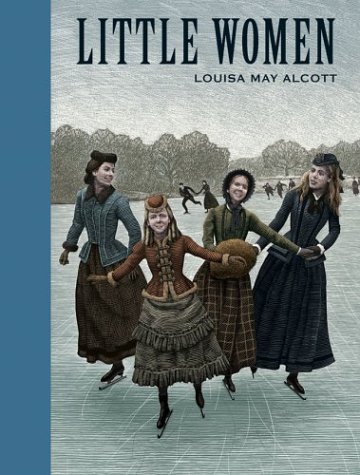
Little Women, Louisa May Alcott

I used to be confused and a bit annoyed when film and stage adaptations of this classic story would be titled Little Women but contain the story both of Little Women and the "sequel" Good Wives. It was not until relatively recently that I discovered that Good Wives is merely the UK title for what was originally, and still is elsewhere, the second half of Little Women itself. Upon discovering this, and not being overly fond of the twee Good Wives as a title, I determined to buy my own copy of the complete text. Previously I had never got past volume one, but having a book all-in-one would get me past the usual stopping point. It seemed that a Penguin paperback would be my best bet, but in Foyle's I found a lovely hardback for a lower price.

Little Women was never one of my absolute favourite books, although I've read it a fair few times, seen the 1990s film and a West End play. It's a strange thing, but every time I read this book I seem to come to it with a different attitude, and take different things away from the reading. As a child I viewed it as similar to What Katy Did, but a bit more grown-up - possibly because I was a bit more grown-up when I first read it. I came back to it a year or two ago, intending to read the whole series, but stopped at the end of Little Women [volume one] after feeling bogged down by all the moralising. Frustrated, I found the girls too good to be true, their faults only there to be overcome and an over-keenness to be lectured by their "Marmee."

That was just about a year ago. This time around I wondered if I was reading the same book, because Meg, Jo, Beth and Amy were refreshingly real, made up not of a single fault there just to be overcome, but flesh-and-blood teenagers with understandable struggles against hot tempers, jealousy, discontent, crippling shyness among others. The girls' friendship with the boy next door, Theodore "Laurie" Laurence was refreshing for the era, a cosy, platonic companionship full of fun, games and silliness that you just don't get in Victorian literature. I noticed scenes and chapters I must have only skimmed before, because they felt quite new to me. Perhaps these were the scenes omitted from the film, of which I may have retained more memories.

That's not to say I didn't find the moralising a little heavy-handed at times. In the chapter Meg Goes to Vanity Fair, Meg is rebuked first in the text, then by Laurie and finally by Marmee, for allowing herself to be made-over by her rich friend-of-a-friend for a party, and acting the part. Looking at it one way I felt quite cross, asking "What's wrong with dressing up once in a while?" and wondering if the moral here was that one shouldn't act above one's station, an idea that appalled the twenty-first century English girl who - until very recently - had an idea that class boundaries were fairly fluid. Looking at it the other way and I know quite well what Alcott's point was. After all, I tut when watching Grease to see Sandy dressing up in her leather catsuit and smoking cigarettes just to gain the respect of someone who isn't worth it. Here, Meg is doing just the same thing (I'm just picturing her in that tight catsuit!) by pretending to be someone who she isn't, just to try to fit in. We see the same in enough high school dramas nowadays.

Similarly, I was riled in part two when Professor Bhaer - and Miss Alcott - preach about the evils of writing and reading gothic thrillers and sensational stories. (Maybe I'm just horribly degenerate.) On the other hand, Alcott satirises Jo's attempts to write the sort of sickly, moralistic Victorian fiction that makes Little Women look positively riotous, the lesson being that Jo should write for herself, write what she knows and loves, and not merely what sells - something that still holds true for writers today.

I, as well as probably most girl readers of Little Women, and certainly Alcott herself, identify best with tomboy Jo, the independant woman, the writer with the hot temper and burning ambition. As a small girl I had some sympathy with shy Beth, but nowadays she comes across not as a human being, but that device of the sicklier Victorian literature: the good girl who essentially dies of being too angelic and insipid. I have to confess I've never liked Amy very much, finding her spoilt and a bit of a snob.
Read as Children's Classic for the
Back to the Classics Challenge
 
When it comes to the love stories, I'm not quite satisfied. I'm certainly not Laurie/Jo "shipper," but it seems to me that Laurie ends up with Amy simply as the next best thing, if he can't marry Jo. Jo's eventual husband Professor Bhaer is a very pleasant character, but being about twice her age, very plain and having a rather distancing title, just isn't the dashing hero I'd wish for the heroine. Meg's marriage to John Brooke, on the other hand, is portrayed very realistically with two young people as poor as the proverbial church mouse, living in the house about the size of a shoe box, madly in love, but still experiencing conflict as the honeymoon period comes to an end, with Meg accidentally neglecting her husband when being overwhelmed with coping with twins, and John happening to bring a friend home for supper on the one day Meg is having a disaster in the kitchen. Marmee steps in to offer some very wise advice, and in this context it doesn't come across as preachy, but as the calm voice of experience. Marmee is the steady force in the family, always with the right answers, but with the sympathy that comes from having been in the same fixes as her girls in her own youth.


Sunday, 16 January 2011

Anne of Avonlea, L. M. Montgomery


At sixteen and a half, Anne Shirley has finished her own schooling at Queen's Academy, and is preparing to return to Avonlea school, this time as its teacher. Though much changed from the talkative eleven-year-old adopted by Matthew and Marilla, Anne is still full of dreams and ideals, and always on the lookout for "kindred spirits." There are several newcomers to Avonlea, from the prosaic, grouchy Mr Harrison who moves in next door with his parrot, to poetic Paul Irving, kindred spirit and Anne's favourite pupil - if teachers had favourites, which of course they don't. And Marilla, who a few years ago no one would have foreseen raising one child, has taken in two more, six-year-old twins Davy and Dora Keith. As reflected in the title, the setting of the story spreads from the grounds of Green Gables, the school and surrounding woodland, to the whole village, and we get to know more of its inhabitants. As well as the next generation of Avonlea schoolchildren, we get to see more of the elder residents of the village when Anne, Gilbert and some of their other friends set up the Village Improvement Society, and through this we get to better know assorted friends-and-relations: Andrewses, Sloanes, Pyes and more. I've read this book more times than I can remember, and still can't work out who's who in Avonlea, but it's clear that Mrs Montgomery knew them all.

While just as episodic as Green Gables, the stories told in Avonlea are slightly more grown-up in theme and perhaps overall a little more sedate. Anne at sixteen to eighteen years of age seems a good deal older than I am at twenty five! Yet she is not yet cured of landing herself in embarrassing situations, such as falling through the roof of a neighbour's duck-house, and smothering her nose in red dye instead of freckle lotion before a surprise visit from a distinguished authoress. More childish amusement comes from the Keith twins, or rather Davy who always "wants to know" - Dora might as well be a porcelain doll for all the personality she is given. Paul Irving, too, is clearly intended to be a kindred spirit, though I find him a rather soppy character for a ten-year-old boy, despite Anne's and the author's protests that he is as manly as all the other boys in his class. Clearly Paul is supposed to be a reflection of Anne, with his make-believe and quirky little thoughts, but I couldn't believe in him. To me he seemed like a prototype of Walter Blythe from the later books, but Walter is more fleshed-out and his struggles make him come alive. Paul's difficulty in eating a whole dish of porridge doesn't quite work as a character flaw.

Still, Paul's presence in Avonlea brings about the last section of the novel, where it stops being so anecdotal and has an ongoing story. Anne befriends a charming old maid named Miss Lavendar Lewis, who lives alone in a quaint, fairy-like house with a young maid who she calls Charlotta the Fourth. Miss Lavendar seems to epitomise all that a child would think good about being grown-up and independent: having the freedom to do what you want, when you want, stay up all night and eat nothing but cake if you so desire! But Miss Lavendar has a history of romance with Paul Irving's father - who is now a widower. In the Anne books there are a lot of stories where Anne plays matchmaker or meddles in other people's relationships for better or worse, and in most cases I find these stories leave me cold. But the romance of Miss Lavendar and Stephen Irving is the first and the best, as we've spent plenty of time getting to know and love these characters and to wish them happiness. And although Anne is oblivious, or as good as, there are hints and suggestions of romance in her own not-too-distant future.

Monday, 3 January 2011

Anne of Green Gables, L. M. Montgomery

What better way to start a new year than to rediscover my favourite book of all time?

When old-fashioned, late-middle-aged brother and sister Matthew and Marilla Cuthbert send for an orphan boy to help on their farm at Green Gables, the last person they expect to meet is the precocious, imaginative redhead Anne Shirley. At eleven Anne has never been loved or wanted, but makes up for lost time by winning the hearts of the rural community of Avonlea, winning friends - and a few enemies - with her impulsive ways.

I first read this book at the age of about seven, and immediately Anne was a true "kindred spirit." Like me, she lived more in a dream world than the real one, making up stories left, right and centre, and being remarkably scatterbrained when it came to real life. I spent hours reading and rereading about her exploits until, looking back, it feels difficult to separate the book from my own childhood. L. M. Montgomery brings Avonlea, Prince Edward Island to life by furnishing it with a cast of lovable and believable characters. As well as the irrepressible Anne, there is Mrs Rachel Lynde, who made it her business to know everyone else's, shy and softhearted Matthew who wraps his sister around his little finger without seeming to try, and Marilla who isn't half as stern as she'd have you believe. There are countless ladies who are known only as Mrs [Husband's-name Surname] - a thing that confused me no end when I was small. Then, among the younger generation who I know better than many of my own primary school classmates: pretty, jolly Diana Barry, spiteful Josie Pye and her sister Gertie, airhead Ruby Gillis, sensible Jane Andrews, pompous Charlie Sloan, the rather nerdy Moody Spurgeon McPherson and of course the rascally Gilbert Blythe, who makes his debut in the book's most infamous scene by having a slate cracked over his head after making fun of Anne's red hair.

Anne of Green Gables is a light, episodic novel, the majority of the book taking place during Anne's first couple of years at Green Gables, showing her falling from scrape to scrape, and also experiencing simple delights with such pleasure that you can't help but feel her wonder: eating ice cream for the first time at a Sunday School picnic, making friends, exploring the great outdoors and inventing histories for every place. Anne really is a story to make you appreciate the little things, and to a small girl such as Anne, everything is the most important thing in the world.

You don't really notice Anne changing much, but as the novel progresses, she grows up naturally, her excitable speeches don't sound quite so precocious and gradually she comes to keep her excitable ways under control. Almost before you know it, Anne is fifteen and heading off to Queen's Academy to work for her teacher's certificate. Although she is still very much Anne, I can't help agreeing with Marilla as she laments the loss of the funny, melodramatic little girl Anne was.

"I just couldn't help thinking of the little girl you used to be, Anne. And I was wishing you could have stayed a little girl, even with all your queer ways. You're grown up now, and you're going away; and you look so tall and stylish and so - so - different altogether in that dress..."
As if to reassure the reader as much as Marilla, Anne quickly lets us know that:
"I'm not a bit changed - not really. I'm only just pruned down and branched out."
Anne never gives up her vivid imagination, but channels it into her writing and English Literature studies, and she continues to fall in and out of trouble for several volumes to come.


Sunday, 21 November 2010

The Book of Tomorrow, Cecelia Ahern

Cecelia Ahern is best-known for her romantic tear-jerker, P.S. I Love You, which was made into a film starring Hilary Swank and Gerard Butler. I enjoyed the book, well enough, and also the film, but they were what I classed as Chick Lit, a genre I tend to investigate about once a year. The pastel covers of her other books did nothing to rid me of this impression, and although some of them were pretty, I didn't bother with them.

Then The Book of Tomorrow appeared on the shelves, and what a beautiful book! I am an incurable cover-judger, and this elegant purple volume with its glorious golden shinies could not keep me away. But enough of the swooning, onto the story.

When spoilt Tamara Goodwin's father dies, leaving her and her mother bankrupt, she has to leave her Dublin mansion and move to the middle of nowhere, to live under the watchful eye of her aunt Rosaleen and uncle Arthur. Tamara's mother, catatonic with grief, is confined to her room, and Rosaleen is twitchy and constantly checking up on Tamara. But is she being overprotective of Tamara, Mrs Goodwin, or of her own secrets? With nothing else to do, Tamara explores the ruins of the nearby castle, befriends a bee-keeping nun, and discovers a mysterious journal, whose entries are written in her handwriting, dated the following day, and describing events which have not yet happened.

On my second reading of The Book of Tomorrow, I felt that it would be a good companion novel to Lauren Oliver's Before I Fall. Like the latter, it shows two alternative versions of a day, depending on the choices made by the individual. Tamara feels full of guilt that the last time she saw her father they had fought bitterly, and she wishes she could recall her final words to him. The diary's offering of a glimpse into the future offers her insight into the consequences of her actions, and turns her from a thoroughly unpleasant little madam into the more thoughtful and considerate young lady who narrates the story. The Book of Tomorrow is filed in adult fiction in the bookshops, perhaps containing stronger language than you'd find in most teenage novels, but with a sixteen-year-old protagonist, I don't think it holds anything new to readers of the same generation. The setting, tone and mystery of the novel took me back to my own teens, reminding me of some of the best children's and young adult novels, compulsive, with a sense of adventure and a setting I really wanted to explore. I particularly loved the character of Sister Ignatius, the wise old nun with a sense of humour, who refused to get offended by Tamara, despite her best efforts. My favourite scene depicts Sister Ignatius and her fellow nuns avidly discussing a Mills and Boon novel as if it were great, or at least good, literature.

I have since read one or two more of Ahern's novels, but this is, for me, easily her best so far. One of my great discoveries of last year.

Thursday, 29 July 2010

The Trebizon series: Anne Digby


From a young age I was interested in boarding school stories, having been introduced to them through Malory Towers and The Chalet School. One day my mother brought home a book called First Term at Trebizon for me from the library, which soon became another must-have. It's not particularly ground-breaking in the school story genre. The main premise is the same as every other beginning of a school story series, and very similar to the many I started writing myself and never got beyond the first page: the main character, Rebecca, starts at boarding school a year after her contemporaries, strives to fit in, makes bad friends, good friends, bad enemies, proves herself on the hockey pitch, fights injustice and wins the day!

But despite the rather formulaic plot-summary, Trebizon school always felt more real to me than Malory Towers and the Chalet School. It was set nearer to the modern day, written in the 1970s or 80s, as opposed to the 1920s-1950s golden era of girls' school stories. Trebizon is probably the last classic girls' boarding school series before the genre died out.

It was the detail that I loved, and still do. I was a stickler for knowing all the intricacies of the school, and Digby satisfied that, with details of school uniform, enough descriptions of the living quarters that you could probably map out the boarding houses, write a timetable and class lists. Rebecca is part of a realistic friendship group, with her two closest friends, Sue and Tish, Mara, Margot and Elf (Sally.) Secondary characters are also fleshed out and minor characters recur and develop throughout the series.

I always loved the first three books the best, when Rebecca is 12/13, where the books were what I considered "pure school story," concerned with school affairs, lesson worries and friendship woes. In these books Rebecca's aim is to be a writer, and the main plot of First Term at Trebizon revolves around this. As I wanted to be a writer, this was right up my street. I always felt quite a pang as the series went along where Rebecca's writing fell by the wayside to be replaced by her growing skills at tennis. Now, the sports plot seems to be mandatory for girls' school stories, and is certainly shorthand for showing the good characters from the bad. In First Term at Trebizon, we know that Tish is the sort of friend Rebecca should hang around with, because she's on the hockey team, while Debbie is clearly a Bad Egg because she hates sport. So it is only fitting that Rebecca, despite never having played tennis before the age of 13, manages to make it into a county under 14's tennis team the following term.

From this point on, Rebecca's tennis takes over, usually being one of the major plots in each book. For me - who despite my efforts to get on the team and be a Good Sport, was hopeless at all PE and could never quite convince myself I really enjoyed it - this sent the series downhill until one of the Fifth Year books when Rebecca breaks her arm and has to sit tennis out for a term. By this point in the series even other characters have shown her that she is taking it too seriously, to the detriment of her school work, and by the end of the series she balances her priorities and the stories get better again. However, by that point, this being a more modern series than the other school stories, boys have arrived on the scene in the form of Robbie, Tish's elder brother, and a boy from the local high school.

Fortunately, there are enough school-stories to keep the series enjoyable. There is a mystery to be solved by Rebecca, Tish and the "Action Committee" each term, my favourite being the titular mystery of The Ghostly Term at Trebizon.

Tuesday, 19 May 2009

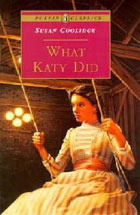
What Katy Did at School, Susan Coolidge

I know I already named the Malory Towers series as my introduction to school stories, but What Katy Did at School preceded it - I just didn't know that the "school story" was a sub-genre of children's fiction.

What Katy Did at School takes place shortly after the close of What Katy Did, when Katy is recovered from her accident. She is now sixteen, and a very serious, grown-up, responsible young person. Too grown up, her father thinks - she is more like a thirty-five-year-old than a teenager. He decides to send her, with her sister Clover, away to boarding school, in order to remind her what it is to be young, (perhaps Coolidge, too, noticed that Katy had been over-improved by the end of the preceding book.)


Certainly it's not possible for Katy to stay altogether solemn and serious at Hillsover school - or "The Nunnery" as its scholars call it - after meeting the girl in the next bedroom. Rosamund Redding - more commonly known as Rose Red - is full of fun and mischief, one the most irrepressible girls of girls' literature. On walking down to the bath-house, she wears her towel, sponge and soap in a manner that defies my imagination: "There, to be sure, was the long towel, hanging down behind like a veil, while the sponge was fastened on one side like a great cockade, and in front appeared a cake of pink soap, neatly pinned into the middle of a black velvet bow." She is inclined to be melodramatic, writing little notes to Katy and Clover after getting into trouble for some escapade or other, that are hilarious in their tragedy: "My heart is broken," after a severe scolding. But it's impossible to put Rose down for long, and she falls out of one scrape into another.


Sad to say, even at school, Katy is so terribly proper. I suppose she has to be, given the genre of moral writing for girls. Still, though I can sympathise with her frustration with the "unladylike" flirtations of her schoolmates, I can't quite see where she's coming from when she scolds Clover for the crime of sitting at the bedroom window and watching the college boys outside. That may be a sign of the times - but it seems insufferably stuffy to me. Fortunately, Rose is at hand, and when Katy declares she has "a great mind to get up a society to put down flirting," Rose hijacks the idea and makes it a lot more fun than it sounds, an excuse for girls to get together and enjoy themselves. There is a flash of the pre-accident Katy, who shows her old Carr ingenuity by introducing a game involving a random word, a question and an answer in rhyme, which is a joy to read and reminds one of the "valentines" in What Katy Did, before the accident. I once tried to introduce that game to my friends when I was little, but without the success and ingenuity of Katy and co. Perhaps now I am older I will have another go...

The other moment of note is the occasion when Katy and Clover receive Christmas boxes, a never-ending tuckbox containing enough sweets and cakes to feed the entire school. How I used to fantasise over those boxes! The item that appealed to me the most was the "jumble," which Clover, Jack Horner-like pulls out "fitting on her finger like a ring." I always had an idea that jumbles were like cinnamon doughnuts, though Jane Brocket's book Cherry Cake and Ginger Beer revealed that they were a cross between a cake and a biscuit and could be made with a number of different flavourings. I, of course, experimented with flavouring them with cinnamon. I don't know if that recreated an accurate jumble, but it certainly recreated that moment as I knew it.

Monday, 18 May 2009

What Katy Did, Susan Coolidge

What Katy Did was probably the first book I read that I would call "girls'" fiction. I was bought the book when I was very small because, of course, the heroine shared my name.

The book is often criticised for being too sugary-sweet and moralising, but that is an inevitable result of the time, place and audience of writing - it is similar in that respect to Little Women. I always preferred the Carr family to the Marches, however, probably because they were younger. The earlier chapters are quite simply about children playing, quarrelling and getting into trouble - and it's so vivid. Katy had such a vivid imagination, and I could just dream I was there, sitting on the roof of the ice-house, or exploring Paradise with a picnic, playing Kikeri or the river game, playing post-offices... to name but a few. There is no doubt in my mind that the first half of the novel is the most fun.

At the beginning of the novel, Katy is twelve years old, full of mischief, thoughtless, careless, untidy - for a C19th century children's novel bound for reform from the very start - but one does so much wish she wasn't. She's not always very nice, which we see in her treatment of Elsie. Elsie is very much the middle child - wants to join in with her big sisters' games, but always pushed aside and told to run along and play with the children. Yet Katy means well, and that redeems her character.

Halfway through the book, we are introduced to Cousin Helen, and this is a character that I think has changed over the last century or so. Before they meet Cousin Helen, who is an invalid, Katy predicts that she will be "something like 'Lucy' in Mrs Sherwood, I suppose*, with blue eyes, and curls, and a long, straight nose. And she'll keep her hands clasped so all the time, and wear 'frilled wrappers', and lie on the sofa perfectly still, and never smile, but just look patient

Ugh! Doesn't she sound simply ghastly? Though that is what Katy is looking forward to. Thank goodness Cousin Helen is not like that - though she's almost as bad. She is just too perfect. Unlike the imaginary Helen, she does smile, and has fun, and is never too busy for the children. She never gets cross, and when she became an invalid, broke off her engagement to the man she loved, so that he wouldn't have to be always looking after her. "[a]nd now, he and his wife live next door to Cousin Helen, and are her dearest friends. Their little girl is names 'Helen'. All their plans are talked over with her, and there is nobody in the world they think so much of." I don't know about you, but I find that most unhealthy. More than anything, I pity Alex's wife - surely she would never be able to live up to Alex's first love who is "half an angel already."
Don't get me wrong, Helen is lovely, but she is too lovely. I notice as an adult that she is quite a two-dimensional character, a person for Katy to aspire to, and to trigger her improvement.

For improvement is what Katy is doomed to from the beginning. On a day of bad temper, Katy disobeys her Aunt Izzie's orders not to play on the new swing in the wood-shed, and it breaks and injures her spine. She is confined to bed for four years, where she learns patience and consideration for others, and later the responsibility of being the Woman of the House, after Aunt Izzie dies. She emerges from her bed at the age of sixteen, unrecogniseable from the impetuous little girl she was before - and from this point onwards the interest in the series switches from her to the next sister down, Clover.

Although Clover was much more of a good girl than Katy to begin with, she keeps her sense of humour, and her character. Alas, Katy does not. That is not to say that I don't like the series from this point on - because I do. But the focus of the story switches onto what Katy did, rather than the character of Katy herself.

*Research turns up the story "The History of Lucy Clare" by Mary Martha Sherwood, a story that makes the "moralising" in What Katy Did look simply anarchical by comparison.

Saturday, 16 May 2009

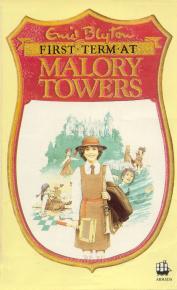
The Malory Towers series, Enid Blyton


When I was a little girl, a relative bought me some Secret Seven books, which got me hooked into Enid Blyton, to my mum's horror. She insisted that Blyton's books weren't actually very good, and that she overused exclamation marks, and recycled the same stories over and over. Fair point. Can't see much to argue with in that. But anyway, when I was a nine-year-old in primary school looking through the book-box for something to read, I was overjoyed to find First Term at Malory Towers, my introduction to the world of the School Story.

I was a little disorientated at first. The only boarding school book I had read before was What Katy Did At School, and I wasn't sure what to make of it. The book opens with my most hated (now) device of standing the character in front of the mirror to tell the reader exactly what she looks like (and it's nearly always a female character.) Still, it gave me a full description of the school uniform, something my later attempts of school-story writing was never without. I was also rather confused by the fact that the main character was called Darrell, though was definitely supposed to be a girl. (If I was living in C21st USA I probably would be used to that gender-swapping name phenomenon, but I was a 1990s English kid.) Still, once that confusion was cleared up, I enjoyed the book, and even bought my own copy so I could finish reading it. Even now, the characters and the events stick firmly enough in my memory to count as "classic."

As I previously mentioned, Blyton's writing is not what one would call literary, but the Malory Towers series counts as one of her best. The characters, though still not always very rounded, are more three-dimensional than her usual goodies and baddies. Most interesting of all is Alicia, the popular girl. As soon as Darrell meets her at the train station she wants to be her friend, but Alicia is not a very nice person. In fact, she's a downright bully at times, having no time for timid or stupid people, and her practical jokes sometimes go too far. That's not an unusual phenomenon if you watch high school movies nowadays - there is always the queen bee and her minions, the popular mean girls - but for Blyton, whose "good" characters have never more than a hot temper as a flaw, that is groundbreaking.

The series is also her most grown-up work. The final book in the series shows the characters at eighteen, looking forward to leaving school and going off to university, or discussing careers, rather than being caught in a time warp and not being allowed to grow past fourteen or fifteen. Of course, there's no suggestion of marriage for any of the characters. Malory Towers is an all-girls' school, and even all the staff appear to be unmarried (though that is partly because of the times - married women of that class didn't work - also there'd be nowhere onsite to put a husband and kids, I expect.) The characters mature and change throughout the series - yet not necessarily leaving school thoroughly reformed. Alicia and her best friend Betty, though the brightest girls in the class, are predicted by the head not to do that well at university because independence will go to their heads - they're the sort of people who would go out all night partying, without realising that natural talent without hard work will only get you so far.

There is even the threat of death in Last Term at Malory Towers. Gwendoline Lacey, the series's villain (though, I am in the school of thought that thinks that she never had a chance to redeem herself - the other girls and even the staff had written her off as a spoilt brat before she'd even got onto the train) spends the final term making herself insufferable, bragging about being sent to an expensive finishing school in Switzerland and how she and her mother had bullied her father into sending her. But at the end of the book, she has to leave school early because her dad is dangerously ill and not expected to survive.
Of course, being Blyton, Mr Lacey does not actually die. His illness is a device to teach a hard lesson to a girl who, though throughout the series appears to change for the better, always reverts back to her own spoilt, catty self. Nothing less than the threat of her father dying without her having the chance to make amends could affect Gwendoline for very long - and when he doesn't die, it gives her the chance to make amends. Though she is doomed to that awful fate (for a Blyton character) - of getting a job. Not a career - a job, probably in the secretarial line. Oh, the horror!

Saturday, 14 March 2009

Cherry Cake and Ginger Beer, Jane Brocket

I certainly didn't think, when I started this blog, I would be writing about a cookery book, but that was before I found Jane Brocket's collection of treasures: Cherry Cake and Ginger Beer. The premise of this book is to recreate the sort of food that was eaten in the golden age of children's literature. I discovered it on the shelf at work, and its very title evoked a Famous Five adventure, with "lashings of ginger beer" (a phrase that is not actually known to appear in any of Enid Blyton's novels, but describes them perfectly.) I looked at this book, and thought, "Surely not? Surely it's just the children's literature obessive in me that makes me think it could be a book about Enid Blyton's love of describing food?" It had a lovely, old-fashioned cover, and looking closely at the illustration I thought it looked suspiciously like Milly-Molly-Mandy. Looking inside, I realised this wasn't just about Enid Blyton, but food in children's literature down the ages. Of course, the first thing I looked for was to see whether there were any recipes from Anne of Green Gables, in particular, for Raspberry Cordial. There it was: "Marilla Cuthbert's Zero-Alcohol Raspberry Cordial." Along the way, I saw recipes also from Swallows and Amazons and, of course, Enid Blyton.

At that point, I realised I was not being paid to stand around reading books all day, so put it back, but my appetite was whetted. I wanted that book so badly! It looked to me as though Ms Brocket had reached into my childhood and made an edible version of it - for the books I mention here were more than just stories I read and forgot. Sometimes, looking back, I have such nostalgia for them that it takes a bit of effort to separate what I did as a child, and what I read about. Out of curiosity, I made a list of the ten most influential childhood books and series, and checked Cherry Cake and Ginger Beer to see how many featured. I expected several. I did not expect them all. But not one of my top ten was excluded. Not one! "This," I thought to myself, "Is a woman who's read all the right books."

Anne of Green Gables, as I may have mentioned before, was the series that was most influential. I found in Anne a "kindred spirit," one who was like me in ways no one in the real world was. She was a dreamer, constantly making believe and telling stories in her mind, if not to others. I have already made the Anne recipes from Cherry Cake... two items of food and drink that involve similar mistakes on the behalf of Anne: the raspberry cordial that Anne meant to give Diana when she came to tea, and the layer cake that was unfortunately flavoured with anodyne liniment. I replaced the liniment with vanilla flavouring, however, not being quite sure what anodyne liniment was when it was at home. Googling the word implies that it is some kind of antiseptic or painkilling medicine - tasty(!) I was very happy with how that turned out. Ms Brocket's recipe was unashamedly going for recreating the childhood fancy of a "layer cake" rather than realism, which was probably nothing grander than a Victoria sandwich. The recipe here was for some kind of strawberries and cream gateau, and allowed one to double the proportions for four layers. Because we had slightly smaller tins than the recipe suggested, I made a three-layer cake, sandwiched together with strawberries and cream. I also used plain flour with baking-powder, rather than self-raising, because in Anne, the heroine at first blames the baking-powder for the disaster, to which Marilla returns, "Baking-powder, fiddlesticks!" I cannot think of the word "Baking-powder" without the word "fiddlesticks" on the end. I have to say, it was the best sponge cake I'd ever made, and it did indeed come out of the oven "as light and feathery as golden foam," thanks to mum's gluten-free flour.

Have also made raspberry cordial, a drink so sweet and indulgent that you (at least, I) wonder that it features - I tend to think of Marilla as keeping a kitchen full of plain, simple, wholesome food, whereas Raspberry Cordial (not to be mistaken for currant wine) is simply delicious! I unfortunately dropped about a quarter of the jug over the kitchen floor, and it looked rather as though I'd committed a murder.

This afternoon, I had a Swallows and Amazons themed baking session. This is the ideal holiday adventure series - not as outlandish as Enid Blyton's Famous Five series, but escapism nonetheless. The series captures a less paranoid time when children would be allowed to go sailing and camping without adult supervision, with a father who reasons that his children are "better drowned than duffers, if not duffers, won't drown." It too is a wonderful world of make-believe, with the town (I visited there when I was younger, but I can't remember what it was called,) renamed Rio, and the Old Man of Coniston (that I do remember) christened Kanchenjunga. The series is well-written because it doesn't talk down to the children, but reports the stories with the same juxtaposition of reality and fantasy as they would use, not having to explain what is "real" and what is make-believe, because we just know. The Swallows and the Amazons (and later the D's) also enjoy lashings of ginger beer, but they call it grog.

I made "Bunloaf," a nice, thick, rich fruit cake, and "Seedcake," which is a funny, old-fashioned recipe, a sponge cake with caraway seeds which I'd never used before but which have a peculiar flavour. Tasty, but a bit dry, so best eaten with plenty of grog to wash it down. Seedcake is a thing I associate with the Secret Seven as well, though I don't know whether it ever made an appearance in the Seven's clubroom. But I have clear memories of play-acting Secret Seven, and even that it was George who brought it as a meeting snack. That was before I was conscious that seed-cake really existed. It just sounded like something the Seven would eat.

The very first recipe I tried out, even before the liniment layer cake, was Debby's Jumbles from What Katy Did at School. They appear in perhaps the most evocative description of luscious food in children's literature; a chapter called "Christmas Boxes." The girls, Katy and Clover, stay at their boarding school over Christmas, but are not forgotten by their family, who send them enough cakes, fruit and sweets to feed them and all their friends. One of these cakes, which I had always wondered about, was the jumble, which was descibed as a round, crumbly cake. I had always thought of them as rather like doughnuts, but they turned out to be half-biscuitty, half-cakey, and could be flavoured with any number of things. This time I made them with lemon zest, but I wonder what they would be like with cinnamon. Hmm... perhaps next time...

In case you were wondering, the ten series to which I was referring were:
Anne of Green Gables,
What Katy Did
Little House on the Prairie (I am yet to make any of these recipes. Am tempted by cornbread but have not yet located cornmeal in Isle of Wight shops.)
Swallows and Amazons
The Chronicles of Narnia (somehow, I never really thought of these in the same category of "food" novels, probably because there was so much else going on. Sardines on toast, though, will always be associated with Mr Tumnus.)
Milly-Molly-Mandy
The Chalet School (When I went to stay with my Aunt in Germany a few years back, I was pleased to discover that kaffee und kuchen really does seem to exist as a meal - so much more honest than English afternoon tea - you skip the bread and butter and go straight onto the cake.)
The Famous Five
The Secret Seven
Malory Towers

These are the books that, one way or another, I seemed to live more than just read, whether it was by writing fill-in fan-fiction in my little blue folder (none of those stories ever got further than a page or two, but the intent was there) or played make-believe (on my own, generally. My school friends, at eight, were far too sophisticated to act out these books when I wanted to, so I had to play all seven members of the Secret Seven. Or I just read them over and over until I knew them backwards, and fictional incidents seem clearer than my own memories. And for me to find a book that has found all of these and extracted the edible parts of them - why, it's almost too good to be true. It's strange to think that anyone else could have written a cookbook that was so completely and entirely targetted at me.

Wednesday, 15 October 2008

The Emily Series, L.M.Montgomery


A family friend once told me that her abiding memory of me was as a little, pigtailed girl wearing a straw hat and with her nose buried deep into the childhood classic Anne of Green Gables. The hat no longer fits, and pigtails are a thing of the past, but the Anne books are perhaps, of all the hundreds of books I have read in my lifetime, the novels which have influenced me the most; the redheaded heroine more of a kindred spirit than is perhaps natural for a character that has "no real existance." It would be only natural for me to open my book blog with a review of Anne of Green Gables, and a discussion of just why it is such an important book to me.

But I'm not going to. It's gone ten at night, too late to be able to do Anne Shirley justice, and too early for the magic to work that brings inspiration to life just at the time when I know I should be getting ready for bed. Instead I will write about one of Lucy Maud Montgomery's other heroines: Emily of New Moon. It is inevitable that there will be comparisons to the Green Gables series, but I hope you will forgive that.


I grew up with Anne Shirley since I was about seven, but had not heard of Emily Byrd Starr until a year or so ago. I stumbled across the first book in the series in a charity shop for the not-too-shabby price of 49p, and took it home.

The first thing that struck me about Emily was a peculiar phenomenon that she called "The Flash."

It always seemed to Emily, ever since she could remember, that she was very, very near to a world of wonderful beauty. Between it and herself hung only a thin curtain; she could never draw the curtain aside -- but sometimes, just for a moment, a wind fluttered it, and then it was as if she caught a glimpse of the enchanting realm beyond - only a glimpse - and heard a note of unearthly music [...] She could never recall it - never summon it - never pretend it; but the wonder of it stayed with her for days.


Reading this description made me shiver, because I realised I knew exactly what Montgomery was trying to say, though I couldn't have expressed it quite so myself. I once wrote:


Sometimes a sight, a word, an image, sends me right out of myself and I know I am in another world - a story. Sometimes it is so vivid it gets mixed up in my memory with reality, at other times I can't quite grasp it, like there is something beautiful just out of sight.


Emily's "Flash" is at the heart of the series, making remarkable a straightforward coming-of-age novel. No, not straight-forward. Anything but that.


Eerier than the Anne novels, Emily of New Moon has traces of the supernatural, all the unexplained, throughout the series. Hinted at with her "Flash," each tale has at least one incidence of the "second sight" which Montgomery never tries to explain away, or to explain. Emily 's is also a darker story than Anne's. Towards the end, in particular, I see traces of Montgomery's darker state of mind, of "white nights" and three o'clocks in the morning. I would find all this tied up in two themes: love and writing. There is the pain of misunderstandings that threaten the relationship between Emily and a childhood sweetheart, the pain of smiling through what seems like unbearable sorrow and forgiving a betrayal unknowingly commited. But there is more, and I would say it is all tied up with a character named Dean Priest.


Now, I don't know whether L.M.Montgomery intended Dean to be quite so creepy as I find him, but in the twenty first century... well! He is in his mid thirties when he meets Emily - she is a little girl of twelve. There is nothing wrong as such in his behaviour at first - but his mind! From the first time he meets her, he is waiting for her to grow up - he is waiting until she is old enough for him to love. And what starts off as mildly disturbing just grows and grows. When Emily is an adult, and the age difference between them is only an issue because of the "age difference" rather than her being a child, he slowly becomes a double of Mrs Kent, the possessive mother of Emily's friend Teddy. Mrs Kent will not allow Teddy to love anything lest it make him love her less. She hates anything he likes and will set out to destroy it, whether it be his artwork, his kittens or friendships. What I find to be the darkest part of the Emily series is when Dean echoes that so completely - in his jealousy, he lies to Emily in a way that destroys the writer within her for a time, and threatens to destroy her very essence.


For writing is the essence of Emily. She is a writer to her very core. When asked to give up her writing by a disapproving, old-fashioned aunt, Emily's reply that it's "[n]ot that I won't - it's just that I can't," strikes a chord with me. I couldn't stop being a writer. Even Emily, when she commits no fiction to paper for two years - a sacrifice I never would be able to make, for anyone or anything! - stories and characters grow, bursting to be written. Writers are advised that they should never write about writing, but Montgomery's ignoring of that rule was a successful putting into words of things that otherwise might remain unexpressed. The series is a story about coming of age as a woman, and as a person, but most of all as a writer. Some people write, other people are writers, and the Emily of New Moon series expresses just what it means to be the latter.

When I read the Emily books the first time, I wasn't sure I liked Emily, simply because she wasn't Anne. As a child I found Anne Shirley to be more even than a friend - it felt as though she was a part of me, a dreamer, an optimist, someone who loves people. Emily is certainly more down-to-earth than Anne, and while Anne's imagination is her defining characteristic, Emily is far more single-minded. It's not that writing is the only thing that matters to her - love, friendship and pride are also top priorities. But without her writing - she cannot be truly herself. In that brief period after Dean told that awful lie to her, she is almost a puppet, fooling nobody but herself that she is happy and fulfilled. Anne could live without writing, I think. She'd not stop imagining, or dreaming, but writing seems more of a fancy for her, rather than a desperate need. She could write, or she could not write. Emily could not not write.
Related Posts Plugin for WordPress, Blogger...