Showing posts with label love triangle. Show all posts

Wednesday, 9 March 2011

Norwegian Wood, Haruki Murakami

Whenever Toru Watanabe hears his favourite Beatles song, “Norwegian Wood,” his mind is taken back to the late 1960s, when he was a student in Tokyo. In particular he relives his relationships with two girls: vulnerable, damaged Naoko, the girlfriend left behind by his best friend Kizuki, who took his own life aged 17, and lively, curious Midori who is Naoko’s opposite in every way.

Norwegian Wood is first and foremost a story about memory. It’s quite difficult to comment on the prose, as being a book in translation, I’m not sure whether to credit the author Murakami, or translator Jay Rubin. Still, the narration is beautiful and poetic. In the descriptions, I felt the effect of a lazy, sultry summer afternoon, as if lying in a meadow and watching the world go by. There is a haunting sense of the sadness of time gone by, lost loves and missed opportunities.

In Watanabe we have a protagonist who is drifting, unsure of what he wants to do with his life. He is an ordinary youth at a time of revolution: he watches his fellow students protest about the “established order,” then slink back to class so as not to fail their course. Watanabe is a student of drama, more out of a vague curiosity than because he has any passion for the subject, a rather world-weary, bored character who describes university as “a period of training in techniques for dealing with boredom.” He is somewhat of a loner, going through to high school making up a third with Kizuki and Naoko. After Kizuki’s death, he and Naoko clung together as if for safety, but when they have spent only one year at university, Naoko takes “leave of absence” and is taken to a sanatorium for mental health.

When compared with Naoko, Watanabe himself, or anyone else, Midori stands out as someone fully alert and alive amongst a cast of sleepy drifters. She is rather a breath of fresh air, a childlike character in her curiosity and frankness. Despite being rather sex-obsessed and starting horribly inappropriate conversations at the worst times, there is a sort of innocence about Midori that is very endearing in a world of “phonies.”

Immediately after I jotted down that thought, a throwaway line from Midori jogged my suspicions as it echoed from another character’s history, and I expected a plot twist that never came to pass – much to my relief, for it would have completely changed my feelings towards one of the most central characters, and not for the better.
Read for the Support Your Local
Library 2011 challenge

Usually, love triangles bore me, and I have little patience with a character torn between two people. If it’s not obvious who you should be with, I reason, then should you be with either? In Norwegian Wood, however, I felt sympathy with Toru Watanabe’s dilemma. Naoko and Midori were so different, yet both were such important parts of his life. His choice seemed so impossible.

Norwegian Wood is the first book I have read by Haruki Murakami, and it is described as being very different from his usual style – a coming-of-age novel and a romance – or several romances. I understand that most of his books have more surreal or supernatural elements to them – but this is something I would be perfectly happy to find out for myself.

4 stars

Norwegian Wood has been made into a film which is released in the UK on Friday.

Thursday, 25 November 2010

The Sky is Everywhere, Jandy Nelson


What kind of girl wants to kiss every boy at a funeral, wants to maul a guy in a tree after making out with her (dead) sister's boyfriend the previous night? Speaking of which, what kind of girl makes out with her sister's boyfriend, at all?
It wasn't the brief book blurb that caused The Sky is Everywhere to leap off the bookshop shelves, onto the counter and beckon to my purse, but the unique style and format of the book itself. About the size of a small paperback, but squarer with a cover that is not-hardback, not-paperback but a kind of stiff, rough-textured card. The text inside is blue - like ink, perhaps, or the sky of the title - and the book held shut by a strip of elastic, like a decent notebook, or a journal. This book promised secrets.

I resisted this book's charms for a while, as I had read other books dealing with the subject of grief, (Hold Still, Twenty Boy Summer,) and I didn't think that I would like the main character, Lennie. What kind of girl does want to kiss boys at her sister's funeral? But in the first sentences I couldn't help warming to Lennie. Her elder sister, Bailey, who Lennie adored, died suddenly at the age of nineteen, leaving Lennie devastated. But in the wake of her sister's death, Lennie has started to come alive and discover who she is without Bailey's shadow to hide in. And it just so happens that at the exact same time, she starts to notice boys.

Despite its sad themes, The Sky is Everywhere is full of humour in Lennie's narration and a quirky cast of characters who are much more vivid than most young adult books. Lennie is the protagonist, seventeen years old and clarinettist in the school band. She seems to be drifting apart from her best friend Sarah, an outgoing, outrageous girl who changes her style every day, and the two girls really long for their friendship to be what it was before Bailey's death changed everything. Lennie lives with her Gram, an extraordinary flower gardener, and her Uncle Big - "arborist, resident pothead and mad scientist," wannabe Casanova - he's been married five times and trying for a tidy half dozen. The narration is full of quirky little observations - music teacher known as Yoda, for example or a fit of hysterical laughter compared with "a crazy relative who shows up at the door with pink hair, a suitcase full of balloons, and no intention of leaving."

Music, flowers and romantic novels, especially Wuthering Heights, are recurring motifs in this novel, and it presents a different picture of California and American high schools to what I'm used to seeing in books and film. Instead of the usual cheerleaders, cliques, locker-lined halls, cafeterias and the occasional biology lab, for Lennie the heart of school is the band, and somehow this felt more like high school as I knew it. We didn't have cheerleaders or lockers in the corridors (too narrow!) and the school canteen was best avoided. We did have music though, a jazz band (and was there an orchestra? Must have been!) a choir and various dramatic productions going on.

As well as the music, Lennie writes poetry, scribbles it down on any surface handy - at one point the narrative describes her attempting to write a poem on the sole of her shoe. She jots down her thoughts, memories of Bailey and remembered conversations, putting her thoughts onto paper (or shoe, or bathroom wall...) to try to straighten them out and make sense of the world. This is something I do myself - I carry a notebook in my handbag at all times, even post-its and a mini Sharpie if I don't have room for anything else - so it made me warm to Lennie further. Unlike me, though, Lennie lets her writing go, hides it all around the town, and between the chapters are included photographs of her poetry and a note where each piece was found.

Lennie's two romantic interests are Toby, Bailey's bereaved boyfriend, who gravitate towards each other to try to fill the Bailey-less hole, and Joe, new boy in the school band, who gets to see Lennie without the spectre of Bailey hanging over her. This was a love triangle that didn't feel forced, didn't seem to be put in to liven up a dull romance, or just because Love Triangles Are The In Thing. Although it was clear that Lennie was in too deep and heading for trouble, you could understand what got her tangled up in the situation she found herself in. An accessibly arty novel, with vibrant characters and rich, poetic language.

Saturday, 6 November 2010

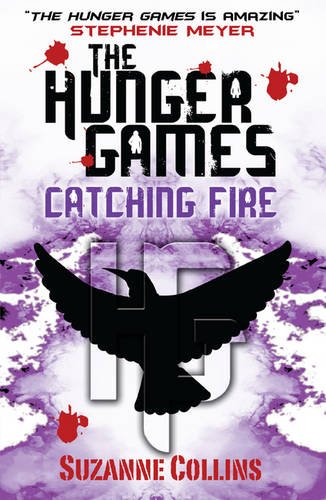
The Hunger Games: Catching Fire, Suzanne Collins.

Okay, okay, I admit it. I'm hooked. I've come to The Hunger Games series late - as usual - but now I've started I can barely stand to take a breather to write down my review of book two, Catching Fire, before picking up Mockingjay.

The Hunger Games are over for another year, and Katniss and Peeta are home. Yet though the Games have finished, the acting has not. After their triumph in the arena, they have become celebrities, and the Capitol is uneasy. Katniss and Peeta's small acts of defiance have inspired the viewers, and revolution is in the air. Katniss and Peeta have made a dangerous enemy, and it is only time before they are thrust into the limelight and the action once more.

In my review of The Hunger Games, I stated that I was disappointed that Katniss did not take more of a stand against the Capitol and the regime that enforces the barbaric scheme. I stand corrected. In such a repressive society, even "token" acts of rebellion are enough. Katniss's defiance of the regime was subtle but insidious and people all over the country of Panem are saying, "enough is enough." The Capitol is worried. Like a chip in a car's windscreen (as I am reminded by the Autoglass ads on the radio) where the Capitol's authority is not absolute, there it is endangered. If people can express discontent with tyranny, sooner or later they will, and another uprising is inevitable.
A spark could be enough to set them ablaze.
In the second chapter of Catching Fire we are introduced to the president of Panem. President Snow, who smells of roses and blood. A fitting name, Snow, for this man makes me feel cold just to read about. In just one chapter, I can see him clearly: cold and ruthless with a thin veneer of charm that just accentuates his cruelty.

Spoilers ahead

In Catching Fire, Katniss and Peeta find themselves once more in the arena for a second round of the Hunger Games, the seventy-fifth anniversary of the last uprising and the Capitol's victory. To commemorate, and also to have a legitimate chance to kill off these troublemakers once and for all, the Capitol decrees that the contestants should be chosen from previous victors - a "best of" show, if you like. I had thought that this would make dull, or at least a little repetitive reading, but I should have known better. Things are different this time. We get to know the rival contestants better as individuals, and it is even more upsetting to remember that they are not meant to survive, that even as Katniss grows fond of her companions, she means for them to die in the end.

 Katniss chooses different tactics this time, and we get to see the Games from a different angle - similar scenes up close where last time they were from a distance, teaming up with some other contestants rather than going it for the most part alone. The challenges they face are markedly different too. Like the Gamemakers, Suzanne Collins knows how to keep the idea fresh. But if I was a little disappointed with the ending of The Hunger Games, Catching Fire makes up for it, fulfilling the criteria I had regretted not being there in the first book, and keeping me glued to the pages. And what an ending! A cliffhanger that ensures I will be picking up Mockingjay as soon as this review is finished (so please excuse any typos.)

A note on the love triangle: before reading this book, I read enough about "Team Gale" and "Team Peeta" to know that Katniss was conflicted about which she loves. I was surprised to discover that Gale doesn't actually appear that much in the story, and although is a good character, I don't yet feel I know him very well. Unlike many love-triangle stories, though, I have genuinely no idea which - if either - Katniss will end up with in the long run.

I can't deny it any more. The Hunger Games does live up to the hype, or very nearly. I don't know why, or how - I can't put my finger on the secret, but it does. It is just very good, gripping and well-written, causing the reader to truly emphasise with the characters and feel hatred against the tyrannical regime. And, unusual in teenage books, especially those with love triangles, none of the characters annoy me.

Related Posts Plugin for WordPress, Blogger...