Showing posts with label young adult. Show all posts

Tuesday, 23 September 2014

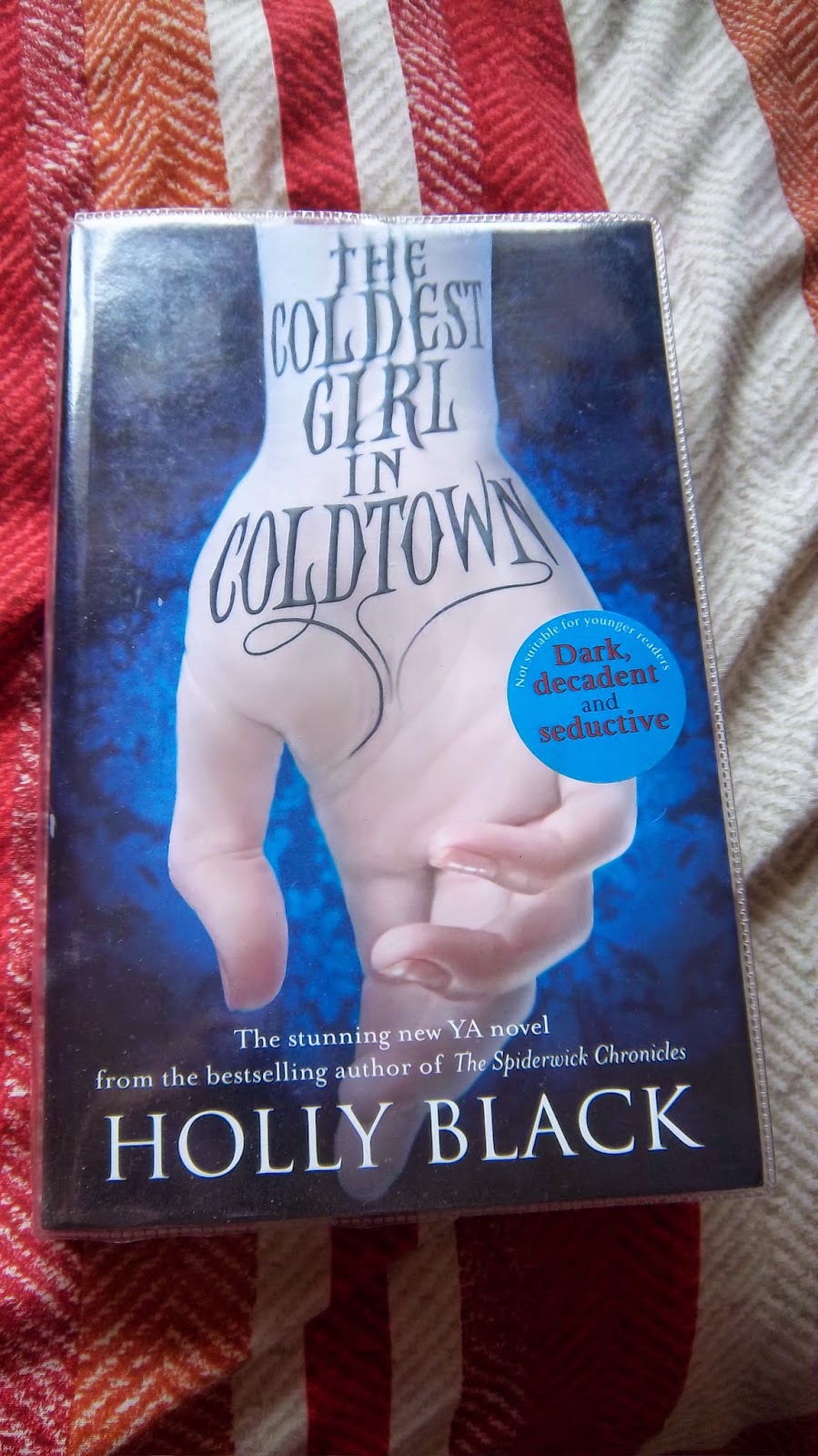
The Coldest Girl In Coldtown - Holly Black (RIP IX book 2)

People liked pretty things. People even liked pretty things that wanted to kill and eat them.
Vampires have always existed, but until recently they took great measures to keep their existence a secret. That all changed a few years ago, when a vampire named Caspar Morales got carried away, creating many more. The epidemic spread out of control, and now the vampires of the USA, and anyone infected by them, are imprisoned in Coldtowns, where they party and feast all night long. These parties form the basis of the most popular reality TV shows, are there is a significant proportion of the population who longs to join them, attracted by the glamour and the danger and the romance of being forever young.

Seventeen-year-old Tana is not one of them. She's seen the other side: when she was very young her mother was attacked by a vampire, and infected. In this world, one does not automatically become a vampire until one drinks human blood, but before you can return to your human life, you have to endure the Cold - up to eighty-eight days of desperate cravings as the infection sets in. Not many people make it through.

When Tana wakes up to find herself one of only three survivors of a vampire attack on the party she'd been at - the other two being Gavriel, an ancient vampire and her infected ex-boyfriend Aidan - she heads down with them to the nearest Coldtown, where she finds herself caught up in a strange world of death-seeking misfits, vampire politics and her own nature. Gavriel is an enigma, an oddly charming but deadly vampire with a Past. Can she trust him? Can she even trust herself?

I was impressed with Holly Black's world-building for The Coldest Girl In Coldtown, bringing a renewed sense of danger and glamour to vampire fiction. There was a classic, pre-Twilight feel to this book, of beauty and horror, and I was not at all surprised to see Anne Rice cited as one of Black's influences in the acknowledgements. The crowds of uninfected humans who made their way to Coldtown, particularly the twins known as Winter and Midnight, repulsed me in their sick fascination for the vampire lifestyle, giving up what it was to be human to be part of the undead fame game - for the gate into Coldtown is, with few exceptions, one way only. Yet they were entirely believable too, liveblogging and videoing every experience, and everyone convinced that they were safe, they were immune, that danger and death were things that happened only to other people. This is vampire fiction for the social media generation.

I read The Coldest Girl In Coldtown as part of Readers Imbibing Peril IX.


Thursday, 28 July 2011

Specials, Scott Westerfeld

Sorry for the sparsity of book reviews at the blog recently. After the thrill of getting really immersed into the Harry Potter world once more, reading one book after another, I've taken my reading a bit slower than usual, as well as reading many books at once - and subsequently taking longer to finish any one.

If you come to Specials after reading the prequel books, Uglies and Pretties, you'll probably have a good idea of the patterns the story takes. It starts off, some time after Tally Youngblood and her friend Shay have had yet more operations to make them "Special:" Employed as government agents and set to crushing the rebellions among the ordinary Pretty folk, Tally and Shay have had their faces redesigned to intimidate the "bubbleheaded" pretties, senses finely-tuned to track and outsmart miscreants, and radio antennae implanted into their skin so they can communicate from afar. Their minds are made coldly logical, and their personalities rewritten once more to incorporate a large dose of arrogance. As far as Tally's concerned, this is the way things are supposed to be, until a reminder from her past sets her questioning her world once more.

Like Pretties, it is frustrating to read Tally's thought processes from the outside - when you know how she is brainwashed and manipulated into working for a crazy totalitatian government. With her new personality traits, I found myself actually disliking Tally this time around - even though I knew this wasn't really her. But the story begs the question: when her mind has been so meddled with, what is her real personality? Is it how she used to be, or what she seems to be now? It was interesting to see the dystopian world from other side; the point of view of those who not only support but enforce it, so that everyone can live in peace and order, and that individuality and personal freedom are a small price to pay for such a world.

Westerfeld also raises the questions of what it is to be human. What started off as a little bit of meddling - cosmetic surgery to make everyone look a certain standard of "pretty" - requires more and more meddling to keep under control. "Pretties" need brain surgery to prevent them thinking too hard about the ethics of the process, and then there need to be Special Circumstance agents to keep control, who need to be rewired in another way. As a Special, Tally finds herself repulsed by her former boyfriend Zane, because although he is "pretty," he is just the same as everyone else. All are equal, but some are more equal than others.

Despite the ethical questions, I found myself skimming through chunks of Specials, losing interest as the story seemed to repeat the same patterns as the first two volumes, saturated with technobabble I couldn't really visualise. It picked up towards the end, when Tally reached the "New Smoke," the city of Diego, where she finds that her very existence is questioned in its legality, and is faced with the dilemma of how to proceed in the upcoming war between Dr Cable's neatly-ordered Pretty city, and the New Smoke. I was surprised by the ending, and impressed that Westerfeld did not go for the easy or obvious ending, but I am in no great hurry to read the companion novel Extras. All in all, I think the Uglies story had potential, but that it was dragged out too long.

Sunday, 17 July 2011

Mini-Reviews: Forever & Amy and Roger's Epic Detour

Forever - Maggie Stiefvater:

In Shiver, Grace fell in love with a boy with golden eyes, who was a wolf in winter. The book ended with his cure. In Linger, the werewolf virus that had lain dormant in Grace for so many years kicked into life, and we were left staring after her as she shifted and ran off into the night.

Now Grace and her friend Olivia are, for all intents and purposes, missing. Sam, Cole and Isabel know the truth, but who else would believe it? And when Olivia turns up dead, Isabel's father Tom Culpeper makes plans for the extermination of the Mercy Falls wolves. Even when Grace is in her human form, she can't go home, so this book is much more pack-based than its predecessors. I had a sense of the loneliness of living a life that no one else can be told about. Grace can't even let her friends and family know she's alive, and it seems like survival must be impossible. If Tom Culpeper and his cronies killed her while she was in wolf form, her disappearance would never be explained. Sam, Grace and Cole are faced with the near impossible task of moving the wolves out of the woods to a safe place.

This volume is more of a werewolf race-against-time than the love story of the previous two volumes, and I kept turning the pages with a desperation for everything to turn out all right, but a dread of the more likely outcome. Forever is a beautiful end to a simple but exceptional story.


Amy and Roger's Epic Detour - Morgan Matson


I bought this book after having seen a lot of reviews on other people's blogs, and, I confess, because it has a pretty cover. After her father's death, Amy Curry is charged with bringing the family car from California to their new home in Connecticut, but she won't drive any more. Enter Roger, an old family friend, and the pair decide to make a proper road trip of the journey, taking the scenic route.

I found the plot of Amy and Roger to be fairly standard for a real-issues teenage novel. I'd read too many books with the main character dealing with bereavement and family upheaval (Fixing Delilah, The Sky Is Everywhere, Tiger Eyes, Hold Still, The Truth About Forever to name but a few) for this to really stand out as a story. It was the travel that made this book different. I loved reading about the different places Amy and Roger visited: Yosemite National Park, America's Loneliest Highway, Graceland, Utah and there was a scrapbook effect with photos, ticket stubs, receipts and iPod playlists, which added to the feeling of being a passenger in the car. Along the way, Amy and Roger meet up with some lovely supporting characters, who open their homes and hearts to strangers. When Amy visited Graceland, a trip she'd always been meaning to take with her Elvis-mad father, I found myself close to tears and realised this story had drawn me deeper in than I'd previously thought.

Saturday, 18 June 2011

My Sister Lives on the Mantlepiece, Annabel Pitcher (audiobook)

sister mantlepieceFive years ago, Jamie’s sister Rose was killed in a terrorist attack in London. He doesn’t really remember Rose, because he was only five at the time, but his family has never recovered. His mum left just a few weeks ago after having an affair with Nigel from the support group. Jamie’s dad drinks all the time and hates all Muslims. Rose’s twin sister Jas – now fifteen – has dyed her hair pink and got her nose pierced, an act seen as a betrayal by their parents, because she doesn’t look like Rose any more. It’s like Jas and Jamie are less visible than the urn on the mantlepiece, less present than the hole where Rose ought to be, the gap around which their whole family revolves.


After Mum’s desertion, Dad, Jas and Jamie move to a small village in the Lake District to start a new life. At his new school, Jamie doesn’t fit in. His teacher always seems to ask the very questions he can’t answer, and is frustrated by his reticence and apparent stupidity. The other kids call him “freak,” with the exception of sparky, mischievous Sunya, who recognises in him a kindred spirit, a fellow super-hero. But Jamie dreads to think how his father would react to his friendship with a Muslim girl, when he blames all Muslims for Rose’s death.

Jamie is a bright, unusual child with a vivid imagination. His narration is full of bright similes and metaphors which fit perfectly:
“I was more nervous than the most nervous person I could think of, which right now is the lion from The Wizard of Oz. My tummy had something bigger and scarier than butterflies inside it. Maybe they were eagles or hawks or something. Or, come to think of it, they could have been those monkeys with wings that kidnap Dorothy and take her to the witch that's scared of water.”
Jamie doesn’t really remember his sister Rose. Every day he sees the effect of her death on his parents, but for him that’s normal. He doesn’t remember when life was any different. For the outside reader, it is clear that something is very, very wrong. I felt intense pity for Jamie’s parents – one could never get over the loss of a child – but they are unreasonable in the way they treat their surviving children, so wrapped up in their own pain that they resent Jas and Jamie for not being Rose, or for not letting their lives revolve around her absence. When Jamie had to write a school essay about a hero, and chose footballer Wayne Rooney, his mother made him rewrite it about Rose, dictating the memories he didn’t have. Then, at a birthday party, when Jamie asked for food, his dad filled a plate – to put on the mantlepiece beside Rose’s urn. Jamie is such an optimistic child, but his hope is painful to an older, wiser reader (or listener listener) because of the awareness of the crushing disappointment that is to come when his wishes don’t come true, or if they do, they aren’t what he had hoped. At times the story just seems to be disappointment after disappointment, and Jamie has to learn the difficult lesson that adults don’t always get it right, don’t have all the answers and do let you down. But they get there, slowly, until Jamie concludes:


If OFSTED inspected my family, then I know what grade we'd get: Satisfactory. OK, but not brilliant, but that's fine by me.
I downloaded the audio version of this book when I was struck by a bad migraine attack. I couldn’t sleep for the whole time but wasn’t up to reading, so I let David Tennant read this to me instead. Although he is a talented voice actor, seemingly able to imitate any accent he tries, in this case his reading is simple and understated, letting the story do the work, narrating with the right amount of innocent hope, eagerness and subdued sadness. I bought the audiobook from Audible.co.uk, but was quite disappointed that it came as one six-hour track, so I couldn’t burn it to CD to wake me up in the morning. In future I think I’ll stick to buying  audio books as CDs.

Friday, 17 June 2011

Rainbow Valley and Rilla of Ingleside, L. M. Montgomery


I've decided to review the concluding two books in the Anne of Green Gables series in a single post, as I've already said a lot about Rilla of Ingleside three years ago. (You can read the original post here. Caution: It's long and full of spoilers.)

Rainbow Valley follows on from Anne of Ingleside, but by this point the Anne books aren't really about Anne Blythe, nee Shirley, any more. Rainbow Valley isn't even a Blythe family book, but instead is centred on a new family, the Merediths. John Meredith is the new Presbyterian minister, a young widower with four children. Although academically brilliant, Mr Meredith is completely at a loss when it comes to bringing up his children, and Jerry, Faith, Una and Carl cause scandal in the community by their wild behaviour.

I found Rainbow Valley to be much more enjoyable than Anne of Ingleside. The Blythe children, who befriend the Merediths, are a little older, and their escapades are less cutesy-poo and more heartfelt. Under the children's silly scapes is their real longing to get their father's attention, and to become respectable members of the community. Although I didn't feel that I got to know the boys very well - I would get Jerry Meredith confused with Jem Blythe, both being the eldest of their respective families, and having similar names - there was real character in the girls: impulsive, big-hearted Faith, and shy, thoughtful Una. We also got to know Walter Blythe better, who is growing to be an extraordinary, unearthly boy with his own battles.

Then there's Mary Vance, a runaway orphan "adopted" by the Merediths. Mary's story has strong parallels with Anne's own childhood, but a very different character - maybe an insight into what Anne could have been like without her imagination? Mary's language and attitude horrifies the minister's children, and even after she is being "brought up properly," she has a sharp tongue and too high an opinion of herself. I don't exactly like Mary Vance, but there is no denying she is a living character.

Perhaps I felt more interested in Rainbow Valley than its predecessor because L. M. Montgomery herself was more interested. Ingleside and Windy Willows, which are less of a joy for me to read, were written at a later date when I understand Montgomery had fallen out of love with Anne, and it shows. In Rainbow Valley there is stronger characterisation, with some newcomers who are more than gossippy old women and match-making subjects, but who take on a valuable role in the story. We meet intelligent, argumentative Norman Douglas, the West sisters imprisoned by their own vows to each other, and of course Mary and the Merediths, all of whom are as knowable as the Avonlea residents of old.


Anne's story concludes in Rilla of Ingleside, when her children are grown up, and so has the story. For the first time the timeless, slightly other-worldly, other-time classic is brutally placed into an exact place in history: World War One. I found it interesting to read about Canada as part of the British empire and the characters' patriotism towards a country most of them had never seen. I felt uncomfortable noticing that Rilla, who was so set against her brothers going to war, addressed a meeting about dying for one's country being glorious, and helping to persuade young lads to join up.

But this book does not allow idealism to overshadow the ugliness of war. We don't get to see the action first-hand - although one of Jem's letters home was reminiscent of some of war poet Wilfred Owen's writing - but Montgomery focuses in on the agony and helplessness of the people on the home front; the families, friends and lovers of the soldiers. Though full of comic and heartwarming scenes, through Rilla, Anne and Rilla's friend Gertrude, we feel the relentless agony of life, love and loss at such an unpredictable time, the fear that must underscore every aspect of life "Till the boys come home." And, of course, many never would return, including one of the Blythes' most beloved friends-and-relations. To Gertrude, Rilla, Una Meredith and me as a reader, it seemed that such loss could not be borne, but of course they survive and carry on. They must. But Rilla of Ingleside made it clear that for all who lived through the fateful years, the world had changed forever in a way that one can never quite get over.

Rilla of Ingleside is a guaranteed tearjerker, a bittersweet ending to the story that started off as such sweet escapism. In some ways I am glad that Anne retreated into the background in the later stories, as it seems so terrible that her story should take such a turn. By this point, this is far more than just a children's story, but a unique piece of World War One literature that deserves a place in the canon.

Sunday, 5 June 2011

Why Stories Are Important

A few times over the last year I've found myself questioning whether, or why, my love of reading is worthwhile. Back at the end of last year, when the British government announced their plans to treble university tuition fees, a newspaper comment on the subject suggested that students wanting to study "worthwhile" subjects such as medicine and teaching, should pay substantially reduced fees, while those who chose to study the arts must pay the whole lot. The sentiments I got from this letter were that studying non-essential subjects were a selfish indulgence and ultimately useless.  Now, my degree is in Creative Writing with English Literature, and so far it hasn't got me very far. I could have been in my current job with a handful of GCSEs, and I've had to move back home - something that I am very ashamed of. While the student protests went on, and the government and general public all had their own opinions on the matter, I found myself in a dark place questioning my own worth. All I was good at was reading or writing stories, and a bit of singing. What was the point of me? I'd always valued reading highly, but why, exactly? What was the point of stories?

Books like Harry Potter and Twilight are often praised, not so much for their literary value but because they've got people reading who wouldn't otherwise have picked up a book. But why is this important? What is it that makes reading a virtue?

The first purpose of stories - and really, I'm including films, TV and the theatre as well as my medium of choice, books - is simply entertainment. A good story will take you away for a little while, and you spend time getting to know characters and care for them, wanting to know "what happened next?" Reading fires the imagination and opens the mind to infinite possibilities and may inspire great ideas of your own. Or it may simply distract you, if perhaps you're not in a great place at the moment. Simply put, a good story makes people happy - and surely that can't be a bad thing.

Secondly, stories enlighten, and teach empathy and compassion. I've found myself reading books from the point of view of a character who reminds me of someone I'd never liked, or sympathised with. Sarah Ockler's titular Delilah was externally a high school delinquent, a trouble-maker and probably someone I would have avoided if she was one of my classmates. But seeing her from the inside out and learning what made her tick, I came to understand her real-life counterparts and realised that maybe we weren't so different after all. Or a a book might show the life of someone from another culture, another country, place or time, a story you might not find in your back garden, but the human experience nonetheless.

Finally, stories make sense of the world, and show readers that they are not alone. I know when I find myself in a situation I don't know how to handle, I find myself thinking of my beloved characters, their good and bad decisions, and that in turn helps me to understand my own emotions and actions. Even bad role models have been known to help here. When I was dumped by the Ex-Vampire, Bella of New Moon was a wonderful model for How Not To Act. I refused to think my life was over just because of a bloke. Maybe I felt like it - but I was not going to let the next six months pass like blank pages. Doctor Who's Donna Noble was living at home and working dead-end jobs when she was considerably older than me, before she was whisked away by a madman in a box to see the universe and finally realise her potential. (For the purpose of this article, let's ignore how that adventure ended!)

And I'm fortunate in that these were the first examples I could think of from my own life. Last autumn's Speak Loudly campaign, and a backlash against a Wall Street Journal article today, have demonstrated that books can offer a way out of despair. Fictional characters can offer hope to readers in comparable situations, and show that they are not alone, not the only person who has been there, done this or felt like that, and that there is a way out.

Thursday, 3 March 2011

The Truth About Forever, Sarah Dessen

Since her father died, Macy has been struggling to hold everything together. On the surface everything looks perfect: perfect grades, perfect boyfriend, perfect life - but underneath she's falling apart. It's the summer before her last year of high school, and everything counts towards going to a good university. Her boyfriend's gone away to "brain camp" and left her his job at the library - but she hates it. Her colleagues sneer at her, and at home her workaholic mother is too busy with her job as some sort of estate agent/party host who shows off the new houses. At one of her mother's functions, she befriends the kind-hearted but chaotic caterers and takes on a second job with them. Her new friends help her to see that life is not to be feared but embraced, while Macy finds herself growing closer to Wes, the boy with a Past.

Grief treats everyone in different ways, and Macy and her mother bury theirs deep inside, pretending that everything is fine. Macy's mother loses herself in her work, while Macy's coping mechanism is her pursuit of "perfection," for only when she's perfect, she reasons, will she have control. But she is not happy. Although she claims to be in love with her boyfriend, Jason, it's clear the lady doth protest too much, and that Jason is not good for her, being more interested in his university applications and that Macy covers his job adequately.

I found The Truth About Forever to be much more a character-led book than plot-driven. Dessen does a great job at bringing Macy's new friends to life: accident-prone, pregnant caterer Delia - UK readers may be amused by her name, being very unlike another Delia in food! - bickering brothers Wes and Bert, lively Kristy and her sister Monica "Monotone" whose vocabulary consists of "Mmm-hmm/Nuh-uh," "Don't even..." and "Better quit."

I wasn't so convinced by the "villains" of the piece, if I may so call them. Jason acted more like he was Macy's middle-aged, humourless boss than her boyfriend, and her mother was a monster. Yes, I know she was grieving and stressed, but the way she treated Macy was disgraceful. One evening she came home to find Macy had invited her friends in to watch TV - whatever next? Offering them coffee? Playing music? - and she acted as if Macy had staggered home drunk at three in the morning and thrown up over the new carpet. If Macy's aim of perfection was unhealthy, her mother's pushing her was far, far worst. Any time Macy spent on her summer holiday not studying or working - and only the library job counted - just wasn't good enough. Only perfect was good enough. She's seventeen years old! Let her live!

But what is the truth about forever? The subject popped up throughout the book, but I wasn't quite sure what message Dessen was trying to get across. Kristy contradicts herself by saying at different times, "Life is long," and "Life is short." In short, nothing lasts forever. A few weeks of summer might feel like forever at the beginning, but it's gone before you know it.

Although I quite enjoyed this book, it took me a few days to get through as it was quite similar to some other books for teenagers, and not a lot ultimately happened. I felt the need to read something a bit more challenging; this was nice but too light and fluffy for my taste at the time of reading.


If you enjoyed this you may like:

Tiger Eyes - Judy Blume

Friday, 18 February 2011

Artichoke Hearts, Sita Brahmachari

Mira Levenson has just turned twelve and her world is becoming a strange and unrecogniseable place. Her Nana Josie, always so artistic, passionate and full of life, is dying; she can't stop thinking about Jidé Jackson, whose confident, joky manner hides a tragic history and a sensitive soul. Mira is changing. Sometimes she catches her mouth saying what she didn't intend to say, speaking out when she's always been so shy, or alternatively keeping secrets to herself. Nothing particularly drastic, she just doesn't feel like sharing everything with everybody.

There are a lot of books for teenagers that deal with the aftermath of the death of a loved one. Artichoke Hearts actually seemed to be targetted at the younger end of the Young Adult range (11+) but is unusual in exploring a terminal illness, and the feelings of helplessness of those who can only watch as a relative approaches death, and Brahmachari writes this with simplicity but a great deal of maturity. Nana Josie is early on established as a vivacious, artistic woman, a former hippy and passionate protester. Early on, there is a moment of dark, uncomfortable humour, as she embarks on her big artistic project: to paint her own coffin. It is heartbreaking to watch such a lively person fade.

The artichoke of the title refer to a charm given to Mira by Nana Josie, a symbol of the human heart, and how with age and experience, a heart which may seem to break grows tough layers to protect it, like the layers of an artichoke. The novel is a sweet, beautiful coming-of-age story, showing a child starting to learn who she is. Mira is a quiet girl, artistic and thoughtful, but through the sadness of seeing her grandmother die, the strangeness of early adolescence and the sweetness of a first romance, she grows in confidence and self-awareness. The characters are all very-well rounded individuals, and I think that Jidé Jackson is one of the loveliest boyfriends I've encountered in a kids' or teen book for a long time - and he's only twelve.

Read for the Support Your Local
Library Challenge 2011
One way that Mira grows in her understanding is in her extracurricular creative writing class, which is led by writer Miss Pat Print, and consists of herself, her best friend Millie, Jidé and his friend Ben Gbemi.  In the classes, Miss Print (an unfortunate name for a writer!) helps the children to understand themselves and their world through writing. The novel is written as being Mira's diary, in the present tense which itself is highlighted early on as helping reader and writer feel the immediacy of the narrative. On occasion, after a short writing exercise, the children start to feel empathy for others in a way that they hadn't before. I found these writing sessions fascinating, and they summed up what is, to me, why literature is so important: Fiction (or poetry, theatre, film, TV) helps to make sense of the world and cultivates understanding of other people.

Artichoke Hearts is a pensive, sometimes sad read, but ultimately it left me feeling uplifted, a celebration of life, youth, a loving family and good friends. I would recommend it for Judy Blume fans and older readers of Jacqueline Wilson, who are maybe looking for something a bit more grown-up. So far, Artichoke Hearts has quietly slipped onto the bookshop shelves with little fanfare, but it deserves to be widely read and talked about.

Wednesday, 9 February 2011

Delirium, Lauren Oliver

Love, who needs it? Sure, it feels good when you're with that special someone, but what about the pain when it ends? What about the fear that you're not good enough and that one day they'll realise it, or the jealousy that eats you up when he's late home for work? The soaring highs and the crashing lows are bad enough, but on top of that, love makes you do stupid things, put the beloved before yourself even at risk to yourself. Make no doubt about it: Love is a disease.

Or so Lena is led to believe, growing up at some unspecified point in the future. Luckily there is a cure against Love, or Amor Deliria Nervosa as it is now called. At eighteen, all US residents undergo surgery to remove all traces of the disease. They are paired up with suitable spouses, married out of college or high school, and have as many babies as the government tell them they can support. It seems to work all right. Even today many people argue that arranged marriages are as good as the kind based on being in love, with both parties having to work at the marriage and love coming as a result of this.

But wait. Did I mention love is a disease, and cured when a person reaches adulthood. Think about that for a moment. It's not just the being in love, but love, full stop. That's the love of parents to children - they bring them up dutifully and make sure they lack nothing they need, but there's no love. And without love, what is left? You're not even left with a love of things: hobbies, colour, beauty, music. There is no joy. There is no hatred or anger either; without love there is no emotion. But can you call yourself human? You might as well be one of the Cybermen of Doctor Who.

This is the world to which we are transported in Lauren Oliver's long-awaited dystopia, and what a bleak world it is. I've read a few dystopian teen novels recently, but they - Uglies and The Hunger Games are set in a very changed world. Uglies' is very polished and futuristic, while The Hunger Games has progressed technologically, and regressed in other ways, until it could be a high fantasy novel. But Delirium takes place in Portland, Maine, with real landmarks you can look up on Google Maps Street View. Although time has obviously passed, it feels as though this isn't so far away.

Delirium is the first part of a series - I think a trilogy - and all the way through myself wondering just how the story can end happily. Protagonist Lena is an ordinary teenager who falls in love just before she is due to undergo "the proceedure." After having unquestioningly accepted her fate, and the dangers of love, once she has experienced it for herself she finds herself wondering, desperate to defy the authorities and live happily ever after, and never mind the disease. But there is more at stake: it won't be enough for her to resist or survive the proceedure. The entire worldview of a nation has to change, and Lena is so very insignificant. I can't see how she and other resistors will realistically manage to persuade the whole country that all they've been brought up to believe in is wrong.

I found some of the culture in Delirium to be bizarre and contradictory. Love has been declared a disease, fair enough, but everything seems to revolve around keeping people uninfected. It's fair enough to succumb to the disease - that can be cured - but "sympathisers" are treated more like criminals, and punishment is harsh. It may appear to be a government concerned for its citizens, but it seems to me that there is an ulterior motive for keeping the people loveless. Even if it's the same old story: keeping people in their place and stopping them from thinking for themselves, I suspect more will be revealed in the sequels. And if this is a totalitarian regime, it doesn't have to make sense. You only have to look at somewhere like North Korea to see that.

After reading Oliver's Before I Fall, which was one of my big discoveries of last year, I've been eagerly awaiting Delirium, along with most other bloggers who read teen fiction. For me, though, "unputdownable" wasn't the word. (As far as I'm concerned "unputdownable" isn't a word!) Before I Fall was so fresh and original, I really did take it with me all around the house and got through it in a day. This time around I was able to read two other books at the same time as Delirium and it took me several days to finish. I thought the concept was fascinating, and that Oliver explored it well, with some beautiful writing, great characters and moments that came to life off the page. The plot itself, however, felt very familiar and I realised that the pattern of events, if not the details, mirrored the story outline of Uglies, at least in the first half. The second half is where the story really started to grab me and take on its own shape until its shock ending. Although other bloggers gave away no spoilers, I guessed from their reactions what might happen. That ending, however, ensures that the story from here on, and possibly even the story up to this point, isn't what you'd expect it to be, but something new and unexpected.


If you enjoyed this, you might like:

Uglies - Scott Westerfeld
The Hunger Games - Suzanne Collins
Never Let Me Go - Kazuo Ishiguro
Matched - Ally Condie

Friday, 28 January 2011

Follow Me Down, Julie Hearn

When Tom's mother is recovering from breast cancer, she takes him to London to visit his grandmother. While upstairs, Tom is aware of the tension as his mum and gran try to repair a long-damaged relationship, he finds himself called downstairs by the voices only he can hear. In the basement is a gap, which takes him back in time, when the house was home to the "freaks" and "monsters" of the Bartholomew Fair: Astra, the tiny "Changeling Child," Angel, the "Gorilla Woman," Malachi Twist the "Bendy Man" and others.

Follow Me Down is a very evocative novel, well-written and poetic, but in such a way that brings to life the murkiness of 18th century London. From the very beginning, when Tom's mother is driving around, looking for the old house, there is a sense of something not being right, in the description of the stink of Smithfield Meat Market on a hot day, while Tom's mother who "could recognise anything from gas to a bunch of flowers through several closed doors," can't smell anything. The Black Raven, the pub next door to Tom's gran is adorned with an "evil-looking bird" on its sign which appears to swing without any wind. When Tom gets taken through "the gap" back in time, we find ourselves in a dark underworld, seen through the eyes of the outsiders in the freak shows, with menacing villains in the "freaks'" masters and the grave robbers who would go to any lengths to procure bodies for experimentation. This is the nasty side of historical London. But the menace is not restricted to the past. In the present day, Tom's gran's house is haunted by the spectres of what isn't spoken. There is Tom's mum's illness, his gran's implied alcoholism and the mystery of his dead grandfather looming over like a shadowy figure that can't be seen, but neither can he be ignored.

Read as part of the Support Your
Local Library challenge
One theme I found interesting was that of memory. First of all we see Tom remembering how, as a toddler, he was fascinated by the railings outside his gran's house, "tall and sharp as spears. He had wanted one to play knights of old with; hadn't understood that you couldn't just pull one up and put it back after slaying a few imaginary dragons." But when he arrives, the railings don't fit his memory, being somewhat dulled and tarnished either by the passing years or by his growing up. When he gets into the basement and sees the gap, Tom suddenly remembers it from before, when he was just two years old. You'd think that a magical experience such as being pulled into the past would not be forgotten, but when you're two, perhaps you haven't yet worked out what the rules of the world are, and what is an unusual experience, what's just matter-of-fact. It means that when Tom is pulled into the seventeenth century, no time is wasted in telling us about him working out what's going on, but instead we are plunged straight into the story.


If you enjoyed this book, you may like

Kids'/YA
Tom's Midnight Garden, Philippa Pearce
Celandine, Steve Augarde

Adult
Neverwhere, Neil Gaiman
The Company of Liars, Karen Maitland

Follow Me Down is published in the USA as The Sign of the Raven.

Wednesday, 5 January 2011

Torment, Lauren Kate

Daniel has whisked Luce away from her old reform school, Sword and Cross, and hidden her at Shoreline, a new boarding school in California which couldn’t be more unlike the last. Where Sword and Cross was bleak, grey and miserable, Shoreline is more like a summer holiday resort, fresh and modern and sunny. There are special classes for those students descended from angels – a sort of celestial Hogwarts! – while to the unknowing it is simply a very exclusive private school. I found the strong point of Fallen to be the school-story scene setting, the friendships and the gothic atmosphere. Although less memorable than Sword and Cross, I enjoyed reading more of the set-up and meeting new characters, especially Luce’s roommate, the irritable Shelby. On the other hand, Luce’s other new girl friends, Dawn and Jasmine, who swoon over her as though she were a celebrity, almost gave me a headache with their shrill hysteria, and this was from reading about them on the page!

After reading Hush, Hush and Crescendo, which I found to be somewhat insipid, I’m glad to see that Lauren Kate’s mythology has something behind it to identify it as being about angels and demons (rather than Interchangeable Magic Boyfriend Creature whose defining feature is that "wings are a neat idea.") Although it isn’t consistent with my understanding which is that there are either angels which are good, demons which are the same as fallen angels, no middle ground, this is Lauren Kate’s story, not mine, and she’s clearly put a lot of work into establishing a fantastical world. All the same, there seem to be a few inconsistencies or things that just feel like cheating. For one thing, there is the whole “You and I aren’t so different after all,” message between angel and demon which goes against their being the forces of good and evil – a conflict which indicates that Lauren Kate has drawn inspiration from Milton’s Paradise Lost. "Or at least the CliffsNotes."

We see a return of the shadows which have plagued Luce since her childhood, which have been revealed to be messengers for dark forces, called Announcers. Now, it seems that if you can hold onto them and stretch them about, they become magic TV screen/crystal balls which show you scenes from the past, which also double as a kind of spatio-temporal hyperlink.* I was reminded of my own juvenile attempts at writing fantasy where I made the rules up as I went along.

In Fallen, I found myself irritated by Luce’s insistence of her twoo wuv for Daniel which seemed to be without any foundation except the discovery that she is his reincarnated soul mate, and that they always end up together (before she dies.) I put enough distance between me and Fallen to forget the details of why their “inexplicable connection” and subsequent “relationship” annoyed me, and this time around was able to take Luce’s word for it. They’re in love, they’re soul mates, yeah, whatever, if you say so. I still wasn’t convinced, but this time around at least Kate didn’t constantly rub my face in it.

Torment is that obligatory Volume Two of many Magic Boyfriend Creature romances where the couple are parted – for the girl’s own good, of course – and the boy acts mysterious and won’t tell the girl anything. It happened in the Twilight books and Crescendo, and here it happens again. I was glad to see that Luce didn’t waste too much time moping, however, but was proactive, questioning what she’s been told by Daniel about their past together, and trying to find out the truth for herself instead of blindly accepting everything he has to say.  Also, by this time some of the initial dizziness of first romance - at least, Luce’s first romance where the boyfriend didn’t spontaneously combust on their first kiss! – has worn off, we find Luce identifying some of the traits of the modern YA Interchangeable Magic Boyfriend Creature (IMBC) Romance genre which are so worrying as a relationship model for teenagers: that the IMBC boyfriend has to know and control his girlfriend’s every move, but keeps his own a secret. Luce even finds herself wishing that Daniel is more like her new crush Miles (Yes, here goes another love triangle! Make up your mind, girl!)
“This was exactly the kind of goofy, teasing rapport she would love to have with Daniel. If only he weren’t so brooding all the time. If he were actually around.”
If, in short, he wasn’t Daniel at all. For a moment, I wondered if this would be the IMBC romance where the girl might realise that she’s in love with the idea of the IMBC more than the guy himself, and make her choice based on reasons other than fate/inexplicable connection/magic/he wants my blood [delete as appropriate.] Just for a moment.

Another three-star rating, but with less polar extremes than Fallen: it isn’t as good as the best of the former, but it’s not as bad as the worst. A lot better than I had expected.


*Didn’t want to say “magic door.”

Tuesday, 28 December 2010

Liar, Justine Larbalestier

Hi everyone! Sorry about the lack of updates in the last week or so. Life has been so busy in the run-up to Christmas that I haven't even had much time for reading. There have been carol services, Christmas parties, musical rehearsals and a heap of overtime at work that have kept me from my beloved books. But I aten't dead* - although for the second Christmas in a row I've had my worst cold of the year - and hopefully there will be regular updates again from now on. I've also merged this blog with my film and TV review site, because I didn't update that one often enough to justify having a separate blog.

I preordered the paperback of Liar on Amazon a couple of months ago, and it turned up at home on Christmas Eve, by which time I'd all but forgotten about it, so it really was a surprise Christmas present from myself to me.

Micah is a compulsive liar, always has been. When she started high school she passed for a boy for a little while, with a boy's name, short hair and underdeveloped figure. Lies lead to more lies until no one knows what to believe about her. But when her sort-of boyfriend dies suddenly, it is time for her to tell her story. The truth. Or at least her truth.

The clue is there in the title: Liar. Micah vows again and again to tell the truth in her story, and then contradicts herself: okay, that was a lie but everything I say from here on is true. Well... except that bit. Oh, and that.
I wanted to see if you would buy it. And you did.
You buy everything, don't you?
You make it too easy.
You find yourself wondering what, if anything, you have been told is the "truth" - and what, after all is the true version of a work of fiction? The narrator's account, even if she is a pathological liar? After all, Micah is the only narrator we have. Are we supposed to read between the lines to understand what the author wants us to believe really happened? Many works of literature give you clues towards an alternative interpretation, but Larbalestier doesn't give us anything to go by except Micah's words, and as we have established, these can't be trusted. Instead, the reader has to draw their own conclusions, so that the book has as many meanings as it has readers.

It seems straight-forward enough at first, a contemporary crime story set among New York high school students. Halfway through, there is a sudden shift in genre which led me to think, "this is ridiculous! Surely we're not meant to believe that in this story?" It seems clear, at first, when Micah is telling the truth and when she is lying, then everything is shaken up and you're not sure what's what any more. Micah argues that she lies because we wouldn't believe the truth, and "maybe I lie because the world is better the way I tell it." We're left with a choice. We can accept her final version of her story, discard the parts she's confessed to be untrue and accept her story at face value. Or we can wonder, speculate and come to our own conclusions. I think I know my version of events, but to say more would be straying into spoiler territory.

A very intelligent read that will end up asking more questions than it answers.

*Terry Pratchett

Friday, 17 December 2010

Wintergirls, Laurie Halse Anderson

At the beginning of Banned Books week in September, the Speak Loudly internet campaign reminded me that among the rubbish, there is a lot of important and good-quality young adult fiction about, and I returned to Speak, one of my favourite books when I was about sixteen. Anderson's mixture of humour and tragedy, poetry and really serious issues that made you think, and I was excited to read another of Laurie Halse Anderson's novels.

I found Wintergirls to be a much more disturbing and difficult read than Speak, full of poetic and creative imagery, but lacking the latter's humour. Its central character is Lia, an eighteen-year-old girl who is trapped in a dark, cold world of anorexia and self-harm. Cassie, the girl who was her best friend since third grade, has just died, killed by her own eating disorder, and added to Lia's troubles is the knowledge that Cassie had tried to call her that night, not once but thirty-three times.

Unlike Speak, whose sad, lonely protagonist was one I could recognise all too well in myself, I found it difficult to identify with Lia, and found myself baffled and frustrated to read her thoughts and know all too well where she's all wrong. A few years ago, I was with a friend of a friend who was stick-thin and counting calories on the back of a pot of pasta salad. I could see she had a problem, but I felt helpless, knowing that I couldn't get through to her telling her that someone of her age and size shouldn't even know what a calorie was. Reading Wintergirls provoked the same reaction, and I felt quite baffled and adrift in Lia's thoughts. It was clear from early on that her goal of losing more weight wasn't about looking slim to be pretty, but a target to aim for, and keep aiming for. When she achieves her goal of losing five pounds, she sets herself five more to lose.
"The number doesn't matter. If I got down to 070.00, I'd want 065.00. If I weighed 010.0, I wouldn't be happy until I got down to 005.00. The only number that would ever be enough would be 0. Zero pounds, zero life, size zero, double-zero, zero point. Zero in tennis is love. I finally get it."
Now, I'd always been told that "eating disorders are mental illness," and "it's not about losing weight, but control," but I'd never really been able to understand this. Books I'd read as a teen exploring the issue, tended to be rather two-dimensional: girl (because they're always girls in the books) thinks she's fat, girl goes on a diet, girl keeps pushing to lose a little more weight, family starts to worry, girl thinks they shouldn't worry, girl admits she has a problem, girl gets treatment.

Wintergirls has many more dimensions. As an outsider I found Lia difficult to fully sympathise with: she knows she's got a problem, why doesn't she want to be helped? At the same time, as an insider - reading her thoughts in first person - I found her hard to understand. Then I realised, Lia was trapped, didn't understand her own thoughts. Anderson uses a great deal of poetic imagery, which could be very effective but I couldn't always understand what she was trying to say. Again, perhaps this was a deliberate decision - to portray a messed-up mind, where madness and reality mix and mingle to create a new reality. Wintergirls evoked in me pity more than empathy, and I think I will need to read it more than once to pick up on what I missed the first time around.

Saturday, 11 December 2010

Fixing Delilah, Sarah Ockler

Fixing Delilah isn't even available to buy in the UK yet, but thanks to the wonders of the internet I was able to order a US copy of the book. I commented in my review of Ockler's first novel, Twenty Boy Summer, that the US paperback has a different texture to it than a UK one. Fixing Delilah is a hardback book, but I still found enough little differences that interested me: the copyright page has more information in it. Under the heading of Library of Congress Cataloguing-in-Publication Data a twitter-sized synopsis and hashtag or blog-label-style details of the book's contents, such as Secrets, Family problems and Vermont.

Delilah Hannaford is a troubled teenager who doesn't seem to know who she is any more. We get to see her inner turmoil first:
"Despite all evidence to the contrary, I'm really not the car-denting kind of girl. I'm also not the lipstick-stealing, school-skipping, off-in-the-woods-with-someone-I-barely-know kind of girl, or the kind who loses all of her dignity over a scandalous cell phone picture on a trashy blog."
Like Twenty Boy Summer, this is a holiday book, and we don't get to see Delilah at school. We get an idea of what her school life is, though, and I have an impression of a character I probably wouldn't sympathise with if I didn't get to know her from the inside out, so to speak. If portrayed through the eyes of someone else, or possibly even with a third-person narrator, I would probably see her as one of the popular kids, maybe a bit shallow, messed up, one of the cool kids who I'd probably have nothing to do with if I were in their class. But because Ockler presents Delilah as narrator, I found her, if not always likeable, identifiable. Because I know well enough what it is like to appear like one person and feel like another, to find myself doing things I really don't want to. And reading Fixing Delilah, I found myself thinking, "maybe we're not so different after all," the "cool" kids and the outsiders, the "good" girls and the "bad."

Not only does Delilah feel lost, but her relationship with her mother is a mess. Claire Hannaford sees that Delilah is "seeking attention" but won't give her any, doesn't try to understand why her daughter's gone off the rails; she is far too caught up being an efficient businesswoman, successful but stressed, to think of family. Alternatively, perhaps it is too painful - if Delilah's relationship with her mother is strained, it is nothing compared with the extended family. Eight years ago, Claire, her sister Rachel, and her mother Elizabeth had such an argument that they have never spoken since, and now Elizabeth, Delilah's grandmother is dead. Delilah, Claire and Rachel return to Red Falls, Vermont, to sort through Elizabeth's belongings and make her house ready to put on the market. While there, Delilah starts trying to find out the secrets in the family's past, secrets that appear to be focused on Claire and Rachel's youngest sister, Stephanie, who died before Delilah was born.

Family is the main theme of Fixing Delilah. There are many parallels with Delilah and her dead aunt Stephanie. They look alike, Delilah was Stephanie's middle name, Delilah was conceived not long after Stephanie was buried. Though as far as I noticed there was no hint of a throwaway remark on the subject of reincarnation, the idea flitted across my mind. More realistically, there was the threat of history repeating itself. Delilah worries that perhaps the problems with the family are inescapable, that perhaps her relationship with her mom is doomed to go the same way as Claire's with her mother. But ultimately, this is a story about reconciliation, and taking responsibility for one's own future and relationships. I didn't like all of the characters all the time, especially Delilah's mom, or the memory of her Nana, but ultimately we are presented with a story about realistic, flawed characters who, like Delilah (and like myself) aren't always the person they seem to be, despite all the evidence.

Sarah Ockler excels in setting the scene, in writing simple description that captures a scene, a sound or a moment perfectly. In Twenty Boy Summer, it is the sound of the sea: Shhh, ahhh. Shhh, ahhh. Here we have the cool, robotic voice of the Sat-Nav system: Left turn in four. Hundred. Feet. Like Twenty Boy Summer this is a holiday story, but instead of the California beaches we are treated to a trip to Red Falls, Vermont. Now, Vermont is a state I know nothing about. I imagine it cold and sweet, probably because it  is the home of Ben and Jerry's ice cream. Red Falls is certainly sweet, flavoured with maple syrup candy from the trees that no doubt give the town its name. Cold - not so much. It is a summer story, after all. Reading it in a chilly English December, it took a bit of brain-adjustment to get my head around Delilah's romantic interest Patrick working on the house shirtless, or taking her kayaking and swimming on the lake. That aside, I had a vivid image of a small, rather quaint lake town that is increasingly becoming a tourist-trap in summer. I'd quite happily visit it, minus, of course, the Hannaford family troubles.


If you liked this book, you might enjoy:

Twenty Boy Summer - Sarah Ockler
The Sky is Everywhere - Jandy Nelson
Hold Still - Nina LaCour
The Book of Tomorrow - Cecelia Ahern

Thursday, 2 December 2010

Adults, why do you read YA?


Katie as a skinny, scruffy teenager, aged about 14

After reading a blog post by Anna, I found myself wondering about my own reasons for reading young adult fiction, and came to the conclusion that there wasn't just one reason. Until fairly recently, it was a genre I hadn't read a lot of since I was a teenager, although I had never entertained the notion of being too old for children's books. I suppose I considered Young Adult to be a rather exclusive genre, for teens, about teens, and generally a bit rubbish. There were some series - Harry Potter, which started as kids' fiction and ended up quite adult - and Twilight, which were being read by everybody, but in general I considered teen fiction angst or fluff. Or angsty fluff.

Then came the start of the new school year, Banned Books Week and the Speak Loudly campaign, and I was reminded that some YA fiction books were pretty good, and others were very good indeed. Although I'd been quietly keeping the Book Blog for about two years, with maybe six followers, that was when I really became aware of the book blogging community. I decided to do a YA mini-challenge in October, but as I followed more blogs, the list of recommendations grew longer and longer, until it wouldn't fit in one month, or two. And so many bloggers are adults who read YA. Why is that?

My Answers
  1. Now that I'm out of that stage of life, and distanced from it, the teenage years make a good story. The drama, the relationships - friends and romantic - the mistakes made, lessons learned, character development - it's better than any soap opera. Even Corrie with its tram crash coming up (!) Which brings me to...
  2. I mentioned character development, and that is a crucial part of any story for me. The teenage years are when you really start to become your own person, and that is reflected in a good-quality teenage novel, that is not just for teenagers.
  3. Katie age about 18,
    less scruffy, but still skinny
    I am 25, and starting to feel like I really ought to be an adult by now. Unfortunately, the last few year haven't let me feel that way. After leaving uni with a top degree, when all my hopes were high, I found the country in recession and had to move home, where I found a job that would better suit a student. I don't feel twenty five, I feel seventeen, and many of the issues YA characters face don't seem so far from my own.
  4. Somehow it seems there are more possibilities in children's and teen fiction than in adult. Fantasy and reality can be mixed and matched, and not constrained by the rules to which mainstream adult fiction seems limited.
  5. Also, more frivolously, there are so many beautiful YA book covers. The now overused Twilight was the first, but now YA publishers seem to be moving away from the bandwagon-hopping black and red trend that had been creeping over the shelves, there are some gorgeous books that just scream out to be read.
  6. Another, even more frivolous reason is that they take less time to read than an average adult novel and with my greed to inhale as many stories as possible (and blog frequently) that is a minor bonus.
Related Posts Plugin for WordPress, Blogger...