Showing posts with label school story. Show all posts

Sunday, 29 March 2015

Murder Most Unladylike & Arsenic For Tea - Robin Stevens

There's been a rather shocking murder at Deapdean School for Girls. Unfortunately, there is no proof; between Hazel Wong stumbling upon a dead science mistress in the gymnasium and going for help, the body has vanished, leaving no evidence that Miss Bell has done anything other than resigned her post and moved away. But Hazel knows what she saw. It is up to her and her friend Daisy Wells, the founding members of the third-form Wells and Wong Detective Society to uncover the truth!

Set in a 1930s girls' boarding school, Murder Most Unladylike is reminiscent of the school stories that made up a lot of children's literature of the 20th century - Malory Towers, the Chalet School, Angela Brazil - mixed up together with the Famous Five or Nancy Drew. Robin Stevens recreates the golden age of children's books wonderfully, with dormitory pranks and midnight feasts, gym tunics and bun breaks, with a mystery to be solved without getting the police involved. But within this old-timey children's story are subjects that wouldn't have been written about in 1934, not for children - the racism Hazel, who is from Hong Kong, faces, two of the schoolmistresses having been in a relationship, and an illegitimate child showing up from someone else's past. Plus murder, of course - I don't think anyone ever actually died in Enid Blyton's writing. A dog might have got ill from eating poisoned food once or twice, but that's about the extent of it.

Daisy and Hazel join a long line of classic detective duos: Like Sherlock Holmes, Daisy is the intrepid detective whose excitement for a case sometimes overlooks human compassion. Hazel is more cautious, and the chronicler of their adventures - Daisy even calls her "Watson" from time to time. The story is a lot of fun, if verging on the ridiculous sometimes as this small private school has an unusually high body count!

The sequel, Arsenic for Tea, takes place away from Deepdean. You can't have too many murder mysteries at one school; it would be closed down! Hazel goes to stay with Daisy at her huge, if slightly faded, English country house. Daisy's birthday falls during this holiday, and her mother throws a big tea party, but as well as the family and school friends, the house has some mysterious and sinister guests. The atmosphere is terrible, filled with unspoken secrets and deceit. And then, one of the guests falls horribly ill and dies. The evidence points to poison. But who might bear such ill-will towards this guest? Perhaps it would be easier to ask who doesn't. Wells and Wong launch another investigation, but Daisy finds it is not so easy to get swept up in the spirit of adventure when her own family members are implicated in murder.

Arsenic for Tea is another instant classic of children's literature, perhaps even better than Murder Most Unladylike. It is Agatha Christie for children: a well-plotted, twisty mystery with plenty of red herrings, a limited cast of suspects, but everyone keeping secrets, even if none of them are the secrets they are suspected of hiding. But Stevens plays fair, and hides the clues within the text, if you only know what you're looking for. I actually picked my suspect quite early on and stored up the evidence against them even while they were seemingly eliminated from the list. I felt very proud of myself when I was proven right - not because the author was sloppy but because I was paying attention. An excellent, very satisfying pair of mysteries, and I hope to see a lot more of Daisy Wells and Hazel Wong.

Thursday, 9 January 2014

Bout of Books: Days 3-5


Wednesday:

After a long weekend, I was back at work trying to smother a rotten headache with painkillers. The headache had been bad enough to keep waking me up in the night - and of course, sleepless night made it worse in a downward spiral effect. The school holidays are now over, meaning that the shop has gone very quiet indeed all of a sudden. This doesn't mean I've been sitting on my backside all day, though. Most of the day was spent in removing the seasonal promotions, setting up the new displays, and rearranging the shop in a way that makes some sort of sense.

I finished NOS4R2 on Tuesday evening, which left me with a book-hangover. I needed some time to put that story world to rest, and so I continued with a safe reread: Harry Potter and the Order of the Phoenix. In the book's early chapters, I picked up on one of the series' unanswered questions.
Dementors caused a person to relive the worst moments of their life. What would spoiled, pampered, bullying Dudley have been forced to hear?
I wonder if J.K. Rowling has ever answered that question, or if anyone has thought to write fanfiction on the subject. It reminded me that even supporting characters have their own secret lives, that even though we only see the Dursley family in the summer holidays, when Harry lives with them, they exist throughout the year, and don't define themselves as supporting roles in the Potter boy's story. The very idea!

I decided Wednesday should be a computer-free day, as I came home very tired, wanted an early night, but still planned to get some reading and writing done without the distractions of the internet. I found it quite liberating to write by hand for a change; there are no word-count widgets, and again, fewer procrastination opportunities this way. I'd like to get back into the habit of writing at least bits of first drafts on paper.

Books read today: Harry Potter and the Order of the Phoenix
Pages read today: 70
Running total: 342
Books finished: 1: NOS4R2
My life outside books: 4 and a bit notebook pages filled. Fountain pen loves me.

Thursday

Despite setting myself a rule of not adding more books to my to-read pile than I read, I have already acquired two books this year, while only finishing one. Judith lent me Commander Chris Hadfield's book: An Astronaut's Guide to Life (which, in fact, was my Christmas present to her in the first place.) My second book might not count, as it's one I've already read, but I will be strict with myself and include it in the total: it is a second copy of Enid Blyton's Second Form at Malory Towers, found in the Oxfam bookshop. I collected these books when I was growing up, but they changed the cover design partway through, and this one and the last book featured more modern and less faithful illustrations. This was the first time in maybe 16 years, maybe more, that I have tracked down one of the remaining books with the "right" cover, so I couldn't help myself. (Now, if I can find the last book in the same style...)


At lunch time, I made a start on reading Paul Magrs' Something Borrowed, the second book in his series about a couple of old ladies with unusual pasts who solve mysteries of the gothic and supernatural kind. I read the first book about Brenda and her friend Effie when I was on holiday. Like the first, Something Borrowed is an easy read, darkly funny and a literary nerd's dream. I expect to have finished that by the end of tomorrow.


Books read today: Something Borrowed
Pages read today: 63
Running total: 405
Books finished: 1: NOS4R2
My life outside books: Yes, I bought a kids' book I already own, because I liked the cover better. So sue me.

Friday:

I'd made a long list of things I wanted to get done today, but the headache that began Tuesday evening has stuck around and keeps threatening to turn into an all-out migraine. Instead I spent the morning and early afternoon finishing off Something Borrowed. While not as brilliant as its prequel, it was a fun, entertaining read. One character, who did not feature in the book itself, but was there in flashbacks, I rather suspected was loosely based on J. R. R. Tolkien. Named Professor Reginald Tyler, a don at Cambridge university (rather than Oxford), he was a key member of a literary society called the Smudgelings (see Inklings) and spent his entire life working on an elaborate mythology (although this was more Lovecraftian in style.) It made me smile, although I rather doubt that Tolkien had the same sort of dark and horrifying secret life that Tyler led.

Over Christmas I sorted out a load of books, DVDs and clothes that I no longer wanted, and this afternoon I took some of these down to the charity shops: Oxfam bookshop, the Red Cross and the Earl Mountbatten Hospice shop. I've still got another bag to go, but I can only carry so much at a time.

Books read today: Something Borrowed
Pages read today: 261
Running total: 666 pages (haha!)
Books finished: 2: NOS4R2, Something Borrowed.
My life outside books: Quiet day off. Back at work tomorrow.

Thursday, 23 June 2011

Harry Potter and the Prisoner of Azkaban

Contains some spoilers (just in case you've survived this long unspoiled!)

After J. K. Rowling's first two fun and magical boarding-school adventures, Harry Potter and the Prisoner of Azkaban seems to be the point at which the series starts to assert itself as something extraordinary. The first two books worked well as connected, stand-alone stories, setting the scene for Hogwarts and the wizarding world. Although there is still much to learn and discover all the way through the series, book three is where, for me, The Story really begins.

Prisoner of Azkaban has a noticeably darker tone than its two predecessors. I will state this once, and in my reviews for the rest of the series you can just take this for granted. Each book is darker than the last. (When the last few films have been released, this information was announced by reviewers as if it were some great surprise. We all know it. Let's move on.) So far, despite events at Hogwarts, the wizarding world as a whole has been at peace. Now, there is a flutter of fear in the air. Notorious mass-murderer Sirius Black has escaped from the supposedly inescapeable Azkaban Prison - and all the evidence suggests that he's trying to kill Harry. The Dementors, shadowy prison guards who spread despair wherever they go, have been set to guard Hogwarts, but they don't seem to be doing any good, and their presence is having a serious effect on Harry. Thankfully, for the first time there is a competent Defence Against the Dark Arts teacher at Hogwarts: the mild-mannered Professor Remus Lupin, who gives Harry some valuable extra coaching. But Lupin has some dark secrets of his own...

Prisoner of Azkaban is one of my favourite books in the Harry Potter series. There is less world-building and more plot, a twisty, page-turning and very satisfying plot. We learn some of Harry's family history, about Harry's father at school, and about the circumstances leading up to their deaths. Harry starts studying two new subjects: Divination and Care of Magical Creatures. Although both of these classes are crucial to the plot of this story, it is probably Lupin's extra-curricular Patronus charm lessons that are the most valuable to Harry. In later books, the Patronus seems to come as second nature to Harry, passing it on to his fellow students, and I forget how advanced magic it is, but for Harry, aged only thirteen, to produce a Patronus is extraordinary.

Remus Lupin is one of my favourite characters in the books - and the first sympathetic werewolf I ever encountered. Rowling managed to change the way I viewed some of the typical "monsters" of fantasy and horror writing, and influenced a couple of werewolves into my own writing. Again, I was blown away by the twists and revelations that came at the end of the book, and by this point it is apparent that the books are coming together to lead up to some bigger event; that the stand-alone stories are just chapters in a seven-volume epic.

Saturday, 21 May 2011

What Katie Did: a general update

What Katie Read: Skippy Dies by Paul Murray.

See, there's this boy, right.
Called Skippy. He dies.
This crazy, sprawling epic is set in and around a prestigious old boys' school and follows staff, students and other local characters in the events leading up to and following the death of Daniel "Skippy" Juster. Seemingly unconnected characters all had their own stories to tell, and gradually all came to fit together like the pieces of a jigsaw. Murray uses a mixture of unusual narrative techniques: alongside the ordinary third-person narration are chapters written in the second person - "you" - the first book I've read to use this, and stream-of-consciousness. Despite this, Skippy is quite intelligible, although some of the consciousnesses we see into are decidedly disturbing, horrible, twisted places. In the end, though, I couldn't be sure what to make of this book. There was so much going on, and it was so many different things: blackly comic, bleak, tragic, innocent and at the same time as obscene as only fourteen-year-old boys can be. Then, after the tragedy, shocking revelations come to light. Not shocking because of being unexpected - given the setting and date of writing, these secrets were almost inevitable - but due to the way they are handled, and because this didn't come from one man's twisted imagination but based upon reality.

I wouldn't recommend Skippy Dies to everyone, as it is horrible in places, and despite its humour in the first part, I reached the end with an impression of disgust and despair. Still, it is an interesting, sometimes amusing, sometimes tragic interesting, well-written and thought-provoking piece of work.

What Katie Watched: Glee and Doctor Who

Once again, I'm late to the party. I tried to avoid the phenomenon of being the last person to discover a new story/band/TV show, but after watching the first two episodes, predicting an adultery storyline and misinterpreting a throwaway line as being much filthier than it actually was, I wasn't too impressed. Then I tried again for season two and got myself hooked, and ended up renting series 1 from Blockbuster to catch up. I've always had a thing about school stories, and the American High School of TV and film seems such a more glamorous, story-worthy place than the bog-standard 13-18 comprehensive I attended. I guess the grass is always greener. Interesting to notice that the American preppie style of fashion seems to be the in thing at the moment. TopShop, H&M, et al are full of High school style sports jackets, short red cheerleading-type skirts and anything out of Rachel Berry's wardrobe, such as polka-dot blouses with cute little rounded collars.

The latest series of Doctor Who opened with a huge two-part story that is comparable to most seasons' finales. Ten minutes in, spmething unthinkable happened, and I was in denial. But due to the laws of timey-wimey and Steven Moffat's magnificant brain, there are still many, many unanswered questions of "what happens next?" and "what happened to lead up to this point?" Unfortunately, it's hard to follow up on such an opener, and stand-alone episodes that would be great in an ordinary season just seem to fall a bit flat, when what you really care about is the big story arc. However, last week's episode, "The Doctor's Wife" was written by Neil Gaiman, and what a cracking story it was! Full of Gaiman's trademark humour and horror, we get a new point of view on the Doctor's life story. I could tell Gaiman was a fan of both old series and new, and although some people complained that the title was "misleading" (which it was) I thought that it was perfect, its meaning perfect and in fact I had predicted the identity of "The Doctor's Wife" as a "mad crazy theory" the day before, after picking up on a clue from the previous episode.

Fangirl much?

What Katie Listened To: Rumours by Fleetwood Mac

Just before Spotify changed The Rules to limit how often one can listen to music for free, I had this album pretty much on repeat, so I was thrilled to see Glee dedicating an episode to this album, causing me to buy it for myself. The album tells the real-life story of the band's relationship breakdowns - with each other! - but instead of letting their emotions break up the group, they turned them into some amazing music. Go Your Own Way, Second Hand News and Songbird are my favourites at the moment, but the other tracks follow close behind, and I'm sure they are liable to change.

What Katie Planned:

I've got a much-needed week of holiday from work, in which I intend to spend a lot of my time catching up on my reading. Since my Lent book-buying embargo, I've added some half dozen or so books to my collection as well as a few borrowings from libraries and friends.
Contrary to labelling, Catherine
Tate is the redhead and David
Tennant is the furtive-looking one
with facial hair.

Currently I'm reading The Woodcutter, a crime thriller by Reginald Hill who wrote the Dalziel and Pascoe detective novels. So far, it is remarkably different from the run-of-the-mill mystery I was expecting to read, and is the second book in a row to feature at least some second-person narration - unusual. Hodder books sent me Cold Light by Jenn Ashworth to review, so that will appear online in the next week or two, as will part two of Whitney's Tenant of Wildfell Hall read-along.

On Thursday I'm off to the theatre to watch some Shakespeare: Much Ado About Nothing starring the wonderful pairing of David Tennant and Catherine Tate as Benedick and Beatrice. I absolutely cannot wait.

Wednesday, 5 January 2011

Torment, Lauren Kate

Daniel has whisked Luce away from her old reform school, Sword and Cross, and hidden her at Shoreline, a new boarding school in California which couldn’t be more unlike the last. Where Sword and Cross was bleak, grey and miserable, Shoreline is more like a summer holiday resort, fresh and modern and sunny. There are special classes for those students descended from angels – a sort of celestial Hogwarts! – while to the unknowing it is simply a very exclusive private school. I found the strong point of Fallen to be the school-story scene setting, the friendships and the gothic atmosphere. Although less memorable than Sword and Cross, I enjoyed reading more of the set-up and meeting new characters, especially Luce’s roommate, the irritable Shelby. On the other hand, Luce’s other new girl friends, Dawn and Jasmine, who swoon over her as though she were a celebrity, almost gave me a headache with their shrill hysteria, and this was from reading about them on the page!

After reading Hush, Hush and Crescendo, which I found to be somewhat insipid, I’m glad to see that Lauren Kate’s mythology has something behind it to identify it as being about angels and demons (rather than Interchangeable Magic Boyfriend Creature whose defining feature is that "wings are a neat idea.") Although it isn’t consistent with my understanding which is that there are either angels which are good, demons which are the same as fallen angels, no middle ground, this is Lauren Kate’s story, not mine, and she’s clearly put a lot of work into establishing a fantastical world. All the same, there seem to be a few inconsistencies or things that just feel like cheating. For one thing, there is the whole “You and I aren’t so different after all,” message between angel and demon which goes against their being the forces of good and evil – a conflict which indicates that Lauren Kate has drawn inspiration from Milton’s Paradise Lost. "Or at least the CliffsNotes."

We see a return of the shadows which have plagued Luce since her childhood, which have been revealed to be messengers for dark forces, called Announcers. Now, it seems that if you can hold onto them and stretch them about, they become magic TV screen/crystal balls which show you scenes from the past, which also double as a kind of spatio-temporal hyperlink.* I was reminded of my own juvenile attempts at writing fantasy where I made the rules up as I went along.

In Fallen, I found myself irritated by Luce’s insistence of her twoo wuv for Daniel which seemed to be without any foundation except the discovery that she is his reincarnated soul mate, and that they always end up together (before she dies.) I put enough distance between me and Fallen to forget the details of why their “inexplicable connection” and subsequent “relationship” annoyed me, and this time around was able to take Luce’s word for it. They’re in love, they’re soul mates, yeah, whatever, if you say so. I still wasn’t convinced, but this time around at least Kate didn’t constantly rub my face in it.

Torment is that obligatory Volume Two of many Magic Boyfriend Creature romances where the couple are parted – for the girl’s own good, of course – and the boy acts mysterious and won’t tell the girl anything. It happened in the Twilight books and Crescendo, and here it happens again. I was glad to see that Luce didn’t waste too much time moping, however, but was proactive, questioning what she’s been told by Daniel about their past together, and trying to find out the truth for herself instead of blindly accepting everything he has to say.  Also, by this time some of the initial dizziness of first romance - at least, Luce’s first romance where the boyfriend didn’t spontaneously combust on their first kiss! – has worn off, we find Luce identifying some of the traits of the modern YA Interchangeable Magic Boyfriend Creature (IMBC) Romance genre which are so worrying as a relationship model for teenagers: that the IMBC boyfriend has to know and control his girlfriend’s every move, but keeps his own a secret. Luce even finds herself wishing that Daniel is more like her new crush Miles (Yes, here goes another love triangle! Make up your mind, girl!)
“This was exactly the kind of goofy, teasing rapport she would love to have with Daniel. If only he weren’t so brooding all the time. If he were actually around.”
If, in short, he wasn’t Daniel at all. For a moment, I wondered if this would be the IMBC romance where the girl might realise that she’s in love with the idea of the IMBC more than the guy himself, and make her choice based on reasons other than fate/inexplicable connection/magic/he wants my blood [delete as appropriate.] Just for a moment.

Another three-star rating, but with less polar extremes than Fallen: it isn’t as good as the best of the former, but it’s not as bad as the worst. A lot better than I had expected.


*Didn’t want to say “magic door.”

Thursday, 21 October 2010

Fallen, Lauren Kate

As soon as Fallen arrived on the bookshelves of my workplace in all its gothic glory, it was inevitable that I would not be able to resist its call forever. Long I protested that I wasn't interested in teen romances with non-human love interests, but the book won out in the end.*

Fallen opens with a prologue set about 150 years before the main events of the story, well-written with a good sense of time and character, an artist and his mistress in 19th century England. A short scene, seemingly unrelated, but it hooked me immediately and kept me wondering how it was relevant.

Chapter one, and the scene changes to Luce arriving at her new boarding school. Great! (Have I mentioned that I am partial to boarding school stories?) Sword and Cross is no ordinary boarding school, but a reform school for juvenile delinquents and headcases, where Luce has been sent after an unfortunate incident where a boy died. Sword and Cross has a creepy, zombie atmosphere to it, everything described in shades of black and grey, mould and mildew. To add to the bleakness, although there is no school uniform, the dress code is black, black and more black. Black jeans or skirts, black sweatshirts or jackets, black Converse boots... you get the picture. The students are watched 24/7 by surveillance cameras (although they show great resourcefulness in disabling them!) one third are tagged by electronic wristbands, and detention involves clearing the neighbouring graveyard at the crack of dawn.

Somehow I found myself seeing superficial similarities between Sword and Cross and my university hall of residence: not only did the back buildings overlook Surbiton Cemetary, but it was rumoured to have formerly been a prison - although the truth of that rumour never was established. Being a reform school, the characters were not the same archetypes of the average high school story. Everybody had a Past. Still, Luce manages to make some friends, Arriane and Penn (short for Pennyweather! Probably the only sane person at Sword and Cross, who is only there because her late father was on the staff.) As this is young adult literature, she also meets two boys: the friendly and flirtatious Cam. And Daniel.

From here I felt the story go downhill. Daniel is gorgeous and expresses an instant dislike to Luce, but she "feels a connection" with him, a sense of deja vu and persuades herself that actually they were meant to be together. Daniel gives little to no encouragement to Luce, and all we have to go on are vague descriptions of "feelings," which was a problem as their "connection" proved to be central to the plot. I found Luce's obsession over someone who treated her badly unconvincing from the start, and their relationship to have as much substance as that of Bella and Edward in Twilight, if that.

Meanwhile, Luce seems to be getting on pretty well with Cam, who is instantly smitten. Unfortunately, he just doesn't compare to Daniel. It is as if Cam is the boy Luce would like, if she was simply what she appears to be. But there is something strange about Luce, something that she doesn't understand but that Daniel seems to - if he would only talk to her for two minutes at a time without vanishing on her. Aside from the deja vu, Luce is haunted by "shadows" that no one else can see, but from which she senses threat and hostility. Since arriving at Sword and Cross, these shadows have appeared to her more frequently and they are gaining substance, bringing disaster with them.

As the book comes to a close, and Luce agonises over her two romances, some truths are revealed about Daniel's true nature and his history - and hers. As a battle begins between good and evil manifest, friends, classmates and staff are forced to take sides and some of their true loyaties are surprising. The finale in the graveyard and around the school is a dramatic and terrifying affair, and I was left with the knowledge that this is just the beginning. Only some of the questions raised in the book were answered, and I wanted to know more. Why does the fate of the world revolve around Luce (and Daniel?) What really happened the night Luce's first crush died? And how on earth will they keep their world appearing to be the same as the one we know?


I found it difficult to rate this novel, because there was so much good about it, and yet so much that really annoyed me. In the end I settled on an average of three stars, although that feels stingy to the story as a whole and over-generous to Luce and Daniel, who are the largest part of it. I shall certainly be reading the sequel, Torment, although I haven't decided whether to wait for it to be released in the smaller-format paperback or take advantage of the excellent multi-buys that the bookshops are currently offering on children's books.


*Having looked at the cover for about a year before reading it, I was rather disconcerted to discover Luce does not look like the girl in the picture, having had her long hair cut short just before the book opens.

Wednesday, 29 September 2010

Cross My Heart and Hope to Spy, Ally Carter

Perhaps it's because I accidentally came into the Gallagher Girls series at book 2, but Cross My Heart... did nothing for me. The premise was great: an elite boarding school is actually a school to train young woment to become spies. Brilliant! I always had a soft spot for boarding school stories, especially the more unusual schools like the Chalet School (or Hogwarts.) And the Gallagher Academy is one of the stranger. While Chalet School girls are fluent in three languages, Gallagher Girls speak up to fourteen. They develop skills so that they can appear to be anyone or anything they like: writing with their non-dominant hand, they have photographic memories, can fool lie detectors and tell you exactly how many people in the room are wearing purple socks (for example.)

All interesting and highly unlikely for high school students, and unfortunately I couldn't even believe it in the context of the story. The main character, Cammie "The Cameleon" is has a reputation for being one of the best young spies (a contradiction in itself, surely!) and yet in Cross My Heart she can be so incredibly stupid. She and her classmates demonstrate this on a countersurveillance exercise - there are spies watching you, you don't know who they are, you have to shake them off and get to a certain place at a certain time. Now is NOT the time to start chatting up the boys. Especially when you have just found out that there is a boys' spy school out there, a fact which, by the way, shouldn't be quite such a shock when you yourself go to a spy school no one else knows about. She doesn't seem to learn, either, seeming to forget half the time that she is a spy, and the other half of the time that Zach who she has a love-hate relationship with, is also a spy. Trust no one!

Despite their rigorous training, I found it difficult to believe that the Gallagher Girls were entirely serious about their vocations: whenever they set up surveillance on the headmistress, and later on the Blackthorne boys, it read more like a Mystery Kids or Secret Seven story with top-of-the-range gadgets. Surely such training requires the girls to be single-minded in their training, but instead they were double-minded: they thought of exactly two subjects throughout the book - spying and boys. Mostly boys. From the moment they see the Blackthorne boys, Cross My Heart fails the Bechdel test - the female characters talk only to boys or about them. I'm not saying this is unrealistic for teenagers in a formerly all-girl school, quite the opposite! Unfortunately it doesn't help to flesh out the characters, and I found it difficult to keep track of which name belonged to which of Cammie's classmates. It might have helped if I'd read the first book in the series: I'd Tell You I Love You, But Then I'd Have To Kill You (Imagine having to type that multiple times in a blog!)

There were a couple of problems that I had with this story that were resolved at the end, especially regarding some of the headmistress' decisions. Early on, Cammie and her friends suspect that the head (who is also Cammie's mother) is up to something dodgy. Now, surely if you're head of a spy school, you wouldn't conduct suspicious business where the girls would use the skills you've taught them to uncover your secrets! And secondly, I thought it highly unwise of her to introduce half a dozen handsome boys into a school full of hormonal teenage girls and expect them to carry on undistracted. In the end, though, it turned out to be all a test, and the head's realisation that running an all-girls' school left the students ignorant of half of the world's population - not a good place to be if you want to be a spy! Unfortunately, the one plotline where I thought there was genuine danger out of a classroom context, was also part of the test, leaving me once more feeling that the Gallagher Girls were just playing spies.

Thursday, 29 July 2010

The Trebizon series: Anne Digby


From a young age I was interested in boarding school stories, having been introduced to them through Malory Towers and The Chalet School. One day my mother brought home a book called First Term at Trebizon for me from the library, which soon became another must-have. It's not particularly ground-breaking in the school story genre. The main premise is the same as every other beginning of a school story series, and very similar to the many I started writing myself and never got beyond the first page: the main character, Rebecca, starts at boarding school a year after her contemporaries, strives to fit in, makes bad friends, good friends, bad enemies, proves herself on the hockey pitch, fights injustice and wins the day!

But despite the rather formulaic plot-summary, Trebizon school always felt more real to me than Malory Towers and the Chalet School. It was set nearer to the modern day, written in the 1970s or 80s, as opposed to the 1920s-1950s golden era of girls' school stories. Trebizon is probably the last classic girls' boarding school series before the genre died out.

It was the detail that I loved, and still do. I was a stickler for knowing all the intricacies of the school, and Digby satisfied that, with details of school uniform, enough descriptions of the living quarters that you could probably map out the boarding houses, write a timetable and class lists. Rebecca is part of a realistic friendship group, with her two closest friends, Sue and Tish, Mara, Margot and Elf (Sally.) Secondary characters are also fleshed out and minor characters recur and develop throughout the series.

I always loved the first three books the best, when Rebecca is 12/13, where the books were what I considered "pure school story," concerned with school affairs, lesson worries and friendship woes. In these books Rebecca's aim is to be a writer, and the main plot of First Term at Trebizon revolves around this. As I wanted to be a writer, this was right up my street. I always felt quite a pang as the series went along where Rebecca's writing fell by the wayside to be replaced by her growing skills at tennis. Now, the sports plot seems to be mandatory for girls' school stories, and is certainly shorthand for showing the good characters from the bad. In First Term at Trebizon, we know that Tish is the sort of friend Rebecca should hang around with, because she's on the hockey team, while Debbie is clearly a Bad Egg because she hates sport. So it is only fitting that Rebecca, despite never having played tennis before the age of 13, manages to make it into a county under 14's tennis team the following term.

From this point on, Rebecca's tennis takes over, usually being one of the major plots in each book. For me - who despite my efforts to get on the team and be a Good Sport, was hopeless at all PE and could never quite convince myself I really enjoyed it - this sent the series downhill until one of the Fifth Year books when Rebecca breaks her arm and has to sit tennis out for a term. By this point in the series even other characters have shown her that she is taking it too seriously, to the detriment of her school work, and by the end of the series she balances her priorities and the stories get better again. However, by that point, this being a more modern series than the other school stories, boys have arrived on the scene in the form of Robbie, Tish's elder brother, and a boy from the local high school.

Fortunately, there are enough school-stories to keep the series enjoyable. There is a mystery to be solved by Rebecca, Tish and the "Action Committee" each term, my favourite being the titular mystery of The Ghostly Term at Trebizon.

Tuesday, 19 May 2009

What Katy Did at School, Susan Coolidge

I know I already named the Malory Towers series as my introduction to school stories, but What Katy Did at School preceded it - I just didn't know that the "school story" was a sub-genre of children's fiction.

What Katy Did at School takes place shortly after the close of What Katy Did, when Katy is recovered from her accident. She is now sixteen, and a very serious, grown-up, responsible young person. Too grown up, her father thinks - she is more like a thirty-five-year-old than a teenager. He decides to send her, with her sister Clover, away to boarding school, in order to remind her what it is to be young, (perhaps Coolidge, too, noticed that Katy had been over-improved by the end of the preceding book.)


Certainly it's not possible for Katy to stay altogether solemn and serious at Hillsover school - or "The Nunnery" as its scholars call it - after meeting the girl in the next bedroom. Rosamund Redding - more commonly known as Rose Red - is full of fun and mischief, one the most irrepressible girls of girls' literature. On walking down to the bath-house, she wears her towel, sponge and soap in a manner that defies my imagination: "There, to be sure, was the long towel, hanging down behind like a veil, while the sponge was fastened on one side like a great cockade, and in front appeared a cake of pink soap, neatly pinned into the middle of a black velvet bow." She is inclined to be melodramatic, writing little notes to Katy and Clover after getting into trouble for some escapade or other, that are hilarious in their tragedy: "My heart is broken," after a severe scolding. But it's impossible to put Rose down for long, and she falls out of one scrape into another.


Sad to say, even at school, Katy is so terribly proper. I suppose she has to be, given the genre of moral writing for girls. Still, though I can sympathise with her frustration with the "unladylike" flirtations of her schoolmates, I can't quite see where she's coming from when she scolds Clover for the crime of sitting at the bedroom window and watching the college boys outside. That may be a sign of the times - but it seems insufferably stuffy to me. Fortunately, Rose is at hand, and when Katy declares she has "a great mind to get up a society to put down flirting," Rose hijacks the idea and makes it a lot more fun than it sounds, an excuse for girls to get together and enjoy themselves. There is a flash of the pre-accident Katy, who shows her old Carr ingenuity by introducing a game involving a random word, a question and an answer in rhyme, which is a joy to read and reminds one of the "valentines" in What Katy Did, before the accident. I once tried to introduce that game to my friends when I was little, but without the success and ingenuity of Katy and co. Perhaps now I am older I will have another go...

The other moment of note is the occasion when Katy and Clover receive Christmas boxes, a never-ending tuckbox containing enough sweets and cakes to feed the entire school. How I used to fantasise over those boxes! The item that appealed to me the most was the "jumble," which Clover, Jack Horner-like pulls out "fitting on her finger like a ring." I always had an idea that jumbles were like cinnamon doughnuts, though Jane Brocket's book Cherry Cake and Ginger Beer revealed that they were a cross between a cake and a biscuit and could be made with a number of different flavourings. I, of course, experimented with flavouring them with cinnamon. I don't know if that recreated an accurate jumble, but it certainly recreated that moment as I knew it.

Saturday, 16 May 2009

The Malory Towers series, Enid Blyton


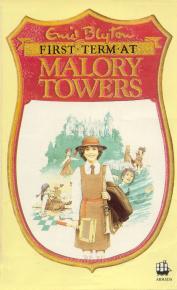
When I was a little girl, a relative bought me some Secret Seven books, which got me hooked into Enid Blyton, to my mum's horror. She insisted that Blyton's books weren't actually very good, and that she overused exclamation marks, and recycled the same stories over and over. Fair point. Can't see much to argue with in that. But anyway, when I was a nine-year-old in primary school looking through the book-box for something to read, I was overjoyed to find First Term at Malory Towers, my introduction to the world of the School Story.

I was a little disorientated at first. The only boarding school book I had read before was What Katy Did At School, and I wasn't sure what to make of it. The book opens with my most hated (now) device of standing the character in front of the mirror to tell the reader exactly what she looks like (and it's nearly always a female character.) Still, it gave me a full description of the school uniform, something my later attempts of school-story writing was never without. I was also rather confused by the fact that the main character was called Darrell, though was definitely supposed to be a girl. (If I was living in C21st USA I probably would be used to that gender-swapping name phenomenon, but I was a 1990s English kid.) Still, once that confusion was cleared up, I enjoyed the book, and even bought my own copy so I could finish reading it. Even now, the characters and the events stick firmly enough in my memory to count as "classic."

As I previously mentioned, Blyton's writing is not what one would call literary, but the Malory Towers series counts as one of her best. The characters, though still not always very rounded, are more three-dimensional than her usual goodies and baddies. Most interesting of all is Alicia, the popular girl. As soon as Darrell meets her at the train station she wants to be her friend, but Alicia is not a very nice person. In fact, she's a downright bully at times, having no time for timid or stupid people, and her practical jokes sometimes go too far. That's not an unusual phenomenon if you watch high school movies nowadays - there is always the queen bee and her minions, the popular mean girls - but for Blyton, whose "good" characters have never more than a hot temper as a flaw, that is groundbreaking.

The series is also her most grown-up work. The final book in the series shows the characters at eighteen, looking forward to leaving school and going off to university, or discussing careers, rather than being caught in a time warp and not being allowed to grow past fourteen or fifteen. Of course, there's no suggestion of marriage for any of the characters. Malory Towers is an all-girls' school, and even all the staff appear to be unmarried (though that is partly because of the times - married women of that class didn't work - also there'd be nowhere onsite to put a husband and kids, I expect.) The characters mature and change throughout the series - yet not necessarily leaving school thoroughly reformed. Alicia and her best friend Betty, though the brightest girls in the class, are predicted by the head not to do that well at university because independence will go to their heads - they're the sort of people who would go out all night partying, without realising that natural talent without hard work will only get you so far.

There is even the threat of death in Last Term at Malory Towers. Gwendoline Lacey, the series's villain (though, I am in the school of thought that thinks that she never had a chance to redeem herself - the other girls and even the staff had written her off as a spoilt brat before she'd even got onto the train) spends the final term making herself insufferable, bragging about being sent to an expensive finishing school in Switzerland and how she and her mother had bullied her father into sending her. But at the end of the book, she has to leave school early because her dad is dangerously ill and not expected to survive.
Of course, being Blyton, Mr Lacey does not actually die. His illness is a device to teach a hard lesson to a girl who, though throughout the series appears to change for the better, always reverts back to her own spoilt, catty self. Nothing less than the threat of her father dying without her having the chance to make amends could affect Gwendoline for very long - and when he doesn't die, it gives her the chance to make amends. Though she is doomed to that awful fate (for a Blyton character) - of getting a job. Not a career - a job, probably in the secretarial line. Oh, the horror!
Related Posts Plugin for WordPress, Blogger...