Showing posts with label moral. Show all posts

Tuesday, 19 May 2009

What Katy Did at School, Susan Coolidge

I know I already named the Malory Towers series as my introduction to school stories, but What Katy Did at School preceded it - I just didn't know that the "school story" was a sub-genre of children's fiction.

What Katy Did at School takes place shortly after the close of What Katy Did, when Katy is recovered from her accident. She is now sixteen, and a very serious, grown-up, responsible young person. Too grown up, her father thinks - she is more like a thirty-five-year-old than a teenager. He decides to send her, with her sister Clover, away to boarding school, in order to remind her what it is to be young, (perhaps Coolidge, too, noticed that Katy had been over-improved by the end of the preceding book.)


Certainly it's not possible for Katy to stay altogether solemn and serious at Hillsover school - or "The Nunnery" as its scholars call it - after meeting the girl in the next bedroom. Rosamund Redding - more commonly known as Rose Red - is full of fun and mischief, one the most irrepressible girls of girls' literature. On walking down to the bath-house, she wears her towel, sponge and soap in a manner that defies my imagination: "There, to be sure, was the long towel, hanging down behind like a veil, while the sponge was fastened on one side like a great cockade, and in front appeared a cake of pink soap, neatly pinned into the middle of a black velvet bow." She is inclined to be melodramatic, writing little notes to Katy and Clover after getting into trouble for some escapade or other, that are hilarious in their tragedy: "My heart is broken," after a severe scolding. But it's impossible to put Rose down for long, and she falls out of one scrape into another.


Sad to say, even at school, Katy is so terribly proper. I suppose she has to be, given the genre of moral writing for girls. Still, though I can sympathise with her frustration with the "unladylike" flirtations of her schoolmates, I can't quite see where she's coming from when she scolds Clover for the crime of sitting at the bedroom window and watching the college boys outside. That may be a sign of the times - but it seems insufferably stuffy to me. Fortunately, Rose is at hand, and when Katy declares she has "a great mind to get up a society to put down flirting," Rose hijacks the idea and makes it a lot more fun than it sounds, an excuse for girls to get together and enjoy themselves. There is a flash of the pre-accident Katy, who shows her old Carr ingenuity by introducing a game involving a random word, a question and an answer in rhyme, which is a joy to read and reminds one of the "valentines" in What Katy Did, before the accident. I once tried to introduce that game to my friends when I was little, but without the success and ingenuity of Katy and co. Perhaps now I am older I will have another go...

The other moment of note is the occasion when Katy and Clover receive Christmas boxes, a never-ending tuckbox containing enough sweets and cakes to feed the entire school. How I used to fantasise over those boxes! The item that appealed to me the most was the "jumble," which Clover, Jack Horner-like pulls out "fitting on her finger like a ring." I always had an idea that jumbles were like cinnamon doughnuts, though Jane Brocket's book Cherry Cake and Ginger Beer revealed that they were a cross between a cake and a biscuit and could be made with a number of different flavourings. I, of course, experimented with flavouring them with cinnamon. I don't know if that recreated an accurate jumble, but it certainly recreated that moment as I knew it.

Monday, 18 May 2009

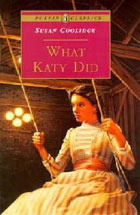
What Katy Did, Susan Coolidge

What Katy Did was probably the first book I read that I would call "girls'" fiction. I was bought the book when I was very small because, of course, the heroine shared my name.

The book is often criticised for being too sugary-sweet and moralising, but that is an inevitable result of the time, place and audience of writing - it is similar in that respect to Little Women. I always preferred the Carr family to the Marches, however, probably because they were younger. The earlier chapters are quite simply about children playing, quarrelling and getting into trouble - and it's so vivid. Katy had such a vivid imagination, and I could just dream I was there, sitting on the roof of the ice-house, or exploring Paradise with a picnic, playing Kikeri or the river game, playing post-offices... to name but a few. There is no doubt in my mind that the first half of the novel is the most fun.

At the beginning of the novel, Katy is twelve years old, full of mischief, thoughtless, careless, untidy - for a C19th century children's novel bound for reform from the very start - but one does so much wish she wasn't. She's not always very nice, which we see in her treatment of Elsie. Elsie is very much the middle child - wants to join in with her big sisters' games, but always pushed aside and told to run along and play with the children. Yet Katy means well, and that redeems her character.

Halfway through the book, we are introduced to Cousin Helen, and this is a character that I think has changed over the last century or so. Before they meet Cousin Helen, who is an invalid, Katy predicts that she will be "something like 'Lucy' in Mrs Sherwood, I suppose*, with blue eyes, and curls, and a long, straight nose. And she'll keep her hands clasped so all the time, and wear 'frilled wrappers', and lie on the sofa perfectly still, and never smile, but just look patient

Ugh! Doesn't she sound simply ghastly? Though that is what Katy is looking forward to. Thank goodness Cousin Helen is not like that - though she's almost as bad. She is just too perfect. Unlike the imaginary Helen, she does smile, and has fun, and is never too busy for the children. She never gets cross, and when she became an invalid, broke off her engagement to the man she loved, so that he wouldn't have to be always looking after her. "[a]nd now, he and his wife live next door to Cousin Helen, and are her dearest friends. Their little girl is names 'Helen'. All their plans are talked over with her, and there is nobody in the world they think so much of." I don't know about you, but I find that most unhealthy. More than anything, I pity Alex's wife - surely she would never be able to live up to Alex's first love who is "half an angel already."
Don't get me wrong, Helen is lovely, but she is too lovely. I notice as an adult that she is quite a two-dimensional character, a person for Katy to aspire to, and to trigger her improvement.

For improvement is what Katy is doomed to from the beginning. On a day of bad temper, Katy disobeys her Aunt Izzie's orders not to play on the new swing in the wood-shed, and it breaks and injures her spine. She is confined to bed for four years, where she learns patience and consideration for others, and later the responsibility of being the Woman of the House, after Aunt Izzie dies. She emerges from her bed at the age of sixteen, unrecogniseable from the impetuous little girl she was before - and from this point onwards the interest in the series switches from her to the next sister down, Clover.

Although Clover was much more of a good girl than Katy to begin with, she keeps her sense of humour, and her character. Alas, Katy does not. That is not to say that I don't like the series from this point on - because I do. But the focus of the story switches onto what Katy did, rather than the character of Katy herself.

*Research turns up the story "The History of Lucy Clare" by Mary Martha Sherwood, a story that makes the "moralising" in What Katy Did look simply anarchical by comparison.
Related Posts Plugin for WordPress, Blogger...