Showing posts with label TV. Show all posts

Friday, 21 July 2017

TV: Doctor Who, Season Ten and Beyond.

I've been reluctant to admit it, but the last few years my interest in Doctor Who has started to wane. I can trace the decline in fanaticism to the first mid-season break in season six. The series had its most ambitious, complex narrative arc to date, but splitting the season in half stalled the momentum, and giving us just a few episodes at a time for two or three years did not give me the chance to really become invested. There came a change in companion, then in Doctor. I did not warm to Clara at all; she was primarily a mystery to be solved, and her characterisation followed the narrative's requirements instead of shaping the plot.

I've rewatched the first five and a half seasons enough times that it probably wouldn't be too hard to give you a rundown of the episodes, but after that first mid-season cliffhanger, everything starts to blur together in my memory, and only the odd episodes, characters and ideas stand out: the War Doctor, Missy, the immortal girl-woman Ashildir, and the chilling puzzle-box episode "Heaven-Sent." There was still some great material, but it just did not come together as it might.


Season ten is a return to form. With a new companion comes a fresh start, and Bill's first episode was the closest thing to an introduction to the series since Matt Smith's first episode. The danger with telling the story of a man who goes here and there throughout all of space and time is that the narrative risks being untethered. This year, the writers introduced a simple yet radical new element into the mix: stability. The Doctor has a profession, a purpose, for the first time since his brief stint living as John Smith. Ostensibly, he works as a university professor, and this shapes his relationship with his newest companion into that of teacher and student. Bill Potts is a breath of fresh air into the series: being the first openly gay companion (although there has been some bisexual representation in Jack Harkness, River Song, and probably Clara Oswald) means that there are none of the messy romantic feelings that have crept across the edges of Doctor-companion relations since the 1995 film. Bill catches the Doctor's eye because of her curiosity. "Most people, when they don't understand something, they frown," he tells her. "You smile." That line gives us a better understanding of Bill than the show gave us of Clara in three years. I loved Bill instantly; she is bright, curious, good-humoured and big-hearted - and a big old nerd. She brings her savviness of science fiction into the very science-fictional world she inhabits, and she wants to know everything. Who better to learn from than a tutor whose expertise spans all of time and space?

But The Doctor's real reason for the change in lifestyle, the real reason he has settled down to academic domesticity, is what's at the heart of this series, for he has sworn an oath to guard a locked vault for a thousand years. The Doctor goes on his adventures, as ever, but always he comes back to guard the vault, assisted by his assistant Nardole. A lesser series would have dragged out the mystery of what, or who, is in the vault until the finale. The story would stand or fall by the surprise factor - and if Doctor Who had done that this year, it would have fallen, as the mystery was easily deduced by the knowledge of which guest stars were returning. Instead, it was a story all about the characters. I don't think it's a great strength to say that it was a love story of sorts, a story of hope, loyalty, and redemption.

It's a shame that Doctor Who only returned to its former glories in Peter Capaldi's - and head writer Stephen Moffat's - final year with the series, but it's best to end the era on a high. The reason Doctor Who has kept going all this time is because it is not afraid of change; there is no more sure way of killing a TV show than to keep trying to satisfy the audience's desire for more of the same. Capaldi has one more episode, the Christmas special, and next year we can expect another fresh start with Chris Chibnall in charge of the writing and Jodie Whittaker playing the Doctor. I don't know much about either of these names, but they have worked together on Broadchurch, whose first and third series seem to have done very well, and I'm excited to see what they can do given the keys to the Tardis. There are limitless possibilities; my wish is for the Thirteenth Doctor to travel with more than one companion, in a practical outfit, with pockets aplenty!


Sunday, 14 May 2017

Book to TV: Anne with an E

Here I am, right on schedule to pronounce my judgement on the latest Anne of Green Gables adaptation, Netflix's Anne With An E. In the last two or three years I've been rather pleased by the abundance of different versions of Anne Shirley, what with last year's TV movie starring Ella Ballentine, and the two webseries, Green Gables Fables and Project Green Gables. But how does Anne With An E measure up to the rest?


The Ella Ballentine adaptation attempted to hint at a darker side to the familiar story, but it is a half-hearted effort, with little more than a few flashbacks to Anne's unhappy pre-Green-Gables life to add shadow. Ballentine is sweet and likeable, but her delivery of Anne's peculiar speeches feels calculated for effect; her "depths of despair" are melodramatic but quickly shrugged off. It sticks to the story, but on a surface level; it is the child's Anne. What makes Lucy Maud Montgomery's story stand out from her contemporaries like Pollyanna and Rebecca of Sunnybrook Farm is her deft weaving of light and shadow; the light touch of sorrow makes the joy all the more rewarding. And so, it is not necessarily a bad thing that Anne With An E does explore more darkness than we are used to, mostly in examining how a childhood of neglect, drudgery and loneliness would form a character like Anne, with a second level exploring the attitudes of cliquey, small-town people towards an unknown orphan. There is some room to readjust the balance between darkness and light in this story, but it is a delicate process, to be handled with care, if Anne is not to skew too far either way. 

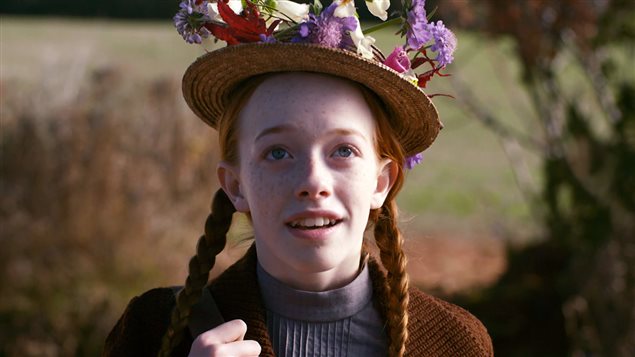
Anne With An E starts off with a superb pilot episode, sticking faithfully to the first fourteen chapters of the book, at least up to the last few minutes. Amy Beth McNulty is a wonderfully lovable and believable Anne - and unlike every other version where her plainness is in name only, her Anne is "terrible skinny and homely," all eyes and teeth and elbows. Her non-stop chatter is humorous and heartfelt, with an underlying desperation to please and to be loved. She is a more traumatised Anne than we've seen before, which does not take away from her endearing Anne qualities, but rather gives them more depth. Her imagination has helped her to survive. 

There is a solid supporting cast, especially R.H. Thomson and Geraldine James as Matthew and
Marilla Cuthbert. Marilla in particular is a "Spock" sort of character: it requires great subtlety to correctly convey the amount of emotion that goes on behind the repressed, stern facade, and James plays the part admirably. However, as in several of the other adaptations, it really bothers me that Anne's initial stay at Green Gables is dependent on her good behaviour; it does not sit well with me that Marilla would hold the threat of banishment over Anne like a weapon. Diana is a sweet girl and a devoted friend, without being Anne's shadow, and the series gives a different perspective towards her and her family; there is a noticeable difference in class between the Barrys and the Cuthberts. We also get to see a bit more of Aunt Josephine, and I enjoyed seeing a new side to this cantankerous old lady with a heart of gold. Gilbert Blythe passed the test; the popular boy in class, who is used to getting the girls' attention, mischievous but with a goodness and maturity that hints at the man he will become. Not that there's any room for the lovey-dovey stuff so early in the story, although Anne already doth protest too much.

I am open to different interpretations of Anne; I welcome them. I return to the story again and again because I get something new out of it every time I read it or watch an adaptation; if it was the same experience every time, I don't think it would be alive the way that it is. So I am not going to declare the story "ruined forever!" because another person reads it differently. Some of the scenes shown in Anne With An E did not work for me, but they gave me something to think about. I did not like Anne's frank speculations with her classmates about her teacher's relationship with Prissy Andrews - it seemed more Mary Vance from Rainbow Valley, a character who I view as the antithesis of Anne. And yet there was an innocence even in her scandalous breaking of taboos that she's not even aware of, that makes the scene make sense from another angle. The same could not be said about her lying about skipping school, when the show earlier worked so hard to establish Anne's honesty.


The faithfulness towards book details and historical setting varied wildly. The team worked hard at ensuring the right sorts of potatoes were used, and that Anne's schoolbook was correct, for example, and then might utterly blow it with something utterly anachronistic; a line of dialogue, the use of pinky-fingers in Anne and Diana's oath of friendship, and a progressive mother's group being so progressive that they use the words "feminism" and "suffragette" about twenty years before their first recorded use (if Anne With An E is set in 1876 like the book; the last two adaptations were brought forward to the turn of the century.) And it felt all wrong to show characters such as Mrs Andrews and Mr and Mrs Barry - the Cuthberts' nearest neighbours! - introducing themselves for the first time, when the defining characteristic of the Avonlea setting is that it is a small rural community where everyone knows everything about everyone else's business!


The publicity for Anne With An E, back when it was just called Anne, made a big point about introducing new themes of feminism and being true to yourself - except they are themes that have been in the text all along. Lucy Maud Montgomery was a remarkable woman for her time, very unusual to have a university education and an independent career, and throughout the books Anne defies society expectations with a similar determination. The addition of the minister telling Anne that she needs to learn to be a good wife, or the boys shouting at the girls to get back in the kitchen, felt like a heavy-handed imposition on the storytelling.


After the first episode, the plot takes ever-increasing detours away from the source material. I'm the person who takes note of every digression of the 1985 Megan Follows miniseries/film from the book; it (the first story, anyway) is so faithful there is only minutiae to criticise. I'm less of a purist than I used to be; I went into Anne With An E allowing for a lot of wiggle-room in the treatment of the story. It is an episodic book, so new episodes can be slotted in alongside the familiar ones, giving Anne new adventures without derailing the entire story. I didn't sit there saying "NO, IT DIDN'T HAPPEN LIKE THAT!" but considered each alteration under the question "could it have happened like that?" Sometimes yes, the changes fitted, and other times they did not. Some plot elements, although they did vary from the book, could have been written in collaboration with L.M. Montgomery herself, albeit the older, sadder Maud who wrote Rilla of Ingleside and The Blythes Are Quotes, the Maud revealed in her diaries. Other aspects felt heavily influenced by the Brontes, Dickens and Hardy. The narrative wanders off the path, then comes back for such key moments as the cracked slate, the raspberry cordial and the puffed sleeve dress, usually framed in a new and more sombre context. 


But with every step off the path, the plot gets further away from what is recognisably Anne, and I'm sorry to have to report that by the last episode, the series is well and truly lost in the Haunted Woods. Although I had a high tolerance for the series taking liberties with the plotline and the tone, I nearly switched off halfway through the final episode, watching one particular scene with absolute horror and fury. Unforgiveable is a strong word, and at the end of the day, even Anne of Green Gables is only a story, but one character's decision, and one newly-introduced plotline for a cliffhanger, felt like a violation of something precious. By the end, the dynamic of the story has changed, and I'm not sure how Anne With An E can find its way back to the sanctuary of Green Gables. 

Sunday, 8 January 2017

Sunday Summary: Do It Anyway


Happy new year to you all. (Is it too late to be saying this now?) I hope you're all not too gloomy about Christmas being all over now and the return to normality - although Christmas isn't really over until the last of the snack food is gone. Fact. Or if you're a fellow retailer, perhaps you're relieved.

I quite like the beginning of a new year. The empty pages in the calendar with their infinite possibility; though I don't really do resolutions, I like to take the time to look over my life and see what has been a success in the last 12 months, and what changes I could make. This year has a massive change on the cards: I've handed in my notice at work, and will be leaving in four weeks' time. There is still a lot I love about my bookshop job, and I'm very proud of what I've achieved there in the last eight years, but I'm afraid of stagnating, and all the signs seem to be pointing towards it being time for me to say goodbye. But I'm leaving without anything certain to go to yet, which is almost as frightening. Financially I'll be OK for a while, as long as I only buy necessities, but of course the sooner I find a new job, the better. (In the spirit of "Do It Anyway," I've promised myself the reward of a trip to visit a friend in Canada if he's still there when I'm back in work.)


With the dark grey weather and long evenings, it's a good time to get back into my books, and Jessie Burton's The Muse is easing me out of my recent reading slump. I really loved her debut novel The Miniaturist, and The Muse is shaping up to be just as good, although I've reached a perspective-shift and need to adjust to the new characters and setting.

With my change in financial circumstances I'm going to be very strict with my spending and am enforcing a partial book-buying-ban (though I do intend to go to Bex's second London Bookshop Crawl next month, mostly for the social element and with a strict budget.) There are a few books out now or coming soon that I want to buy, such as Juno Dawson's new book Margot and Me, and the short "Spinster Club" book And A Happy New Year by Holly Bourne. But I shall also be making more use of the library and second-hand bookshops this year (as well as continuing the battle with my to-read pile and all the books I want to reread.)

I recently watched Netflix's surprise series The OA, which turned up with little fanfare. I'm not really sure what to make of it. It's the story of a young woman who reappears after going missing seven years previously. But she used to be blind and now she can see! As she struggles to adjust back to living an ordinary life, she meets with a few other people and tells them the story of her strange experiences in captivity. But how reliable is she? I'm not really sure if The OA was a bit good or really, really (but endearingly) bad. Certainly there were some elements that were utterly ridiculous; in particular the "movements" that were supposed to have mystical powers. But as much as I laughed at the weird interpretative dance scenes, I was left pondering over questions of reality and narrative, and thinking about the characters after the credits had finished.

Also there was the return of BBC's Sherlock on New Year's Eve, with another episode tonight and a third next Sunday. I wrote a rave review of the first series of Sherlock all the way back in 2010 when it first aired. I was a huge admirer of Stephen Moffat, one of the series' creators and also head writer of Doctor Who. But Moffat has come under fire a lot in the past few years, and his Doctor Who and Sherlock with it; although I don't agree with a lot of the things I read, I can't help but keep in mind some of the criticism when viewing his work, and I think my enjoyment of the stories has suffered as a result. And the series has never reached the heights of the first episode "A Study in Pink." I think that the rules of TV mean that each story has to be bigger than the last, the stakes higher, the conflict darker, and it has moved away from the source material a bit. Last week's episode was a thriller more than a mystery, and it employed an egregious use of a much-criticised narrative trope that I don't think is likely to be forgiven any time soon. I understand some of the reasons why the writers made the decision that they did, but it's disappointing. A good writer has awareness of the tools of their trade; not just their words, but the character archetypes, tropes, cliches to avoid, common narratives to subvert. And unfortunately in that regard, Moffat and Gatiss are perhaps not quite such great storytellers as I used to believe.

Edited later: Although I still haven't forgiven them for last week's "twist," this week's episode, "The Lying Detective" was pretty epic, with a genuinely creepy villain and some real shockers - some that I'd foreseen in part, others that I think were deliberately written to make you kick yourself for not seeing and exposing even the supposedly savvy viewers' internalised prejudices and assumptions. Okay, Moffat and Gattiss, you win round 2.

One more episode of the season, and although I do enjoy Sherlock over all, I kind of hope this'll be the last series, to leave us wanting more instead of carrying on past its welcome, as too often happens with popular series. Best to go out on top, I think.

Tuesday, 15 November 2016

Sci Fi Month: Creating Life - Artificial Intelligence in A Closed And Common Orbit and Channel 4's Humans.

Sci Fi Month is hosted by Rinn at Rinn Reads
and Lisa at OverThe Effing Rainbow

What was the difference between strung-together neurons and a simple bundle of if/then code, if the outward actions were the same? Could you say for certain that there wasn't a tiny mind in that bot, looking back at the world like a beetle might?
 - A Closed and Common Orbit by Becky Chambers

It was quite by chance that I found myself reading Becky Chambers' second novel A Closed and Common Orbit at the same time that I finally got around to watching season one of Humans this month. Both works are based around artificial intelligence beings in humanoid bodies. As such, the book and TV series explore similar themes, although they go about it in very different ways.


Humans is set in a Britain that is superficially identical to that of today, but for one exception: the existence of Synths. Synths, or Synthetic people, are machines, created to help around the house, whether as domestic servants or care workers. They look like beautiful people, are capable of responding to a wide variety of conversations, but are not capable of independent thought outside their area of purpose. Nor do they have feelings like humans do - at least, that is the popular belief. However, early on, we learn that there are a few synths out there who have been programmed to have emotions, to think for themselves, and are nearly indistinguishable from humans. Only their green eyes and some of their stilted mannerisms give them away as synthetic. But it is that emotion that worries people, because where synths can have feelings and opinions, then they cannot be controlled. The scientists studying these enhanced synths have difficult decisions to make. If they destroy a being that looks, thinks and feels like themselves, where is the line between recycling technology and murder? But if the enhanced synths can go about unchecked, what does it mean for the human race? Even more complicated is the man who is being kept alive by synth technology, many of his memories recorded as audio and visual data. There are such advances in medical technology being made all the time, but at what point does the technology overtake the humanity?

A Closed and Common Orbit, by contrast, is a "far-future fiction" set in space, in a galaxy where humans mingle with diverse alien races: the Harmagians, Aandrisks, Aeluons, and many others. Artificial intelligence is a part of everyday life; there are AIs in the ships, delivery drones, artificial pet-bots and so on. But it is illegal to house an AI in a human-appearing (or other species) body-kit. One of the novel's two protagonists is one of those illegal AIs. Sidra is a ship's AI computer system installed into a body kit, and it is a huge struggle for her to adjust to this limited (to her) way of life. She is used to being able to process multitudes of information at once; see every view from the ship's cameras, be connected to the "linkings" (like our internet) at all times so that she can instantly access anything she needs to know. Now she's trapped in a perfectly lifelike body kit that can only see what is before her eyes, only process one thing at a time, only know what is stored in her memory files. Becky Chambers does an excellent job of helping us understand how limiting a human body must be to a computer, and consistently emphasises that the body kit is not really Sidra. She is the code installation, and would be herself whether she was in a ship, a body kit, or any other technological device. Because as a computer installation she cannot experience touch, smell and taste, these are translated into associated images - a soothing beverage triggers an image of a sleeping cat in sunlight, for example. It's an awesome exploration of how an AI being made of code, though they may be indistinguishable from a human to the eye, would experience the world very differently.

The fear of being replaced is a recurring theme in Humans, from the genius schoolgirl who worries about her future career options being eroded away and all positions being filled by the efficient Synths, to the husband whose disabled wife relies more on their live-in Synth assistant and doesn't seem to need him any more. And throughout the series, conscious Synths are viewed as a threat, by scientists and by some of the people who come into contact with them. Some are indeed dangerous, in particular Niska, full of cold fury. Others, such as wide-eyed Max and motherly Mia, are all goodness. They are formed by their experiences and their temperaments, but ultimately all they want to do is to be left alone and live their lives.

When the subject of AI body kits is first introduced in The Long Way to a Small Angry Planet, the prequel to A Closed and Common Orbit, the character making the enquiry is sternly warned off. He doesn't know the risks, he is told. Quite aside from the danger of being caught, arrested, the "kit" destroyed and the installation erased, this is untested technology, and you just don't know what might happen if you start meddling with what it means to be a person. But in A Closed and Common Orbit, we don't really get to see the reasons behind the ban. It takes Sidra the course of the novel to adjust to her new life in a humanoid body kit, but the other dangers are not really explored. Of course, in a universe where humans are small, humble dwellers of a diverse interplanetary community, one more kind of life form isn't going to make many waves. In a setting such as the Britain of Humans, our position at the top of the food chain comes under threat, and we don't like it. But by the time of Becky Chambers' books, we have learned to take our place alongside others. It can surely only be a good thing to learn a bit of humility, that perhaps we will not always be the dominant species and to take care of how we treat the universe and other beings.

My review of A Closed And Common Orbit is due to go online Friday.

Monday, 8 February 2016

Old Stories, New Settings: on modern-day adaptations of classic literature

I always used to consider myself a purist when it came to adaptations of beloved books. I have a button badge that says "The Book Was Better," and yes, ninety-nine times out of a hundred, it is. And yet we book-lovers do like to watch film adaptations of familiar stories, to see the stories and characters we know and love brought to life. Woe betide anyone who gets it wrong! But can anyone really reproduce the films that play out in a person's mind when they read a book? No one ever reads the same book as anyone else, or so they say; everyone brings something new to the reading. But a good story is timeless, and so often people demonstrate this by bringing old stories to a new setting, to show how themes and characters can transcend a single place and time. It's an idea I used to frown upon, but have come to appreciate. Viewing a familiar tale in a new way can give you a new understanding and better appreciation of the original text.


The point at which I first acknowledged this was in the summer of 2010, when the BBC showed the first series of Sherlock. I recognised the brilliance of casting Benedict Cumberbatch and Martin Freeman (even without a moustache) as the Great Detective and his sidekick, before I even identified that they were dressed in modern clothes. They were Holmes and Watson, there was no doubt about it. From before Holmes appeared on-screen, from the first time he spoke, his character was clearly defined, given new life free from the trappings of the smoggy setting of Victorian London and its formal language.


I didn't need to read the back blurb of Jacqueline Wilson's recent novel Katy to know what it was. A Katy on a swing? Well, that would be a modern-day telling of Susan Coolidge's What Katy Did, a classic that was inevitably a big part of my childhood - and indeed now Nick Sharratt has illustrated a paperback of the original to match, a visual confirmation that times may change but children do not.

I knew that Wilson had liked that book as a child, although to the modern or older reader, the Victorian moralising is rather unpalatable now. Jacqueline Wilson specialises in stories about dysfunctional families and flawed but believable child heroes and heroines, so adapting What Katy Did plays to her strengths. I really liked how closely she stuck to the original, especially in the first half of the book, mirroring even the minor details: the ice-house, on which the children love to sit, has become a garage roof. Aunt Izzie is now Katy and Clover's stepmother, and middle-child misfit Elsie their stepsister, while the younger ones are at least half-siblings. It was the details of the children's make-believe storytelling and games that made that story come alive for me as a child, so it's really interesting to see what their modern-day counterparts get up to (and it is really not that much different at all. Katy and her friend Cecy have mobile phones now, instead of "post-offices" in the garden, but they use them to taunt and exclude poor Elsie in just the same way.) Halfway through, at the time of the accident, the story moves away from the original What Katy Did and becomes a new Jacqueline Wilson book with 21st century values. Katy does not need to become reformed (and utterly dull) and be rewarded with miraculous healing. The world doesn't work that way, and by giving her heroine the challenges of accepting her limitations and setting herself new goals as a person with a disability, Jacqueline Wilson has written a more relatable young heroine for modern-day Katys to relate to.


Possibly the most adapted and updated story of them all is Jane Austen's Pride and Prejudice, the tale of hate turning to love that has formed the starting point of most romantic comedies. Bride and Prejudice brings a Bollywood twist to the classic tale. The world has grown smaller, but human nature remains, and the formalities and misunderstandings of Regency England translates well into the cultural divide between a rich, haughty American businessman and a bright young Indian woman whose mother wants to arrange good marriages for all her daughters. Oh, you know the story! Bride and Prejudice is a smart, funny, sometimes corny but feel-good adaptation of the old story.

Then, of course, there's Bridget Jones's Diary, based on the novel by Helen Fielding (which I think was originally published as a weekly newspaper column.) I read and watched this before I ever read Pride and Prejudice (yes, there was such a time!) and haven't seen it for ages, but although it's more loosely based on Austen's novel, there are clear parallels in this tale of a thirty-something singleton surrounded by smug marrieds, with the charming cad on one side, and on the other hand the snob called Darcy who looks like Colin Firth (the ultimate bit of meta-casting.)


The latest adaptation Pride and Prejudice heralded a new kind of storytelling in the form of the Literary-Inspired Webseries. Filmed in short episodes in video-journal format, The Lizzie Bennet Diaries give us Lizzie Bennet, a twenty-something graduate student who has moved back home with her family in a difficult financial climate, wondering what future there is in store for someone with an English degree - a painfully relatable variation on the theme. Most of the drama happens with Lizzie relating events to her video journal (with some interruptions from friends and family, and some excellent re-enactments.) Ashley Clements is sassy and expressive as Lizzie, Laura Spencer (wasn't she in The Big Bang Theory as Emily?) is sweet and lovable, while Mary Kate Wiles is lovably obnoxious as Lydia, as you'd expect, but shows more character growth than Austen allowed her, and a rare vulnerability later on. The other two sisters are relegated to being Mary the Emo Cousin who Lizzie (perfect!) and Kitty is literally Lydia's adoring cat.


Since The Lizzie Bennet Diaries, Youtube has been rather overrun with modern-day video-diary versions of every classic imaginable: all the Austen, I think, Shakespeare, Sherlock Holmes, Little Women, and my beloved Anne of Green Gables has got not one but two webseries inspired by it. Green Gables Fables came first, starring Mandy Harmon as Anne, and in September returned for its second season. I think it took a little while to get really good, as the actors grew into their characters. It is very faithful to the book, although I wasn't quite sure that some of the substitutions quite reflected the original - having a manicure at the salon, for example, doesn't quite have the same importance as finally getting to wear nice clothes, and the hair disaster and the cake disaster less dramatic. But by the time Gilbert Blythe turns up in the middle of the first season, it got into its stride, and it is notable for its amount of "transmedia" with Youtube channels for supporting characters, who all have regularly-updated Twitter accounts interacting with each other for things that can't be shown in a five-minute video diary once a week. Tanner Gilman is a magnificently lovable, nerdy Gilbert Blythe, who is more important to get right than a Mr Darcy (and I'm sorry, women everywhere, but I still don't get the appeal. Not when I've grown up with Gilbert Blythe.)

Between the first and second seasons, Green Gables Fables filled in with some of the events of Anne of Avonlea updated and the stories told through their social media. Season two focuses on Anne of the Island, which follows Anne at Redmond College. It diverged a little from the book at the beginning with a subplot about Diana, who never went to university in the book, and yet it seems mostly to remain true to their characters - the growing distance between two friends, Diana being more of a homebody while Anne is academic and ambitious. The format doesn't always quite work; how do you show intensely private moments in a "Hello world, this is what happened to me today" video diary? And fitting four years' worth of events into one academic year also has its occasional uncomfortable juxtaposition of events happening too close together (notably Anne's romantic woes.) But I'm so glad to see Anne of Green Gables being talked about more - and discussions use the books as a starting point, instead of the (albeit excellent) 1985 TV miniseries. Green Gables Fables is an immersive storytelling experience, putting the viewer into the story and living through it as it unfolds. There's been some extraordinary writing and acting, and Ruby Gillis's last video made a fine adaptation of a particular scene in Anne of the Island. 


And I'm completely spoilt in having Project Green Gables as well. This Finnish-made adaptation re-imagines Anne Shirley as a black foster kid in a mostly-white community, a decision that gives added weight to the story in a contemporary setting. Like her ginger counterpart, Anne has her own hair woes, though with its natural texture rather than colour, and this change gives a deeper, more serious interpretation than mere vanity. Gilbert is going to have to work very hard at repentance for his hair taunts, and you can't blame Anne or laugh about her unforgiveness under these circumstances. This isn't a petty matter any more. As I write this, the story is up to the point of the Great Hair Disaster, and in Project Green Gables, Anne's rash mistake is buying a cheap chemical hair relaxer from the internet, with devastating results.

Project Green Gables may be less polished than Green Gables Fables, but it is more adventurous when it comes to adapting scenes and chapters of Anne's life to a modern setting, and by doing so it better retains and underlines the nuances of the original. It is not a brooch that Marilla accuses Anne of stealing, but her prescription medicine, an accusation that cuts much deeper and has potentially far-reaching consequences. She's not an orphan any more, but a foster child of unreliable parents. And just her gossip about Avonlea school goings-on makes me think about the original, so-familiar text in a different light. Laura Eklund Nhaga plays a very different Anne Shirley to Mandy Harmon - and yet they both are Anne, bringing out complementary sides to her personality. Both Annes are aged up to about sixteen or seventeen, whereas in the book she first appears as a precocious eleven-year-old. Laura Eklund Nhaga brings out her innocence, her passion and enthusiasm, her non-stop joyful chatter, instantly convincing me that she was Anne. The supporting cast are also wonderful, and like Anne, they are the book characters come to life but in a very different way from Green Gables Fables. A special mention for including the hilariously obnoxious Charlie Sloane, not a character who tends to be very prominent in film adaptations. The series shows a deep knowledge of the source material, easily making reference to the little things as well as the defining events.

With two webseries adaptations as well as a film and a new television adaptation in the works, I'm over the moon. Anyone who knows me will tell you that Anne of Green Gables is the book that defines me, and although I can hardly fault the best-known television adaptation, as far as I'm concerned, the more Anne, the better.

Tuesday, 2 June 2015

Battlestar Galactica (2004-2009)


The Cylons were created by Man. They evolved. They rebelled. There are many copies. And they have a plan.
The miniseries that served as a pilot episode for the reimagined Battlestar Galactica showed the human race all but annihilated in a sudden, shocking nuclear attack by their own creations, the Cylons. The twelve home planets of Kobol were rendered uninhabitable, and the fifty thousand survivors take to the skies in a desperate attempt to find a new place to settle and ensure humanity's survival. Their ultimate destination: a long-forgotten planet called Earth, settled, allegedly, by a thirteenth colony from the original Kobol. But no one knows where Earth can be found, and meanwhile the Cylons, not content with their victory, continue their relentless pursuit across the galaxy. Some Cylons even look human, and are hidden within the fleet, ignorant of their own nature.

So, a pretty grim, ruthless premise for a series, and such a situation calls for tough people. There is a wide cast of fascinating characters, complex and nuanced, heroes and cowards, compassionate and selfish, full of love and hatred, loyalty and treason, justice and revenge - and all these qualities often found in the same person! There are very few straightforward heroes and villains, and that is what makes the characters so interesting. I could write about so many of them: Lee "Apollo" Adama, Saul Tigh, Kara "Starbuck" Thrace, Sharon "Boomer" Valeri, but I'm going to focus on the two leaders: Commander (later Admiral) Bill Adama, and President Laura Roslin. I was suspicious of Adama when I first encountered him; a military man all his life, he seemed cold, angry, and proud. My first impressions of Roslin, on the other hand was that she was an absolute sweetie; a motherly former schoolteacher with a strong moral compass. I adored her.

This paragraph contains minor spoilers, more about character than plot. But feel free to scroll down to the black text.


Meanwhile, though friends have proclaimed Whiny Gaius Baltar their favourite character, I could not stand him from first to last: a smug, snivelling coward with an overinflated ego. And yet, when he was pitted against our two heroes at the end of season three, I found myself gradually siding with him against them. Roslin and Adama's desire for justice became a hunger for revenge, and it was very ugly. I found myself furious with them. You're better than this! But I could not hate them for long. I gradually fell away from Roslin's spell during that season, felt less inclined to excuse her as a good person who made bad choices for good reasons. Yes, her ultimate goal remained the survival of humanity as a whole, and the search for Earth, but her moral compass was so unmovable it seemed glued in place: if someone disagreed with her, they were clearly wrong. And her concern for humanity as a species does not always extend to the individuals that make up that species. Meanwhile, Adama said and did some pretty awful things, and yet I found him easier to forgive, because beneath his hard military facade, you come to learn he is a man of strong but controlled emotions. And perhaps it is easier to excuse something said or done in the heat of a moment than a coldly considered cruelty. I did not hate Laura Roslin as a person - she remained lovable in her private moments - but she did not remain a likable president. A good one, nonetheless? The jury is out on that. Difficult decisions must be made, and sometimes there isn't a right choice.


The road to Earth is far from straightfoward, and the fleet is constantly confronted by conflict from within as well as exterior forces - and not just from the Cylons living among the humans. When they start to be revealed, the humans struggle to reconcile their preconceptions with the evidence that confronts them. One must acknowledge the shared humanity of others - even some Cylons - lest you lose your own. Yet this is easier said than done when still reeling from the near-destruction of an entire civilisation.

The plots keep you guessing, and nothing is straightforward. Political intrigue, twists of prophecy, betrayal and the just plain weird make for an exhilarating experience. The plot does not go where you think it ought - and I love a story to be unpredictable. People die that shouldn't, others outlive all expectations, and even the music gets in on the act to scramble your brain. This is not a story that reverts to the status quo. The series finales come with game-changing shocks, and the season finale turns everything you think you know about the Battlestar Galactica universe on its head. It must be very different watching it a second time around.

It is not a perfect show, however. There is a strange mystical subplot that I could take or leave, if it were less critical to advancing events. Prophecies lead to strange McGuffin-hunts ("The arrow of Apollo will open the tomb of Athena which will lead us to Earth" - what?!) There are too many self-proclaimed "chosen ones" and too many answers are provided by dreams and visions, and just accepted to be accurate predictions of the future (and usually are, in some way.) This seems like weak plot progression to me. Prophecies, visions and dreams should be used lightly, I think - see the twist in Harry Potter and the Order of the Phoenix for an example of it done well. Also, I noticed there is a lot of repetition in the dialogue, and it sounds scripted rather than like real speech, sometimes even like poetry. And not good poetry, either.

But perhaps these are minor quibbles from one who has spent too long studying creative writing. Battlestar Galactica is a revolutionary space disaster adventure, and despite the irritations, I have thoroughly enjoyed watching it. It is a show best watched with very little foreknowledge, and I've enjoyed watching the mysteries unfold before being resolved in an epic climax. I know some of my Twitter followers have been reading my tweets with smug enjoyment of my ignorance (and one of my colleagues will be asking me tomorrow for my thoughts on the ending.) Definitely one to watch twice.

Thursday, 26 February 2015

Battlestar Galactica - 2003 miniseries

Oh no. Here we go again. Katie's found a new television show to geek out about, years after everybody else as usual!

The Cylons were created by the people of the Twelve Colonies of Kobol as a labor and military force. Approximately 52 years ago, the Cylons turned on their human creators and the Cylon War ensued. After an armistice was declared, the Cylons left the Colonies, ostensibly to seek a homeworld of their own. The Colonials maintain an Armistice Station as a place where Cylon and Colonial representatives can meet in order to maintain diplomatic relations. However, the Cylons have never sent an ambassador. No one has seen a Cylon since the end of the Cylon War, over 40 years ago...
On what is supposed to be a quiet day, the day of the decommissioning of the old Battlestar spaceship Galactica, the unthinkable happens. The Cylons, not seen or heard from in decades, launches its attack on the human colonies of Kobol, causing total devastation. Only 50 000 humans are left from all twelve worlds. Commander Bill Adama finds himself suddenly the head of the military, while Secretary of Education Laura Roslin, still reeling from a cancer diagnosis, discovers she is the most senior surviving member of the colonial government and sworn in as president. These two have to negotiate the best method of continuing the survival of the human race, and take opposite sides in the "fight or flight" argument. Adama, the military man, initially chooses to continue battling the Cylons, while civilian Roslin's priority is to keep the survivors alive. "The war is over," she says bluntly. "We lost." Sure, I've spent time with the losers of a galactic war before, in Firefly, but that was a petty rebellion, a scuffle, by comparison. Battlestar Galactic is the aftermath of near-annihilation. I say again. Fifty thousand people remain. 

I found the idea about technology advancing so far as to turn on its creators fascinating. It's not a new concept in science fiction, certainly, but I loved the details, that Caprica's Galactica ship reverted back to older technology. Considering how smart technology has got these days, it seems even more relevant than ever now.

The point at which this series tipped from interesting to amazing was when Adama announced the survivors' destination: Earth. I had presumed that the Twelve Colonies of Kobol were extensions of Earth-that-was, a la Firefly. It is the logical assumption, from my Earth-centric perspective. But Adama presents our planet not as "home," but as a legendary "thirteenth colony." Suddenly everything I believed to be true in this universe was turned on its head, especially afterwards when Roslin confronts Adama with the fact that Earth is nothing but a myth. No one knows where it is - or if it even exists!

Battlestar Galactica already shows signs of being darker, less optimistic than most science fiction shows. One character had to make the choice in cold blood to send a hundred people to their deaths in order to save the ship and everyone else aboard - and unlike Star Trek or Doctor Who or any other show with a similar dilemma, no third option became available at the last minute. I can already tell that this is going to be a very traumatic story to get lost in. But it's the characters that will make it worthwhile. Adama and Roslin, reluctant leaders with their vastly different approaches to, well, everything. Adama's son Lee "Apollo," who still blames his father for the death of his brother. Lieutenant Kara "Starbuck" Thrace, the cute, hotheaded, tomboyish fighter pilot. Gaius, the untrustworthy, cowardly doctor who presents a threat due to being under the control of his Cylon lover, the tall, creepy blonde lady who may not be physically present aboard the Galactica, but who he has brought with him nonetheless. And so many more who I haven't yet got straight in my head, but who I am very much looking forward to getting to know better.

Sunday, 2 November 2014

Sunday Summary: fly-by post 4

Well, my manic October is over and now I go back to having weekends of a sort again, even if, as is the case this week, actually in the middle of the week. Hurrah! But although I'm doing fewer hours at work, with Halloween over, the world is ready to catch up with the retail calendar and launch into Christmas, and of course things will only get busier. This Thursday I actually ran out of tasks to do. (There is never actually nothing to do, even if it's just cleaning and replenishing the shelves, but I stopped chasing my tail for a moment, making the most of the fact that this was probably going to be my last afternoon like that.

This week I have been:

Reading: 


The last part of 11.22.63. Beautiful, devastating, a wonderful book (that has already altered the way I think time travel in other fiction, such as last night's Doctor Who.) Stephen King does it again! I plan to write a proper review of this one later this week.

The Guest Cat by Takashi Hiraide, a novella about a thirty-something Japanese couple who get adopted by their neighbours' cat, and form a bond with this darling creature. A pensive, poetic read that is worth taking time over, despite its short length.

Rereading Redshirts, one of my top books of last year, and one which I recommend to anyone who has affectionately noticed the absurdity inherent in certain kinds of science fiction TV shows. A must-read if you like the film Galaxy Quest.

Watching: 


A bit more of Heroes - season two is a short one, due to the writers' strike of a few years ago.

Captain America, to remind my dad of Steve Rogers' story so far, before we watch the sequel. (The Avengers is, naturally, also on the cards.)

A bit more Star Trek: The Next Generation. There are some great, thought-provoking episodes of this series, but the fact remains that it doesn't capture my affections as much as the original series, the original cast. I do like Worf and Data, though.


The Addams Family, on Netflix. It seemed appropriate Halloween viewing, with hot chocolate and marshmallows, while tucked up with a rotten head cold.

Doctor Who. The first part of the season finale was powerful stuff. I've been a bit ambivalent about this season, enjoying each episode well enough, but not really hanging on to the story during the week. A recurring small character through the series really gave me the creeps in a way I term "the Umbridge Effect" - making the watching experience less enjoyable when the character is on screen. But a few weeks back, I stumbled upon someone's apparently random idea about this person which, if it were true, might make me rethink my approach to them.

Last night's episode was really powerful. An unforeseen* major event within the first minutes, some fine acting, especially from Jenna Coleman, some fantastic lines (including a reference to Peter Capaldi's most famous previous role), a journey somewhere that seemed impossible even for the TARDIS, and some huge plot twists that were unusual in being none the worse for being anticipated.

Scaring myself with: just the thought of getting scared by certain Stephen King books. Perhaps it is not a good idea to read his "Nightmare fuel" page on TV Tropes just before bed. I was the child who had to be taken out of birthday parties and school assemblies because I'd freak out when I saw a clown. Guess which book is not on my immediate to-read pile!

Can't sleep. Clown'll eat me.

But who needs Stephen King when you've got some of the stuff in that last Doctor Who episode? There was a time watching that episode that made me really wonder if the show had crossed a line, gone too far - and I like it when it goes dark. There were some ideas that will linger uncomfortably for a long time, I think.

Sneezing: A lot, especially (naturally) on my day off.

Writing: Well, I've made a start on NaNoWriMo, although I didn't even manage the wordcount for the first day. That's fine. For me it's not about reaching the 50 thousand words, so much as getting back into writing stories, and sticking with it. I don't know who I am when I can't write, and it's been such a long time.

Also, this week I hope to get back into some proper reviews for the blog, now I've (potentially) got a little more time on my hands.


SPOILER in white text >>> 

Actually, I did think for a moment, "Danny's too close to the road" before the phone went silent his end.  <<<
<<<

Sunday, 19 October 2014

Sunday Summary: Fly-by post 2.

Good afternoon! There is sunshine today, which I have missed. Even though summer has not been over for long, I was starting to feel as though the sun had gone into hibernation until spring. I'm tempted to go out for a walk this afternoon, to make the most of the good weather and take in the bright autumn colours.

This week I have been...


Reading: 


I Am Malala by Malala Yousafzai (with Christina Lamb). More than just a memoir, this book helps you to understand not just what it is like to live under threat from the Taliban, but also the social, historical and political context that allows extremism to take hold. Malala is intelligent and passionate about the importance of universal education, demonstrating the harm done by ignorance, her frustration with those who would warp her religion to make it a tool for oppression. A powerful read from an extraordinary young woman.

I have also begun 11.22.63 by Stephen King, in which a teacher is sent back in time to try to stop the Kennedy assassination. This book has a new, perhaps unique, take on time-travel. In this universe, it seems that there is a proper timeline, an established chain of events, and time really doesn't want to be altered. Every time you go back to the past (down an invisible flight of stairs in the pantry of a diner) the timeline resets itself. Or does it...?

Watching:

I finished season 1 of Heroes, which I had been buddy-watching "with" my sister. I won't write a full review of this, but will put some of my thoughts onto the page in bullet-point form.
  • Fun, entertaining, incredibly cheesy at times, but not the greatest mastery of storytelling in the world. It felt a bit first-drafty, with plot holes and continuity errors, and seemed a bit disorientated. All I knew going into this show was "save the cheerleader, save the world," but I'm still a bit unsure of how saving Claire actually helped with saving "the world" (read: New York City) and how much of trying to prevent the coming apocalypse actually helped to make it (almost) a self-fulfilling prophesy.
  • There were several characters with their own subplots, but the ones that interested me the most were Claire the indestructable cheerleader, the adorably geeky Hiro and his friend Ando, Peter Petrelli (although I loathed his family) and the psychotic super-villain Sylar (played by Zachary Quinto, the young Spock in the Star Trek reboot films), who could perhaps be argued to be a darker version of Peter. Peter absorbs other people's powers by standing near them. Sylar absorbs other people's powers by killing them horribly.
  • Sylar reminded me in some ways of Spike from Buffy, starting from the time when he paid a visit to the Bennet home and charmed the mother while waiting for the daughter to come home. Both have mommy issues, and both have a sinister dangerous charisma which is disturbingly attractive. 
  • A couple of characters had what I called "the Umbridge effect," which is to be so creepy and unpleasant they make the watching experience less fun. Claire's father, who Jenny and I christened Creepy Bennet, was one of these, morally ambiguous, doing terrible things for noble motives, but making my flesh crawl, and not in a good way. He does get some backstory and character development along the way, but I will keep up the nickname. Also, Peter Petrelli's politically ambitious brother Nathan, and their mother, were just plain slimy, contemptible. And there were a bunch of sinister corporations and mobsters whose stories just didn't interest me. Ultimately, sexy psychopathic supervillains are much more entertaining than slimy older guys in suits.

The verdict: Probably not something I'd re-watch over and over, but it sustained my interest enough to order the second season second-hand. (I intended to renew my Netflix subscription to watch the rest of the season, but the internet is a bit slow and unreliable on my computer and doesn't always like streaming videos.)


Planning:


Judith asked me the other day if I was going to do NaNoWriMo (National Novel Writing Month) this year, to which I answered unequivocally "no." I haven't written any fiction for a while, or at least not stuck to anything. And a couple of days ago, I was feeling sad about this lack of productivity, and my brain said, "surely you can write something, just a drabble or a short story?" But it seems I can't do short stories. With short stories you really need to keep it simple, about one thing, one event, just a couple of characters. And the plot bunnies got breeding, and the basic idea expanded and spread, until I came up with something that might at least go some way towards the 50 000 word count required to complete NaNoWriMo. My only fear is that I have two weeks before November starts: what if I lose interest? I'm not too concerned about hitting the 50K mark, but I'd like to write something in November. (I also have an idea for a drabble slash "fanfiction*" about two of the supporting characters in a novel I wrote several years ago. Hardly enough for a novel, but something.)

Enjoying: Pumpkin spiced lattes. As well as Starbucks, which I don't tend to visit, one of our local coffee shops has this as a limited edition autumn flavour, and it is delicious, one of the things that had me actually looking forward to autumn, which I tend to dread a little.


*Can one write fanfiction about one's own unpublished writing? I'm not sure this drabble is "canon" but I want to explore the relationship between these two characters nonetheless.

Sunday, 12 October 2014

Sunday Summary: Fly-by post

Hello all, hope you're well. I've been back at work this week and it's been ridiculous. Two weeks into October, we are well and truly into the Retail Christmas season. I'm working full time this month to cover various other people's shifts, and my days off aren't even the same every week. I've worked four days, have today off, and have another four days starting tomorrow. I'm physically tired from moving so many heavy books and boxes around, so today is pretty much a duvet day.

This week I have been:

Reading: 


Moving Pictures by Terry Pratchett. I'm still working through all the Discworld books I haven't read before, and hope to finish the series by the end of the year.

We Are All Completely Beside Ourselves by Karen Joy Fowler. This was my birthday present from Ellie, a moving and surprising story about the effects of an unconventional upbringing on a family. It was very different from what I had expected - another book following this year's trend of excellent books with bright yellow covers.

Girl In Translation by Jean Kwok: the story of a little girl and her mother who move from Hong Kong to America, to find life there very different from the life they had envisioned. A beautiful, often sad but ultimately hopeful story about the triumph of the human spirit over adversity. Kwok evokes well the confusion of being young in a strange culture, with an incomplete understanding of the language and culture.

Not reading:

Moby-Dick by Herman Melville. I have to confess that went back to the library unfinished. I would like to read it at some point, but I've got so many newly-bought and birthday books to read, and I'd much rather get stuck into them.

Unwrapping:


Two more birthday presents arrived this week: books from bloggers Hanna and Charlotte. Charlotte sent me science fiction classic Flowers for Algernon, as well as a little Tolkien treasury full of poetry, art and ponderings about the Lord of the Rings. (This has found a home on my Lord of the Rings feature shelf - yes, I have a shelf of my bookcase devoted to Tolkien!) Meanwhile, Hanna sent me Stephen King's 11.22.63 which I, along with probably all of the UK Stephen King readers, keep writing the wrong way round, and which I have been wanting to read ever since it first came out. She also sent me The Girl Who Circumnavigated Fairyland In A Ship Of Her Own Making. How can a book with that title be anything but excellent? Thank you both so much, I'm thrilled by all of these books. My only problem is: which do I read first?

Watching:

Heroes, season one, which I have been buddy-watching with my sister (even though she lives in London.) This never interested me when it was on TV - I couldn't be having with those superheroes. And then The Avengers happened, and I realised that those kinds of stories appealed to me after all. So far, Heroes is fairly familiar territory to anyone who watched X-Men or Agents of SHIELD, but with a greater focus on the effects of developing superpowers on ordinary people's ordinary lives. I'm only a few episodes in so far but I'm already getting attached to the characters. Hiro Nakamura is my favourite character so far - he is so unashamedly geeky! His excitement is so endearing.

Playing:

Some friends had a tabletop gaming evening last night. The previous week, I was introduced to Netrunner, which was not very successful due to a poorly two-year-old refusing to go to sleep. Luckily young Sam was fast asleep last night, and we got through a game which I can't remember the name of, but was based on Lovecraft's writings. It is a collaborative game: players versus the monsters. The monsters won.

Internetting:

Not a lot, because the thunderstorm a few nights ago did something - I don't know what - to our wireless router. But since that's been fixed, I've been reading and watching Mark Oshiro reading Wyrd Sisters. With the introduction of Granny Weatherwax, Nanny Ogg and Magrat Garlick, the series becomes a very different thing. This is when it starts to get really good. 

Tuesday, 2 September 2014

Fringe: Season 4


Spoilers, of course. It would be impossible to discuss this show without them.

Season three of Fringe ended with a nice note of happily-ever-after. The two universes were brought together to create a new world and prevent all-out apocalypse. But then - Peter Bishop, who brought about the unification, popped out of existence. Oops.

The credits sequences of Fringe in season three were colour-coded in order to quickly establish which universe each episode would take place in: blue-green for the original world, and red for the alternative universe. Season four's credits were coloured in yellow. Or amber, if you prefer... ominous in itself when you consider that amber is used in the second universe as a preservative to prevent any holes in the world from growing and spreading. And this new season's setting and characters are different. Despite the lack of Peter, there has still been a "bridge" built between the universes, and the two Fringe teams are working together to repair the damage rather than to destroy each other. But the characters are subtly altered. Our Olivia is harder, having killed her abusive stepfather without Peter there to save her as a child. She was brought up by Massive Dynamic's Nina Sharp, and wears pale pink lipstick. Her redheaded counterpart from the other universe is no longer a mother (has never been a mother - Peter never existed and so neither did their son Henry.) Walter is more broken, and never leaves his lab in the Harvard basement. Other characters are still alive who should have been dead, and vice-versa. It would be interesting to watch the entire first three seasons through and pay attention to every event influenced by Peter in one way or another.


Despite what the observers (the creepy pale bald men who keep showing up whenever anything big is about to happen, and who know too much) have said, it is not that Peter never existed, but that both versions of him really did die as a child. Except, whoops, he doesn't seem to have got the memo, and materialises in the river to find himself in a terrifying It's A Wonderful Life world where no one knows him. His memories are intact, but the world around him is not quite the same - everything and everyone that had been impacted by coming into contact with Peter now is as if he had never been there. The big question is: is this yet another alternative universe, or an altered version of his own world? Can he go home, or is he there already, finding it changed out of recognition?

In this version of reality, poor Olivia is suffering from dreadful migraines - which turn out to have been induced by mysterious figures breaking into her house and secretly dosing her with Cortexifan, the mind-enhancing drug developed by William Bell and Walter Bishop to give her psychic powers. And then we discover that Massive Dynamic's Nina Sharp - in this version, her own foster-mother - is behind it all. As a migraine-sufferer, I hated her for this. Clearly Nina is up to something nefarious - but never mind that; inflicting migraines on a person is pure evil.

But as it happens, it is the other Nina Sharp behind the migraines - the one from the other universe and it turns out she is working for someone else: David Robert Jones, the Big Bad of season one. We last saw him gruesomely killed by being trapped in a door between universes - but in the Peterless universe, Jones survived and is as magnificently evil as ever. His purposes are not made clear, but they are full of havoc and destruction, the end of the world.

Episode nineteen takes a break from the main season's plotline and flashes forward to a very bad future. It begins with scrolling text: "They came from the future." The title credit sequence, traditionally covered in words of science just outside possibility, is changed to include words such as "Joy" "Individuality" "Community." I wibbled and screamed a bit watching this new sequence. If the future Peter had witnessed from the doomsday machine at the end of season three was grim, it is nothing compared with this future. The observers are revealed to have come from a future Earth - perhaps a later stage of human evolution - and we already knew that they can see all points in time, all the different things that might happen. But now it seems they are not just disinterested observers, dispassionately committed to ensuring that events take their rightful course. Now we see another side to them - time travellers from an uninhabitable future earth, who come to 2036 and enslave humanity.


We are introduced to a new team of resistance fighters, and find Walter, Peter and Astrid (who I have unjustly neglected in my reviews. She is a brilliant scientist, a valuable member of the Fringe team, and just lovely) frozen a la Han Solo in amber. Olivia is nowhere to be seen, which is ominous. Earlier in the season (in her own time) she was warned by an Observer that there is no version of the future in which she will not die. Well... surely that goes without saying of anyone? But Olivia has taken his message to heart, and expects this death to be imminent. One young woman from the future resistence (Etta) at one point claims Walter as her grandfather, which set my mind going. If she's, say, 24, she could have been born not long after the current season takes place. Her name - Etta - short for Henrietta - and what was the other Olivia's short-lived son's name, again? Yes, she really is Peter and Olivia's daughter, Walter's granddaughter. Which means that Olivia has a little longer to live, anyway.

Episode twenty takes us right back to the present day, as if we had not seen the future, and we meet the real - real - Big Bad. Now, I'd accidentally been spoiled on this by reading the box blurb. I had thought before that we had not finished the William Bell story. His attempt at immortality in season three had gone nowhere. But after all the shenanigans involved in getting the character into season three without showing Leonard Nimoy - Anna Torv's uncanny impersonation, the animated episode - I had not expected to actually see him in the role again. But it seems that he just cannot stay in retirement. I'd never been quite sure where to place Dr Bell on the scale of good and evil. Certainly his methods were morally dubious, but he was pretty likeable in person. But in this altered universe in which Peter died young, Dr Bell had heard his science partner's rage against the universe and decided to do something about it: to destroy the world and create a new one for just him and Walter, a universe with no place for the human race.

Of course, the season finale ends with the Fringe team saving the day again, but not without great cost. Bell needed Olivia's psychic powers to bring about his new universe, so Walter shoots not his old friend, but Olivia herself. (It's all right - she gets better.) Apocalypse is averted once more, Olivia is expecting a baby, so Peter, Olivia and Walter can look forward to a bright new future...

Future, you say? Remember episode nineteen...

Best episodes: 

2. One Night In October: The Fringe team recruit the other-world counterpart of a serial killer to help solve their case.
6. And Those We've Left Behind: Time loops can be traced back to a husband's desperation to keep hold of his wife.
10. Forced Perspective: A teenage girl has the power to predict death.
11. Making Angels: A beautiful episode bringing together the Astrids of both worlds.
14. The End of All Things: Olivia is held captive. David Robert Jones wants her powers.
18. The Consultant: Events in one universe have effects on the other.
19. Letters of Transit: The terrifying future, in which the Observers have enslaved mankind.
20. Worlds Apart: After spending a season working together, the two Fringe teams must say goodbye and close the door between their worlds.
21 and 22: Brave New World: In which we discover a bigger, badder Big Bad planning a bigger, badder apocalypse than ever before.

Just one more season to go now, and it's a short one - only 13 episodes compared with the other seasons' 22. I'm expecting this final season to take place mostly or entirely in the bad future of episode 19, which is a chilling thought. I wonder if it might not have been better to finish the series here - but then that would leave season 19 as an unfinished plotline. Besides, I thought that last season and look how season 4 turned out!
Related Posts Plugin for WordPress, Blogger...