Showing posts with label film. Show all posts

Tuesday, 29 November 2016

Sci Fi Month: Science Fiction in 2016... and beyond


Find out all about Lisa and Rinn's Sci Fi Month here.
Hi friends old and new. Apologies for falling off the radar last week; I had a family wedding to go to at the weekend, which fell during a time when I wasn't allowed to take holiday from work, so I ended up swapping shifts with a colleague and working for nine consecutive days. Good old retail(!) But I'm back just in time to wrap up November by having a look back on just a few highlights from 2016's science fiction films.

Star Trek Beyond: I'll try to keep this brief, as I still haven't got around to reviewing Star Trek Into Darkness, and I'd eventually like to have the set of full-length reviews. Star Trek Beyond coincided with the franchise's fiftieth anniversary, and in many ways the latest film went back to its roots. Into Darkness was, as suggested by the title, a rather gritty tale, with terrorism, revenge and moral ambiguities (mixed in with a lot of borrowing from The Wrath of Khan and the episode "Space Seed.) Beyond returns to the more hopeful Utopia that Gene Roddenberry conceived - even if all is not as it seems beneath the surface. The plot is fairly standard Star Trek fare; there are too many explosions and action sequences, but it is a wonderful celebration of the characters, who spend a decent chunk of the film separated and working in pairs. After a rather irritating start in the prequel films, Chris Pine has settled well into the role of Captain Kirk, away from the popular perception of the character as a cocky womaniser, and closer to how he actually was. Bones and Spock's bickering friendship is a thing of beauty; their scenes together were the highlight of the film. There was also a moving tribute to the original Spock, Leonard Nimoy, who passed away last spring. And of course there was a double-whammy this time around with the death of Anton Yelchin this year; his Chekov played only a small part in the proceedings, but lit up the screen whenever he appeared, and we finally got to hear what was "inwented in Russia." A talented actor and an endearing character; he is irreplaceable and will be sadly missed.


Ghostbusters (2016 reboot): To be quite honest I wasn't sure whether to include this as science fiction, or whether it would be more strictly classified as supernatural horror. Ghosts aren't usually a feature of sci-fi, but, like the 1980s original, the team use science and technology instead of excorcism and magic in order to defeat the forces of darkness, so I'll include it anyway.

The new film attracted a lot of criticism when it was release, particularly from die-hard fans of the original cult classic. Remaking something so beloved is always a risky move. Although I've enjoyed the original, I must confess that I don't have a particular attachment to it (it is dryly amusing but I really don't see it as a comedy) and so I was happy enough to see what the new cast had to offer. It is more overtly comedic than the original, with varying levels of humour - some jokes were not to my taste, while others made me giggle like a schoolgirl in the cinema. On a repeat viewing, I wasn't sure it held up to my memory of it; perhaps being in a room full of laughing people made it seem funnier than watching alone at home. But the ghostbusting quartet (Kirsten Wiig, Melissa McCarthy, Leslie Jones and the amazing Kate McKinnon) form a formidable team. The film does not make a point of the team being remarkable despite or because of being women, they just get on with the job in hand without a mention of their gender - just like their male predecessors do! It's a rare movie not to have even a whiff of romance, unless you include Kirsten Wiig's character finding Chris Hemsworth to be pretty, or Kate McKinnon's Holtzmann finding her pretty. It's all about strong friendships and fighting the apocolypse.

Perhaps there is a pointed lack of subtlety in the villain being a marginalised geek who has been bullied and sneered at all his life, and has taken to sneering at the rest of the world. I can see why he might upset Ghostbusters fanboys. But he has his foil in the Ghostbusters themselves. They too have lived with being the outsiders, the geeks, the "ghost girl" and the freak. It's no excuse, the movie says. You get to choose how your experiences shape you. Use your weirdness for good or for ill.

I suspect the new Ghostbusters will not join its predecessor in the cinematic history books as a classic; there are no plans for a sequel, but that's okay. The last thing we need is another never-ending franchise outstaying its welcome. As a stand-alone, it is fun and enjoyable, and a good example to little girls who want representation in the world beyond princesses and fairies.


Arrival: Most of the films I've seen in cinemas in recent years have either been based upon books I've read, or part of an ongoing franchise. Arrival is the exception; it was originally a short story, but not one I've read, so I went in knowing hardly anything about it. This is the best way to experience Arrtival, and I can't say very much without spoilers. It is the tale of a linguist (Amy Adams) who is tasked with communicating with aliens whose vessels appear above twelve spots around the world. Arrival is a quiet, gently paced film with a small main cast, balancing a deeply personal, bittersweet story with the big implications of extraterrestrial life, the links between language and understanding the universe. It is an intelligent movie, thought-provoking and hushing, combining sadness and hope, and it was very satisfying to my geeky heart and mind.


I've found it interesting to notice that the stand-out sci-fi of this year has been rather more optimistic than of late. How many dystopian futures have we seen in the twentieth century? How many darker and edgier remakes? (Battlestar Galactica, I'm looking at you!) Arrival is bittersweet but ultimately optimistic about humanity. Star Trek turned its back on the "grimdark" and returned to its hopeful vision of teamwork. And I've absolutely fallen in love with Becky Chambers' novels, with their vision of a far-distant future with good intergalactic relationships and alliances.

But science fiction inevitably is influenced by the time it was written, and 2016 has been a time of great change - and not for the better. The dark spectres of humanity have crept out of the shadows; people begin to forget the lessons learned from history's shames. The new year will bring with it a very different understanding of the world than many people held as we entered 2016. So I wonder how science fiction creators are going to respond to this changing world. Will we be deluged once more with dystopian warnings? There is a valuable place for this, but also for hope. Remember that Star Trek first aired in the 1960s, during the Cold War, in a time and place of great racial and gender inequality, and the show helped pave the way for social change. And I think we need that now as much as ever.
What were your science fiction highlights of 2016? Where do you think the genre will take us in the next few years? I'd love to hear your thoughts below.

Monday, 8 February 2016

Old Stories, New Settings: on modern-day adaptations of classic literature

I always used to consider myself a purist when it came to adaptations of beloved books. I have a button badge that says "The Book Was Better," and yes, ninety-nine times out of a hundred, it is. And yet we book-lovers do like to watch film adaptations of familiar stories, to see the stories and characters we know and love brought to life. Woe betide anyone who gets it wrong! But can anyone really reproduce the films that play out in a person's mind when they read a book? No one ever reads the same book as anyone else, or so they say; everyone brings something new to the reading. But a good story is timeless, and so often people demonstrate this by bringing old stories to a new setting, to show how themes and characters can transcend a single place and time. It's an idea I used to frown upon, but have come to appreciate. Viewing a familiar tale in a new way can give you a new understanding and better appreciation of the original text.


The point at which I first acknowledged this was in the summer of 2010, when the BBC showed the first series of Sherlock. I recognised the brilliance of casting Benedict Cumberbatch and Martin Freeman (even without a moustache) as the Great Detective and his sidekick, before I even identified that they were dressed in modern clothes. They were Holmes and Watson, there was no doubt about it. From before Holmes appeared on-screen, from the first time he spoke, his character was clearly defined, given new life free from the trappings of the smoggy setting of Victorian London and its formal language.


I didn't need to read the back blurb of Jacqueline Wilson's recent novel Katy to know what it was. A Katy on a swing? Well, that would be a modern-day telling of Susan Coolidge's What Katy Did, a classic that was inevitably a big part of my childhood - and indeed now Nick Sharratt has illustrated a paperback of the original to match, a visual confirmation that times may change but children do not.

I knew that Wilson had liked that book as a child, although to the modern or older reader, the Victorian moralising is rather unpalatable now. Jacqueline Wilson specialises in stories about dysfunctional families and flawed but believable child heroes and heroines, so adapting What Katy Did plays to her strengths. I really liked how closely she stuck to the original, especially in the first half of the book, mirroring even the minor details: the ice-house, on which the children love to sit, has become a garage roof. Aunt Izzie is now Katy and Clover's stepmother, and middle-child misfit Elsie their stepsister, while the younger ones are at least half-siblings. It was the details of the children's make-believe storytelling and games that made that story come alive for me as a child, so it's really interesting to see what their modern-day counterparts get up to (and it is really not that much different at all. Katy and her friend Cecy have mobile phones now, instead of "post-offices" in the garden, but they use them to taunt and exclude poor Elsie in just the same way.) Halfway through, at the time of the accident, the story moves away from the original What Katy Did and becomes a new Jacqueline Wilson book with 21st century values. Katy does not need to become reformed (and utterly dull) and be rewarded with miraculous healing. The world doesn't work that way, and by giving her heroine the challenges of accepting her limitations and setting herself new goals as a person with a disability, Jacqueline Wilson has written a more relatable young heroine for modern-day Katys to relate to.


Possibly the most adapted and updated story of them all is Jane Austen's Pride and Prejudice, the tale of hate turning to love that has formed the starting point of most romantic comedies. Bride and Prejudice brings a Bollywood twist to the classic tale. The world has grown smaller, but human nature remains, and the formalities and misunderstandings of Regency England translates well into the cultural divide between a rich, haughty American businessman and a bright young Indian woman whose mother wants to arrange good marriages for all her daughters. Oh, you know the story! Bride and Prejudice is a smart, funny, sometimes corny but feel-good adaptation of the old story.

Then, of course, there's Bridget Jones's Diary, based on the novel by Helen Fielding (which I think was originally published as a weekly newspaper column.) I read and watched this before I ever read Pride and Prejudice (yes, there was such a time!) and haven't seen it for ages, but although it's more loosely based on Austen's novel, there are clear parallels in this tale of a thirty-something singleton surrounded by smug marrieds, with the charming cad on one side, and on the other hand the snob called Darcy who looks like Colin Firth (the ultimate bit of meta-casting.)


The latest adaptation Pride and Prejudice heralded a new kind of storytelling in the form of the Literary-Inspired Webseries. Filmed in short episodes in video-journal format, The Lizzie Bennet Diaries give us Lizzie Bennet, a twenty-something graduate student who has moved back home with her family in a difficult financial climate, wondering what future there is in store for someone with an English degree - a painfully relatable variation on the theme. Most of the drama happens with Lizzie relating events to her video journal (with some interruptions from friends and family, and some excellent re-enactments.) Ashley Clements is sassy and expressive as Lizzie, Laura Spencer (wasn't she in The Big Bang Theory as Emily?) is sweet and lovable, while Mary Kate Wiles is lovably obnoxious as Lydia, as you'd expect, but shows more character growth than Austen allowed her, and a rare vulnerability later on. The other two sisters are relegated to being Mary the Emo Cousin who Lizzie (perfect!) and Kitty is literally Lydia's adoring cat.


Since The Lizzie Bennet Diaries, Youtube has been rather overrun with modern-day video-diary versions of every classic imaginable: all the Austen, I think, Shakespeare, Sherlock Holmes, Little Women, and my beloved Anne of Green Gables has got not one but two webseries inspired by it. Green Gables Fables came first, starring Mandy Harmon as Anne, and in September returned for its second season. I think it took a little while to get really good, as the actors grew into their characters. It is very faithful to the book, although I wasn't quite sure that some of the substitutions quite reflected the original - having a manicure at the salon, for example, doesn't quite have the same importance as finally getting to wear nice clothes, and the hair disaster and the cake disaster less dramatic. But by the time Gilbert Blythe turns up in the middle of the first season, it got into its stride, and it is notable for its amount of "transmedia" with Youtube channels for supporting characters, who all have regularly-updated Twitter accounts interacting with each other for things that can't be shown in a five-minute video diary once a week. Tanner Gilman is a magnificently lovable, nerdy Gilbert Blythe, who is more important to get right than a Mr Darcy (and I'm sorry, women everywhere, but I still don't get the appeal. Not when I've grown up with Gilbert Blythe.)

Between the first and second seasons, Green Gables Fables filled in with some of the events of Anne of Avonlea updated and the stories told through their social media. Season two focuses on Anne of the Island, which follows Anne at Redmond College. It diverged a little from the book at the beginning with a subplot about Diana, who never went to university in the book, and yet it seems mostly to remain true to their characters - the growing distance between two friends, Diana being more of a homebody while Anne is academic and ambitious. The format doesn't always quite work; how do you show intensely private moments in a "Hello world, this is what happened to me today" video diary? And fitting four years' worth of events into one academic year also has its occasional uncomfortable juxtaposition of events happening too close together (notably Anne's romantic woes.) But I'm so glad to see Anne of Green Gables being talked about more - and discussions use the books as a starting point, instead of the (albeit excellent) 1985 TV miniseriesGreen Gables Fables is an immersive storytelling experience, putting the viewer into the story and living through it as it unfolds. There's been some extraordinary writing and acting, and Ruby Gillis's last video made a fine adaptation of a particular scene in Anne of the Island. 


And I'm completely spoilt in having Project Green Gables as well. This Finnish-made adaptation re-imagines Anne Shirley as a black foster kid in a mostly-white community, a decision that gives added weight to the story in a contemporary setting. Like her ginger counterpart, Anne has her own hair woes, though with its natural texture rather than colour, and this change gives a deeper, more serious interpretation than mere vanity. Gilbert is going to have to work very hard at repentance for his hair taunts, and you can't blame Anne or laugh about her unforgiveness under these circumstances. This isn't a petty matter any more. As I write this, the story is up to the point of the Great Hair Disaster, and in Project Green Gables, Anne's rash mistake is buying a cheap chemical hair relaxer from the internet, with devastating results.

Project Green Gables may be less polished than Green Gables Fables, but it is more adventurous when it comes to adapting scenes and chapters of Anne's life to a modern setting, and by doing so it better retains and underlines the nuances of the original. It is not a brooch that Marilla accuses Anne of stealing, but her prescription medicine, an accusation that cuts much deeper and has potentially far-reaching consequences. She's not an orphan any more, but a foster child of unreliable parents. And just her gossip about Avonlea school goings-on makes me think about the original, so-familiar text in a different light. Laura Eklund Nhaga plays a very different Anne Shirley to Mandy Harmon - and yet they both are Anne, bringing out complementary sides to her personality. Both Annes are aged up to about sixteen or seventeen, whereas in the book she first appears as a precocious eleven-year-old. Laura Eklund Nhaga brings out her innocence, her passion and enthusiasm, her non-stop joyful chatter, instantly convincing me that she was Anne. The supporting cast are also wonderful, and like Anne, they are the book characters come to life but in a very different way from Green Gables Fables. A special mention for including the hilariously obnoxious Charlie Sloane, not a character who tends to be very prominent in film adaptations. The series shows a deep knowledge of the source material, easily making reference to the little things as well as the defining events.

With two webseries adaptations as well as a film and a new television adaptation in the works, I'm over the moon. Anyone who knows me will tell you that Anne of Green Gables is the book that defines me, and although I can hardly fault the best-known television adaptation, as far as I'm concerned, the more Anne, the better.

Wednesday, 6 January 2016

Star Wars, Episode VII: The Force Awakens

THIS POST CONTAINS SPOILERS.


You can't beat a good Star Wars film for the ultimate cinema experience. When those words flash up on-screen: "A long time ago, in a galaxy far, far away," and the triumphant theme music blares around you in surround sound, with the narrative crawling up the screen: this is what the movies were made for. To watch a new Star Wars movie like that: it feels a little like living through a moment in history, a nostalgia for a time before I was born. And yes, I know I have experienced this before, but those were episodes I and III, and we don't talk about them.

Admittedly, I'm not a Star Wars obsessive. I love the films - the original trilogy, that is, I have no strong feelings about the prequels which I regard as an optional extra - but I wouldn't be able to tell you the names of many character not named in script, and I haven't read any of the Expanded Universe novels. A decade ago I argued in favour of the series in a Wars vs Trek debate with one of my friends; now I have turned to the Dark Side as this blog has documented. But it doesn't have to be an either-or thing. Star Wars is magnificant, magical storytelling at its finest.

In the promotional material for The Force Awakens, fans across the world were asking the same question: "Where's Luke?" We knew that Mark Hamill, Harrison Ford and Carrie Fisher were all signed up to reprise their most famous roles in the new installment, so what was the big secret? Had Luke, dear, eager, pure Luke Skywalker turned to the Dark Side? What a punch in the gut that would be. Or perhaps, almost more unthinkable, he'd actually died in the time since Return of the Jedi and would only appear as a Force ghost...

All became clear from the start of the opening crawl. "Luke Skywalker has vanished." Well played, J.J. Well played. Out-of-universe, we'd inadvertantly been asking the same questions as the characters in-universe. Where's Luke?

Luke, who turns up only at the very end, stouter and bearded and oh so sad, and Leia - now General Organa - appear really only as cameos in this film (much like Leonard Nimoy as the elder Spock in the 2009 Star Trek reboot.) Han Solo has a bigger role,but the focus is solidly on the next generation of characters. There is Poe Dameron, the star fighter pilot in Leia's Resistance to the First Order, the new baddies. Then there is Finn, formerly known as stormtrooper FN 2187, who has defected from the Dark Side and just wants to get away, but keeps on being drawn back to danger on the planet of Jakku. Finn is lovely character, fearful yet brave, with some great moments when he tries to be all chivalrous and rescue Rey, who is quite capable of saving herself, thankyouverymuch. Rey is a resourceful, rather angry young woman who was abandoned on Jakku as a child and left to fend for herself as a scavenger on a junkyard. And it is she who is at the heart of The Force Awakens; she who fills the ordinary teenager-turned-hero role originally held by Luke (and isn't it great for little girls to have a hero of their own?)

And as for the villains. Out of the ashes of the evil Empire has risen the First Order, overruled by Supreme Leader Snoke (a giant hologram of a creature) but the face of the villains is unmistakeably Kylo Ren, who proved to be a far more intriguing and multi-faceted character than I could have imagined. I saw his image in the promotional material and said, "Seriously?!" J. J. Abrams had replaced the most iconic baddies of all time, Darth Vader, with another tall dude with a cloak and a bucket on his head?

But that's the point. Kylo Ren idolises Darth Vader - conveniently ignoring the fact that he'd switched back from the Dark Side in the end - and of course he's never going to be as impressive, or live up to Vader's memory. He is powerful with the Force, but unstable, unhinged, lacking in self-control. There's a wonderful moment where one of his minions (no, not a little yellow squeaky banana-man! Despicable Me has ruined that word forever) comes to Ren with a look of terror on his face, to confess a failure to recapture the adorable droid BB8, with its map of "where to find Luke Skywalker." Being used to Darth Vader, the minion - and the viewer - is prepared for a ruthless and speedy death. Instead, Ren turns his lightsaber onto his expensive and complicated machinary. Where Vader was cold, Ren is hot-headed, immature, dangerous yes, but not fully-grown into his power.

And Kylo Ren does have a lot of power. How could he not? For before he wore the mask and took on the name Kylo Ren, he was simply Ben. Ben Solo, son of Han and Leia, nephew to Luke, grandson of Darth Vader himself. As a trainee Jedi, he turned on the rest of his class and slaughtered them all, it seems, causing a devastated Luke to disappear to an unknown planet. But what could have happened to turn the son of our heroes to the Dark Side? What kind of parents were Han and Leia? Could they have done anything to prevent his fall? Ren's commitment to the Dark is not absolute; we see him wrestle with the temptation to turn back to good, and his mother believes there is hope yet. And Han, the cynic, though he suspects Ben is lost forever, reaches out to him nonetheless. They meet on a bridge (it is always a bridge) and Han urges his son to come back with them. That would be interesting, wouldn't it? To have the bad guy in the midst of the Resistance, with his parents, striving to come back to the light. That would have been an interesting Episode Eight plot. And it looks, for a moment, as though Ren is tempted. He falters. He expresses his inner turmoil and anguish over "what must be done." And then I had another horrible dawning realisation, as Ren handed over his lightsaber. It looked awfully like he was begging Han, his own father, to kill him, to put him out of his misery. There would be a painful struggle, but I didn't believe Han could do it. He's not as hardened as he wants you to believe...

But as it happens, he was saved from having to make that agonising decision, once Ren activates his lightsaber just as it's directed at Han's heart.

I did not see that coming. I should have seen that coming, but I did not. I fell for it. I fell for that manipulative piece of work and gaped in disbelief as Han reached out to his son, forgiving him even for his own murder, and tumbled off the bridge into the darkness. Well. That made things much more interesting! And we see that there is more to Kylo Ren than the wannabe villain emo kid with a bad temper. Can there be any coming back from this?

I'm pleased to be able to conclude that Star Wars has recovered from the disappointment that was the prequel trilogy, and is back up to a high standard. My only criticism, bringing it down to four stars instead of five, is the amount of repetition, visual and plot, from the original movie. Instead of the Empire there is the First Order. Instead of the Death Star which can destroy a planet, there is the Starkiller Base, which looks an awful lot like a planet-sized Death Star which can destroy an entire solar system in one go. And, once more, it is taken out by a fleet of ace pilots. You get the Big Bad murdering the mentor figure in front of the fledgeling Jedi. All this seems very familiar. But Han Solo highlights some of these similarities with disdain: "So, it's bigger." It's very safe ground to return Star Wars to its former glory, and if the plot takes the shape, it is a classic shape of storytelling: the hero's quest. Already it fits into the canon as if it were always part of the story (a feat the prequels never managed) and, as my friend Paul said the other day, it's good to watch a Star Wars film without knowing what was going to happen next. Roll on Episode VIII!

Monday, 29 September 2014

Star Trek: Insurrection (IX)


An undercover surveillance mission on a quiet planet of peaceful people, the Baku, goes wrong when Lieutenant Commander Data malfunctions and starts attacking the people around him. Captain Picard is faced with a dilemma: this is a dangerous example of technology going horribly wrong, but though Data may be a machine, he is a good friend and a trusted crew member. How can the captain allow his destruction? This could have been a major cause of conflict throughout the film, but in actual fact, all it takes is an epic rendition of Gilbert and Sullivan's "An English Tar" from the Captain and a reluctant Worf, to jog Data's memory and restore him back to his old self (with a bit of help from Chief Engineer Geordi LaForge.)

When Picard and Data return to the planet to make amends, they uncover a suspicious plan masterminded by the Federation Council itself, to move the Baku off their home planet and onto another one without their noticing, thanks to my least-favourite addition to the Next Generation Trek-verse, the Holodeck technology. This discovery calls into question the Federation's very soul, a systematic violation of the Prime Directive of non-interference of a culture's natural development. Insurrection adjusts this law to refer only to those planets who have not yet discovered warp-speed travel. The Baku have invented this technology, although they shun it, so apparently they are fair game. It seems a somewhat arbitrary place to draw the line, although we discovered in First Contact that this was the point where everything changed for the human race, when the Vulcans decided it was okay to say hello and introduce them to the wider universe.

This planet has some interesting properties in its atmosphere, restoring youth and extending life - which is why the Federation wants it. After all, there is a case to be made for the fact that it has the potential to help millions and billions of people, instead of just the few hundred who live there. "The needs of the many," and all that. But Picard and the Enterprise crew determine to defend the Baku against forced relocation. Data befriends a little boy on the planet, and learns from him a little more about what it is to be human. Picard finds a girlfriend, and Deanna Troi and Will Riker rediscover the romance that has been hinted at right from the start of the first season - but lose Riker's beard. Riker's beard, has been popularly linked with The Next Generation getting good, and so to have him shave it off - and in an odd-numbered Star Trek movie - could be viewed as a very risky move. Insurrection is not a terrible Star Trek film. It hasn't got the cringe-factor of The Final Frontier (V) nor will I deny its place in Trek canon, as I do Generations, but neither is it ever going to reach classic status with The Wrath of Khan, the one with the whales, or First Contact. It is a solidly OK film, but overall just feels like an average episode on a grander scale.

Sunday, 14 September 2014

Star Trek: First Contact (VIII)


The first Next Generation film that wasn't Generations, Star Trek: First Contact takes place as a far-distant sequel to the two-parter episode "The Best of Both Worlds," which took place over two seasons and was cut in half by a whopper of a cliffhanger, when Captain Jean-Luc Picard introduced himself as "Locutus of Borg." Six years later, he still experiences traumatic flashbacks to his time spent as part of a hive-minded killing machine. When the Borg show up to threaten the earth, Starfleet expressly forbid the Enterprise to come to help in the battle, but, defying orders, the crew are forced to travel back in time to prevent the entire world's population from being assimilated, and to ensure that two pivotal events in Earth's space-travel history take place: the first warp-speed space flight, and first contact with extra-terrestrial life forms.

First Contact makes an interesting use of time travel: as discussed in John Scalzi's Redshirts, normally shows like Star Trek will travel either to a significant historical date, or to sometime around the show's own air date. Here, the Enterprise goes back but to a date in our future: 2063, a dark period around the time of the Third World War. Of course, out of this darkness, a bright future dawns.

I left reviewing this film far too long, and had to re-watch it before writing up this post. As such, I'd forgotten how much happened in a relatively short time (and how little happened in its predecessor, Generations. Nothing happened in Generations, because that would imply that it existed, which I'm unwilling to acknowledge.) There are two main stories in this film. Picard's fight against the terrifying Borg, who have assimilated half of the Enterprise's crew (the most casualties so far?) and captured Data. The usually calm, moral and, well, Patrick Stewartish Captain Picard is driven half-mad with his desire for revenge. "The line must be drawn here! This far - no further! AND I WILL MAKE THEM PAY FOR WHAT THEY HAVE DONE!" We know he has gone too far when he accuses the Klingon warrior Worf of being a coward! Picard is kept from going completely overboard by Lily, the 21st-century Earth woman caught up in the battle, who compares him with Captain Ahab of Moby-Dick. First Contact is not the first Star Trek film to draw on this novel: Khan, too, imitated Ahab in his all-consuming pursuit of Captain Kirk and the first Enterprise. 

Meanwhile, on 21st century Earth, Geordi LaForge, Will Riker and Deanna Troi meet up with the man who would become the legend Zefram Cochrane, inventor of warp-speed space travel. He is perhaps not the man they had expected: most uncomfortable with the thought of being believed a hero, being in reality motivated by cold hard money. But Riker tells him, "Don't try to be a great man. Just be a man, and let history make its own judgements." Riker then reveals, this is a quote from the future Cochrane himself. This whole plot is as heartwarming as the Borg story is disturbing: the not-too-distant-future setting bridging the gap between the world as we know it, and the Star Trek universe. Certainly it reawakened the long-forgotten longing of a little girl in the early- to mid-'90s, lying on her bedroom floor poring over her space encyclopedia and dreaming of visiting distant planets. The score is a quiet, haunting theme that not only reminds me of the BBC's Chronicles of Narnia music, but evokes the exact same wistful feelings. And the first contact itself! The aliens push back their hoods, and are, of course, Vulcans, making their traditional greeting. When Cochrane can't replicate the salute, he takes the Vulcan's hand, and it is beautiful: the very, very beginning of the alliance between these two races, an alliance that would expand to include so many more.


Sunday, 6 April 2014

Star Trek: Generations (VII)

Contains spoilers

After finishing off the Star Trek films with the original cast at the end of last year, I have slowly been working my way through the Next Generation series, when I haven't been watching Buffy. I've only watched the first two seasons (of seven!) so far, but am growing to know and like the new crew of the Enterprise-D: the stern but kindly Captain Picard, his first officer William Riker, and crew including the Klingon Worf, android Data, and Data's good friend Geordi LaForge. I've also come to roll my eyes in exasperation every time Counsellor Troi senses that someone is feeling an emotion, and shout "SHUT UP WESLEY" at each appearance of the precocious teenager Wesley Crusher.

The Next Generation takes place a good century after the original Star Trek, and much has changed in Starfleet. Perhaps the biggest invention is the holodeck, which simulates any setting or environment for training exercises or leisure, and is a useful tool for sending the crew to a historical setting without the contrivance of "Oh look, here is a planet whose society is exactly like the Old West," that you might find in the original series. I'm not a huge fan of the holodeck stories; I think there is something missing in a story when the conflict and drama has been created by the characters and ship's computer out of nothing. But it adds variety. Also, in the 24th century, the crew's families live aboard the Enterprise with them - a bit risky considering how much danger the show puts the ship into every week, and most unprofessional to have the kids running up and down the corridors and getting under the captain's feet. Also, see the aforementioned Wesley: a teenager who has earned himself an honorary position on the bridge because he's just that special. (I bet the lower-ranked Enterprise crew love him!) No doubt Wesley was a character put in to the series for the benefit of child trekkies, a character they could identify with, who was constantly overlooked because he was a child, but would save the day; who could ask personal questions and get away with it because of his big serious eyes... it's not cheek, it's just Wesley Crusher!


I had long been looking forward to watching Star Trek: Generations which brought together the casts of both Star Trek series so far. Or so I had been led to believe. After spending most of my Star Trek time in recent months aboard Captain Picard's Enterprise, it gave me a lovely warm feeling to see the old-style Starfleet uniforms - the red uniforms of the movies from Khan onwards, not the really old uniforms. But here there is no Spock, no McCoy, and only cameo roles from Scotty and Chekov. Captain Kirk was his old self, and I found myself chuckling during a very tense scene thanks to William Shatner's classic face-acting. But it's my opinion that Captain Kirk's strongest characteristics are those shown in relation to Spock and McCoy.

After the glorious send-off in The Undiscovered Country, it is quite awful to realise that as far as his old friends are concerned, Captain Kirk's final fate is the most depressing "missing, presumed killed" on the maiden voyage of the Enterprise-B. Of course, this is not the end for James T. Kirk, but no one knows this for nearly eighty years. Poor Spock!

As the seventh movie in the franchise, I'm sorry to say that Generations lives up to the reputation of the odd-numbered films being less than wonderful. It's not as cringe-inducing as The Final Frontier, but Data gives "row, row, row your boat" a run for its money in the "You think this is funny but it's really rather sad" category, when he has an emotion-chip implanted as an attempt to become more human. It is unnerving, when not just embarrassing, to watch him discover laughter, fear and remorse, but, rather like the Vulcan Spock, I find Data evokes far more emotion when he's not expressing any. (His episode "The Measure of a Man," in which he is at the centre of a tribunal to determine his status as property or person, is one of the greatest episodes of the franchise so far.) I love Data - along with Worf, he is my favourite Next Generation character - but I spent most of his screen time in Generations just begging him to stop.

Generations' main plot is pretty thin, revolving around a timey-wimey phenomenon called the Nexus, which seems to double as a natural holodeck and a time-portal, and here Captain Picard comes face-to-face with his pedecessor. Captain Kirk is living in a simulation of his retirement home, a nice country lodge, where he chops wood and goes horseback riding, and lives with the latest love of his life, Antonia (who we have never heard of before, nor see except as a distant figure on the horizon.) As Kirk potters around his kitchen, barely responding to Captain Picard, I found myself thinking this was all wrong. What's happened to Captain Kirk, to make him so reluctant to face adventure. Retirement doesn't suit Kirk; he's lost without his Enterprise. To be fair, he must be in his late sixties, and he's earned his happy-ever-after, but it's kind of sad to watch. I'd rather have finished watching him about to retire, than see him living a nice, normal life. Of course he joins forces with Picard eventually, and in a race against time, Kirk saves a solar system at the cost of his own life, on (and under) a rickety old bridge. Yes, they literally dropped a bridge on him! Kirk's death scene was moving and well-acted, a heroic sacrifice helping out a fellow-captain of the USS Enterprise, but I still found it a rather disappointing end for such a long-running and well-beloved character. There is no grand funeral, no ceremony, (no bagpipes!) just a lonely grave on an abandoned planet.

Then again, remember The Final Frontier? Kirk always knew he'd die alone.

And again: Poor Spock.

Sunday, 9 March 2014

Sunday Summary: Goodbye winter, and good riddance

Hello to you all.

I know I talk a lot about the weather in these blog posts, but what can I say? I'm British. I've spent the last few days really savouring the sunshine, when I've not been at work. It's been lovely to get home when it's still daylight, to go out without a coat, and to sit in the garden or the park with just my book and a cup of coffee (I'm not that British) for company. I'm reading one of Neil Gaiman's short story collections, Smoke and Mirrors, and reading that in the sunshine to the soundtrack of birdsong makes me feel like I'm waking from hibernation. After last year, when winter went on until the end of May, I can barely believe it. We've made it through another winter. There should be badges for that.

I decided this year to give up buying books for Lent, but this week I bought two last books: The Martian by Andy Weir, and Alexander McCall Smith's latest No. 1 Ladies' Detective Agency novel, The Minor Adjustment Beauty Salon. I've also borrowed The Never List by Koethi Zan from the staffroom mini-library, although from what I gather I have to be in the right mood for that one as it's supposedly pretty gruesome and disturbing. The Alexander McCall Smith books are the opposite: they are very sweet stories set in Botswana, easy to read in an afternoon, philosophical but ultimately a celebration of what it is to be human. The Martian is a new science fiction book that has been whispered about in several parts of the internet, (Sarah reviewed it here) and I bought it in hardback because I couldn't wait to see what all the fuss is about. After Shine, Shine, Shine, An Astronaut's Guide to Life on Earth and most recently, James Smythe's excellent The Explorer, I can't get enough of the space stuff!

It's been busy at work this week, thanks to World Book Day, when all the kids dress up as their favourite fictional characters, and they also get a £1 book token. I don't know if the book fairs still come round to the schools: three metal fold-up bookcases in the school hall or library, where I acquired my first two-in-one Famous Five books, and later, The Cafe Club and Fiona Kelly's Mystery Kids. I remember dressing up as (of course) Anne Shirley (of Green Gables) when I was about nine, wearing a blue-and-white checked dress, straw boater hat, pigtails and felt-tip-pen freckles. I was not, however, allowed to dye my hair red. It would probably have been as successful as Anne's attempt.


I went to see the Lego Movie last night, which was completely ridiculous, but so much fun. I went into the Lego Movie without knowing much about it, and that's the best way to see it so I won't say much about it. But I recommend it for everyone - kids and parents and nostalgic adults, and definitely for those who insist on keeping each set distinct and separate. (Shudder!) The movie is a celebration of imagination, creation and play, with plenty to geek out about. ("Spaceship!") Everything is Awesome! (And try getting that theme song out of your head. You won't be able to do it.)

I did a little fangirl squeal when the Lego Movie included a tiny, blink-and-you'll-miss-it reference to Fabuland, a long-forgotten Lego town peopled by animal characters, bigger than the usual minifigures, and who made up most of the inhabitants of the Lego world of my childhood. There were storybooks. They had personalities. Most of the Fabuland characters had different names from those they were officially given, and for many years my headcanon was that Edward the Elephant was married to Bonita Bunny, who had two human children, Judith and Jeremy. I was little. I didn't know, or care, about how biology worked, and who's to say what the rules are in the Lego world, anyway? I loved my Lego, and made it my own. I don't know anyone else who remembers the Fabuland creatures. That range ran for 10 years, but was discontinued shortly after I was given my sets, but it has such personal memories for me. This wasn't the Lego that takes up whole walls of the toy shops and has its very own theme parks. This was my childhood, my version of Lego - mine, my own, my precioussss...


My 27th birthday present of Lord of the Rings Lego compares only with my 3rd birthday when I was given that first bucket. I still have it; it lives by my bookcase. I think it once got put away in the attic, but like my Enid Blyton books, I couldn't keep it up there for long.


Tuesday, 17 December 2013

Book to Film: The Hobbit: The Desolation of Smaug


Contains spoilers

This time last year, I was more excited about the first Hobbit film than I was about Christmas itself, and despite mixed reactions to the film, I was pretty satisfied. This satisfaction did not prevent me from being quite nervous about the second film of three based on a short book. Promotional material and internet rumours got me worried that Peter Jackson and his team might be getting carried away with their own storytelling, neglecting the book that they were adapting. Were my fears justified? Perhaps a little. The Desolation of Smaug is certainly the weakest installment of the series so far, and the bad bits were every bit as bad as I had feared. But these were fewer than they could have been, and did not affect my enjoyment of the film as a whole.

When you are adapting six chapters of a book into a film of nearly three hours, you'd expect each chapter to be fully fleshed out, but the scenes at Beorn's house are rushed through at top speed, which I found to be an incomprehensible decision. The most memorable part of this chapter was completely cut, which disappointed me, as was the fact that Beorn was not, nor did he resemble, BRIAN BLESSED.  I also thought, even taking into account that he is a huge man in the company of dwarves, the proportions were all wrong, and they looked strange and unreal on screen together. Still, the actor owned the part for the short time he was on the screen.

The story really got going in Mirkwood, the eerie forest that would gladly lead the company to their doom. This is where The Hobbit benefits from having been made after The Lord of the Rings: If one Shelob is horrid, then many are worse. I had wondered how the film would get around the problem of speaking animals, which we have not yet encountered on the screen. This was neatly shown by being a result of Bilbo's enhanced ring-senses. Martin Freeman is superb in this scene, and you really feel his horror when he realises what his desire for the ring can drive him to: a frenzy of spider-slaughter that may have saved their lives, but which was powered by the One Ring and not his own mind.

I missed the Elves' enchanted feast: in the film the enchantment of Mirkwood was stated to be because of the power of the "Necromancer." As predicted, the Elves' warrior aspect was played up, over their otherworldliness, though Elvenking Thranduil was deliciously, reassuringly creepy. I would have enjoyed seeing more of the Elvish feasting in the film. In a way, Noelle Stevenson's "Randy Thrandy: Racist Party Dad" is closer to how I picture the Elves of the book. The antagonistic Legolas was amusing to watch; a younger, hotter-headed Elf-prince than the one we've come to know.
Legolas: "What's this? Some goblin mutant?" Gloin: That's my son, Gimli.
Fans of Legolas' stunts from Lord of the Rings should be pleased with this film; they are as awe-inspiring and sometimes hilarious as ever.

And then there's Tauriel: a hot-headed young Elf-captain who kicks all kinds of buttock. If only that was all. My friends and readers probably know what I'm about to say, and I'd rather not even acknowledge this part of the film, but I feel I must.Frankly, I would prefer to have no female characters in the film at all than a two-dimensional one, and certainly I could do without one whose main role in the story is for the purposes of romance where no romance should be-o. I enjoyed the first scene between Tauriel and Kili, but it was better implied than overindulged, and it came across as overly sentimental, predictable and sloppily written. But my objection to the inter-species romance goes beyond "Ew, gross" or "It's not in the book and therefore did not happen." I felt that it made Arwen and Aragorn's romance in Lord of the Rings less remarkable and rare, as well as diminishing the power of Legolas and Gimli's friendship sixty years later. And that's all I shall say on the matter. Just no.


The scenes at Laketown were rounded out; I feel in the book of The Hobbit you don't get a lot of time to look around the settings or meet the characters. We get to know a bit more about the character of Bard who will prove important in the future, and also to see the poverty of the town in comparison to the master's lavish living. Stephen Fry as the Master of Laketown was wonderfully disgusting, with a greasy ginger wig and moustache, and his servant/spy could probably have been related to Grima Wormtongue: slimy, sneaky, despicable. Yes, there was an additional subplot added in here, but it was along the lines of the Elves at Helm's Deep or Aragorn floating down the river and being kissed back to life by his horse, unnecessary but inoffensive. Although, come to think of it, that entire subplot was there only to advance the aforementioned dreadful romance. Hmph.

As before, the best parts of this film are those that come straight out of the book, and after the Elvish and Laketown diversions, the film got back on track when Bilbo went inside the mountain and came face to face with the dragon Smaug. The slow reveal of the dragon was magnificent. The gold moves over here to reveal a dragon's eye and head... then, as Bilbo tries to hide from Smaug, the gold moves over there and you, with Bilbo, come to realise just how huge this beast is. Voiced by Benedict Cumberbatch, Smaug is gloriously hammy, but terrifying as well. You know that he could swallow any of the heroes with a single gulp, and his snout comes way, way too close for comfort.The telltale orange glow through his belly before each exhaled inferno gives his victim a few seconds to feel terror with the knowledge of inescapable death. I was very impressed by this addition to the dragon mythology. As with the last film, the most powerful and impressive scenes were those acted by Martin Freeman and an actor in a motion-capture suit.

I am still unconvinced that The Hobbit really needed to be made into three extra-long films. Though I didn't really lose concentration, a larger proportion of this film than others were, well, padding. Last time I called it character development, extrapolation, filling in the details, but this time I don't think any of those words are as accurate as padding. The film is not two and a half hours of story, but is filled out to match the others in length by extended battle scenes, stunt sequences and unnecessary subplots. There was one long sequence towards the end when I though to myself, "I have absolutely no idea what they are doing, but let's just go with it." Turns out they were trying to give Smaug a golden crown a la Viserys Targaryen; a very very stupid decision of the Dwarves. If they'd read A Game of Thrones properly, they'd know that "fire cannot kill a dragon." But it can make him very, very angry. And an angry dragon is not a good thing to have around.


Wednesday, 11 December 2013

Film - The Hunger Games: Catching Fire


When I watched the first Hunger Games movie, although I enjoyed it, my enjoyment was marred by having just reread the book, and knowing exactly what was going to happen and in what order. This time, I resisted temptation and went into Catching Fire with a knowledge of the book, but with enough distance between me and the book that I was able to watch the film as its own thing. Coming back into the world of Panem without having prepared myself, I was expecting to feel a certain level of detachment from the story, but I was surprised to find myself crying very early on, when Katniss and Peeta visited District 11 on their Victory Tour.

I wasn't quite convinced by Donald Sutherland as President Snow during the first film, possibly because he was so different from how I had pictured the character. By Catching Fire, however, he took the part and made it his own; once he has seen Katniss as a threat, he is no longer that outwardly charming, grandfatherly figure, but subtly menacing. "Their love will inspire us and will continue to do so every day for the rest of their lives..." brrr! You can hear the threat behind these words, and they are chilling indeed.

I still felt that the love triangle was incongruous, but this time I thought it was a deliberate choice, highlighting to the viewer that the emphasis on romance is supposed to be a distraction from what's really going on. In conversation, it became very clear that though Peeta is infatuated with Katniss, he really doesn't know her at all. As a result, I'm afraid I found his argument that without Katniss he'd have nothing to live for somewhat pathetic and unbelievable. Johanna's defiance, ("What can they do to me? There's no one left that I love!") was entirely convincing. I don't know if that's a comment on the actors or the characters - probably a mixture of both. Johanna was my favourite newcomer in the book of Catching Fire, and Jena Malone brought her to life perfectly; a tough, angry young woman who is yet pitiable and entertaining despite having been hardened by her experiences.

Catching Fire was notable for the hope amidst the horror. No matter how brutal the Capitol becomes in trying to stamp out every last spark of rebellion, the small acts of heroism and sacrifice shine out the brighter when all is bleak. Cinna, Beetee, Mags show a quiet strength that is extremely powerful when the world seems to be conspiring to dehumanise them all. Cinna's uncertain fate is devastating. Because I knew it was coming, I felt the dread in every scene he appeared in, and even being prepared did not protect me from the horror as he is dragged away just as Katniss is sent straight into a battle for her life while overwhelmed and disorientated by shock and grief.

Effie Trinket also grows as a character since her first appearance, having finally got to know her tributes - her victors - as people after years of seeing them as mere walking dead. Her false jollity in the farcical reaping ceremony is heartbreaking and grotesque. Beneath her daft ways there is a genuine affection, and perhaps even a small complicity in the rebellion. My friends and I discussed afterwards whether Effie and her Capitol cronies were just as much prisoners of the system as the residents of the twelve districts, how much of their superficiality was an act born of fear.

After the demise of suave Seneca Crane and his marvellous beard, there is a new head gamemaker, Plutarch Heavensbee. In stark contrast to Crane, Plutarch comes across as rather sleazy. Having read the book, it's difficult to say whether or not it was obvious that he was secretly conspiring against the government. It seemed obvious to me, but that is probably because I knew how to read his dialogue and motivations. However, he is not what one might picture as a revolutionary, being rather stodgy and unglamorous.

The Hunger Games themselves were the least interesting part of the film for me, probably because I was just waiting for the characters to figure out what I already knew, the nature of the arena, but there was a lot to think about nonetheless. This time, there was more than just action and violence; there was teamwork and characters actually trying to keep each other alive. I was struck by the weirdness of the characters working as allies when the time would come when they must turn on each other. (Of course, the plot has other ideas.) In these Hunger Games, however, personal survival comes secondary to protest, each act of teamwork, sacrifice and life-saving an act of defiance before the final, dramatic confrontation.

Thursday, 14 November 2013

Thor: The Dark World


Last year's Avengers Assemble ruined my conviction that I could not be havin' with superhero movies, that they just did not interest me. I saw it at the cinema, bought the DVD and somehow managed to watch it three times in a single week, before going out to acquire all of the prequels. Thor was entertaining enough, though quite thin on story, with some gorgeous visuals, erm... other gorgeous visuals, and some wonderfully laugh-out-loud funny parts.


But for the most part, I felt that it was a set-up for the main Avengers movie, introducing one of its heroes and its main antagonist. The Dark World takes place after the events of Avengers Assemble. Loki is in disgrace and in prison, while Thor and his Asgardian friends face a force of Dark Elves, led by Malekith, in a war which spans all of the Nine Kingdoms. The opening battle sequences were extraordinarily reminiscent of the prologue to the Fellowship of the Ring movie.

On Earth, scientist Jane Foster has relocated to London, where she can be found reluctantly on a date with a very sweet young man who just can't compare to the godlike being who swept Jane off her feet and then disappeared to fight aliens in New York and Asgard without even a phone call. Luckily, sassy intern Darcy crashes the world's most miserable date and drags Jane off to investigate some strange phenomenon. Upon closer examination, Jane gets either infected or possessed by the Dark Elves' deadly "Aether" power, but not to fear: in comes Thor in a suitably British rainstorm and whisks her off to Asgard.

Asgard is beautifully created on the big screen, an inspired combination of Norse mythology and science fiction which really shouldn't work, but does. The realm celebrates victory against Malekith, though everyone is aware that the war is not over yet. The best parts of Thor showed the Asgardian trying to adapt to an unfamiliar world; this time it is Jane's turn. This is where her lover calls home. Thor has matured since we last saw him, taking on responsibilities he hadn't been ready for until now.(There are also a few camera shots that were purely there for the female gaze, but let's appreciate this redress of the balance within the genre of comics and comic-book-movies. And Mr Hemsworth.)

The first part of the film is enjoyable enough, easy to watch, but the brilliance really starts, unsurprisingly, when Thor enlists his brother Loki. Tom Hiddleston was always going to be the real star of this film, and he is hilarious with his smart one-liners, trickery and disguises. One disguise in particular is sheer genius, and will have Avengers followers cheering with glee. Yet there is also some sadness, when you actually get to see Loki with all his illusions stripped away, and again, a little later. Hiddleston slides effortless between quick-witted snark and breaking your heart, and back again. The plot twists and turns, as you might expect if you get the god of mischief involved, with betrayals, double- and triple-crossing. Thor might have his brother on his side through necessity, but trusting him would be foolishness.

Second to Thor and Loki's banter in terms of humour comes from Jane's back-up team: Darcy, Darcy's own intern Ian, and Erik Selvig, who seems to have lost some of his marbles - as well as his clothes - after the events of The Avengers. Thor asking for directions on the London Underground also brought a smile to my face. Thor brings the film's climactic battle to London, and I have to admit it was great to see London getting smashed by aliens on the big screen for once. I appreciated the CGI much more when it was familiar landmarks being destroyed, instead of it being "Oh, look, someone's broken New York again."

Finally, let me leave you with a short video clip of Loki conducting some very important research to answer the question of who is better, Thor or Loki, once and for all.

Friday, 25 October 2013

Star Trek III: The Search for Spock


Contains spoilers, both for this movie and The Wrath of Khan

Nobody warned me about this one. I went into The Wrath of Khan with a fairly good idea of the main plot, and with detailed knowledge about the major shock event that concludes the story. Admittedly, that still did not prepare me, but at least I had an idea of what I was letting myself in for. My knowledge of The Search for Spock before watching it was the following: The crew of the Enterprise search for Spock, because he's not as dead as they originally thought. I thought to myself: this film is the one to heal all the emotional trauma suffered in the last one.

HA HA HA no.

In case you needed reminding of where we left off...
Right from the start, The Search for Spock hits you right in the feelings, by showing a nice little montage of "the story so far," opening up the old wounds once more. The Enterprise arrives home from her last mission, not in a triumphant procession, but battered and subdued. To add insult to injury, the ship is to be decommissioned and replaced with a bigger, faster, swankier model. The cadet crew has been reassigned and only a few people remain, all grieving the loss of one of their greatest officers and friends. None is more hurt by Spock's death than James T. Kirk - unless, perhaps, it is the ship's chief medical officer, "Bones" McCoy, whose mind has either snapped or been possessed by Spock himself! The reason for this is given when Kirk meets with Spock's father, who tells him that Vulcans can transfer their souls by mind-meld into another living being, when they know death is coming. Yes, this may be a cheesy cop-out plot device - written because Leonard Nimoy wasn't quite as ready to part with the character as he'd previously thought - but we'll let that slide, this once. As a general rule, I'm not a fan of stories that require a "reset button" to put things back to normal, of sequels that unravel everything that the previous installment accomplished. And The Search for Spock does not, to my mind, achieve the same classic status of its predecessor, which has already been added to my mental list of films which will require regular viewings. However, The Search for Spock has a sincerity about it that turns a clumsy plot device into a decent film.

After its emotional start, I was pleasantly surprised to find myself laughing out loud in one scene. After Kirk requests and is refused permission to go back to find Spock's body, and take it home to Vulcan... he goes anyway, with the help of the bridge crew. Scotty, Sulu and Uhura collaborate to help Kirk steal the enterprise, coming out of the background and being both hilarious and awesome. Their loyalty to their commanding officer is heartwarming, and you see how well beloved Spock is, that the bridge crew risk their lives and careers to save him without a second thought.


Meanwhile, on Genesis, the new planet created in The Wrath of Khan, Kirk's son David, and Vulcan officer Saavik, investigate an unknown lifeform, and find that Spock's body has regenerated into that of a child: alive, but empty, and rapidly aging. It is not long before the Spocklet is all grown up and suffering from Ponn Farr (um... this is to do with Vulcan biology...the biology of Vulcans) but fortunately there is a nice Vulcan lady conveniently there for him. Cue the most awkward sexy-time ever shown on a 12-rated film.

But all is not well on Genesis. The exciting new technology developed by Kirk's former lover and their son has gone wrong, and the planet is going to blow up! All that wonderful but dangerous power at the heart of The Wrath of Khan has revealed itself to be just dangerous.

Just as the Enterprise with her five-man crew arrives, they are faced with another danger: the Klingons. This proud warrior race doesn care that the Genesis technology doesn't work; all they see is a weapon, and they don't care what they destroy to get their hands on it. We've met Klingons before (even if their appearance has changed somewhat since the original series) but don't let that fool you into a false sense of security. This lot, particularly Commander Kruge (played by Christopher Lloyd) are not to be trifled with. Kruge may appear to be an entertainingly dramatic villain of the week, but all that changes when he gives the order to execute one of the three people held captive on Genesis: Saavik, the young Spockless Spock, or Kirk's son David. The tension is high. Surely, he wouldn't really do it?

And then David flings himself at the Klingon, interrupting the planned execution. For a moment, I let out my breath... but too soon.

"Admiral, David is dead."

NO! We'd hardly got to know David well enough to grow attached to him, but isn't Kirk broken enough by the loss of his best friend? How much more pain can one man endure? And then, while we're still reeling from this shock, the Klingons command the surrender of the Enterprise. Kirk and the crew start speaking instructions into the ship's computer. I recognised the sequence from a third season episode, and started shouting at the TV in horror. No! You can't do this. And I'll admit to it: I shed more tears at this point than at the death of Spock in the last film. I'd known Spock would die, and I also knew that he would return. But no one had warned me of this. For the code Kirk, Scotty and Chekov activated before beaming down to Genesis was the Enterprise's self-destruct sequence. And this time, they weren't bluffing.

To give the effects team their due, the Enterprise goes up with an impressive bang, a death scene worthy of a spaceship that has been as much a character in the series as any of her crew (and more than most.) It was as awesome and devastating as the finale of the V for Vendetta adaptation.


It's probably not much of a spoiler here to reveal that they do manage to resurrect Spock, whose absence has been felt throughout the film. Before they arrive back on Vulcan, there is a touching scene where Dr McCoy, alone with the empty body of his old colleague, confesses: "I'm gonna tell you something that I never thought I'd hear myself say. It seems I've missed you, and I don't know if I could stand to lose you again." They may spend all their time together arguing, but in some ways Spock and McCoy represent two halves of a whole, the head and the heart, emotions and logic. After all they've been through together, there is a deep affection between the two men that goes far beyond their external differences. When warned that the ritual to get Spock's Spock-ness out of McCoy's head and back into Spock's could be dangerous, McCoy doesn't hesitate. "I choose the danger!" At least this time he has warning and a chance to back out, should he so choose. Last time they were on Vulcan, in season 2's "Amok Time," Kirk agreed to fight Spock, before being told, "Oh, by the way, this fight is to the death!" (Needless to say, neither died that time.)

Dangerous it may be, but though you can't take anything for granted in the new, higher-stakes version of Star Trek, after a lot of Vulcan ritual and ceremony and holding of breath from all watching, of course McCoy and Spock come out unharmed, though Spock looks confused and almost shy walking among all these half-familiar people watching him intently. Not an enviable position, I think, when he's been mostly-dead for so long. It is when he starts speaking to Kirk, that his memories start to return, in fragments. "Jim," he says at last. "Your name is Jim." Not Captain, or Admiral, simply Jim. First and foremost his friend. And with that friendship reestablished, we know that despite all that has happened up to this point, it's going to be all right.

Monday, 21 October 2013

Star Trek II: The Wrath of Khan

Contains spoilers, if of the "Rosebud Was His Sled" variety.

From the very first moments of the title credits, The Wrath of Khan promises to be the Star Trek motion picture that, um, Star Trek: The Motion Picture never was. The Motion Picture was released a couple of years after a certain other space science fiction film with the word "Star" in the title, (and many, many terrible copies) and allegedly wanted to remind filmgoers that there was more than one type of science fiction movie, being the 2001: A Space Odyssey of the '70s. The Wrath of Khan is, right from the beginning, much more user-friendly. Its title sequence may evoke the Star Wars-type crowd-pleaser, with its starry screen, and James Horner's combination of the classic series theme tune and a new, jaunty, adventurous and hummable melody, but that's not a terrible thing. Perhaps, by 1982, the bad Star Wars knock-offs had begun to die out somewhat, or perhaps the producers were less concerned about VERY MUCH NOT BEING LIKE STAR WARS, NO SIR. This new score sets the tone for the film, and does not disappoint.


The movie opens by plunging straight into an action scenario, with the crew of the USS Enterprise in the middle of a crisis. A large crisis, with a magnificent entrance hall, carpeting throughout, 24-hour portage and an enormous sign on the roof saying This Is A Large Crisis. (Er, sorry) Captain Kirk is nowhere to be seen; instead, in the chair is a young Vulcan officer named Saavik (subsequently referred to as "Mister" Saavik, though she is about as un-Misterish as you can get.) Saavik is faced with a deadly dilemma. There are explosions, and bodies strewn all across the bridge. (You may wish to observe and take note that in the new Starfleet uniforms, everyone is dressed in red.) But wait! If the melodramatic line-delivery of certain crew members did not strike you as suspicious, at the height of the death and destruction, a door opens, and Admiral James T. Kirk enters. It was all a test: the Kobayashi Maru; a test of an officer's character when faced a no-win scenario. Don't feel cheated, though. It may be a fake-out dramatic opening, but the Kobayashi Maru is something that resonates through the entire movie.

My main criticism of The Motion Picture was the under-use of the series' beloved characters. The Wrath of Khan brings them right back, recognisable but not unchanged. After deciding that the robotic life was not for him, Mr Spock has mellowed. The inner conflict between his human and Vulcan side seems to have been resolved, and he has become more relaxed and likeable. We see him express concern for his captain's wellbeing, and speaking frankly and unsentimentally about the importance of their friendship. He even gives Kirk a birthday present: a beautiful copy of Charles Dickens' A Tale of Two Cities. And though he and Dr. "Bones" McCoy still have their heated arguments, the edge of cruelty that so often came into their rivalry of head and heart before, has gone.


Captain - sorry, Admiral - Kirk, too, has changed. It is his birthday, and it is making him feel gloomy - perhaps one of the Big Ones, probably fifty. Also, he has apparently had a bad perm. Still, it takes very little in the way of plot manoeuvres before he has once more commandeered his beloved Enterprise, full of new recruits, and is heading off into an epic adventure. Soon, he is reunited with two people from his past: old flame Carol Marcus (plus son who also has very, very curly hair. Hmmm...) and Kirk's old enemy and rival to the title of Largest Ham In The Galaxy: Khan Noonian Singh. Or, as he's better known:

"KHAAAAAAAAAN!"
With the arrival of Khan, Star Trek gets much darker than it has been before. Sure, the series has never been short of death, torture, betrayal and other perils, but in the series, you always knew it was going to be all right in the end. As a viewer, you never really feared for the characters' lives. James Kirk acknowledges this himself, when he admits that when he took the Kobayashi Maru test, he cheated, because he doesn't believe in a no-win scenario. "I haven't faced death," he admits, at last. "I've cheated death. I've tricked my way out of death and patted myself on the back for my ingenuity." We may joke about the fates of the expendable redshirts, and though Kirk may have suffered agonising guilt and grief at their loss, to a certain extent it's all been part of the day's work. It's fairly standard, family-friendly sort of violence. The Wrath of Khan shows a more horrifying brutality, with the gruesome use of Ceti Eels as a means of mind control, and the carnage found aboard the space station that the Enterprise did not get to until Khan had been there first. Khan, though often deliciously melodramatic, is a formidable foe, obsessed by his hatred, in a plot heavily influenced by Moby-Dick. (A book I have never read, nor particularly wanted to, but one I ought to educate myself on so that I can understand references to it in other works.)

"Do you know the old Klingon proverb that tells us
revenge is a dish that is best served cold?
It is very cold... in space."
But, for all that, The Wrath of Khan is an epic swashbuckler of a space movie, regaining the element of fun and adventure that was, if not missing in The Motion Picture, secondary to being Serious Science Fiction That We Must Take Seriously. There are battles and revenge and double-crossing, and more explosions, and action, action, action! Then Scotty has to race against time to fix the warp drive down in engineering. But, you know Scotty! He can do it! Give him four minutes to do something that requires an hour, and he'll bodge it somehow.

Right?

Chances are, you know the answer to that one. Even before I watched Star Trek, I knew how the Enterprise would be saved, and at what cost. But that did not stop the ending from being any more heartbreaking. The moment at which I saw the look of understanding and decision cross Spock's face, I flashed back to another moment in fiction. I remembered that horrified dawning realisation of what a very different character was planning, the very first time I read... now which book was it Spock bought Kirk for his birthday?

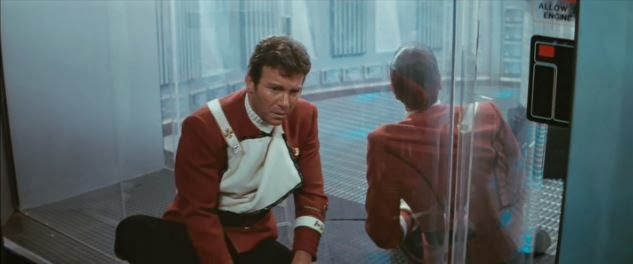
Now, William Shatner has certainly earned his reputation for overacting, which perhaps makes Kirk's reaction to Spock's sacrifice all the more devastating. Even being prepared, even knowing that the next film is called The Search for Spock, does not protect the viewer's heart from being ripped out by the friends' farewell, unable to reach each other, divided by a pane of glass. And Kirk's utter brokenness at being unable to do anything for his friend would bring a Vulcan to tears. (See Saavik in the funeral scene.)


The film does not let up in the aftermath to the famous death scene. First, witness Kirk trying not to break down as he delivers Spock's eulogy. As if that was not upsetting enough, Scotty gets out the bagpipes to send Spock off! Kirk briefly interrupted my grieving process by quoting Sydney Carton's last lines in A Tale of Two Cities - and getting the wording wrong, which caused my brain to itch. But I had barely enough time to compose myself before the famous "Space, the final frontier" voice-over begins, and it's Leonard Nimoy's voice! WHY WOULD YOU DO THAT? 

Thankfully, I know that the story is not over for everyone's favourite "pointy-eared hobgoblin," but at the time, when The Wrath of Khan could have marked the end of Star Trek, what a downer-ending that would have been. I must think myself fortunate that I have come to Star Trek late in the game, because to leave it on that note must have been unendurable.
Related Posts Plugin for WordPress, Blogger...