Showing posts with label boarding school. Show all posts

Sunday, 24 May 2020

Book to Screen: First Term at Malory Towers

When I was about eleven, I started adapting Enid Blyton's First Term at Malory Towers into script form, in a small Lion King notebook. It may have been around the same time that CITV broadcast an excellent adaptation (at least to my pre-adolescent eyes) of the Famous Five books. It was certainly an exercise in wish-fulfilment that I knew would never see the light of day, partly because I was a kid, but also because even at that age I knew there would be no home on kids' TV for a series with an all-female cast.

The Malory Towers books - especially the first one - opened up an entire world to me. I was not new to Enid Blyton's books - I was an enormous fan of her mysteries, especially the Famous Five - and I remember rummaging through the classroom book box for something by the author, and turning up triumphantly with Malory Towers. At first I was a little nonplussed, with a little confusion over the lead character's gender - I had only known Darrell as a boy's name at that point - and some bewilderment about how the brown tunic with orange trim could possibly constitute a "jolly nice" school uniform, but by the time I'd made it onto the train, I had put aside these nitpicks and become thoroughly engrossed in the story and the new-to-me setting of the Girl's Boarding School. Malory Towers came alive; I could picture the school, in its grey stately setting, built around a courtyard, with its salt-water swimming pool on the cliffs, and the dormitory towers.

That was at least 25 years ago, yet that series, especially the first book, became one of the stories that became inextricably entangled with my own childhood. It seems strange to lay a personal claim to a popular book by one of Britain's biggest-selling children's authors, but when I learned that the BBC had adapted it as a 13-part series, I felt weirdly proud and possessive. I approached it excitably - even getting up early on the day it arrived online, to watch an episode before work (my last day of work before we closed due to The Current Situation.)

Readers, it was simply marvellous!

I wasn't sure how much of Blyton's story was going to be used, and how much would be using her setting to tell original stories.  The story takes an episodic form - ideal for the genre, which takes place over the course of a school term - which blends scenes from the book with new material very well. Every scene I'd hoped for was there, in full and with very little meddling: the slap in the pool, the tricks, the mystery of Sally, and Mary-Lou's fountain pen. These scenes were adapted just as faithfully as my inner purist could ever have hoped, and so I don't mind in the least that additional material has been tidily slotted in alongside it. As well as the Blytonesque hijinks - midnight feasts, secret passages, a ghost story - the characters face things that maybe Blyton wouldn't have written about herself, but that ring true to the boarding school setting of the late 1940s, such as class and its expectations, and academic struggles. I think that it was a bold step to depict one of the bright heroines as having what would now be recognised as dyslexia: an important piece of representation for Malory Towers' young audience

The girls and mistresses were brought to life by a diverse cast who worked well together as a team. They embodied the classmates I've known for a quarter of a century - even the minor characters who even Blyton forgot about or replaced over the course of the series. (The only girl missing from the First Form North Tower dormitory is Violet, mentioned twice, whose defining trait is that she has exactly zero personality. Poor soul, I often wondered what became of her.) The only character I felt disappointed with was Matron (Ashley McGuire), reduced to a walking stereotype, a bullying, incompetent martinet. I've a suspicion that she was used to fill the gap left by Ma'm'zelle Dupont, Blyton's comedy French mistress whose main purpose was to be the butt of Alicia's pranks.

Ella Bright plays a spirited, well-rounded Darrell Rivers, a Darrell with a Past - an elaboration from the source material, but which is consistent with her character: she is the quintessential schoolgirl heroine, kind, fair, sporty and smart. (I just wish she had curly hair like the illustrations on my 1990s paperbacks.)
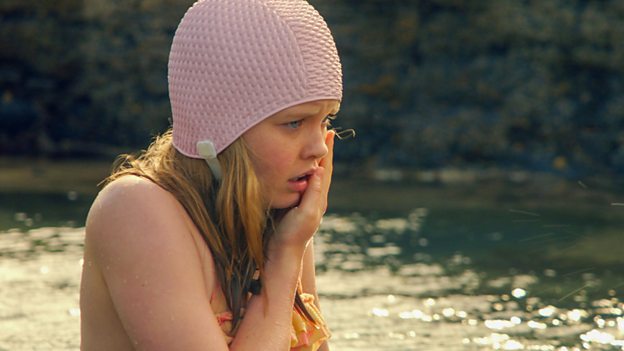
Meanwhile, Danya Grivers is every bit the spoilt, catty drama queen Gwendoline Mary Lacey - the perfect antagonist. Yet even she is shown a little more compassion, by the script and the characters, than Blyton ever afforded her. I never thought it fair that she was sneered at from her very first appearance. She's awful, but she was never given the chance to be otherwise. Here, at least, she is shown a little mercy and her character's vulnerability peeps through her spiteful exterior.

Then there's timid, sweet little Mary-Lou, jolly and scatterbrained musician Irene - as soon as they appeared, the friends who had been words on a page had faces of their own. Moody Sally, sensible Jean (albeit not Scottish) and stern Katherine, the head of form. Quiet, traditionally feminine Emily, who only really spends a couple of pages in the limelight on the page, has a subplot of her own, not from the book but that fits in seamlessly. A few lines and a North American (I think Canadian?) accent go a long way towards explaining hard-edged prankster Alicia, who rarely gets to see her family, even in the holidays, and who has huge hampers and gifts sent to her, perhaps as compensation, and remember that this is post-war Britain where rationing is stricter than it was even during the second world war.

Aside from the Matron quibble, I only have a few minor criticisms; occasionally some 21st-century-isms popped into the dialogue, such as Alicia saying "guys" or a couple of characters using the pinky-promise to swear everlasting friendship, which is a ubiquitous trope and yet I'm pretty sure has not been around as long as writers think it has. And I'd like to draw the distinction between anger, which can be used for good, and "temper" which is anger without self-control. Finally, there appear to be only about a dozen pupils and four members of staff in the whole school, and poor Pamela the head girl is also games coach and remedial tutor, and it leaves you wondering when on earth she has time to study her own lessons! But all in all, the first series of Malory Towers was simply smashing, and I'm really keen to see the rest of the books also adapted for the screen. I want to meet Bill, and Clarissa, and Mavis; I want to see the clifftop rescue, the midnight horse-ride, the Fifth Form pantomime.

I've waited 25 years for this, and now I want more.

Monday, 21 September 2015

Rereadathon 2: Epilogue


Apologies that this blog went silent after about the first week of the rereadathon. I've been keeping up my rereading, fitting it around work and writing, but haven't been making notes as I went along. But it's been a great fortnight of rediscovering old and more recent favourites, and although I didn't get through my entire pile, I read the books I realistically expected to.

Final Stats:

Number of books read: 8
"Big" novels: 3
Which were: The Martian - Andy Weir
11.22.63 - Stephen King
Fingersmith - Sarah Waters
School stories: 5
Which were: First Term at Malory Towers - Enid Blyton
The School at the Chalet - Elinor M. Brent-Dyer
Charlotte Sometimes - Penelope Farmer
The Girl in the Blue Tunic - Jean Ure
First Term at Trebizon - Anne Digby
Total pages read: 2402
Favourite reread: 11.22.63

A few last thoughts.

It was an absolute joy to reread my two favourite books from last year, and one which I reread a couple of years earlier. Of these three "big" books, 11.22.63 was the one which kept me every bit as gripped as on the first reading, and has probably earned itself a place in my top five books of all time. I wanted to read The Martian again before the film was released, not realising it's coming out at the end of next week - just in time for my birthday! It's a really believable science fiction novel, a tale of survival, and a celebration of human creativity and spirit against incredible odds. I'm really looking forward to seeing it on the big screen. Fingersmith is a mischievous adventure full of scoundrels and rogues, skulduggery and double-crossing, although on a second reading I was a little bit more critical than the first time around, noticing in a few places when the plot was just a bit too contrived. But it's a lot of fun, nonetheless.

On boarding school stories

I read through a range of boarding-school stories in preparation for my NaNoWriMo project for this year, written between about 1926 and 1997. It's interesting just how many books and series in the genre begin with the protagonist being a new girl in her class, when everyone else has settled into school for a few terms and got to know each other - four of the five books I read conformed to that pattern, and in fact I intend to use it myself this November. Harry Potter, while drawing on the grand old tradition of British Boarding School literature, is unusual for introducing an entire new class at the same time - there are never any new kids or transfer students at Hogwarts, except for the first years each September.

Three of the books were conventional school-stories of lessons, games and pranks, while two had a fantastical or supernatural plot to them - ghosts and time-travel, the latter of which (Charlotte Sometimes) has a similar premise (in reverse) to my planned story, of a schoolgirl finding herself in a different time period and having to adjust to an alien way of life, while being mistaken for someone else. I was struck by how short the books were - most of them under 200 pages - and am aware that this is going to be a challenge for me, as I have a tendency for rambling on. My current work in progress is at nearly 100 000 words and only just past the halfway mark. I'm starting to grow concerned, although I expect to cut a lot in the next draft. If my NaNoWriMo target is 50 000 words in a month, I want to reach that word count without having too much more left to write afterwards.

What to read next?

Since this year, I've been sticking to a "read 3, buy 2" rule, which has lasted eight months, but now my to-read shelf is looking sadly empty, so I've decided to relax that a little. I'm certainly overdue a good old book-shopping spree, and in October I'm going to Hay-on-Wye and all its bookshops, as well as, hopefully, Stratford-upon-Avon with some of the other bloggers. (Is that still going ahead, guys?) I've picked out a few books for the rest of September, but that is, as ever, subject to my moods and whims. It does look as though I need to buy some books that aren't from the science fiction, fantasy and horror shelves, though!


Not pictured: Wintersmith and Small Gods by Terry Pratchett, and Jonathan Strange and Mr Norrell by Susanna Clarke, borrowed from my dad, and 3 of the 80p Penguin Mini Classics books.

Friday, 11 September 2015

Rereadathon 2: part 2 Wednesday 9th-Friday 11th September


Hello! I haven't had an awful lot of rereading time in the last couple of days, as I was at work Wednesday and Thursday. Tuesday night, for some reason, I just could not get to sleep, and by the time about 2.30AM rolled around, I decided to get out one of my books to help wind my brain down. I finished The Martian on Tuesday evening, and so for that stupid o'clock read, I picked up Elinor M. Brent-Dyer's The School at the Chalet. 

The Chalet School series is one of the longer-running girls' boarding school series, running to about 60 books, begun in the 1920s and ending in the '60s. As you might expect, it changes a lot over the course of the books, and this week I decided to go back to where it all began. 24-year-old Madge Bettany decides to start an English girls' school in the Austrian Tirol, near a lake a little way from Innsbruck. Her first pupil is her twelve-year-old sister Joey, who is a bright spark, with a big heart and a passion for life, but whose physical strength does not match up to her boundless enthusiasm. There are only nine pupils on the first day of term: as well as Joey, there is another English girl from the same school, Grizel; Simone Lecoutier, the shy and clingy niece of the French mistress and deputy head, and six Austrians from the nearby village, ranging from nine to sixteen. It's been a long time since I went right back to the beginning, where there is a really cosy, intimate setting, and you get to know all the characters really well. The school grows and grows, and before long Madge leaves the school to get married, but new teachers come in, and pupils from across Europe and beyond. (Although entirely white, except for one Indian girl in one book, despite a couple of the books having misleading titles. I wanted A Chalet School from Kenya to be about an actual Kenyan girl, not an English child whose parents worked abroad!)

Of course, when Elinor Brent-Dyer started writing her school stories in the mid-1920s, she had no way of knowing that real-world events would force the plot to take a drastic turn if it were to continue in 1939, resulting in the excellent Chalet School in Exile. This is outstanding, not just in the series, but in the literary canon in general, as a contemporary account of Austria during the Anschluss, as seen from Britain. It's a hair-raising tale of adventure and courage, as well as sadness, as Madge and Joey, who, although this point are no longer part of the Chalet School, are still attached to it, have to close down their beloved school which they'd built up from one chalet and a handful of children, and escape and start again. On Guernsey, for a little while, then onto the Welsh border for the duration of the war.

I suppose there are three main segments of the Chalet School series: the Austrian years, mostly when Joey is a schoolgirl, then the war years, during which the school moves around several times, and then, finally, returning to Switzerland for the rest of the series. By this point, Joey is married, and the focus moves onto her eldest daughters, triplets called Len, Con and Margot - as well as an older girl called Mary-Lou, who readers either love or hate. I find her a bit too good to be true. She gets away with more than her contemporaries, has to make a project of "improving" any new girl who doesn't quite fit in, and is far too familiar with the teachers, but this is excused because "it's not cheek, it's just Mary-Lou." She really takes the biscuit in one of the books when she is made head girl of the school and her response is "oh, no, I couldn't possibly" after being the unelected leader of the senior school for years. And then, the very next chapter, she gets a special award for - I don't know - being Mary-Lou. "Oh, no, I couldn't possibly." Stupid or false modesty just comes across as stupid and false.

The other book I've been rereading is Stephen King's excellent 11.22.63 which I'm just about used to writing the date the wrong way round now. The hero, Jake, is currently living in 1950s Derry, Maine, in the aftermath of IT. Now I've read IT, the setting is even more eerie and unsettling, and I'm able to appreciate all the references to the previous novel. I haven't got as far into it as I'd hoped, as I spent this morning having a writing session (forsaking my usual local coffee shop for Starbucks - I am ashamed!) and then wandering around the town, looking in the other bookshops and admiring the autumn fashions, with their turning-leaf colours and chunky knitted jumpers. I've bought some wool to make myself a hoodie, in multi-coloured blue and purple shades, and I've also just started teaching myself to crochet with a new magazine partwork, each one teaching a new stitch or two, and with a pattern for a different kind of granny-square which will join together to make a patchwork blanket. I don't intend to buy the entire series - I've no idea how many will be in this series - but enough to make a variety of blanket squares. But I can't crochet and read at the same time, so I'll start knitting the hoodie this evening.

This weekend is the Bestival festival, at Robin Hill Country Park a few miles from my house. I always kind of dread this festival. the Isle of Wight music festival is closer to home, but at least the music stops at about midnight. It's not been unheard of for Bestival events to keep me awake until 4 in the morning with thumping bass on a Friday night. And I have to get up at half past 7 for work on Saturdays. Ugh ugh. So I'm prepared for a long reading night tonight, although I might also take my duvet downstairs and sleep on the sofa, as I don't think it is as audible from the front room. We'll see.

Bex's Rereadathon Challenge

Last time, Bex asked which is the one book you reread over and over again. This time, she wants a list. Book bloggers love lists, right?

  • Anne of Green Gables. C'mon, you know me better than to expect me to omit this one! I'll reread at least one of the Anne books pretty much every year. Not necessarily the entire series, but I can't go very long without spending some time with my favourite redhead: Anne of Green Gables, Anne of the Island are the usual candidates, but also Rilla of Ingleside (although that is more centred upon her children as young adults.)
  • The Lord of the Rings. Back in my sixth form and student days I just could not put these books down. I'd start reading every November, at first in preparation for the film adaptations, and then because it had become tradition. I don't read it quite so frequently any more, but I have read it three more times since starting my blog seven years ago.
  • Harry Potter. The ultimate in comfort reading; I start getting the urge for a reread about every two years, usually in the autumn or winter.
  • The Chronicles of Narnia. These have been a part of my life for as long as I can remember. I saw the BBC adaptation back when they used to show serialised children's classics on a Sunday night in the lead-up to Christmas, and when I was about seven, Dad sat me down and began to read: "There was a boy called Eustace Clarence Scrubb, and he almost deserved it." I was thrilled to discover this was part of a series with my beloved The Lion, the Witch and the Wardrobe. I stuck little pictures to the back of my wardrobe and would sit in there and imagine myself away. And I always try to reread The Lion, the Witch and the Wardrobe before Christmas, and some of the other books in the series in the appropriate time of the year: The Magician's Nephew in spring, The Voyage of the Dawn Treader at the end of Summer (hmm... must be about time to reread that again...) etcetera, etcetera.
  • Neverwhere. This was the book that made me fall in love with Neil Gaiman's writing. He created a new mythology for London, out of the names of the places, and it just made sense. It was like just scratching away the surface to make sense of a city that is, when you come to think of it, quite strange. I've reread all of his books on my bookcase at least once, I think, except for the Trigger Warning collection which only came out this year. American Gods and Good Omens should also feature on this list, as I've reread them at least three times since buying them. American Gods, in particular, I find new things on every reread (and is also on my reserve rereadathon pile) and Good Omens is just so funny.
  • Discworld. With 41 books, of course I don't do a complete reread every year, but there are certain sub-series within the series that I return to most often. Top of that list are the first few Watch books: Guards! Guards!, Men at Arms and Feet of Clay, as well as the masterpiece Night Watch. Then there are the Witches books: Wyrd Sisters, Witches Abroad, Lords and Ladies and Maskerade. Hogfather gets read a lot at Christmas, and if I don't read the book, I'll watch the TV film. And Going Postal and Monstrous Regiment are others that appear regularly. I'm filling in the gaps this year; there are now only 4 left I haven't read.
So, what about you? Do any of these books or series appear regularly on your reading list, or are your favourite rereads completely different? 

Sunday, 29 March 2015

Murder Most Unladylike & Arsenic For Tea - Robin Stevens

There's been a rather shocking murder at Deapdean School for Girls. Unfortunately, there is no proof; between Hazel Wong stumbling upon a dead science mistress in the gymnasium and going for help, the body has vanished, leaving no evidence that Miss Bell has done anything other than resigned her post and moved away. But Hazel knows what she saw. It is up to her and her friend Daisy Wells, the founding members of the third-form Wells and Wong Detective Society to uncover the truth!

Set in a 1930s girls' boarding school, Murder Most Unladylike is reminiscent of the school stories that made up a lot of children's literature of the 20th century - Malory Towers, the Chalet School, Angela Brazil - mixed up together with the Famous Five or Nancy Drew. Robin Stevens recreates the golden age of children's books wonderfully, with dormitory pranks and midnight feasts, gym tunics and bun breaks, with a mystery to be solved without getting the police involved. But within this old-timey children's story are subjects that wouldn't have been written about in 1934, not for children - the racism Hazel, who is from Hong Kong, faces, two of the schoolmistresses having been in a relationship, and an illegitimate child showing up from someone else's past. Plus murder, of course - I don't think anyone ever actually died in Enid Blyton's writing. A dog might have got ill from eating poisoned food once or twice, but that's about the extent of it.

Daisy and Hazel join a long line of classic detective duos: Like Sherlock Holmes, Daisy is the intrepid detective whose excitement for a case sometimes overlooks human compassion. Hazel is more cautious, and the chronicler of their adventures - Daisy even calls her "Watson" from time to time. The story is a lot of fun, if verging on the ridiculous sometimes as this small private school has an unusually high body count!

The sequel, Arsenic for Tea, takes place away from Deepdean. You can't have too many murder mysteries at one school; it would be closed down! Hazel goes to stay with Daisy at her huge, if slightly faded, English country house. Daisy's birthday falls during this holiday, and her mother throws a big tea party, but as well as the family and school friends, the house has some mysterious and sinister guests. The atmosphere is terrible, filled with unspoken secrets and deceit. And then, one of the guests falls horribly ill and dies. The evidence points to poison. But who might bear such ill-will towards this guest? Perhaps it would be easier to ask who doesn't. Wells and Wong launch another investigation, but Daisy finds it is not so easy to get swept up in the spirit of adventure when her own family members are implicated in murder.

Arsenic for Tea is another instant classic of children's literature, perhaps even better than Murder Most Unladylike. It is Agatha Christie for children: a well-plotted, twisty mystery with plenty of red herrings, a limited cast of suspects, but everyone keeping secrets, even if none of them are the secrets they are suspected of hiding. But Stevens plays fair, and hides the clues within the text, if you only know what you're looking for. I actually picked my suspect quite early on and stored up the evidence against them even while they were seemingly eliminated from the list. I felt very proud of myself when I was proven right - not because the author was sloppy but because I was paying attention. An excellent, very satisfying pair of mysteries, and I hope to see a lot more of Daisy Wells and Hazel Wong.
Related Posts Plugin for WordPress, Blogger...