Showing posts with label sci-fi. Show all posts

Monday, 21 September 2015

Rereadathon 2: Epilogue


Apologies that this blog went silent after about the first week of the rereadathon. I've been keeping up my rereading, fitting it around work and writing, but haven't been making notes as I went along. But it's been a great fortnight of rediscovering old and more recent favourites, and although I didn't get through my entire pile, I read the books I realistically expected to.

Final Stats:

Number of books read: 8
"Big" novels: 3
Which were: The Martian - Andy Weir
11.22.63 - Stephen King
Fingersmith - Sarah Waters
School stories: 5
Which were: First Term at Malory Towers - Enid Blyton
The School at the Chalet - Elinor M. Brent-Dyer
Charlotte Sometimes - Penelope Farmer
The Girl in the Blue Tunic - Jean Ure
First Term at Trebizon - Anne Digby
Total pages read: 2402
Favourite reread: 11.22.63

A few last thoughts.

It was an absolute joy to reread my two favourite books from last year, and one which I reread a couple of years earlier. Of these three "big" books, 11.22.63 was the one which kept me every bit as gripped as on the first reading, and has probably earned itself a place in my top five books of all time. I wanted to read The Martian again before the film was released, not realising it's coming out at the end of next week - just in time for my birthday! It's a really believable science fiction novel, a tale of survival, and a celebration of human creativity and spirit against incredible odds. I'm really looking forward to seeing it on the big screen. Fingersmith is a mischievous adventure full of scoundrels and rogues, skulduggery and double-crossing, although on a second reading I was a little bit more critical than the first time around, noticing in a few places when the plot was just a bit too contrived. But it's a lot of fun, nonetheless.

On boarding school stories

I read through a range of boarding-school stories in preparation for my NaNoWriMo project for this year, written between about 1926 and 1997. It's interesting just how many books and series in the genre begin with the protagonist being a new girl in her class, when everyone else has settled into school for a few terms and got to know each other - four of the five books I read conformed to that pattern, and in fact I intend to use it myself this November. Harry Potter, while drawing on the grand old tradition of British Boarding School literature, is unusual for introducing an entire new class at the same time - there are never any new kids or transfer students at Hogwarts, except for the first years each September.

Three of the books were conventional school-stories of lessons, games and pranks, while two had a fantastical or supernatural plot to them - ghosts and time-travel, the latter of which (Charlotte Sometimes) has a similar premise (in reverse) to my planned story, of a schoolgirl finding herself in a different time period and having to adjust to an alien way of life, while being mistaken for someone else. I was struck by how short the books were - most of them under 200 pages - and am aware that this is going to be a challenge for me, as I have a tendency for rambling on. My current work in progress is at nearly 100 000 words and only just past the halfway mark. I'm starting to grow concerned, although I expect to cut a lot in the next draft. If my NaNoWriMo target is 50 000 words in a month, I want to reach that word count without having too much more left to write afterwards.

What to read next?

Since this year, I've been sticking to a "read 3, buy 2" rule, which has lasted eight months, but now my to-read shelf is looking sadly empty, so I've decided to relax that a little. I'm certainly overdue a good old book-shopping spree, and in October I'm going to Hay-on-Wye and all its bookshops, as well as, hopefully, Stratford-upon-Avon with some of the other bloggers. (Is that still going ahead, guys?) I've picked out a few books for the rest of September, but that is, as ever, subject to my moods and whims. It does look as though I need to buy some books that aren't from the science fiction, fantasy and horror shelves, though!


Not pictured: Wintersmith and Small Gods by Terry Pratchett, and Jonathan Strange and Mr Norrell by Susanna Clarke, borrowed from my dad, and 3 of the 80p Penguin Mini Classics books.

Wednesday, 1 July 2015

Lock In - John Scalzi


It is the not-too-distant future, and the world has changed. After a worldwide epidemic of a debilitating disease, called Haden's Syndrome, whose worst (non-fatal) effect is lock-in syndrome, science and technology have made great leaps to help sufferers lead some semblance of a normal life. Firstly there are remotely-controlled robotesque bodies colloquially known as "threeps" (as in C-3PO). The Haden's afflicted person may physically be lying paralysed in a bed, but their minds can inhabit these synthetic bodies and do most of the things that everyone else can do. Then there is the Agora, a sort of fully-immersive internet, where people can meet in cyberspace without the hastle of computers or smartphones. Finally, there are the integrators, a small minority of people who can let the Hadens borrow their bodies for a while - but fully conscious, and are an essential part of the decision-making and action processes.

So, this is the world of Lock In. Quite a complex set of ideas to get your head around, and it's best to take the first chapter or two slowly to figure it all out, but it's a really fascinating concept for a book. After all, if a person's mind/soul/personality are all made up of electrical signals from the brain, then why not? Why can't they be remotely transmitted to other places outside the body?

The protagonist of Lock In is Agent Chris Shane*, a new recruit to the FBI - and a Haden. On Shane's very first day, an apparent suicide leads to the discovery that someone is abusing the Haden's technology for their own nefarious purposes, and it is up to Shane and partner Vann to get to the heart of the mystery. But the conspiracy goes far deeper than Shane could have imagined, with far-reaching implications...

Lock In is an intelligent science fiction novel which uses fantastical ideas to make you think about real-world issues, such as corruption in business, the dangers of the commercial side of the health industry, and raises questions about the ethics of  medical advancement, technology, and quality of life. The scientists in the world of Lock In see opportunity in disaster, and in treating Haden's Syndrome, they have made steps towards the evolution of a new life form. But what does this mean for the human race? In such a situation, do we have a moral obligation to fix what is broken or to take the broken pieces to create something new which could end up replacing us?

It is these questions which make Lock In something beyond a simple science-fiction detective novel. After finishing the book, I found myself missing it, sorry to have reached the end and said farewell to the characters, the world and the questions it provokes. An excellent novel, and I recommend it to anyone who enjoyed Ready Player One, Scalzi's Redshirts (very different kind of story but the same humour and narrative voice) or Joss Whedon's TV series, Dollhouse. 


*It was not until it was pointed out to me that I realised that Scalzi never specified whether Agent Shane was a Christopher or a Christine. I assumed all the way through the book that the character was male, possibly because of the masculine-sounding surname, but I'm going to have to reread imagining the character as a woman. Apparently there are two audiobook versions, too, one read by Wil Wheaton and the other by Amber Benson (the lovely lovely Tara from Buffy!)

Friday, 7 December 2012

1Q84, Haruki Murakami

The year is 1Q84. This is the real world, there is no doubt about that. But in this world, there are two moons in the sky. In this world, the fates of two people, Tengo and Aomame, are closely entwined. They are each, in their own way, doing something very dangerous. And in this world, there seems no way to save them both. Something extraordinary is starting.

This review could be considering spoilery, if the above book blurb is all you have to go on.

1Q84 follows the lives of two characters, Aomame and Tengo, who are living very different lives in Tokyo. Aomame is a fitness trainer who doubles as an assassin, and who finds her world ever so slightly but significantly wrong after taking a shortcut off the expressway when running late for an "appointment. Tengo is an aspiring writer with a part-time job as a mathematics teacher at a girls' school. When offered the morally dubious task of rewriting a fantasy novel by an enigmatic child prodigy for a literary competition, Tengo finds himself embroiled deeper and deeper in trouble that has little to do with the legal ramifications of fraud. To his dismay, he starts to realise that this extraordinary tale of "Little People," who spin air chrysalises to hatch - essentially - changelings, a secretive cult, and a world with two moons, is not fantasy at all, but autobiography. And the Little People did not want to be written about.

Murakami keeps you guessing about how Tengo and Aomame's stories fit together, as they spend much of the book going about their lives without any kind of interaction or indication that they have ever met. Their worlds don't fit together neatly at first, and in fact I wondered at least once whether they even inhabited the same reality. There are parallels between the two characters' lives, and I would be just on the verge of thinking I knew how they worked when a small detail would seem to throw me off the scent again. The world, or worlds, of 1Q84 shifted and were just a little off-kilter for a while, before Murakami began to answer the questions raised.

The influence of Murakami's "Little People" can be felt throughout the novel, though they are rarely seen and never explained. Are they malevolent fairies or demons? When we do actually meet them, it is in a haunting, surreal scene that unsettles the mind for a long time afterwards. Despite the vagueness of the "Little People," they seemed more vivid and real than any other part of the story - it felt impossible to me that the human mind could make this up. In a New York Times interview, Murakami explained that "The Little People came suddenly. I don’t know who they are. I don’t know what it means. I was a prisoner of the story. I had no choice. They came, and I described it. That is my work." An unsettling thing to read, considering the catastrophic consequences of writing about the Little People in 1Q84. Within the book, Murakami blurred the lines between fiction and reality so well that it even spills into the mind of the reader.

The world of 1Q84 really held my imagination for a long time after I finished reading it, but the story itself was far from flawless. In three volumes, it is too long, with a lot of unnecessary exposition - book 3 introduces a character whose main role is to discover all the things the reader already knows. The characters often don't act or think like real people at all, but are quite clearly doing what they have to in order to fit the plot, rather than the plot evolving naturally from the characters' actions, and the leaps of logic with which characters solve mysteries are ridiculous. Tengo has a memory of Aomame, as a child, looking at the moon, and takes this thought as a message that he needs to look at the moon - and wait! There are two moons! Which automatically means a lot of other things are instantly to be taken as fact, not fiction. Characters somehow arrive at unlikely but true conclusions with very little reason to lead them there, and Aomame "just knows" an impossible thing can only be caused by another, specific, impossible thing.

And, though I can believe in Little People, parallel universes and two moons, I cannot suspend my disbelief enough to be convinced that two people, who interacted precisely once, twenty years ago, in fifth grade, can have a "connection" that means that they are each other's lost love, destined to be together.

All in all, I had a love-hate relationship with 1Q84. It began and ended well, and was full of   extraordinary moments. I felt a thrill every time Aomame noticed something not-quite-right about her new world, and the Little People were among the weirdest things I've read in recent times. But ultimately, the questions were more satisfying to see asked than answered, and the fantasy world was more interesting than the characters or the story itself.

Friday, 24 August 2012

Looking Forward: Doctor Who, Series 7

It's been a long wait, but the new series of Doctor Who is almost upon us. Since the cult sci-fi series' relaunch in 2005, it has aired in the spring, usually beginning around the Easter weekend, but this year Steven Moffat has kept us waiting until the end of summer. As the evenings begin to grow darker, the atmosphere intensifies, the monsters that keep viewers behind the sofas are that bit scarier, the nightmares a little bit more real. But what awaits the Doctor and his brave companions this time around?


Daleks again, for one thing. So often killed off for good, but they always return, bigger and more numerous and more imposing than before. Or, alternatively, brightly coloured and/or offering round cups of tea. This lot certainly look impressive - but I've started to tire of the question, "How do we improve on Daleks?" being answered with, "MORE Daleks!" It is, however, grand storyteller Moffat in charge, so I think we can count on some more plot than mere grandeur.

More monsters! Dinosaurs - on a spaceship! Weeping angels again, including a creepy, creepy weeping cherub. (Eep!) The Doctor getting out of control again, flipping back to his "vengeance!" setting. (He seems to flip between two settings - vengeance and mercy, which coincide with whether he thinks he is more dangerous travelling alone or with a friend.) America! And then the trailer ends with this image that the BBC have been plastering all over their marketing: the Doctor carrying a limp and lifeless Amy Pond in his arms.

But will they really do it? Come on, Moff. I dare you.

Time and time again, since the relaunched series, the question has been asked: will the Doctor's companion be killed off for real? First of all we had Rose's voiceover in her final episode: "This is the story of how I died." Well, I'm sure I don't have to point out the logical flaw in that. Two series later, Rose (who had been trapped in a parallel universe forever and ever, impossible to return or it would mean the end of the universe) returned, and warned Donna she was going to die. So did an insane Dalek.

Donna didn't die.

Both of those companions' departures were heartrending. Neither were ever going to leave the Doctor of their own free will. They got too attached, and I wonder if the head writer at the time, Russell T. Davies, felt that he had written himself into a corner. How was he ever going to let these characters go? But he found a way, and perhaps that way was more tragic than killing Rose or Donna outright. Perhaps.

At the end of series 6, I thought that Moffat and co had written Amy and her husband Rory out of the series quite neatly, with the Doctor realising that their travelling with him was too much of a risk, dropping them off at home to live happily ever after, a subdued but tidy tying up of their characters' journeys. So I was rather dismayed to read that their real ending was to be "heartbreaking." Now, I'm as big a fan of a good tragedy as anyone, but if every send-off is a tearjerker, does it diminish its power? Does that have to be the norm? (I know Martha's farewell wasn't a tissue-fest, but I think she was a weaker character anyway.)

But is Amy really going to die? We've been fooled too many times. Neither Rose nor Donna actually died when they were supposed to, nor - SPOILER ALERT - did the Doctor in 2011 and, if you want to include Moffat's other works, what about Sherlock? (Although that should have surprised no one familiar with the Holmes mythology.) Besides, if the BBC have put that image out so publicly, they've taken away any shock value of killing off Amy Pond. Haven't they?

But what if that's what they want you to think? Maybe they're double-bluffing. I dare you, Moffat! I dare you to actually kill off Amy. Who, by the way, is not the Doctor's only companion. I get so irritated when the TV magazines continue to show pictures of the Doctor and Amy posing together, as the Doctor has posed in publicity with all the other young, pretty girls he's taken for companions. Amy travels with her husband Rory, and their romance has been a key element of the last two seasons - so why must the publicists keep on leaving him out?

I'm ranting, sorry. The other part of Rory's story is that he is the man who keeps on cheating death. It's become quite an in-joke, in fact. How many times has he died since his character's introduction? He's lived for thousands of years - but perhaps, if Amy is really and truly killed off in this upcoming series, his fate will catch him up properly, and he will "greet death like an old friend."


Huh. That's rather a gloomy thought to dwell on, though. The other thing of interest is, of course, the new companion, Amy and Rory's replacement. Aside from the actress playing her, Jenna-Louise Coleman (young, pretty and female) the Moff has kept mum about this new character, not even revealing her name. This silence leads me to wonder what the big secret is. My theory is that she is not a modern Earthling. Perhaps she is from another planet, far in the past or far in the future, and that revealing her name as Gingledwina, Starshine or Aelfrida would spoil the surprise.
Head writer Steven Moffat and new companion Jenna
image taken from the Guardian website

Like last year, it appears that series 7 will be split in two, and, because of the unusual scheduling, the annual Christmas episode will actually come part-way through the series. How will that work, I wonder, if they leave part 1 on a massive cliffhanger as they did last year? The Christmas Special tends to be a stand-alone episode, but will they work it into the overall series storyline this year?

All these questions, and more, leave me shivering with anticip...

Thursday, 28 July 2011

Specials, Scott Westerfeld

Sorry for the sparsity of book reviews at the blog recently. After the thrill of getting really immersed into the Harry Potter world once more, reading one book after another, I've taken my reading a bit slower than usual, as well as reading many books at once - and subsequently taking longer to finish any one.

If you come to Specials after reading the prequel books, Uglies and Pretties, you'll probably have a good idea of the patterns the story takes. It starts off, some time after Tally Youngblood and her friend Shay have had yet more operations to make them "Special:" Employed as government agents and set to crushing the rebellions among the ordinary Pretty folk, Tally and Shay have had their faces redesigned to intimidate the "bubbleheaded" pretties, senses finely-tuned to track and outsmart miscreants, and radio antennae implanted into their skin so they can communicate from afar. Their minds are made coldly logical, and their personalities rewritten once more to incorporate a large dose of arrogance. As far as Tally's concerned, this is the way things are supposed to be, until a reminder from her past sets her questioning her world once more.

Like Pretties, it is frustrating to read Tally's thought processes from the outside - when you know how she is brainwashed and manipulated into working for a crazy totalitatian government. With her new personality traits, I found myself actually disliking Tally this time around - even though I knew this wasn't really her. But the story begs the question: when her mind has been so meddled with, what is her real personality? Is it how she used to be, or what she seems to be now? It was interesting to see the dystopian world from other side; the point of view of those who not only support but enforce it, so that everyone can live in peace and order, and that individuality and personal freedom are a small price to pay for such a world.

Westerfeld also raises the questions of what it is to be human. What started off as a little bit of meddling - cosmetic surgery to make everyone look a certain standard of "pretty" - requires more and more meddling to keep under control. "Pretties" need brain surgery to prevent them thinking too hard about the ethics of the process, and then there need to be Special Circumstance agents to keep control, who need to be rewired in another way. As a Special, Tally finds herself repulsed by her former boyfriend Zane, because although he is "pretty," he is just the same as everyone else. All are equal, but some are more equal than others.

Despite the ethical questions, I found myself skimming through chunks of Specials, losing interest as the story seemed to repeat the same patterns as the first two volumes, saturated with technobabble I couldn't really visualise. It picked up towards the end, when Tally reached the "New Smoke," the city of Diego, where she finds that her very existence is questioned in its legality, and is faced with the dilemma of how to proceed in the upcoming war between Dr Cable's neatly-ordered Pretty city, and the New Smoke. I was surprised by the ending, and impressed that Westerfeld did not go for the easy or obvious ending, but I am in no great hurry to read the companion novel Extras. All in all, I think the Uglies story had potential, but that it was dragged out too long.

Sunday, 19 September 2010

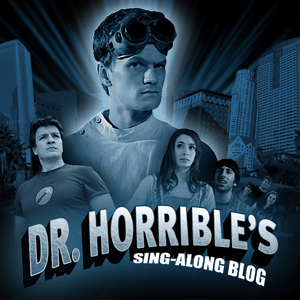
Dr. Horrible's Sing-Along Blog

"I've got a Ph.D in horribleness."

Who'd have thought it? A three-act online mini-series chronicling the life of an ineffectual super-villain as he attempts to get into the Evil League of Evil, led by the elusive Bad Horse, and win the girl of his dreams. And it's a musical. And it works.

Dr. Horrible was created by Joss Whedon, best known for such TV series as Buffy the Vampire Slayer, during the American Writer's Strike of a couple of years ago on a low budget and broadcast online. It is a parody or deconstruction of the superhero genre of films. When he's not plotting crimes that will satisfy the Evil League of Evil, Dr. Horrible is a rather awkward but sweet young man called Billy, who is too shy to speak to his "laundry buddy," the beautiful and kind-hearted Penny (Felicia Day). His aspirations seem to be more about gaining respect and status as a supervillain than an actual villainous nature, and changing the world, because "the status is not quo." He has a vocal coach to help him work on his evil laugh, and has no problem stealing "wonderflonium" to power his freeze-ray, but he is reluctant to harm anyone: "There's kids in that park!" he says to a wannabe nemesis after refusing to fight him. He has been beaten up many, many times by his real archnemesis, Captain Hammer.

Hammer, the Superhero to Dr. Horrible's Supervillain, is on the other hand an egotistical, callous slimeball. When Captain Hammer decides to make Penny his girlfriend, just because Horrible likes her, Dr Horrible is pushed out of his comfort zone. He vows to get his ultimate revenge and satisfy Bad Horse's tough criteria for entry into the League at the same time.

For me, the musical highlights are the duet between Dr. Horrible and Penny in the beginning of Act II, where Horrible's bitterness and Penny's hope and idealism meet in catchy, beautiful harmony, and on the flip side, the rocky, angry, guitary Act II finale, "Brand New Day," where Dr. Horrible swears revenge on the sleazy jerk Captain Hammer.

Short and sweet, only the length of a single episode of Doctor Who in its entirety, nevertheless Dr. Horrible's Sing-Along Blog is memorable and well on its way to becoming a classic alternative media film. Its story is concise, simple yet radical, making you cheer on the villain and boo the hero. And in the end, Horrible succeeds in getting "the world I wanted at my feet/ my victory's complete/so hail to the king," but at such a cost! Up to that point a comedy, the story turns to tragedy in the last few minutes, in a classic case of "be careful what you wish for." The ending is abrupt, with its victory dirge "Everything You Ever" cut short at the end, showing the smallest glimpse of Dr. Horrible in Billy mode, looking completely lost and forlorn and out of his uniform, looking nothing if not in need of a hug.

Friday, 3 September 2010

TV: Ashes to Ashes (series 1-2)

Let's fire up the Quattro.


After the phenomenon that was Life on Mars, it was not too surprising that Gene Hunt would appear on our screens once more, in another Bowie-song-titled series. This time it is 1981 and the much-loved anti-hero and his team have been transferred down to London. The series has undergone a glamorous makeover and now we land at the beginning of the New Romantic movement. The new titles blare with squealy guitars, and of course Hunt has a shiny new car: the iconic Audi Quattro.

One member of the Life on Mars team is notably absent: protagonist Sam Tyler ended the series 2 finale by committing suicide, sending himself (temporarily) back to 1973 where he felt he belonged. Time moves differently there, and he spent six happy years in the seventies before his fate caught up with him. This time it is police psychiatrist  psychologist Alex Drake in the fish-out-of-water role. Back in the 2000s, Alex had been investigating Tyler's death, and therefore when she arrives in 1981, she has a little background knowledge of DCI Hunt, DS Ray Carling and DC Chris Skelton. Seeing that, as far as Alex is concerned, they and their world were dreamed up by a comatose Sam Tyler, and considering that her last memory was of being shot in the head, it is not unreasonable for her to assume that she too is unconscious and dreaming. Unfortunately for her, Hunt, Carling, Skelton and newcomer Sharon "Shaz" Granger won't accept their roles as sidekicks in her story, and object to this newcomer strutting around as if she is the only person who matters - or even really exists.

Introducing a strong-willed female counterpart to Sam Tyler - and one whose first 1980s outfit is that of a prostitute - adds a new angle to the love-hate relationship between old and new methods, and of course between the characters themselves. As far as Gene is concerned, Alex "Bolly-Knickers" is a posh, smug - but strangely sexy - know-it-all, and Alex considers Gene a misogynistic neanderthal (but ditto the strangely attractive factor.) 


In Ashes to Ashes we get to see deeper sides to the characters introduced in Life on Mars. Ray Carling, (Dean Andrews,) who was not portrayed wholly sympathetically in the original series, softens in his attitudes, showing more respect to Alex than he did to Sam. The moment where I found myself warming to him was in the third episode when he is awkwardly compassionate towards a young woman taking refuge in the police station. Chris Skelton (Marshall Lancaster) has matured from the nervous and rather dim youngster he was in Life on Mars and is in a romantic relationship with the rather lovely Shaz Granger (Montserrat Lombard.)

As in Life on Mars, while Alex tries to get used to her new life in the '80s, surreal happenings keep imposing on her, cementing her belief that she is in a coma and dreaming. As well as seeing her daughter Molly in a time before Molly even existed, every so often the clown from David Bowie's Ashes to Ashes music video turns up taunting her, like the Test Card girl in Life on Mars. She also has to deal with meeting her parents, who died when Alex was a little girl. In 1981. The first series deals with Alex trying so desperately to change her past and prevent the bomb from exploding and killing her family. But alas, as we saw in Life on Mars, it seems that you just can't change your own history.

Or so it would seem. In series two, Alex meets another time traveller from the early twenty first century. The plot around Martin Summers challenges everything you think you know about the rules of time travel in this story's world, when he does something that really, really screws up his own timeline.

Monday, 23 August 2010

TV: Life on Mars

My name is Sam Tyler. I had an accident and I woke up in 1973. Am I mad, in a coma, or back in time? Whatever’s happened, it’s like I’ve landed on a different planet. Now, maybe if I can work out the reason, I can get home.

Despite myself living practically on a different planet when Life on Mars was first broadcast in 2006 (I was a student in a house with no TV,) I was aware that it was a refreshingly original drama series: a new take on an old genre, the 70s cop show, but with a mystery. However, it wasn’t until this year that I finally sat down and watched the two series of Life on Mars and three of Ashes to Ashes in about a month.

Life on Mars began as the sort of TV programme that you really couldn’t make these days! A modern-day police show is far removed from the high-action cops-and-robbers chase shows that were around in the good old days, or so they say. Police officers have to be careful, professional and respectful - all well and good, but not so much fun to watch.

Until they get hit by a car, sent back in time to the ‘seventies and introduced to the Gene Genie. Make no doubt about it, although Sam Tyler (John Simm) is the protagonist of Life on Mars, Gene Hunt is who we watch the show for. Gene Hunt (Philip Glenister) is Sam’s new boss, and he has very different ideas about how a police force should be run. Rather, Sam’s ideas are the new ones: Gene runs his department on the tried-and-tested method of brute force and ignorance… and an unlimited capacity for creative and outrageous verbal - and physical - abuse. The differences between their styles of policing is most concisely shown when trying to gain access to a flat: while Tyler fumbles around attempting to pick the lock, Hunt kicks the door in: Crude, but efficient.
While at first 1973 seems a rather random date for Sam to be sent to, with great music and lots of nostalgia for a rather iconic era, as the story unfolds it is revealed that something significant happened to the Tyler family at that time and it’s up to Sam to change his family’s history. But is time changeable? In some ways it seems possible: in the very first episode, Sam manages to influence a chain of events that eventually help to save his girlfriend in 2006. But other events are inevitably, tragically doomed. Evidence suggests that one can’t change one’s own timeline in this version of time travel.

Life on Mars isn’t, however, a straightforward time-travel show. Even while in a fully-formed 1973, with flared jeans, awesome music and a lot of brown, Sam experiences strange, out-of-place phenomena that make the series far more complex, thought-provoking . The Test Card F girl comes to life and walks out of his TV screen to talk eerily to him, and he hears voices that he recognises from his life back in the 21st century.
So, is he mad, in a coma or back in time? Is 1973 real or in his mind? (Or, as Dumbledore suggests in the final Harry Potter book, both? Life on Mars in some respects reminded me of Terry Pratchett’s book Night Watch. If it weren’t for the fact that the novel was published before the TV series, you could be forgiven for thinking that Pratchett had borrowed some aspects of his story from a roundworld equivalent. Watchman Commander Sam Vimes is sent back in time by a freak accident where he has to survive a major incident in his past, and in this case, mentor his younger self with his modern-style policing to keep him from being influenced by the dodgy coppers. Interestingly, it is in Discworld where there is a straightforward morality in the Watch, while in Life on Mars, although we really can’t condone everything anything - that Gene Hunt says or does, it has to be confessed, he gets results and his heart is (more or less) in the right place.

Saturday, 3 April 2010

Doctor Who: The Eleventh Doctor: First impressions. Here be spoilers.

Just a short post, this time, but I thought it only fair to state for the record my first thoughts on Matt Smith as the Eleventh Doctor, and the first episode of the new series. Warning - Spoilers!

If I were to summarise it in one sentence, I would say "I enjoyed it, but it doesn't feel like Doctor Who." There wasn't very much to link this series to the last one, which I think was intentional to mark Steven Moffat taking over the job as Big Boss Man, making a break from the old and starting with a clean canvas. When Ecclestone regenerated into Tennant, he still had Rose, and, essentially could just carry on where he left off. Tennant regenerated alone, and it was definitely the end of one story and the beginning of another, and it feels that way. The titles are different. The Doctor is different. He's meeting a new companion. The TARDIS itself regenerates, and he even gets a new sonic screwdriver. He doesn't even wind up in London, which was featured in so many of the first 4 1/2 series that it became the main setting. This was a new series, and it will take a while to think of it as Doctor Who. No doubt when the 2005 Series One came out, older fans felt the same, but as I said in a previous post, I don't remember it enough to feel that very much.

I can't say a lot about the characters, yet, having spent only an hour with them. The Eleventh Doctor (who I can't yet think of without the number) seems like a big child - he's a new person and doesn't seem quite sure what to do with himself, very clumsy. He seems to be a mild-mannered, understated sort of man with this crazy, adventurous, carefree side just beneath the surface. And he seems very innocent - a pre-time-war version of the Doctor, without all the pain that his previous two incarnations suffered. This makes me wonder if the series is going back into a smaller scale of story. The last series just got bigger and bigger, darker and more dangerous, week by week, and now it seems to have switched back to the olden days, where the Doctor is travelling just for the fun of it. With the Tenth Doctor, though it was for the fun of it, you got the impression he was always running away from something, trying to run away from himself.

Amelia/Amy Pond was an interesting character, though, again, we don't know much about her yet. She met the Doctor when she was seven years old, and he crashed into her back garden. After trying out half of the contents of her kitchen (and spitting them out again, reminding me and mum very much of Tigger) investigating a crack in her bedroom wall, the Doctor nipped back into the Tardis to check it was regenerating properly, promised to see her in five minutes - and vanished. For twelve years.

Amelia seems to be a very lonely, unhappy little girl. She has no parents, no siblings, has moved to England from her beloved Scotland, and it's implied she's at least a bit neglected, as her aunt leaves her alone in the house when she is seven years old, and has no qualms about using the stove. I wrote in my last post that she seemed too young, but although she looks young, even as a small girl she's had to grow up fast. And the Doctor makes such an impression on her at a young age because he actually notices her and shows interest in her. (Or maybe, just maybe, because he crashlands a time machine into her back garden, opens up a crack in her bedroom wall which is also a crack in the universe, exposing a giant eyeball, then runs off again.) The adult Amy, as she now calls herself, is an independent woman, but still seems to be searching for something, possibly unable to believe it when "something" returns.

Wasn't quite sure of the aliens this time around, but certainly there were a few creepy moments: the voices through the crack in the wall, the room hidden in plain view in Amy's house that she never even knew was there, and the alien disguised as a man walking his dog... but that went a bit wrong, giving the man the dog's voice. I even found those - what were they? - little models of "the raggedy doctor" a bit creepy, but I think that was because I felt I was missing something. The TV had cut out for a moment when Amy was explaining what was meant by "the raggedy doctor." Having said that, even that name has the potential to cause nightmares.

When at the end of the episode, the Doctor confronted the aliens, telling them of all the aliens that had attempted to invade the earth before, and of what happened to them (he happened to them) he spoke so matter-of-factly. I don't think I found his way of warning them away frightening like Ecclestone's rage or Tennant's cold, quiet, fury, but there was a moment when there was a montage of all of the previous incarnations of the Doctor, and then he walked out and just said, "Hello. I'm the Doctor. Basically... run." They didn't need to be told twice. That was pretty glorious.

Doctor Who: The Tenth Doctor:

Spoilers galore, though if you're reading this you're probably up-to-date with Doctor Who up to The End of Time.

I hadn't heard of David Tennant before he was announced as replacing Christopher Ecclestone as the Doctor for the second series of the revamped Doctor Who. My sister filled me in: he played Casanova in a BBC drama series of the same name. I had seen trailers for the show and thought Tennant seemed an... unusual... casting: a scrawny, scruffy-looking young man as the world's greatest lover? I had expected someone a bit more... dashing, especially after having seen the trailer for a film starring the more conventionally good-looking Heath Ledger. However, I had never seen the programme, so could only judge from vague memories of the trailers.

I thought at first that Tennant's Doctor was the Ninth all over again. They did, certainly, have a bit in common: both were by turns manic and brooding. However, I thought the Tenth Doctor more likeable, gentler, cheeky but with less of a sharp edge to his tongue, even when rude. "Is that what sort of man I am? Am I rude? Rude and not ginger?" Which was why, when he got angry, he was all the more frightening.

 And as the series went along, the Doctor changed... and not always for the better (as a person. As a character development story, it just kept on getting better and better.) After the loss of Rose in a parallel universe that she could never ever return from (for now) The Doctor starts getting darker, crueler. The sight of him standing, hard-faced, staring down at the dying Racnoss, is frankly terrifying. Donna tells him "sometimes you need someone to stop you." He also seems to be stringing Martha along, letting her come along with him for the ride, then one more, then another, but constantly comparing her with Rose. And of course, Martha is in love with him too.

Maybe because she was only there for one series (and some odd episodes in series 4) and maybe because she was constantly feeling like a second-best Rose, but unfortunately I never really felt that Martha was very well-rounded as a character in her own right. I think because of the way she related herself to the Doctor - wanting to take Rose's place in the TARDIS and the Doctor's life, but being a poor second best, that's the way she came across in the series (again, that's only my opinion.) With series 4, when Donna came along, it seemed as though they were deliberately trying to make her the anti-Rose. Every episode so far on my re-watching of the series, they are mistaken for a couple and make it quite clear that they aren't married. At first she seemed like the writers had put in the effort to make her the exact opposite to Rose and Martha, but as the series progressed she became a more fleshed-out character.
At the end, the character development becomes terrifying, when he decides that as the last Time Lord, it is up to him to make the laws of time... culminating in a character's suicide. "I've gone too far!" From there on, he has to die. He thinks he is a god... there is nowhere he can go from there, except redemption and death.

Rewatching the series in an attempt to remind myself where we've got to and how we got there in time for the new series (which starts in ten minutes so I think I failed in that one!) I am reminded just how much the Tenth Doctor suffers. The Ninth Doctor was the first shown after the Time War that destroyed his home planet and all his people, and he was a little bitter and brooding about it, but the Tenth Doctor is a tortured soul who takes everything so much to hearts. His home, his family, destroyed - forever. His best friend - trapped forever (for now) in a parallel world. He becomes human, falls in love, has the chance of a happy life - but instead has to go back to being a lonely Time Lord. He discovers his worst enemy is alive - his worst enemy who is like a brother to him. He dies. He has (in one way) a daughter. She dies. (she gets better, but he never finds that out.) His new best friend  has to forget he ever existed, or she will die.

When it comes to New Who finales, there has always been, so far, a build-up to a big bang of a story, hints spread throughout the earlier episodes, ending with something huge - and inevitably even more danger than the last year's story. Series one there were Daleks way into the future. Series two, Torchwood was identified, and both Cybermen and Daleks materialised into the here and now from a parallel world. Series three, the Master became Prime Minister of Britain, Master of the world, decimated the world's population (but at least he used the word literally) and it became a terrifying, barren planet. "Planet Earth is Closed." Series Four ended with Daleks, Davros and the world being moved for some nefarious purpose I can't remember but that was so desperate that a better alternative was to blow up the planet. And Series Five, or the Specials, if you prefer, finished with the return of Gallifrey, the Time Lords, and the revelation that the Time Lords wanted to bring an end not just to the world, not just to the universe, but to time itself.


Problem is, although it is always thrilling to find out what all these mysterious clues mean, to see Daleks, or the return of Rose Tyler, or the Time Lords, once the story's finished, I so often find myself feeling a bit disappointed. The last three finales, in particular. Series 3 ended with time going back a year, so that the worst of the Master's evil plans had never happened. Granted,it is a time-travel show where anything goes, and the Master had gone so far that there was no conceivable way of putting the world right. Granted, there needs to be secrecy to keep the general public from knowing most of what is going on, otherwise it becomes a fantasy world where aliens are accepted as a part of everyday life, and that takes off some of the immediacy. But I still think that the "reset button" should be as much of a taboo as "it was all a dream," a sign that the writer doesn't know how to get his characters out of their predicament.

In series four, the penultimate episode ended with the Doctor getting EX-TER-MIN-ATED by a Dalek and regenerating... only to begin the final episode as the same person, and somehow (again, can't remember the details, growing a second, human, Tenth Doctor from his severed arm. Though I really like Tennant as the Doctor, and didn't want him to change, it would have been very effective to regenerate him without it being given away in advance! It would have been an interesting plot to throw a confused, brand-new version of the Doctor right into the chaos. The fangirls never would have forgiven that, though. Also, after bringing back Rose to the series - which I also thought was a bad idea because her story was over and the show needed to move on - the Doctor fobbed her off by giving her a clone of himself for a boyfriend. (You can't have me, but this bloke looks like me, have him instead.)

I had been hoping that somehow the series would be able to deal with Gallifrey and the Time Lords again, despite the Doctor insisting they were destroyed in the Time War, which presumably means that they're eliminated from all of time and space except from his memory, as he can't even take the Tardis to pre-time-war Gallifrey. After all, "forever and ever" in Doctor Who seems to translate to "for now, anyway." So I was thrilled to see their return at the end of the Christmas Special: The End of Time Part One. But I thought the writers had wasted their opportunity. Clearly they wanted to show the Time Lords as a great finale, a good way for Russell T Davies to finish as Big Boss Man, and certainly they made an impact. But when it came to part two, there just didn't seem to be much of a story. It felt rushed to me, lots of drama, rushed through, before we get to David Tennant's big goodbye scene. And Tennant certainly deserved a good farewell. But it seemed to come at the expense of a story which could have opened up a lot more possibilities than were allowed. (Oh look, there's a bubble hiding the Time Lords. Mwahahaha! Time Lords have gone bad. Pop! Bubble's gone. Time Lords too. Bye-bye!)

With five minutes to go before the new series begins, I think of David Tennant's Doctor as "my doctor." Yet, with the trailers for Matt Smith as the Eleventh Doctor, he is already moving into the past tense. His last words as the Tenth Doctor were, "I don't want to go," to which I wanted to cry, "I don't want you to go either!" I imagine that the new Doctor will be feeling a bit bewildered about that: aware that he was upset about changing, but unable to feel anything now, and thinking he should - rather like the Tenth Doctor, once he had stopped being John Smith the schoolteacher.

Matt Smith looks wonderful, a more classic-style Doctor, reminiscent of Jon Pertwee, with a bit of Tom Baker thrown in. A young actor - only three years older than me - but supposedly playing the character as a much older man. Polite, quietly-spoken, with a real sense of adventure. His companion, Amy Pond is Scottish, ginger and young. I am a bit worried about her, in a way. She seems too young to my eyes. She is described as "feisty," which is all very well, but I'm hoping there is more character depth than some possibilities. It is all too easy to designate a character as "feisty" to make sure they're interesting, and for it to mean little more than "argumentative." Then again, that was what I first expected Catherine Tate's Donna to be like. We will wait and see.

In the absence of a sofa in the house, it is time for me to position myself behind the armchair...

Doctor Who: The Ninth Doctor.

Doctor Who didn't really play much of a part in my childhood. I knew of its existance, of course. I doubt any child who could remain ignorant when in the playground small children ran around with one arm stuck out in front of them, croaking, "EX-TER-MIN-ATE! EX-TER-MIN-ATE!"but I grew up in what Eleventh Doctor actor Matt Smith refers to as "The Barren Age" after the series was cancelled. Repeats were shown on Friday nights on BBC 2, along with Thunderbirds and The Man from UNCLE, but I didn't very often watch them, except Thunderbirds. So without any further ado, I'll go straight onto when the series made its much-hyped return in the spring of 2005.

I wasn't quite sure about the casting of Christopher Eccleston as The Doctor, though. He looked too ordinary. The Doctors of my childhood all had wacky hair. William Hartnell, the First Doctor, was the default Doctor in my mind, followed, of course, by Fourth Doctor Tom Baker with his scarf. Still, the first introduction: "Run!" was perfect. There's a book out at the moment by James Patterson called Run For Your Life. I see that and I hear in my mind, the Ninth Doctor's northern accent saying, "Nice to meet you, Rose Tyler. Run for your life!"
With the exception of the Slitheen story, the series just got better and better, causing us to actually feel sorry for a Dalek, get spooked out by a gas-mask-wearing child asking, "Are you my mummy?" However, I did start to feel a little uncomfortable with the way they were taking the relationship between the Doctor and his nineteen-year-old companion Rose (It's funny to think, now, of the outcry when it was revealed that teen pop star of "because we want to" fame, Billie Piper, was cast as the Doctor's companion.) It started as the odd line, when either Rose or someone else would speak of the Doctor in the same way one would speak of their partner. I was sure that wasn't the way things should be between the Doctor and his companion, though perhaps it is a more realistic portrayal than Peter Davison's Fifth Doctor not even putting his arm around any of the girls, even to comfort them. But what bothered me was the way she treated her boyfriend Mickey.

Mickey first appears as a bit daft, a bit cowardly, and after being swallowed by a bin, Rose didn't even notice that he had been replaced by a living plastic version of himself. (As I said at the time, "She was a bit thick, not noticing that her boyfriend had been turned into a dummy. Wait...") But Rose was not a good girlfriend. Although it's never quite named, and nothing ever happens between her and the Doctor like that, Rose makes it quite clear that she's falling for this 900-year-old alien with two hearts. (As you do.) What she doesn't make so clear is where Mickey stands. She goes off travelling with the Doctor, but never ends it with Mickey, and every now and then she goes back to him and tries to act like he's still her boyfriend.

The other big character of the first series of New Who, was 51st century former Time Agent Captain Jack Harkness, who became so popular he had a whole show created around him. Ridiculously handsome and charming, Jack will flirt with anyone with a pulse... or two. I certainly enjoyed the episodes where he was a companion, however I never watched Torchwood. I found Jack fantastic as a sidekick, but wasn't sure I would like him very much in a lead role.

Partway through the series, Christopher Ecclestone announced he would be leaving at the end of only thirteen episodes. I'm still not convinced that wasn't a mistake. The Ninth Doctor was a perfect introduction to the series for a new generation - but he just wasn't around long enough to make a lasting impression (at least, to me.) I go back to the first series, and then think to myself, "Oh, yeah... him."
Related Posts Plugin for WordPress, Blogger...