Showing posts with label comedy. Show all posts

Monday, 1 February 2016

January mini-reviews: The Tree of Seasons, Galaxy Quest, Pride


I took a trip to nearby Ryde a couple of weeks ago to explore the big bookshop there, and spent a good hour browsing all the rooms and nooks (and being plunged into darkness at one point when the electricians didn't see me hiding in a corner.) I'm sure I've written about Ryde bookshop before. The front part houses the new books, and then you go through a door to the labyrinth behind: three stories of second-hand books: genre fiction and travel at the back, general fiction lining the halls and stairways, and several rooms for children's books and non-fiction of every genre imaginable. I always feel that you can get lost in "L-Space" in a shop like that, take a wrong turning and you might end up in another bookshop in another town. After much deliberation, I bought A Place Called Winter new, and a couple of science fiction novels. 

On the way back to the bus stop, I wandered into a charity shop where I found myself confronted with another name from my childhood: my first celebrity crush, Boyzone singer Stephen Gately, with whom I was embarrassingly besotted during my early teens (don't judge me!) Although I hadn't thought of him for years, it still came as a shock in the autumn of 2009 when Stephen died at the age of just 33. (You might remember  that marking another landmark in the "how low can they go" history of the rag known as the Daily Mail when they published a really hateful article insinuating that instead of suffering the hitherto unknown heart condition diagnosed by the coronors, Stephen basically Died Of Gay.) Anyway, he was writing a children's book at the time - I read somewhere that he was very much against the use of ghostwriters, although the book was ultimately finished off for him from his notes and probably edited a lot - and it was this book, The Tree of Seasons, which I found in the Cancer Research shop on a 2 for £1 deal.

The Tree of Seasons is a rather charming fairy tale, evoking the feeling of endless summer found in Enid Blyton, Narnia, The Hounds of the Morrigan and others. Three siblings, Josh, Michael and Beth Lotts, go exploring in the forbidden woods behind their great-aunt's house, and find within a tree a portal to four magical kingdoms, each controlling a season of the year. But all is not as it should be; the ruler of the autumn kingdom has been overthrown by an evil witch whose influence is spreading out into the world beyond. It is up to the Lotts children to stop her. The plot is a fairly conventional story of the genre, a McGuffin-hunt, with good and evil characters, peril and unlikely friendship. But the world-building is immersive, atmospheric and poetic, the book a joyful celebration of nature. 

On the subject of famous people I like dying, 2015 was a notorious year, with the loss of Leonard Nimoy, Sir Terry Pratchett, Sir Christopher Lee and the actor who played "Gilbert Blythe," Jonathan Crombie. We're only at the end of January but already 2016 is almost matching last year, adding David Bowie and Alan Rickman to that list within about three days of each other, and yesterday I woke up to the news of TV and radio personality Terry Wogan's death as well, all three from cancer. My local radio station has been playing even more Bowie songs than usual, and of course that week I rewatched one of my favourite films from my teens, Labyrinth. It was harder to choose just one of Rickman's films to remember him by: Harry Potter or Robin Hood? Die Hard or Sense and Sensibility? But I went with Galaxy Quest, the affectionate Star Trek spoof described by George Takei as "a chillingly realistic documentary," in which a once-great sci-fi cast, who relive (or endlessly suffer through) their glory days on the convention circuit, get mistaken for real-life space heroes by a race of aliens in desperate need of help. Rickman's performance as the self-loathing thespian (who is never without his alien prosthetic headgear) is a thing of beauty, the film is gloriously quotable, poking fun at all that is ridiculous about the likes of Star Trek, while also celebrating what has made it endure for half a century. As an  honorary entry in the Trek canon, I'd rank it second only to The Wrath of Khan (tied with The One With The Whales.)

After Ellie emailed me to tell me she'd bought and watched one of my more recent favourite films, Pride, I got so excited about her discovering it for the first time that I needed to rewatch it again. And again (twice in two nights.) I could quite easily reach the end and go straight back to the beginning yet again, if I didn't stop myself. It's quite rare for me to find a film so good I don't want it to end; no matter how good a movie might be, normally once it's passed the 90 minute mark I tend to find my attention wandering a little until the climax. Pride is one of those British comedies about unlikely people achieving big things against all the odds, like Billy Elliot and The Full Monty. It's set during the miners' strike of 1984-1985, and based on true events, when a group of gay men and women from London pledge their support for a Welsh mining community. Strong friendships are built between these two very different groups of people. The script is spot-on, uplifting, with a ready wit, and acted by a stellar cast of big names, such as Imelda Staunton, Bill Nighy and Paddy Considine and relative newcomers like Ben Schnetzer, George MacKay and Faye Marsay. It is an absolute joy to spend a couple of hours in the company of these warm-hearted characters.* We see them grow and change as we become acquainted with them, from activist Mark Ashton, to still-closeted young Joe ("Bromley") to Bill Nighy's character Cliff, on first appearances a rather uncomfortable, stern gentleman but who, we come to discover, has a poetic soul, a deep abiding passion for the coal that is at the heart of his homeland, and secrets he's held for decades. Imelda Staunton as matriarch Hefina is magnificent (she must surely banish any thoughts of Professor Umbridge in this role.) Andrew Scott, who you might know as the gleefully evil Moriarty from the BBC's Sherlock, shows a contrasting subtlety in his portrayal of gentle bookseller Gethin, while Dominic West plays Gethin's partner Jonathan, a flamboyant but not cliched actor with secret battles of his own. The film ends with captions of "What happened next," a bittersweet mixture of sadness and triumph, and one simple sentence about Jonathan is particularly sweet.

Pride was an instant addition to my top films of all time; it is perhaps as close as you can get to the perfect film. It tackles difficult subjects with an illusion of ease, is by turns moving, inspiring, and hilarious. You'll laugh, you'll cry tears of sadness but more of joy and mirth. The ultimate feel-good film. Oh dear, I might have to go and watch it again.

*because, although many are based on real people, some of whom were interviewed in the extras and extraordinarily well cast, by nature of being written into a drama, they are characters nonetheless.) 

Wednesday, 13 January 2016

Sofia Khan is Not Obliged - Ayisha Malik


Sofia has recently decided to commit to a life of celibacy. Her sister is due to get married, one of her best friends is about to marry a man who already has another wife, and her family just will not stop badgering her about when it's going to be her turn. But she's just broken up with her boyfriend, who wanted her to move in with his interfering family. One day, after an unfortunate incident on a London Underground train, she finds herself commissioned to write a book about Muslim Dating...

It's unusual to find a protagonist in mainstream fiction these days with a strong religious faith (of any religion.) If you do, it's either downplayed, showing the characters indistinguishable from anyone else but for a few words or rituals. And when religion is explored in depth it tends towards an anguished crisis of faith. And in particular, Islam gets fogged to the outside view by ignorance, misinformation and fear. Sofia Khan Is Not Obliged shows us an insider's view, an ordinary British Muslim whose faith is an integral part of her life. She chooses to wear the hijab (much to the dismay of her mother) and her working life brings its own challenges in finding a quiet place to pray five times a day. She is also loud, stubborn, witty, likeable and intelligent, an occasional smoker and lover of lemon puffs and chocolate hobnobs - a likeable and relatable character.

I picked up Sofia Khan at work when unpacking the new books delivery, and knew after looking through a few pages that I had to buy it. By the time Sofia shouts at a racist about terrorists not wearing vintage shoes, she had become real to me: I could see her, hear her voice, I needed to know her story. Despite her determination to stay single, Sofia ventures out into the dating world for "research" for her book, with its perils and pitfalls. But the most significant relationships come into her life through other means: the American with whom she has a hilarious bantering chemistry, the former fiance returns, and then there is a slower-building friendship that may become something else. Given the genre - the romantic comedy - it's inevitable that Sofia will find love somewhere, but it is not a straight-forward conclusion. Along the way, Sofia falls under pressure to please her family who just want to see her happily married, but is she making the right choices, and if not, how will she know?

Sofia Khan is a cheerful read, and had me giggling every few pages, but also made me feel for her sorrows and dilemmas in her quest to find happiness for her friends and family as well as for herself. She doesn't always make the right decisions, and with mistakes come consequences that are not easily brushed away. Sofia's family might not understand her choices, but what they do have, beneath the bickering and nagging, is love, which shines through the inter-generational conflict, in a wonderfully rounded and believable cast of characters. My only complaint about this book is that one of the promising new friends was written out of the story about halfway through and barely warrants a mention afterwards. But there were so many other great characters to spend the rest of the book with.  I came away from this book feeling as though I'd made a lot of new friends in the Khan family, and in Sofia's closest circle, Hannah, Fozia and Suj, Katie at work, and Conall (not Colin!) the grump next door who has hidden depths.

I'm really excited for Sofia Khan, which I'm hoping will be one of 2016's big debuts. It's been chosen by WH Smith travel stores as part of their Fresh Talent promotion, so this ought to help to make the book one of the big new hits of 2016. I want to get people reading and talking about Ayisha Malik and Sofia Khan, and good news - there is a sequel in the works. I can't wait to see what happens next.

You can read an interview with Ayisha Malik about Sofia Khan at the New Statesman here.

Sunday, 10 January 2016

Bout of Books 15: Saturday, Sunday, Wrap-Up

Bout of Books


Apologies for the lack of any posting yesterday. I'd fully intended to write my last long-overdue post from last year on Friday to schedule for Saturday, but then Hamilton happened, and I was somewhat distracted. And yesterday I've been at work, which is getting nice and quiet again. While everyone else has been groaning about going back to school or work after their holidays, I've been thinking "hooray, it's the furthest point of the year from the pre-Christmas and post-Christmas madness!"

Saturday and Sunday's reading:


I've begun my reread of Pride and Prejudice. It's been a long time since I've read that. It could even be my least-read Jane Austen book because I know it so well from all the million and one adaptations and stories inspired by it, the quintessential rom-com. So coming back to it, I'm reminded anew why it is one of the best-loved books of all time. Despite being written 200 years ago, it's very modern in characterisation and in Jane Austen's sharp and spiky observations. I would not like to get on her wrong side!

But I'm also cheating on Pride and Prejudice with another rom-com, which I unpacked at work yesterday: Sofia Khan Is Not Obliged, which could and probably already has been described as "the Muslim Bridget Jones." I idly thumbed through that book and by the time I'd read about the titular heroine shouting at a racist about terrorists not wearing vintage shoes, I felt as though Sofia was standing right there with me. I could see her, I could hear her voice, and I wanted to know her better. It's a really refreshing read after the darkness of the two thrillers I've read this week, laugh-out-loud funny, and it's the first read of 2016 that I'm going to be pushing at everyone to read. On Thursday I had a customer come to me for "recommendations of romantic comedies," which I had trouble with because it's not really a genre I read very often. If only he'd come in just a few days later! So, mysterious stranger, if by some unlikely chance you're reading this: READ SOFIA KHAN! 

And on that note, I will go and continue doing likewise.

Wrap-Up (Monday 11th January)

I didn't quite manage to read the four books I'd aimed for, partly because of engrossing myself in Hamilton on Friday, and then last night I got caught up in "just one more episode" of Star Trek: Deep Space 9 instead of finishing my book. I followed a couple of new blogs, and said hello to a few of my old favourites, but overall, once I got back to work on Wednesday, I didn't spend so much time interacting with other bloggers or doing challenges or twitter chats as I would have liked. Something to work on for the next readathon, I think. On the plus side, I've written more blog posts in the past ten days than I did for the whole final quarter of 2015.

The final stats:


Books finished: Disclaimer, Silence is Goldfish, Career of Evil
Other books begun: Pride and Prejudice, Sofia Khan is Not Obliged
Total pages read: 1460 (averaging 208 and a half per day.)
Best reading day: Tuesday with 433 pages.
Worst reading day: Friday with 92 pages
Favourite book: Sofia Khan is Not Obliged, even though I haven't finished it yet. Look out for a fangirling review later this week.
Least favourite book: Disclaimer. 


Sunday, 6 January 2013

Mini-reviews: Miranda, The Land of Decoration, The Fault In Our Stars


I always find it exciting to start a new year in Storyland, venturing out into the uncharted lands of new books, TV and film, without any idea about which stories will become home to one's heart and mind. I've read three books so far in 2013: two for the first time and one reread, and so far all three have satisfied.

1. Is It Just Me? - Miranda Hart

One of the biggest selling hardbacks of the Christmas season was comedian Miranda's book - not so much an autobiography, but a "Miran-ual" of ponderings on life generally. Written as a dialogue between adult Miranda and her eighteen-year-old self, Is it Just Me? is packed full of reflections on being big and clumsy, of the joys of stationery and spontaneity, and whether carrying one's personal effects in a battered old rucksack rather than a tiny handbag really means that one is not "taking oneself seriously as a woman." (Spoiler: no.)

Is it Just Me? is an absolute joy to read, especially as someone who cannot leave a room without crashing into the doorpost. I mentally read the book in Miranda's own plummy tones - helped by her addressing the reader as "My Dear Reader Chum" (MDRC for short.) I howled with laughter at some of her escapades - although I did wonder how many had been embellished just the teensiest bit. Her recollections of an embarrassing picnic brought to my mind the memory of a disastrous incident with a barbecue burger bagel I battled in Cardiff with plastic cutlery. I won't go into details. Just imagine anything that could go wrong with these things and you probably wouldn't be far off. It was mortifying. But back to Miranda: I left this book feeling admiration for this woman who could be so confident in her goofiness and unwillingness to be a decorous grown up that she can not only laugh at herself and not care, but star in a sitcom about her life. Is It Just Me? is a funny and feel-good read that was just what I needed to get me through my annual Christmas Lurgy (although it is not good when you have a cough.) I originally bought it as a gift for my best friend, who lent it straight back to me. Now it's my mother's turn to read it.


2. The Land of Decoration - Grace McCleen

Ten-year-old Judith is an unusual child. Brought up by her strict widowed father and bullied at school, she finds refuge in the creation of a miniature world in her room which she calls "The Land of Decoration." Desperate not to have to go back to school, Judith makes snow for the Land of Decoration, and sure enough, it snows in the night, closing the school. Judith becomes convinced that she has miraculous powers, and tries to use these to make life better. But then things start to go wrong. Very wrong indeed.

Grace McCleen leaves it up to the reader to interpret what is going on here. Is Judith really having mystical experiences - and if so, are they benign or malevolent? Alternatively, is she simply over-imaginative, or even mentally troubled? Judith's narration is only reliable to a certain extent, revealing more to an adult reader than the child would understand, and it is unclear how literal we are to take her "visions." I am as yet undecided where I stand, but inclined towards her having a vivid imagination, shaped by her skewed religious upbringing.

At the heart of The Land of Decoration is the relationship between Judith and her strict father. Judith matter-of-factly says that she knows her father doesn't love her, because of her mother's death from complications giving birth to her, and because he always seems so angry. The discerning reader will understand that the truth is far more complicated than this. McCleen's portrayal of the grieving father trying to find his way as a single dad in a difficult world is all the more poignant for being described by someone too young to really understand.

The Land of Decoration is an extraordinary book, strange, challenging and often dark. It took a few pages to hook me, but once it got my attention, I could not put it down. A masterpiece from a new author.


3. The Fault in Our Stars - John Green

It hasn't been long since I read The Fault in Our Stars the first time around and my every intention was to pick up one of the many other books in the staff room library, but somehow this little blue paperback fell into my hands instead. The Fault In Our Stars is an incredible book, marketed at teenagers but one which should be read by people of all ages. I didn't have much to say about it the first time around and can't really add to it today, either. Just go out and read it. Buy, borrow, steal a copy. (Don't steal, kids, it's bad.) I always love John Green's characters: they are so funny and sarcastic and smart and angry, and reading about Hazel and Augustus actually hurt. The Fault in Our Stars hit home even harder the second time around, knowing what was coming. I recommend it whole-heartedly; it is a fiction full of truth and heart - but beware. You will need tissues.


Friday, 30 March 2012

Book to TV: Dirk Gently's Holistic Detective Agency, Douglas Adams

Sherlock Holmes observed that once you have eliminated the impossible, then whatever remains, however improbable, must be the answer. I, however, do not like to eliminate the impossible.
Dirk Gently is a private detective with a difference: he takes the Quantum hypothesis that all things are interconnected, and applies it to his investigations. I'm probably thinking too deeply about this, but it seemed to be a comment on the rules of fiction. In a novel, there are no coincidences, and everything has a purpose in relation to the main plot. In Dirk Gently, we have a character within a fictional world who is aware of these rules, without actually acknowledging that he's in a novel. This makes for quite a surreal read, even without taking into account the other bizarre plot elements familiar to anyone who has read Douglas Adams' more famous Hitchhikers' Guide to the Galaxy books. Adams' matter-of-fact descriptsions -of strange, strange things: a horse apparating in the bathroom, a sofa lodged in an impossible position halfway up the stairs, and a time-travelling Cambridge don, mean that Dirk Genly could conceivably take place in the Hitchhikerverse, if only that hadn't been destroyed at the end of Mostly Harmless.


We don't actually get to meet the titular detective until some way into the first book, and until the sequel, Dirk isn't a viewpoint character. This role is filled in the most part by his old college friend Richard MacDuff, although admittedly Richard shares this position with an alien robot monk, a ghost, and the electric monk's horse (the one that materialised in the bathroom.) Just as in Hitchhiker's Guide to the Galaxy, much of the sciencey-technobabble goes straight over my head, leaving me somewhat discombobulated. Unlike Hitchhiker's, however, much of it comes back later, by which time it actually makes a little bit of sense. I found myself reminded a little of Doctor Who, which, I later discovered, was with good reason: the time-travelling Cambridge don was recycled from a disused Doctor Who script - written by Adams himself.

Dirk Gently has recently been adapted by the BBC for a three-part TV series, but although they share the same starting point - that is, Dirk Gently, his Holistic Detective Agency and his theory of the fundamental interconnectedness of everything, the stories have very little in common, and have a completely different tone and genre. It came across as a parody of Sherlock Holmes, especially with the modern adaptation Sherlock in the public consciousness, with more emphasis on the actual detecting than in the books, in which Dirk and all around him seem to be accidentally swept up into adventures. Richard MacDuff, here generally known by his surname, is now Gently's partner assistant  sidekick, and they are a team in the grand old tradition of Holmes and Watson, Poirot and Hastings, etc. My overall impression of this Dirk Gently was of a charlatan, a fraud who just makes everything up as he goes along, and through sheer audacity, turns out against all the odds to be right - although I found myself growing more convinced by his methods as the series went along.

Although the adaptations use elements of the books, they are generally only minor plot details with original stories built around them. Rather than being out-and-out science fiction, the BBC stories flip-flop over the genre line from surreal realism into fantasy, notably the episode dealing in robotic engineering. I'm not really qualified to comment on the advances in artificial intelligence, but I haven't yet heard of anything resembling the plot twist in episode 2 in real life!

I read Dirk Gently at the same time that the adaptation was being shown on TV, so have no pre-existing attachment to either version, which is probably for the best considering how different they are. They are best enjoyed with an acknowledgement that they are separate stories, separate 'verses - which is probably better suited to Douglas Adams than most authors, considering the many varied and contradictory Hitchhikers' Guide stories he created.

Monday, 25 July 2011

Movie Monday: Robin Hood on Big and Small Screen

There are some stories that don’t wear out, and the Robin Hood legend is possibly one of the most popular. Today I’m going to share my thoughts on just a few of the screen adaptations: good, bad and ugly.

Robin Hood: Prince of Thieves. (1991)

prince of thieves

My goodness, this film is cheesy! Was it supposed to be, I wonder? There seems to be a strange balance between an epic score, a rather melodramatic script being acted by some actors who seem to take their roles very seriously, alongside BRIAN BLESSED (albeit in a tiny role) and Alan Rickman hamming it up as the deliciously evil Sheriff of Nottingham.
“LOCKSLEY! I’M GOING TO CUT YOUR HEART OUT WITH A SPOON!!!”
And let’s not even get started on the accents. (I’ll leave that job up to Mel Brooks and Cary Elwes, see below.) I’m not quite sure of its reception when it first came out, and I’m sure the first time I saw it, when I was a kid of about 11, I found it pretty grim viewing. I don’t even remember watching very far into it, put off by the horrors of the prisons where the story begins. If I’d seen a bit more of Rickman, perhaps I’d have changed my mind somewhat; he is an absolute joy to watch. The film as a whole is all good fun, using some of the best-known traditions of the legend, and helping to cement newer plot additions into the Robin Hood canon, but somehow it seems as though this film isn’t quite sure whether it wants to be adventurous and gritty, or tongue-in-cheek. Maybe it was always a little confused, maybe it hasn’t aged very gracefully, or perhaps I’ve been ruined forever by watching the hilarious Mel Brooks parody Robin Hood: Men in Tights, which just highlighted all that was ridiculous about Prince of Thieves.


Robin Hood: Men in Tights (1993)


men in tights
“Unlike some other Robin Hoods, I can speak with an English accent!”
If Prince of Thieves is a little confused about what genre it is, Men in Tights has no such troubles. A slapstickish comedy full of bad puns, deliberate anachronisms and the complete destruction of the Fourth Wall, somehow Men in Tights is closer to what I think of as the “real” Robin Hood story than the film it is most directly taking the mickey out of. Cary Elwes – “Westley” from the cult classic film The Princess Bride – smirks his way through scenes very reminiscent of Prince of Thieves, with Robin’s escape from prison in Jerusalem (swimming home to the tune of “Row, row, row your boat, kissing the sand, and promptly spitting it out again!) and his tragic homecoming.
Robin Hood: Blinkin, listen to me. They've taken the castle!
Blinkin: I thought it felt a bit drafty. Cor, this never would have happened if your father was alive.
Robin Hood: He's dead?
Blinkin: Yes.
Robin Hood: And my mother?
Blinkin: She died of pneumonia while... oh, you were away...
Robin Hood: My brothers?
Blinkin: There were all killed by the plague.
Robin Hood: My dog, Pongo?
Blinkin: Run over by a carriage.
Robin Hood: My goldfish, Goldie?
Blinkin: Eaten by the cat.
Robin Hood: My cat?
Blinkin: Choked on the goldfish.
Blinkin: Oh, it's good to be home, ain't it, Master Robin?
Then, of course there is the ghastly concoction brewed up by the hideous Latrine, while she tells Prince John all she knows about Robin of Locksley. (“You want certain, hire yourself a witch! I’m just your cook.”) This whole film ensures that I can no longer take Prince of Thieves seriously at all, though there are moments taken from other versions of the tale, such as the trap to catch Robin by luring him to an archery tournament, Prince John’s presence, and of course the green tights.


Robin Hood: BBC TV series (2006-2009)

BBC ONE AUTUMN SEASON LAUNCH IMAGES STRICTLY EMBARGOED FOR PUBLICATION NOT BEFORE 00:01 HRS WEDNESDAY 19TH JULY 2006 Picture shows: JONAS ARMSTRONG as Robin Hood  TX: TBC  Fun, modern and intelligent, Robin Hood sets out to entertain a whole new generation and stars newcomer Jonas Armstrong in the lead role.  WARNING: Use of this image is subject to Terms of Use of Digital Picture Service.  In particular, this image may only be used during the publicity period for the purpose of publicising ROBIN HOOD and provided TIGER ASPECT is credited.  Any use of this image on the internet or for any other purpose whatsoever, including advertising and other commercial uses, requires the prior written approval of TIGER ASPECT.

After the first few episodes of what has become known as “Robin Hoodie” due to its costume choice, I wrote this review:
All right, there is no way that this series can be taken seriously, but it is enjoyable enough to allow me to suspend my disbelief. The cheese factor is bearable, though I could not believe the cheek of some of the lines: "I am your father;" "I shot the sheriff..." "No, you shot the deputy" to name just a couple. Minghella et al have plagiarised shamelessly, but in a tongue-in-cheek way. However, it is left to the supporting characters to give the programme the charisma it needs: what is with Robin Hood being reincarnated as an emo pacifist? Sam Troughton as Much is adorable and grows as a character through the series. Keith Allen hams it up as the Sheriff of Nottingham, and let's not forget Richard Armitage as the brooding villain with a bit of a heart. Marion is gorgeous and manages to avoid the stereotypes that are a danger for females in adventure stories: she is neither a doormat who spends her time working on her embroidery, nor a man's character in a dress, but a strong, feminine woman trapped in a seemingly impossible situation.
I look forward to series two, but I hope for some more bow action and less sulking from Robin next time around.
Perhaps it was Isle of Wight loyalty – the man behind this reinvention of the Robin Hood legend was the brother of the late Anthony Minghella. Looking back now, I feel I was too generous – especially after the plot developments of seasons two and three. There is something wrong when you’re secretly hoping that Guy of Gisbourne will polish off Robin Hood in any confrontation! And this is the version where the writers decided it was a good idea to kill off Maid Marian and introduce their own potential love interest character in her place. It wasn’t a good idea, and by all accounts Maid Marian’s replacement was what fanfiction writers dismiss as a “Mary Sue.” I say “by all accounts” because after series one I only dipped in and out of this series. Even in the first season, most of my enjoyment of this programme came from shouting abuse at the TV screen at either the corny scripts or the actions of our designated heroes, such as Robin failing to follow through on his threats, and generally wimping about.


Robin Hood – 2010 film


robin-hood-2010

Despite, or perhaps because of, my love for the Robin Hood legend, I never went to see the latest film in the cinemas, from Ridley Scott and starring Russell Crowe. By all accounts it was a “darker, grittier” retelling of the legend, and the fact that these two were the pairing for Gladiator, which I disliked, made me suspicious. But was it darker? Well, yes, the light was poor in the opening scene, and there’s a fair bit of blood. But I was hasty to judge.

Over the past century, the Robin Hood tale has evolved, each filmmaker adding new elements to the legend, which the next assumes has always been there, and so the story has mutated. Of course, this has always been the case – the tale has been changing since the early ballads, the old folk plays, literature – Ivanhoe – then later film and television. Ridley Scott has taken the story back a bit, so that the basic plot points remain recognisable, but the details are different.

Lady Marion is older and more worldly than usual,  no longer “Maid,” but widow of Sir Robert Locksley – who is not Robin Hood. The man we know by that name is a humble archer who, for tax reasons, has taken on the identity of Locksley. This version takes place at the very end of King Richard Coeur de Lion’s life – he dies early on – and the wicked Prince John of legend is now the wicked King John by rights. This story is set against the backdrop of treachery and the threat of invasion from France, and turns into a war film, concluding with Robin Hood being declared outlaw – which is where most stories pick up.

But despite the differences, I thought that this film had a greater Robin Hood feel to it than some of the aforementioned, with a good historical setting – though I am quite sure many liberties have been taken with accuracy. And if Russell Crowe’s accent takes a bit of a wander around the British Isles and beyond, at least he tries, bless him. *ahemKevinCostnerahem*


Robin Hood (Disney) – 1973

disney robin hoos

I suspect that a lot of what I’ve referred to throughout this post as the “familiar” Robin Hood story comes from the Disney classic, which stars a strange mixture of anthropomorphic animals with a strange mixture of accents. Historically, geographically or realistically accurate, this is not – talking animals aside. But no matter. It’s a kids’ version, an introduction to the old tales whose only purpose is to tell a good story. And, after all, we are told right from the start that this is the animals’ version of the legends of old, not the British version, or even the human version. So I have no problem accepting a wolf who plays the kind of Sheriff you’d find in an old Western, rather than in medieval Naadinghayem – sorry, Nottingham, or a Friar Tuck who I didn’t even realise was supposed to be a badger, even though it says so in the credits. It doesn’t matter. It’s all good fun, though things take a sombre turn and I confess the song, “Not in Nottingham,” which is sung when our heroes are at their lowest point, still makes me feel a little choked up.

Other notable adaptations include:


The Adventures of Robin Hood (1938, Errol Flynn)
Robin of Sherwood (ITV, 1984-86)
Maid Marion and her Merry Men (BBC, 1989-1994, Tony Robinson)

Friday, 27 May 2011

Theatre: Much Ado About Nothing (Wyndham's)

much ado

Preview showing.

One cold day in January I was mooching around my room, probably reading or using my laptop, when all of a sudden my ears tuned into the radio news: “David Tennant and Catherine Tate are to be reunited on stage, playing sparring lovers Benedick and Beatrice in Shakespeare’s comedy Much Ado About Nothing…” I confess, I actually squealed and did a little happydance. Much Ado About Nothing wasn’t a Shakespeare play I’d seen or read before, but I’d heard a little about it. When I told my dad, who had studied the play at O-Level, he knew immediately which roles they had been cast in. The characters seemed to have been written for the duo. (Perhaps they were…)

shakespeare code
Now, we know he's met Shakespeare when travelling
with Martha Jones. Maybe he popped back to see
his old mate with Donna Noble one time...?
But, strange as it seemed, it didn’t occur to me for a few hours that I could actually see the play. Once that lightbulb lit up, I was on the internet, but so was everyone else, so I tried the phones. Lots of twinkly music later, I decided to give myself another two minutes. Two minutes passed, and then… a person! And I had tickets! And I was one excited bunny.

After many months of waiting, the day came around. My best friend and I had decided to wear nice dresses and stay in a hotel overnight – but just before we got to the hotel, the heavens opened! It looked like we would have to reconsider. My shoes were little more than ballet slippers, not good for splashing through puddles. With a few minutes to go, the rain stopped and we decided to risk it. But as we stood on the station platform, it seemed we had made a bad choice. Rain emptied down once more, and the sky exploded into a thunderstorm. Oh dear. Instead of heading to Foyle’s – the wonderful bookshop up the road from the Wyndham’s Theatre, and grabbing a bite to eat in Leicester Square, we grabbed some food at the station and took the tube straight to the station. We arrived with about ten minutes to go before the doors opened, just enough time to eat our food. And then – we were there!

26-5 Much Ado About Nothing,The Wyndham's Theatre

I had been worrying that something would go wrong - surely it was too good to be true? - but we were ushered in without a problem, and made our way into the stalls. Entering the theatre, I was shocked that it was a lot smaller than I had been expecting. We were six rows back from the stage, and on the end of the row – but the rows were fairly short meaning we got a fantastic view.

Review may contain spoilers.


MuchAdoAboutNothing_852Much Ado About Nothing is the tale of two couples: young Claudio and Hero, whose love is tested by the evil Don John’s lies, and the older Benedick and Beatrice whose relationship consists of trading insults, and whose friends think it would be a laugh if they could be persuaded to fall in love with each other.

This production was updated to a 1980s setting, with its location Messina being translated to being a bit of a party island. Lyrics from Shakespeare’s songs – not only from this play – were set to a variety of ‘80s-style pop and rock arrangements, for both drama and soundtrack. I've had the finale number, "Sigh No More, Ladies, Sigh No More," in my head all day.

Though perhaps Claudio and Hero are supposed to be the “main” couple and provide the most drama, it is the older couple who are the real stars. It seems that Benedick fancies himself as a wit, and a bit of a ladies’ man, but the sharp-tongued Beatrice is more than a match for him. Catherine Tate plays the role pretty much as her fans expect: tomboyish and mouthy and seemingly with more anger in her words than the smart-ass of a Benedick. Seeing her in the role makes you aware of what a modern, interesting character Beatrice is, and I had the impression that she was bitter about the expectations of her sex, battling with her tongue when denied a sword. Tate and Tennant’s banter was perfect, a sort of verbal Wimbledon Final match between pros, although the dialogue was not always audible over the audience’s laughter.

Need I point out that David Tennant was superb? Such a versatile actor, hilarious both in his delivery of his lines, and in his unspoken acting, quietly frightening when angry – I would not want to be on the receiving end of that stony glare – and charming when Benedick finally confesses his love for Beatrice. And, worryingly, he looks better in a mini-skirt and lace tights than I ever would. Perhaps.

Hero was played by West End newcomer Sarah Macrae, who did a great job of playing the pretty, innocent love interest caught in the middle of Don John’s scheming. As the drama came to a head at their wedding ceremony, I found myself glowering at the unkind Claudio, and most of Hero’s friends-and-relations who were so quick to condemn her. Still, Tom Bateman managed to evoke a little sympathy for Claudio in times, once he’d realised his mistake – although shame on Hero for taking him back without question!

The best scenes for me were without doubt those in which Benedick, and later Beatrice, overhear their friends discussing the other’s love for them. After some brilliantly staged slapstick moments, Tennant ended up with paint all over his face, and Tate found herself dangling from the ceiling, trying to assault the gossipers. Benedick's attempts at songwriting with the aid of a little plastic keyboard were brilliant, as was his lack of control over said instrument when interrupted mid-ballad. Hero’s wedding dress also amused me - being set in the 1980s, it was of course a Princess Diana-inspired beast with a ridiculous train, which Beatrice proceeded to wrap herself up in when suffering from a mysterious disease causing her to sneeze at the word “Benedick.” The dress also gave a double meaning to the comparison of Hero with “Diane in her orb.”

Note also needs to be made of John Ramm as the watchman Dogberry, who reminded me very much of Sergeant Colon of Ankh-Morpork, and let me not forget to note that he is an ass!

When I was at school, first studying Shakespeare, I was informed that his comedies are defined by ending in weddings, and the tragedies by ending with a stage full of corpses, but it took quite some time to understand that Shakespeare’s comedies are actually funny! This production made no doubts about that, with a superb cast delivering a witty script so as to cause louder laughter than you may expect if you expect Shakespeare to be “boring, cultural stuff that no one actually understands.” Yet I was drawn emotionally into the play too, feeling anger and pity for those wronged by the villain Don John and rejoicing in a happy – if contrived – ending (if happy it can be for poor Hero marrying the awful Claudio.) The play received a standing ovation, and the cast seemed to really enjoy performing it.

After the show, I took a detour round the back of the theatre “just in case” any of the cast decided to make an appearance at the stage door – which they did. Although not as big a crowd of fangirls – for most people I saw were female and between about 16 and 25! – as I could have predicted, I didn’t manage to speak to Mr Tennant or Ms Tate, or get an autograph. It would have been nice, of course, but it was too busy for an autograph to be more than a squiggle on a programme anyway. I didn’t want to be a demanding fangirl shouting “David! Over here! Catherine! Sign this!” But I’d have liked to thank them personally - and say, "Nice tights!" Still, I saw them up close, close enough to touch if it weren’t for the crowd. Miss Tate has glorious hair. In the flesh, Mr Tennant is very tall and very skinny but looks remarkably ordinary - if a rather eye-pleasing ordinary who looks like David Tennant!

26-5 D Tennant and C Tate26-5 Catherine Tate26-5 Best David Tennant picture

Sunday, 19 September 2010

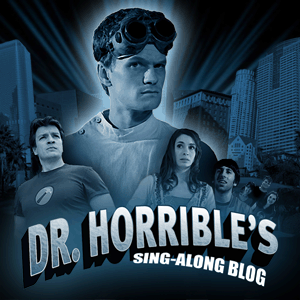
Dr. Horrible's Sing-Along Blog

"I've got a Ph.D in horribleness."

Who'd have thought it? A three-act online mini-series chronicling the life of an ineffectual super-villain as he attempts to get into the Evil League of Evil, led by the elusive Bad Horse, and win the girl of his dreams. And it's a musical. And it works.

Dr. Horrible was created by Joss Whedon, best known for such TV series as Buffy the Vampire Slayer, during the American Writer's Strike of a couple of years ago on a low budget and broadcast online. It is a parody or deconstruction of the superhero genre of films. When he's not plotting crimes that will satisfy the Evil League of Evil, Dr. Horrible is a rather awkward but sweet young man called Billy, who is too shy to speak to his "laundry buddy," the beautiful and kind-hearted Penny (Felicia Day). His aspirations seem to be more about gaining respect and status as a supervillain than an actual villainous nature, and changing the world, because "the status is not quo." He has a vocal coach to help him work on his evil laugh, and has no problem stealing "wonderflonium" to power his freeze-ray, but he is reluctant to harm anyone: "There's kids in that park!" he says to a wannabe nemesis after refusing to fight him. He has been beaten up many, many times by his real archnemesis, Captain Hammer.

Hammer, the Superhero to Dr. Horrible's Supervillain, is on the other hand an egotistical, callous slimeball. When Captain Hammer decides to make Penny his girlfriend, just because Horrible likes her, Dr Horrible is pushed out of his comfort zone. He vows to get his ultimate revenge and satisfy Bad Horse's tough criteria for entry into the League at the same time.

For me, the musical highlights are the duet between Dr. Horrible and Penny in the beginning of Act II, where Horrible's bitterness and Penny's hope and idealism meet in catchy, beautiful harmony, and on the flip side, the rocky, angry, guitary Act II finale, "Brand New Day," where Dr. Horrible swears revenge on the sleazy jerk Captain Hammer.

Short and sweet, only the length of a single episode of Doctor Who in its entirety, nevertheless Dr. Horrible's Sing-Along Blog is memorable and well on its way to becoming a classic alternative media film. Its story is concise, simple yet radical, making you cheer on the villain and boo the hero. And in the end, Horrible succeeds in getting "the world I wanted at my feet/ my victory's complete/so hail to the king," but at such a cost! Up to that point a comedy, the story turns to tragedy in the last few minutes, in a classic case of "be careful what you wish for." The ending is abrupt, with its victory dirge "Everything You Ever" cut short at the end, showing the smallest glimpse of Dr. Horrible in Billy mode, looking completely lost and forlorn and out of his uniform, looking nothing if not in need of a hug.

Monday, 18 May 2009

Fried Green Tomatoes at the Whistle-Stop Cafe

I rarely buy DVDs I haven't watched before, but Fried Green Tomatoes was an exception to that rule. I unpacked the book at work, and on reading the blurb on the back, I remembered a friend had recommended the film to me. I went to see if it was on sale the road. It was - for £5! so I bought it.

Fried Green Tomatoes is a very American film - not in what I think of as the modern USA, full of shopping malls and big cars, but an old-fashioned America, still a new country of joy and freedom and really close-knit communities, but a lot of danger and darkness too. I'd say it was a feel-good film, which would be strange when you look at some of the things that appear in it: lots of death, racism, domestic abuse, murder - and what happens afterwards - but over all of this, it is a film about friendship.

There are two parallel stories in this film: the story of Evelyn, an unhappy housewife, with rather a Homer Simpsonish-husband. She meets Mrs Threadgoode at a nursing home who tells her the story of a girl in her family - Idgie, and her friendship with Ruth, her late brother's fiance, growing up through the '20s onwards.

Idgie is certainly the strongest character - a real tomboy, who makes me think of a C20th Calamity Jane (though that may have something to do with the show I'm currently taking part in) crossed with Robin Hood. She wears men's clothes, gambles, drinks, hangs around some rather unsavoury characters - but there is nothing she wouldn't do for her friends.

As the story progresses, Evelyn turns from a rather wet down-trodden Southern housewife to a feisty woman who knows her own mind, encouraged by Mrs Threadgoode's storytelling - though she does develop somewhat of a destructive streak along the way, "accidently" bashing the car of two bratty teenagers who steal her parking space (six times) and knocking down a wall in their house to let the light in. More importantly, she learns to stand up for herself and do what she believes to be right despite opposition - such as inviting her new friend to live with her and her husband after the old lady leaves the nursing home.

Fried Green Tomatoes has some tear-jerking moments, so be prepared and have some tissues handy - not so much at the deaths of beloved characters, I found, as when Mrs Threadgoode arrives home to find her house has been destroyed as it was unsafe to live in. The pathetic sight of her, sitting on her suitcase asking, "Who'd want to steal my house?" is unbearable.

But the film is full of funny moments too - though one or two are rather horrible at the same time. The obvious is, of course, when one realises just why no body was ever found of Ruth's abusive husband. It brought be right back to a gruesome nightmare I had about five years ago that has prevented me from being able to eat McDonald's food since...

I have to say that Fried Green Tomatoes, though they are presented as a great delicacy, don't much appeal to me (because I don't much like any kind of tomatoes.) All the same, I'd choose that over Big George's barbecue - even if it is the best in Alabama.
Related Posts Plugin for WordPress, Blogger...