Showing posts with label Anne. Show all posts

Sunday, 14 May 2017

Book to TV: Anne with an E

Here I am, right on schedule to pronounce my judgement on the latest Anne of Green Gables adaptation, Netflix's Anne With An E. In the last two or three years I've been rather pleased by the abundance of different versions of Anne Shirley, what with last year's TV movie starring Ella Ballentine, and the two webseries, Green Gables Fables and Project Green Gables. But how does Anne With An E measure up to the rest?


The Ella Ballentine adaptation attempted to hint at a darker side to the familiar story, but it is a half-hearted effort, with little more than a few flashbacks to Anne's unhappy pre-Green-Gables life to add shadow. Ballentine is sweet and likeable, but her delivery of Anne's peculiar speeches feels calculated for effect; her "depths of despair" are melodramatic but quickly shrugged off. It sticks to the story, but on a surface level; it is the child's Anne. What makes Lucy Maud Montgomery's story stand out from her contemporaries like Pollyanna and Rebecca of Sunnybrook Farm is her deft weaving of light and shadow; the light touch of sorrow makes the joy all the more rewarding. And so, it is not necessarily a bad thing that Anne With An E does explore more darkness than we are used to, mostly in examining how a childhood of neglect, drudgery and loneliness would form a character like Anne, with a second level exploring the attitudes of cliquey, small-town people towards an unknown orphan. There is some room to readjust the balance between darkness and light in this story, but it is a delicate process, to be handled with care, if Anne is not to skew too far either way. 

Anne With An E starts off with a superb pilot episode, sticking faithfully to the first fourteen chapters of the book, at least up to the last few minutes. Amy Beth McNulty is a wonderfully lovable and believable Anne - and unlike every other version where her plainness is in name only, her Anne is "terrible skinny and homely," all eyes and teeth and elbows. Her non-stop chatter is humorous and heartfelt, with an underlying desperation to please and to be loved. She is a more traumatised Anne than we've seen before, which does not take away from her endearing Anne qualities, but rather gives them more depth. Her imagination has helped her to survive. 

There is a solid supporting cast, especially R.H. Thomson and Geraldine James as Matthew and
Marilla Cuthbert. Marilla in particular is a "Spock" sort of character: it requires great subtlety to correctly convey the amount of emotion that goes on behind the repressed, stern facade, and James plays the part admirably. However, as in several of the other adaptations, it really bothers me that Anne's initial stay at Green Gables is dependent on her good behaviour; it does not sit well with me that Marilla would hold the threat of banishment over Anne like a weapon. Diana is a sweet girl and a devoted friend, without being Anne's shadow, and the series gives a different perspective towards her and her family; there is a noticeable difference in class between the Barrys and the Cuthberts. We also get to see a bit more of Aunt Josephine, and I enjoyed seeing a new side to this cantankerous old lady with a heart of gold. Gilbert Blythe passed the test; the popular boy in class, who is used to getting the girls' attention, mischievous but with a goodness and maturity that hints at the man he will become. Not that there's any room for the lovey-dovey stuff so early in the story, although Anne already doth protest too much.

I am open to different interpretations of Anne; I welcome them. I return to the story again and again because I get something new out of it every time I read it or watch an adaptation; if it was the same experience every time, I don't think it would be alive the way that it is. So I am not going to declare the story "ruined forever!" because another person reads it differently. Some of the scenes shown in Anne With An E did not work for me, but they gave me something to think about. I did not like Anne's frank speculations with her classmates about her teacher's relationship with Prissy Andrews - it seemed more Mary Vance from Rainbow Valley, a character who I view as the antithesis of Anne. And yet there was an innocence even in her scandalous breaking of taboos that she's not even aware of, that makes the scene make sense from another angle. The same could not be said about her lying about skipping school, when the show earlier worked so hard to establish Anne's honesty.
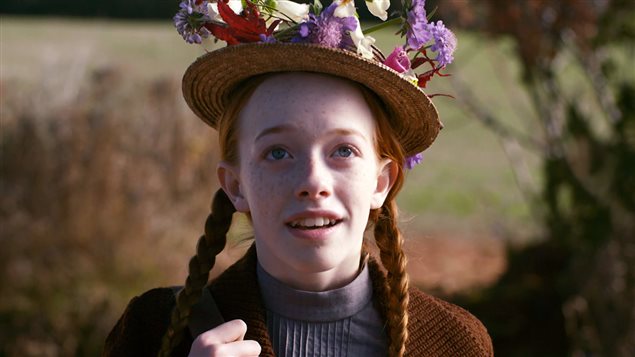

The faithfulness towards book details and historical setting varied wildly. The team worked hard at ensuring the right sorts of potatoes were used, and that Anne's schoolbook was correct, for example, and then might utterly blow it with something utterly anachronistic; a line of dialogue, the use of pinky-fingers in Anne and Diana's oath of friendship, and a progressive mother's group being so progressive that they use the words "feminism" and "suffragette" about twenty years before their first recorded use (if Anne With An E is set in 1876 like the book; the last two adaptations were brought forward to the turn of the century.) And it felt all wrong to show characters such as Mrs Andrews and Mr and Mrs Barry - the Cuthberts' nearest neighbours! - introducing themselves for the first time, when the defining characteristic of the Avonlea setting is that it is a small rural community where everyone knows everything about everyone else's business!


The publicity for Anne With An E, back when it was just called Anne, made a big point about introducing new themes of feminism and being true to yourself - except they are themes that have been in the text all along. Lucy Maud Montgomery was a remarkable woman for her time, very unusual to have a university education and an independent career, and throughout the books Anne defies society expectations with a similar determination. The addition of the minister telling Anne that she needs to learn to be a good wife, or the boys shouting at the girls to get back in the kitchen, felt like a heavy-handed imposition on the storytelling.


After the first episode, the plot takes ever-increasing detours away from the source material. I'm the person who takes note of every digression of the 1985 Megan Follows miniseries/film from the book; it (the first story, anyway) is so faithful there is only minutiae to criticise. I'm less of a purist than I used to be; I went into Anne With An E allowing for a lot of wiggle-room in the treatment of the story. It is an episodic book, so new episodes can be slotted in alongside the familiar ones, giving Anne new adventures without derailing the entire story. I didn't sit there saying "NO, IT DIDN'T HAPPEN LIKE THAT!" but considered each alteration under the question "could it have happened like that?" Sometimes yes, the changes fitted, and other times they did not. Some plot elements, although they did vary from the book, could have been written in collaboration with L.M. Montgomery herself, albeit the older, sadder Maud who wrote Rilla of Ingleside and The Blythes Are Quotes, the Maud revealed in her diaries. Other aspects felt heavily influenced by the Brontes, Dickens and Hardy. The narrative wanders off the path, then comes back for such key moments as the cracked slate, the raspberry cordial and the puffed sleeve dress, usually framed in a new and more sombre context. 


But with every step off the path, the plot gets further away from what is recognisably Anne, and I'm sorry to have to report that by the last episode, the series is well and truly lost in the Haunted Woods. Although I had a high tolerance for the series taking liberties with the plotline and the tone, I nearly switched off halfway through the final episode, watching one particular scene with absolute horror and fury. Unforgiveable is a strong word, and at the end of the day, even Anne of Green Gables is only a story, but one character's decision, and one newly-introduced plotline for a cliffhanger, felt like a violation of something precious. By the end, the dynamic of the story has changed, and I'm not sure how Anne With An E can find its way back to the sanctuary of Green Gables. 

Sunday, 28 August 2016

Book to Film: L. M. Montgomery's Anne of Green Gables (2016)

As a general rule, I don't really approve of remaking classic films. But a second, or fourth, or nineteenth filmed adaptation of a book is not the same thing as a remake, and so when I heard that there was to be a new film of my book, Anne of Green Gables, I was not one of the Megan Follows devotees who bewailed that the 1985 series was untouchable. Because, excellent as that series is (at least, the first one) having multiple adaptations available sends you back to the source material. All on-screen Annes are imitations of the Platonic Ideal Anne found in the pages of L.M.Montgomery's novels. And as far as I'm concerned, the more Anne the better.


All the previous versions of Anne that I have seen have aged Anne up a bit, or a lot, from her original eleven years. Megan Follows' Anne (1985) started out as thirteen, Anne Shirley's Anne Shirley (1934) was fourteen, and although I've only seen the sequel to the BBC version from the '70s, it looks like Kim Braden would have been at least in her late teens. Both contemporary-set webseries Green Gables Fables and Project Green Gables started her story at the age of seventeen. But Ella Ballentine was closer to Anne's real age, and reminds us that she was in fact only a child, and yet she'd already been through so much. She is a resilient, loving little soul who has used her vivid imagination to survive a turbulent childhood and bring what comfort she can to others; we see her trying to cheer up other children in the orphanage and on the train to Prince Edward Island. When she speaks of her hardships, her matter-of-fact tone breaks the listeners' hearts, both in-universe and out, that nothing strikes her as unusual in living with guardians who she was sure meant to be good to her, or never having had a friend.  After such an existence, she revels in life in the countryside, and although Matthew and Marilla don't know what to make of her joy at such (to them) commonplace things as the scent of lilac, the flight of seagulls, they come to see their world as for the first time. This bright-eyed little girl with the fancy turn of phrase is both strange and endearing,


Of course, if Anne is the right age, so are Diana and her schoolmates, and so is Gilbert Blythe (13). He is very definitely a mischievous schoolboy and not a romantic hero. But this is Anne of Green Gables before it becomes a love story; its focus is on family and belonging, and a celebration of simple wonders. Diana is a true kindred spirit; the film shows us a little bit more of what draws her and Anne together, their love of fairy-tales and make-believe. Mrs Rachel Lynde provides a light comic touch. "Now, you know me, I'm not one to interfere..." Marilla Cuthbert is well-drawn, played by Sara Botsford, striking the right balance between severity and soft-heartedness. Martin Sheen's Matthew, was not quite Matthew Cuthbert as we know him. He's lovable, quiet and sweet, but not shy so much as introverted.


This film doesn't cover the whole book, but only Anne's first year at Green Gables. Still, it's better to take its time over the first half and do it well than to rush the entire book into a two-hour movie. It ends with a slight deviation from the original story, in order to have a satisfying conclusion part-way through, while still potentially leaving it open to a sequel.

And if this team does not make a sequel, there will be more of Miss Shirley to come next year on Netflix, with a new series simply entitled Anne. Watch this space.

Sunday, 29 May 2016

Sunday Summary: May in Review

Wow, it feels like ages since I've written anything on here! Everything's fine, I just haven't felt much like writing reviews lately; I've read plenty of books but not had all that much to say about them. But I might ramble a little about a few of them in this post, we'll see.

Some of the things I've done

My work shifts have been all over the place the last few months, although fingers crossed they'll be getting back to something like normality from now on. We've got a new girl just starting at work, doing Sundays and a couple of afternoons in the week, and my manager told me she reminded her of a younger version of me. Having met her, briefly, I sort of agree. In about a two-minute conversation we compared our to-read piles, favourite books, and I already promised to lend her one of my four copies of Anne of Green Gables. I think reading that book is a quick way to get to know me! Must find out what her equivalent book is. I'm sure she'll have one.

When I haven't been at work I've been writing; I've picked up the children's story I began for NaNoWriMo last year and am giving serious thought to submitting it to Mslexia magazine's First Children's Book competition in the autumn. I've nearly finished the first draft, but have discovered I'm already over the suggested word count for a children's book!

I had a week off a couple of weeks ago and spent a couple of days up in London, staying with my sister Jenny. While she was at work I did some exploring, and some book shopping - although only on the first day. I also went up to Camden Market, which is awesome, and as it was a lovely sunny day, I walked up the road to Primrose Hill, where I spent the afternoon sitting on the grass and reading. The Primrose Hill bookshop is one of my new favourites; it's small and cosy. While I was in there, the bookseller, Chrissie, was whizzing around the shop finding recommendations for one of her regulars who wanted some holiday reading.


By some fortuitous chance, an old friend, Anna, happened to be in London the same week, and had got in touch with Jenny suggesting meeting up for drinks. So we found a nice little pub next to the British Library, called the Rocket, and spent a lovely evening between there and Pizza Express reminiscing about our schooldays, making little confessions about being horrid teenagers (only a little horrid, as teenagers go, but I think we were all a little relieved to find the others had no memory of the wrongs we'd felt terrible for years for doing to each other.)

And the following day, as a belated birthday treat for Jenny, we went to Shoreditch to Lady Dinah's Cat Emporium for tea: a cafe where cats roam free and say hello to and play with all the visitors. The cats are very well looked after - the entry fee pays for their welfare, they get days off and all have their own members of staff, and there are all sorts of toys and climbing apparatus to keep them amused (although one of the kittens liked nothing better than a scruffy piece of string. Because cat.)


I'm back on the Island now, for the time being, and am enjoying the summer sunshine. It's a bank holiday weekend, and tomorrow I'm heading for the beach. We're nearly into June and it's been quite warm; let's see if I'm brave enough to go in  the sea yet. I've sorted through my to-read shelf and pulled my science fiction books to the front, because for some reason I've come to think of that genre as good beach reading. I've got sci-fi classics (Iain M. Banks, Bradbury, Asimov, H. G. Wells) shiny new or newish books (The Book of Strange New Things, The Peripheral, Speak) and some weird and probably dreadful old books I've found in second-hand bookshops, which I will not name and shame in case I slander unrecognised gems.


Some of the Books I've read:

Beside Myself by Ann Morgan, and When I Was Invisible by Dorothy Koomson

These were publishers' proof copies that my sister got from work, and it was interesting to read them one after the other, because they shared several themes. In Beside Myself, a set of twins swap places as a prank one day - but then one of them refuses to switch back. Towards the end, one of the characters asked something along the lines of "What does it matter? You're twins, you live the same life, what does it matter which name you are called?" But even from a very early age, different expectations are put on Ellie and Helen. One is a leader, one is a follower. One is perceived as a good girl, the other as a troublemaker. People respond to the twins' actions in different ways according to who is perceived to be doing them. It was a dark, troubling read.

Meanwhile, When I Was Invisible follows the lives of best friends Roni and Nika (Both Veronica/ka Harper) whose lives take very different directions after a shared ordeal leads to one betraying the other. Roni returns home after spending several years as a nun, while Nika is trying to rebuild her life after witnessing a terrible crime. Also a rather heavy read, but I found it much more satisfying than Beside Myself.

The Prime of Miss Jean Brodie by Muriel Sparks

What I expected: A gender-flipped, feminist Dead Poet's Society. Progressive teacher shakes up the establishment but earns undying loyalty from her best students.
What I got: Miss Brodie shakes up the establishment, all right, but she is a manipulative, capricious and sharp-tongued woman who has affairs with other members of staff and sends some of her pupils down destructive paths. The narrative is curious, flitting between past and future and casually revealing what the girls' futures hold while they are still schoolgirls. Miss Brodie is rather more interesting and unsettling than the usual inspiring, unconventional schoolteacher figure, a deconstruction of the trope - except for the fact that she pre-dates many of the iconic examples!

Anne of Avonlea by L. M. Montgomery

Being the second book in my Anne of Green Gables omnibus, I used to read the two books back-to-back as a child, and Avonlea was just as much a favourite as its predecessor. Nowadays, though, I read it less often than Green Gables and Anne of the Island. It's a very episodic book, although the romance between Miss Lavendar Lewis and Stephen Irving towards the end foreshadows Anne and Gilbert's relationship (which for many readers - not this cynical old maid, though - is the main story of Anne.) It was lovely to reread after a few years, to meet Mr Harrison, to spend time seeing the Avonlea Village Improvement Society, to just spend the time with some old friends.

But the character of Paul Irving has come to irritate me no end, although with a feeling of guilt because he is in many ways a lot like Anne. Do different expectations for boys and girls influence what traits one can allow? But then Walter Blythe, in the later books, takes after his mother too, and he is one of my favourite characters. Walter has more depth of character, though, a melancholic temperament, inner turmoil, while Paul's ongoing struggle is with eating all his porridge. He's just so sickeningly good, and the "poetic" temperament Anne sees in him reminds me of nothing so much as Madeleine Bassett from Jeeves and Wooster as an eight-year-old boy.

Currently reading: The Time Machine by H. G. Wells

The original time-travel adventure. I'm only a few chapters in so far, but it reads surprisingly fresh and contemporary, with its succinct explanation of the Fourth Dimension, and the Time Traveller's theories of the future evolution of mankind into a gentle, physically frail and unambitious race living in a paradise - or so it seems at first! This is a book that shaped science fiction as we know it: without it there would be no Doctor Who, no Back to the Future, and everything else would be quite different too!

I'm not sure when I'll get back to blogging regularly; probably not until I've finished my first draft of my work in progress, but watch this space. I will be back!

Saturday, 26 March 2016

Rereadathon the Third: Part two - Saturday 26th - Wednesday 30th March


Saturday:

I finished American Gods yesterday, and although I've read it several times now, I'm feeling a hint of a book hangover; I can't get Shadow and Laura, Wednesday and Mr Nancy and all the rest out of my head. I spent the evening yesterday at a 50th birthday party, which was a really lovely evening, and read most of the stories in Through the Woods, a collection of gothic fairy tales in comic-book form. I left the last one until this morning, however. I remembered being really creeped out by one of the illustrations, and didn't really want that to be the image left in my mind after lights out. Yes, I'm a wimp.

And today I've got stuck back into Anne of Green Gables. If I must buy lots of different editions of my favourite book since childhood, it's only right that I read each one, and I've got a lovely collector's library, pocket-sized with gold edges and illustrations. I know that book inside out. If I found myself in the dystopian world of Fahrenheit 451, where books are banned and live on only because people memorise them word for word, Anne would be mine. I don't know it word for word,  and yet I can identify it from a half-glimpsed sentence on an e-reader screen. I can tell if the wording is slightly different from one edition to another. This copy I'm reading today has Marilla saying she didn't want a "Barnardo boy" instead of "'home' child," which was the wording I knew from my existing three copies. When was this changed?

It really struck me today how little legal protection orphans had back in the nineteenth century, when Anne of Green Gables was set. For one thing, Marilla and Matthew just decided the night before, that if Mrs Spencer was going over to the orphanage in Nova Scotia to adopt a child, she might as well pick one up for them too at the same time - like she's running grocery errands for them. There's no paperwork, they don't even need to go to the orphanage themselves to be assessed (hence the mix-up when they wanted a boy and got Anne instead.) Yes, Matthew and Marilla are good people, but they could be anyone. Mrs Spencer doesn't even take Anne all the way to Green Gables, but drops her off at the Bright River railway station in a strange place where she knows no one.  There's no follow-up; once Anne's off the hands of the orphanage trustees, we never hear from them again. If it weren't for Marilla's change of heart, she could have been fobbed off onto the awful Mrs Blewett and worked half to death, and no one would have any record of where she went or what happened to her. It's all rather sombre to think of what could have happened, if the story had gone differently.

Saturday Stats

Books read from: Through the Woods - Emily Carroll
Anne of Green Gables - L. M. Montgomery
Pages read: 202
Books finished this week: 2
Favourite reread so far: American Gods. 
On the menu: tuna couscous pot, apple, easter egg


Sunday and Monday

Although it's currently quite sunny, the last couple of days have been very temperamental weather-wise with Storm Katie hitting yesterday evening. (I had nothing to do with it, I swear!) So the usual Easter walk has been postponed, and I spent most of yesterday afternoon finishing Anne of Green Gables. What makes Anne stand out from the other children's books of the late 19th and early 20th century, is the way that L. M. Montgomery captures the spirit of childhood in a rural community. Anne is neither sickeningly good, nor do the scrapes she gets in read as though written as a moral lesson to the reader. Montgomery gently laughs at Anne's eccentricities, but does not diminish the soaring highs and crashing lows that might seem mundane but are important to the child. Anne is one of life's optimists, but you read enough sorrow between the lines to keep the sweetness from becoming cloying; the down-to-earth humour keeps Anne's precociousness from becoming twee. She's a bright, sparky child who has survived a tough life - having to care for her former foster mother's eight children (with twins three times in succession) while little more than an infant herself - through the escape of books and imagination. So it's heartwarming to see her delight as she discovers the simple pleasures: eating ice cream, sleeping in a spare-room bed, and to finally discover people who love her unconditionally. 

I've no idea how many times I've read Anne. As a child I would read the same books over and over and over again, and a family friend's enduring image of me is reading that book, with my hair in pigtails and wearing a straw summer hat. But it still has the power to make me laugh and love and cry. I cried twice yesterday, once when the uptight, repressed Marilla half-grieves that Anne has to grow up, and the other time - well, you know which part!

Today, (Monday) I switched off my alarm and let myself sleep as late as I liked (which was pretty late) although the weather outside gave me some strange and frightening dreams. As I've already said, I've been getting into a routine even on days when I'm not working, but bank holidays are different. Today I ought to take a break from the rereadathon to catch up with The Stand for this week's readalong segment with Judith (which reminds me, I need to type up last week's notes.) But I also want to get started on my reread of The Charioteer. 

Sunday Stats:

Books read from: Anne of Green Gables - L. M. Montgomery
Pages read today: 267
Total books finished: 3
Favourite reread so far: American Gods and Anne of Green Gables tie
On the menu: hot cross buns, Easter egg (seeing a theme here?) apple, sour cream and garlic Graze crostini snack

Monday Stats:

Books read from: The Charioteer - Mary Renault
Pages read today: 220
Total books finished: 3
Favourite reread so far: American Gods and Anne of Green Gables tie, but The Charioteer is up there too. Look, they're all excellent! That's why I'm rereading them.
On the menu: Bit of Rocky Road Easter egg, caramel shortbread, apple, Graze snacks.


Tuesday and Wednesday:

It's the last evening of the rereadathon, but I could quite happily do another week, and maybe I will, unofficially; I've still got Monstrous Regiment and Miranda Hart's autobiography, as well as others which got added to my mental list after the books I did read - notably, Anne of Avonlea and Anansi Boys. Yesterday (Tuesday) I spent the evening away from the rereads, as I was a bit behind on my reading of The Stand, although I came back to The Charioteer for another chapter before bed, and over breakfast this morning. The problem with having two books on the go at once - especially when they are two good books - is that you can't choose which one to pick up. But for now, I think I'll aim to finish The Charioteer by the end of today. I'm feeling a little sleepy, however, and might fall asleep quite early.

(Later)

I finished The Charioteer at about 11PM, and I think I'm more satisfied with the ending on the second reading. Although I've concluded it is a happy ending, I find myself wondering about how the story will continue past the last page, and how much of a rollercoaster ride the characters are in for when the book is closed. I don't think that their problems will go away as easily as they, or we, would like. But they will endure the storms together, of that much I'm sure.

I am writing about these ink-and-paper people as if they are real, alive today, and that the next page is tomorrow, despite The Charioteer being written in the 1950s and set in the 1940s. That's the power of books, and why we like to return to books we've already read - to reacquaint ourselves with old friends, and try to know them better. When I was about 17, I read an author's afterward for a novel I studied at school, where they wrote something along the lines of, "People keep asking me what happened to the characters after the events of the book. Nothing happened! It's a story! They don't exist off the page!" I'm certainly misquoting this author's words, and probably misrepresenting what they were trying to say, but it was the message I took away, and I've never quite forgiven that author since. 

Tuesday Stats:

Rereadathon books read from: The Charioteer - Mary Renault
Rereadathon pages read today: 31
Other reading: The Stand - Stephen King
Total books finished: 3
Favourite reread: Anne, American Gods (see above)
On the menu: Apple, Bit of Easter egg, Graze cheesey corn snack

Wednesday Stats:

Rereadathon books read from: The Charioteer - Mary Renault
Rereadathon pages read today: 168
Other reading: The Stand - Stephen King
Total books finished: 4
Favourite reread: See above
On the menu: Special K cereal, chocolate brownie bites.

Final summary:

Books read: American Gods - Neil Gaiman
Through the Woods - Emily Carroll
Anne of Green Gables - L. M. Montgomery
The Charioteer - Mary Renault
Pages read: 1592
Best reading day: Sunday (267 pages)
Average: 159 pages per day

Thanks again to Bex for hosting the rereadathon. I've really enjoyed it. Another one in the autumn perhaps? 

Monday, 8 February 2016

Old Stories, New Settings: on modern-day adaptations of classic literature

I always used to consider myself a purist when it came to adaptations of beloved books. I have a button badge that says "The Book Was Better," and yes, ninety-nine times out of a hundred, it is. And yet we book-lovers do like to watch film adaptations of familiar stories, to see the stories and characters we know and love brought to life. Woe betide anyone who gets it wrong! But can anyone really reproduce the films that play out in a person's mind when they read a book? No one ever reads the same book as anyone else, or so they say; everyone brings something new to the reading. But a good story is timeless, and so often people demonstrate this by bringing old stories to a new setting, to show how themes and characters can transcend a single place and time. It's an idea I used to frown upon, but have come to appreciate. Viewing a familiar tale in a new way can give you a new understanding and better appreciation of the original text.


The point at which I first acknowledged this was in the summer of 2010, when the BBC showed the first series of Sherlock. I recognised the brilliance of casting Benedict Cumberbatch and Martin Freeman (even without a moustache) as the Great Detective and his sidekick, before I even identified that they were dressed in modern clothes. They were Holmes and Watson, there was no doubt about it. From before Holmes appeared on-screen, from the first time he spoke, his character was clearly defined, given new life free from the trappings of the smoggy setting of Victorian London and its formal language.


I didn't need to read the back blurb of Jacqueline Wilson's recent novel Katy to know what it was. A Katy on a swing? Well, that would be a modern-day telling of Susan Coolidge's What Katy Did, a classic that was inevitably a big part of my childhood - and indeed now Nick Sharratt has illustrated a paperback of the original to match, a visual confirmation that times may change but children do not.

I knew that Wilson had liked that book as a child, although to the modern or older reader, the Victorian moralising is rather unpalatable now. Jacqueline Wilson specialises in stories about dysfunctional families and flawed but believable child heroes and heroines, so adapting What Katy Did plays to her strengths. I really liked how closely she stuck to the original, especially in the first half of the book, mirroring even the minor details: the ice-house, on which the children love to sit, has become a garage roof. Aunt Izzie is now Katy and Clover's stepmother, and middle-child misfit Elsie their stepsister, while the younger ones are at least half-siblings. It was the details of the children's make-believe storytelling and games that made that story come alive for me as a child, so it's really interesting to see what their modern-day counterparts get up to (and it is really not that much different at all. Katy and her friend Cecy have mobile phones now, instead of "post-offices" in the garden, but they use them to taunt and exclude poor Elsie in just the same way.) Halfway through, at the time of the accident, the story moves away from the original What Katy Did and becomes a new Jacqueline Wilson book with 21st century values. Katy does not need to become reformed (and utterly dull) and be rewarded with miraculous healing. The world doesn't work that way, and by giving her heroine the challenges of accepting her limitations and setting herself new goals as a person with a disability, Jacqueline Wilson has written a more relatable young heroine for modern-day Katys to relate to.


Possibly the most adapted and updated story of them all is Jane Austen's Pride and Prejudice, the tale of hate turning to love that has formed the starting point of most romantic comedies. Bride and Prejudice brings a Bollywood twist to the classic tale. The world has grown smaller, but human nature remains, and the formalities and misunderstandings of Regency England translates well into the cultural divide between a rich, haughty American businessman and a bright young Indian woman whose mother wants to arrange good marriages for all her daughters. Oh, you know the story! Bride and Prejudice is a smart, funny, sometimes corny but feel-good adaptation of the old story.

Then, of course, there's Bridget Jones's Diary, based on the novel by Helen Fielding (which I think was originally published as a weekly newspaper column.) I read and watched this before I ever read Pride and Prejudice (yes, there was such a time!) and haven't seen it for ages, but although it's more loosely based on Austen's novel, there are clear parallels in this tale of a thirty-something singleton surrounded by smug marrieds, with the charming cad on one side, and on the other hand the snob called Darcy who looks like Colin Firth (the ultimate bit of meta-casting.)


The latest adaptation Pride and Prejudice heralded a new kind of storytelling in the form of the Literary-Inspired Webseries. Filmed in short episodes in video-journal format, The Lizzie Bennet Diaries give us Lizzie Bennet, a twenty-something graduate student who has moved back home with her family in a difficult financial climate, wondering what future there is in store for someone with an English degree - a painfully relatable variation on the theme. Most of the drama happens with Lizzie relating events to her video journal (with some interruptions from friends and family, and some excellent re-enactments.) Ashley Clements is sassy and expressive as Lizzie, Laura Spencer (wasn't she in The Big Bang Theory as Emily?) is sweet and lovable, while Mary Kate Wiles is lovably obnoxious as Lydia, as you'd expect, but shows more character growth than Austen allowed her, and a rare vulnerability later on. The other two sisters are relegated to being Mary the Emo Cousin who Lizzie (perfect!) and Kitty is literally Lydia's adoring cat.


Since The Lizzie Bennet Diaries, Youtube has been rather overrun with modern-day video-diary versions of every classic imaginable: all the Austen, I think, Shakespeare, Sherlock Holmes, Little Women, and my beloved Anne of Green Gables has got not one but two webseries inspired by it. Green Gables Fables came first, starring Mandy Harmon as Anne, and in September returned for its second season. I think it took a little while to get really good, as the actors grew into their characters. It is very faithful to the book, although I wasn't quite sure that some of the substitutions quite reflected the original - having a manicure at the salon, for example, doesn't quite have the same importance as finally getting to wear nice clothes, and the hair disaster and the cake disaster less dramatic. But by the time Gilbert Blythe turns up in the middle of the first season, it got into its stride, and it is notable for its amount of "transmedia" with Youtube channels for supporting characters, who all have regularly-updated Twitter accounts interacting with each other for things that can't be shown in a five-minute video diary once a week. Tanner Gilman is a magnificently lovable, nerdy Gilbert Blythe, who is more important to get right than a Mr Darcy (and I'm sorry, women everywhere, but I still don't get the appeal. Not when I've grown up with Gilbert Blythe.)

Between the first and second seasons, Green Gables Fables filled in with some of the events of Anne of Avonlea updated and the stories told through their social media. Season two focuses on Anne of the Island, which follows Anne at Redmond College. It diverged a little from the book at the beginning with a subplot about Diana, who never went to university in the book, and yet it seems mostly to remain true to their characters - the growing distance between two friends, Diana being more of a homebody while Anne is academic and ambitious. The format doesn't always quite work; how do you show intensely private moments in a "Hello world, this is what happened to me today" video diary? And fitting four years' worth of events into one academic year also has its occasional uncomfortable juxtaposition of events happening too close together (notably Anne's romantic woes.) But I'm so glad to see Anne of Green Gables being talked about more - and discussions use the books as a starting point, instead of the (albeit excellent) 1985 TV miniseries. Green Gables Fables is an immersive storytelling experience, putting the viewer into the story and living through it as it unfolds. There's been some extraordinary writing and acting, and Ruby Gillis's last video made a fine adaptation of a particular scene in Anne of the Island. 


And I'm completely spoilt in having Project Green Gables as well. This Finnish-made adaptation re-imagines Anne Shirley as a black foster kid in a mostly-white community, a decision that gives added weight to the story in a contemporary setting. Like her ginger counterpart, Anne has her own hair woes, though with its natural texture rather than colour, and this change gives a deeper, more serious interpretation than mere vanity. Gilbert is going to have to work very hard at repentance for his hair taunts, and you can't blame Anne or laugh about her unforgiveness under these circumstances. This isn't a petty matter any more. As I write this, the story is up to the point of the Great Hair Disaster, and in Project Green Gables, Anne's rash mistake is buying a cheap chemical hair relaxer from the internet, with devastating results.

Project Green Gables may be less polished than Green Gables Fables, but it is more adventurous when it comes to adapting scenes and chapters of Anne's life to a modern setting, and by doing so it better retains and underlines the nuances of the original. It is not a brooch that Marilla accuses Anne of stealing, but her prescription medicine, an accusation that cuts much deeper and has potentially far-reaching consequences. She's not an orphan any more, but a foster child of unreliable parents. And just her gossip about Avonlea school goings-on makes me think about the original, so-familiar text in a different light. Laura Eklund Nhaga plays a very different Anne Shirley to Mandy Harmon - and yet they both are Anne, bringing out complementary sides to her personality. Both Annes are aged up to about sixteen or seventeen, whereas in the book she first appears as a precocious eleven-year-old. Laura Eklund Nhaga brings out her innocence, her passion and enthusiasm, her non-stop joyful chatter, instantly convincing me that she was Anne. The supporting cast are also wonderful, and like Anne, they are the book characters come to life but in a very different way from Green Gables Fables. A special mention for including the hilariously obnoxious Charlie Sloane, not a character who tends to be very prominent in film adaptations. The series shows a deep knowledge of the source material, easily making reference to the little things as well as the defining events.

With two webseries adaptations as well as a film and a new television adaptation in the works, I'm over the moon. Anyone who knows me will tell you that Anne of Green Gables is the book that defines me, and although I can hardly fault the best-known television adaptation, as far as I'm concerned, the more Anne, the better.

Monday, 4 May 2015

Re-readathon


Monday

What I've been re-reading:

I kicked off this week's re-readathon by finishing off The Lord of the Rings, which I've had on the go since the beginning of the year. The idea was that I would read one chapter before bed each night, and also one in the morning on my days off work. However, I would get sidetracked by my other reading, or watching DVDs in the evening instead, so I'd left Frodo and Sam wandering around Mordor for about a month. I always seem to read the last few chapters all in one go, once the Ring has been destroyed, and thus it was today. I saw the celebrations in Gondor before work, and the journey back to the Shire and beyond this evening, although I did not read all the appendices this time.

Thoughts on today's reading:


It struck me how anticlimactic the "Scouring of the Shire" scenes are, after the epic adventures, battles and hardships our heroes had experienced throughout the book; how relatively easy it was for them to overthrow the bullies who had taken over the Shire. Even Saruman is a petty villain at the end. It goes to show how sheltered the hobbits were in the Shire, and how helpless, and how much Frodo, Sam, Pippin and Merry grew in the year or so they had been away. But though the destruction is fairly minor compared with the horrors of Rohan, Gondor and Mordor, it hurts more because it is home.

What else I've been up to:

I worked a short shift this afternoon - though it was so quiet that it did not feel short at the time. It was a bank holiday - where was everyone? I also did some ironing and tidying at home, and spent some time filling in pages of my Ready, Set, Novel! and 642 Things To Write About workbooks. Now I'm going to put on a couple of episodes of Battlestar Galactica before bed. I watched the initial miniseries in February, and took just over a week to watch the first two full-length seasons. Things are looking very grim indeed on New Caprica...


Tuesday


Today was a day off, so after doing some laundry and cleaning my room, I buried myself in Alan Moore's masterpiece Watchmen. Even though it's a graphic novel, it is far from being "light" reading; to get the full benefit, you have to pay attention to the details in the pictures as much as the words, and so it will take just as long to read as any other 400-page novel. On my second reading I was able to pick up on a lot more clues and symbolism hidden in plain sight - such as Rorschach's other identity, right there from the very first page - and subtle foreshadowing, as well as paying attention to the writing; the way that one scene ties in with the next. Last time around, I didn't really pay much attention to the pirate story, being more interested in the main plot, but today I read the "Tales of the Black Freighter" story observing how each panel of narration from the comic-within-the-comic has close parallels with whatever else is going on around the reader.

Wednesday

Today's reading

I was at work today, so haven't done a huge amount of reading, but I began The Universe Versus Alex Woods during my lunch break. The character of Alex was just as lovable as I'd remembered, but where, on my first reading, I felt that he came across as very young for seventeen, today, starting the book (which begins at the end of the story) and knowing how Alex got to the point where we first meet him, I recognised that actually he shows great maturity and calmness in an extraordinary situation.

When I got home, I finished Watchmen and, even knowing what was coming, still felt the full impact of the villain's shocking revelation: (spoilers)
"Do you seriously think I'd explain my master-stroke if there remained the slightest chance of you affecting its outcome?
"I did it thirty-five minutes ago."
Chilling.

Rereadathon challenge

Bex asks:
Do you have a book that you read over and over (or one that you collect multiple copies of)? Why do you read it so much? What is it that keeps you coming back to it?
My friends and regular readers will know which book I've selected here! I've written many times about my love of L. M. Montgomery's Anne of Green Gables. My parents bought me a hardback containing the first two Anne books when I was eight years old, and it was love at first sight. I believe Anne Shirley was the first fictional character I encountered who not only felt like a real person, but who felt like a real person like me. I was drawn to Anne because, like me, she was chatty, scatty, accident-prone and had a vivid imagination. As a little girl, I loved reading about the scrapes she got into, and as a teenager I grew to identify with the bittersweet nature of change. But ultimately I return to Anne as a comfort read; her optimistic outlook restores faith in humanity when I'm feeling jaded, without being as cloying as, say, Pollyanna, or as moralistic as What Katy Did. Avonlea and its residents feel like a timeless safe place, a retreat from a cynical world, with people I know so well that it comes as a surprise to discover some of them only appear in one or two books, and as supporting characters at that. When winter turns to spring, and daffodils start to appear; when I see blossom on the trees: that is when I feel closest to Anne.


I have three copies of Anne of Green Gables: the original large hardback, the 100th Anniversary paperback - for my handbag - and a spare, second-hand paperback that doesn't matter so much if it gets damaged. Three seems a sensible number - any more, and I'd have to start collecting in earnest and buy all the copies! Also pictured: the entire series, the colouring book, the journal, an exercise book and matching pens, the address book, the VHS of the 1985 adaptation (abridged) and the DVD (full-length.) Not pictured: a poster which was sent by Sarah as part of my Ninja Book Swap parcel, and the 1970s BBC Anne of Avonlea, which is not nearly as good as the 1985 Anne, but fills in the gaps in the story omitted from The Sequel, which I do not own. Apologies for the blurry picture.

Thursday and Friday

Yesterday was Election day in the UK, and after work, and after I'd voted, I hid myself away in my room, ignoring the world. I shut down my computer and switched off the internet connections on my phone, because I can only handle a certain amount of politics before I feel angry, depressed and disgusted. While waiting for it all to be over, I read a bit more of Alex Woods, which I finished off around lunchtime today. It's my dad's birthday, and we had fish and chips. I've been off work today - now it's a quieter time of the year there are not a lot of overtime hours available. Alex Woods was just as funny, heartwarming and philosophical as I remembered. I've now moved onto When God Was A Rabbit, which I had forgotten a lot about. Judging from the first few chapters, it is considerably darker than I recall. I'd thought of it as a cosy, quirky family saga, but there's quite a lot of angst beneath the poetic narration! 

Although I enjoyed Sarah Wiman's When God Was A Rabbit on my second reading, I found it, oddly, slow-going in the first half, and simultaneously quite busy. Often I enjoy the scene-setting childhood chapters of a family story as much or more than the main plot, but I found myself growing a bit impatient. The second half held my attention better, but the tone shifted awkwardly from overwhelming tragedy to lucky but unlikely coincidence. Sometimes it felt a bit contrived. However, the novel shone in its depiction of the events of September 11th, 2001, the terror, confusion and incomprehension of the unprecedented terrorist attacks on New York City. 
Saturday and Sunday

If you work in retail, and agree to work weekends, you can't expect ever to be taken off that shift! So it was quite a luxury for me to only work a half-day yesterday. I spent the morning reading To Kill a Mockingbird, one of those books that demands to be read every couple of years or so. In the evening, I had the house to myself, so I watched the film of Watchmen. That is definitely a story that improves with every reading and/or viewing. I had seen the film before, but a long time ago, and before I read the book. My initial judgement was that it was okay, with a very memorable opening sequence: a montage of scenes from twentieth-century history, in a world where superheroes were real, set to Bob Dylan's "The Times, They Are A-Changin'." I think the film is best watched after reading the book at least twice, when you know the story well enough to appreciate all the little details of world-building, and how faithfully they have recreated the book, frame by frame. I felt that the ending was a little weaker than the rest of the film, possibly because it's changed from the book. Admittedly, on my first reading - after seeing the film - I thought the book's ending was weird, over the top and unnecessarily complicated. On my second reading, I realised that was entirely the point, and that the clues were spread throughout the novel, leading up to the shocking finale. Admittedly, to recreate that well for film, you'd probably end up with a movie at least three hours long - I believe there is an extended cut that length already. As it happened, I was astonished when we reached the final act, already. It was two and a half hours, long, but it didn't feel it. Usually I lose concentration at about the 90-minute mark of any film, but this time Watchmen sustained my interest throughout.

This morning I had a mild case of anxiety out of the blue, and with no discernable cause, so I took myself, my book (To Kill A Mockingbird) and a cup of tea off to the park before lunch. I initially planned to try to finish the book today, but I think it is a novel to take one's time over, not to rush, so instead I shall take it into the Bout of Books readathon next week. This is one of my favourite book-blogging events, but this week I'm going to participate only through Twitter and possibly the occasional Instagram post. I'm on holiday (hurrah!) and going up to York for a few days at the end of the week. I've never been to York before - can anyone recommend anything that I must see or do while I'm up there? On Saturday, I'll also be going over to Chesterfield to meet up with Ellie and Hanna (and, naturally, do some book shopping!)

Stats for the Rereadathon:

Books read from: The Lord of the Rings: The Return of the King - J. R. R. Tolkien
Watchmen - Alan Moore
The Universe Versus Alex Woods - Gavin Extence
When God Was A Rabbit - Sarah Winman
To Kill A Mockingbird - Harper Lee
Pages read: 1380
Favourite reread: Watchmen
Favourite quote: From Watchmen:
Laurie: "But... if me, my birth, if that's a thermodynamic miracle... I mean, you could say that about anybody in the world!"
Jon/Dr Manhattan: "Yes. Anybody in the world. 

But the world is so full of people, so crowded with these miracles that they become commonplace and we forget...

I forget.

Sunday, 19 April 2015

Sunday Summary (19/4/15)

I was making plans for this post as I walked home from work yesterday evening; it was going to be a Five Things That Made Me Happy This Week theme. Then I logged onto the internet to find that Death had visited yet another one of my "safe" places, a story world which shaped my very being, this time taking Canadian actor Jonathan Crombie, who was best known as Gilbert Blythe in Anne of Green Gables. It seems Mr Crombie passed away this week from a brain haemorrhage at the age of 48. (Younger, I could not help observing, than Gilbert was in Rilla of Ingleside. That's not right.)

It's not easy for someone to satisfy me as the romantic love interest of a story which has had my heart since I was eight years old, but as soon as I saw Crombie as Gilbert, there could be no other. ** I only knew of Mr Crombie from that one role, but what a role it was, and how well he fitted it! I had fantasies of bringing him and Megan Follows back to the world of Anne if ever I was to finish my screenplay of Rilla of Ingleside and get it turned into a miniseries. And of course, my condolences go out to his family and loved ones.


But onto happier subjects. Despite the best efforts of Royal Mail, my Ninja Book Swap parcel finally turned up this week, and in fact its sender was the same person I'd sent my parcel to: Sarah in Ottawa. I have to say Bex and Hanna did a wonderful job of pairing us up; Sarah is brilliant; I follow her on Tumblr, and she is one of my favourite posters on there. *waves fangirl flag.* She sent me two books: The Night Guest by Fiona McFarlane, and The Man in the High Castle by Philip K. Dick. I can't wait to read them, and because they came from overseas, they are different editions to the ones I've seen in this country and very pretty! Also included in the parcel were a postcard, a cardboard Bookmobile - she's studying to be a library technician - which is on my bookshelf, a Book Nerd badge (which I've added to the collection on my favourite customised bag) and an Anne of Green Gables poster! (Have I mentioned how much I love Anne? Maybe once or twice? A week? Since I was eight?) Thank you so much, Sarah!


On Friday I went over to Southsea to see a touring production of Return to the Forbidden Planet, which is a rock'n'roll musical loosely based on Shakespeare's The Tempest and set in space! In 1999, when I was thirteen and in my last year of middle school (because we used to have middle schools on the Isle of Wight) this was our school play, and it has so much nostalgia for me. If I looked back at my diaries (which I have long since destroyed) I suspect that I'd find it was a difficult time of teenage angst, the pains of unrequited crushes and being a relatively unpopular kid, but my abiding memories of that summer are of long sunny days, an innocent time, and not being quite so lonely as I would be in high school, when my little group of friends ended up going our separate ways. Ours was far from being a perfect production. We had a parent in to play Prospero, the lead, and adult musicians (including my dad on the guitar.) One of the leads could not sing, could not act, and could not even be heard, and was probably cast in a prominent role entirely due to being the biggest boy in the school. But it was the most fun I've had in a school play, even just being in the chorus, shoved off to one side of the stage, and I was madly in love with a boy called Sam, who had long eyelashes and danced with me once out of pity at a school disco. Even now, if I hear most of the songs on the radio, they automatically make me smile: "Teenager in Love," "Great Balls of Fire," "Good Vibrations" or "She's Not There," to name but a few.

But none of this could compare to sitting in the King's Theatre and hearing the songs combined with mangled Shakespeare, dreadful puns, ...enthusiastic... accents. This felt like the proper context for these songs. The cast were magnificent, especially those playing Cookie, the ship's cook with an unrequited crush on Miranda (daughter of mad scientist Prospero) and the robot Ariel (a combination of Ariel and Caliban from the original Tempest). The music was played by the cast, a very multi-talented group. And the casting of "Chorus" - the pre-recorded narrator - was a stroke of genius in the context of a rock musical about space: Brian May from Queen.

Watching Return to the Forbidden Planet from the audience, I realised how much I hadn't quite appreciated as a chorus member. I still knew the songs inside out (although this [production had a couple of substitutions, as well as reinstating one or two that had been on the soundtrack cassette I have since, regrettably, lost, but which we had not used. But the plot still managed to surprise me in some places, where I had not been present for the acting rehearsals, or our cast had played things differently (and, I suspect, slightly bowdlerised) or the things I'd simply forgotten. And now I have sixteen years' extra Shakespeare knowledge and two of Star Trek fandom. I played a mental game of "identify the original quote" throughout the show, and was astonished that the "Live long and Prospero" line I'd thought was an ad-lib in the school play, was in fact in the script. I suppose you couldn't not put it in. All in all, I had an evening of tremendous fun and nostalgia, boogieing away to my heart's content in my chair by the end. I can recommend going to see Forbidden Planet if it comes to your town.


* and, if you insist, also in "The Continuing Story," if you wish to acknowledge that one's existence. As far as I'm concerned, it occupies the Pit of Oblivion alongside Star Trek Generations and the live-action Thunderbirds movie. Or would, if any of these things existed!

**The webseries Green Gables Fables, which is a modern-day vlog adaptation of Anne does a pretty good job with its casting too. I was slow to be won over to GGF, but somewhere along the line I came to love it, and to love the new generation of fangirls to discuss the Anne books and adaptations with in the sort of minute detail that I love. This was, after all, why I started this blog in the first place.

Sunday, 12 April 2015

Sunday Summary: Migraines, steam trains and Shakespeare... IN SPACE!

Well, here we are on another Sunday afternoon, and LOOK! THERE IS A SHINY YELLOW THING IN THE SKY! (Which reminds me, I have a machine full of soggy washing that needs to go out on the line - which I'm sure you really don't need to know about.) I've had a bit of a rough week, with the migraine to end all migraines - it started up on Good Friday and lasted at least a week. At some point it probably stopped being a migraine but even now there's just enough residual effects to say, "Get used to me, this is your head now." Thanks, brain.

So last Saturday, the day before Easter I had to take the day off from work, meaning that I inadvertently had the whole bank holiday weekend off, though I couldn't really enjoy it, being tucked up in bed, unable to sleep, but also unable to read or watch DVDs or do anything that involved looking at things. 


Monday I was a bit better, and me, my sister, two cousins and one cousin's fiancee went out to the Isle of Wight Steam Railway for the day. When my mum was growing up, her family owned an old train carriage, which had been turned into a holiday chalet called Sunny Siding, and lived in a field near the sea. I never got to visit it as a holiday home, as it was sold back to the railway when the farmer wanted his field back, and it spent a long time being restored, with added disabled access (subtly hidden in the period design) and went back on the rails in the early 2000s, with a big family outing for the official opening. Unfortunately I was off on a university visit that day. But my cousin's fiancee Libby is a big steam train nerd (she will fit right at home in our family) and so we spent a lovely bank holiday at the steam railway centre at Haven Street, which also had a falconry display, my sister got to hold a tiny little owl called Chive, and there was a very attractive man working there who was dressed as a pirate for reasons I was unable to determine. Then, after our train ride (in the family carriage, naturally) it was off to the local carvery for a very late lunch or perhaps early dinner. 


Me, Jenny, Stewart and Jeremy
What else I've been up to:

Reading: 
Mostly sci-fi magazines, rather than books, thanks to the aforementioned migraine, though I was most displeased with Morrison's for displaying them under "Men's interest." Fortunately, the other shops' magazine departments are - mostly - displayed by subject rather than gender. I also read the second Geek Girl book by Holly Smale - how has it taken me so long to read this brilliant series? - and finished Tess Gerritson's Gravity, a thriller set on the International Space Station. There is a high body count, but a satisfying resolution, although perhaps best not read when you're ill. Also, the main character is called Emma Watson, so of course I pictured the actress, if a bit older and with an American accent.


Watching: Dabbling about on Netflix, watching odd episodes of Buffy. I also caught part of the new Thunderbirds Are Go! The original Thunderbirds was the first of many obsessions when I was seven, and I'm very suspicious of any remake, especially when they've made the famous puppet characters into brightly-coloured CGI and (possibly) killed off Jeff Tracy! What I saw did not fill my purist heart with confidence, but I'll watch a few episodes properly before making any judgement. It can't be worse than if they were to make a live-action adaptation, make Alan Tracy a teenager and focus all the attention on him. Which of course would never happen. Nope.


Looking Forward To: going to see Return to the Forbidden Planet in Portsmouth. This was going to be tomorrow, but I realised that the only way home would be by taking the midnight car ferry, arriving on the Island at 1AM, which would be fine by me, but I'm going with Judith who starts work at 7AM the next day. So we changed our tickets to Friday, which has an earlier showing. I was in a school production of that show when I was in year 8 and have such fond memories. Whenever I hear any of the songs on the radio or in a shop, it lifts my mood right up. If you're not familiar with it, Return to the Forbidden Planet is Shakespeare's The Tempest... IN SPACE. With rock'n'roll! It'll be great to watch it from the audience this time.

Other Doings: You may be aware that colouring has suddenly become an acceptable pastime for adults, just in the last few months, largely thanks to the Secret Garden colouring book by Joanna Basford. It is recommended as "art therapy," a way of de-stressing and taking your mind off things. I can confirm it really works; Friday I woke up feeling very miserable and lonely. That day my Anne of Green Gables colouring book arrived, which I had ordered through Hive, and I spent the rest of the day (and also yesterday evening) colouring in the pictures. It's got an abridged version of the story, not just pictures, and I love it. It was Anne of Green Gables, it existed, therefore I had to have it.


Saturday, 9 August 2014

Mini-reviews: Doctor Sleep, Landline &L. M. Montgomery

Doctor Sleep - Stephen King

After rereading The Shining earlier this year and surprising myself with how good it was, I approached its long-awaited sequel Doctor Sleep with some trepidation. Stephen King says he periodically asked himself: "what's Danny Torrance up to now?" and Doctor Sleep sets out to answer this question. When I started reading, I felt that I didn't really want to know what the adorable precocious child turned out like as an adult, and the start of the book confirmed this. Danny, now known as Dan, has inherited many of his father's self-destructive traits and starts off in a very bad place. Unlike his father, however, whose attempt to save himself and his family in isolation led to catastrophe, Danny finds redemption in a small community, with good friends and a job that uses his unique talents to help people.

As a horror story, Doctor Sleep isn't a patch on The Shining. The monsters look like a harmless group of elderly people who travel in camper-vans, but are actually a kind of vampire who achieve immortality by murdering "shining" children. "The True Knot," as they call themselves, repulsed but did not really engage me. I've said before and will say again that Stephen King is more than just a horror writer - his stories' strength is in making you care for the characters. I really wanted everything to work out for Dan and his young friend Abra Stone, a bright girl with far stronger "shining" powers even than Dan himself. And on an emotional level, the novel provides a satisfying sense of closure to the tale that began all those years ago. Dan breaks the cycle of destructive behaviour, and Jack Torrance gets atonement through his son. There is a beautiful moment which made me unexpectedly sob on the train.
You didn't need to be Ebenezer Scrooge to know there were good ghostie people as well as bad ones.

Landline - Rainbow Rowell

There's been a lot of hype about Landline in the blogging world, which has fallen head-over-heels in love with Rainbow Rowell like the characters in her books. I've found Rowell's books are all very different in tone: Attachments is cute, Eleanor and Park is raw and heartbreaking, while Fangirl felt like a chapter from my own life. Landline felt darker than Rowell's previous work, even Eleanor and Park, sad in a way that made me feel uncomfortable, an examination of a marriage that might be in trouble. The story takes place over the Christmas period, when television writer Georgie decides to spend the holiday at home working while her husband Neal and their daughters go to visit his family. Being plunged into the situation at the start, my thoughts were "That's a real shame - at Christmas! - but why is everyone assuming that divorce is on the cards?" Of course, the book reveals that the marriage has had its ups and downs for a while. Luckily, in Georgie's old bedroom there is a magic telephone that allows her to phone Neal - but Neal in the past. "How does that work?" I asked when I read the premise. "How can that possibly not cause a time paradox?" But Rowell handles it well, and reveals how these telephone calls had an impact on their relationship in the past as well as in the present.

Landline is saved from becoming depressing by Rowell's trademark humour and the cute moments captured on paper, little details unique to this couple, this family, and an adorable ending that had me crying happy-tears. It was a quick read which provides a lot of food for thought about communication and compromise, the essential ingredients to any successful relationship.
When Georgie thought of divorce now, she imagined lying side by side with Neal on two operating tables while a team of doctors tried to unthread their vascular systems.

Selected Journals of L. M. Montgomery: Volumes 1 and 2 (1889-1921)

It's no secret that Anne of Green Gables is one of the books that made me what I am today, so when I found the journals of author Lucy Maud Montgomery in the Oxford University Press shop, I couldn't stop myself from splashing out, curious about the woman who invented the beloved redhead. Montgomery lived with her grandmother on Prince Edward Island until the latter's death, and then married a minister and moved to Ontario. Her diaries give a picture of the joys and frustrations of being an intelligent woman at the turn of the last century, with an untamed imagination but having to conform to social expectations. Montgomery, known as Maud - never Lucy - was an observer of life, but not a people-person, which made her role as a minister's wife at the heart of a community a difficult one indeed. She writes of the strain of being expected to socialise with people she had no affinity with, and being unable to make close friends within the parish for fear of showing favouritism.

Those familiar with the Anne books will recognise phrases and incidents that later got translated into fiction, as well as the familiar dreamy prose. The diaries from the war years are particularly interesting to read alongside Rilla of Ingleside as a contemporary account of World War 1 on the home front. The journals are also illustrated with Maud's photographs, and she and some of her friends look far different from the usual stern Victorian and Edwardian portraits. Maud looks like she really lived, her eyes revealing an intelligent sparkle and amusement. I could tell just from the photos that she was a kindred spirit. There are also some
pictures of a pair of china dogs, brought back from honeymoon, which must have been the model for the ornaments Anne falls in love with at her boarding house. I couldn't really understand from the description in the book what was so alluring about these dogs, but the photos reveal them to be positively cute and cheeky little creatures, very different from the austere hounds I had imagined.

L. M. Montgomery kept these journals from the age of fourteen until near the end of her life, and they reveal a fascinating social history of one woman's life in a changing world; as a girl, wife and working woman.
Related Posts Plugin for WordPress, Blogger...