Showing posts with label vampires. Show all posts

Tuesday, 23 September 2014

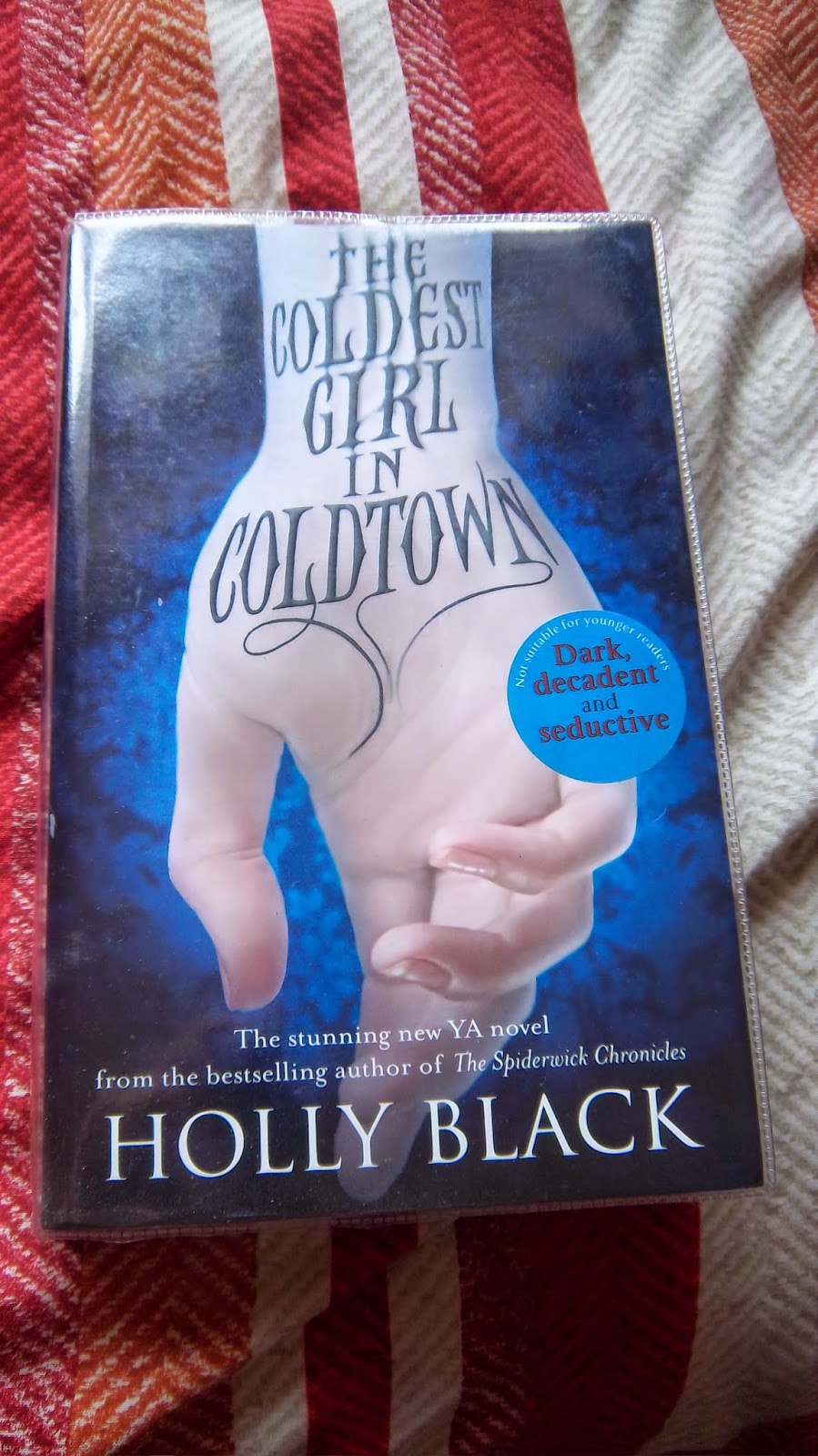
The Coldest Girl In Coldtown - Holly Black (RIP IX book 2)

People liked pretty things. People even liked pretty things that wanted to kill and eat them.
Vampires have always existed, but until recently they took great measures to keep their existence a secret. That all changed a few years ago, when a vampire named Caspar Morales got carried away, creating many more. The epidemic spread out of control, and now the vampires of the USA, and anyone infected by them, are imprisoned in Coldtowns, where they party and feast all night long. These parties form the basis of the most popular reality TV shows, are there is a significant proportion of the population who longs to join them, attracted by the glamour and the danger and the romance of being forever young.

Seventeen-year-old Tana is not one of them. She's seen the other side: when she was very young her mother was attacked by a vampire, and infected. In this world, one does not automatically become a vampire until one drinks human blood, but before you can return to your human life, you have to endure the Cold - up to eighty-eight days of desperate cravings as the infection sets in. Not many people make it through.

When Tana wakes up to find herself one of only three survivors of a vampire attack on the party she'd been at - the other two being Gavriel, an ancient vampire and her infected ex-boyfriend Aidan - she heads down with them to the nearest Coldtown, where she finds herself caught up in a strange world of death-seeking misfits, vampire politics and her own nature. Gavriel is an enigma, an oddly charming but deadly vampire with a Past. Can she trust him? Can she even trust herself?

I was impressed with Holly Black's world-building for The Coldest Girl In Coldtown, bringing a renewed sense of danger and glamour to vampire fiction. There was a classic, pre-Twilight feel to this book, of beauty and horror, and I was not at all surprised to see Anne Rice cited as one of Black's influences in the acknowledgements. The crowds of uninfected humans who made their way to Coldtown, particularly the twins known as Winter and Midnight, repulsed me in their sick fascination for the vampire lifestyle, giving up what it was to be human to be part of the undead fame game - for the gate into Coldtown is, with few exceptions, one way only. Yet they were entirely believable too, liveblogging and videoing every experience, and everyone convinced that they were safe, they were immune, that danger and death were things that happened only to other people. This is vampire fiction for the social media generation.

I read The Coldest Girl In Coldtown as part of Readers Imbibing Peril IX.


Monday, 24 February 2014

Buffy the Vampire Slayer: Season Three


The last we saw of Buffy Summers was of her taking the bus out of Sunnydale to some unknown destination, after killing her vampire-boyfriend Angel to save the world. As you do. Season three opens showing her working as a waitress under an assumed name. But it's not long before the weirdness follows her and sends her home to face up to the consequences of the season two finale.

Back at Sunnydale, Xander, Willow and the others are trying to fight off the vampires without the leadership of the Slayer. This season addresses the relationship between Willow and Xander. First, Willow fancied the oblivious Xander, and then, once Willow got herself a boyfriend, Xander started to feel jealous. Things have come a long way since we first met these characters, and whereas once I would have been happy to see them get together, now I really didn't like seeing them sneaking smoochies whenever they got the chance. Poor Oz! And poor Cordelia. Still, in one way, I'm glad that the inevitable is out of the way now. Although I don't hate Xander's character, I think Willow deserves so much better. Her relationship with Oz survives their cheating. Xander and Cordelia's does not. (I said before, it was never going to last.)

Some new characters are introduced for season three, most notably Richard Wilkins III, mayor of Sunnydale, an apparently genial, fatherly chap who happens to have some nefarious plans of his own. And Faith, the second slayer (Kendra's replacement) a rebellious, angry young woman who is out of control. Faith is played by Eliza Dushku, who I first encountered in Dollhouse, and I observed at the time that she has a very Buffy-ish look to her. I now think that's no coincidence: they are two sides of the same character, Buffy the light, Faith the dark. Faith is how Buffy could have turned out if she didn't have the support from her friends and her mother to keep her grounded, to give her a strong sense of morality. Buffy's conflict with Faith (which could perhaps be interpreted as a conflict between the different sides of her own nature) and the fight to keep the Mayor from transforming into a giant snake monster, is the main plot arc through season three. Because it concerns new characters, it didn't emotionally hook me so much as the story with Angel in season two, but it was entertaining and satisfying to watch, especially in the finale in which the entire graduating class of Sunnydale High join forces to fight the evil (including flaming arrows, because flaming arrows are always awesome.)

I've always thought of Buffy as a high school series, but as Buffy is sixteen at the start of her story, and each season takes place over the course of a school year (like Harry Potter), the show must grow up and move on, like its characters. Season Three finishes with Buffy and co's graduation from high school, and their preparations for university. I felt sad that Willow, after receiving offers from Harvard and Yale, as well as Oxford, decided to study at the local Sunnydale college, but it makes sense in story terms. How could you have a show where each member of the Scooby gang is in a different state? Not to mention the intricacies of filming the series on location. Better to keep them at a fictional college, and build the set to suit the story's need.

There are some marvellous individual stories within season three. I particularly liked "Band Candy," in which students sell chocolate bars to raise money for the school band, and everyone who eats it acts like an irresponsible teenager again. Principal Snyder was both hilarious and creepy acting like a kid, whereas Giles was hilarious with a tough London accent, in a tight t-shirt instead of his usual tweed. This was surprisingly pleasing - and Buffy's mother Joyce certainly thought so, as we discover later on with much hilarity (although I don't think Buffy would share the amusement.) I loved the moment when she confronted Giles about her mother, and he walked right into a tree with shock.

This season also introduces Sexy Evil Vampire Willow, from a parallel dimension created by Cordelia's wish that Buffy had never come to Sunnydale. Willow has certainly gained a new confidence in this season, with her relationship with Oz, and new-found interest in witchcraft. (I do fear for her in her witchery, however. I've noticed hints that she might be getting in over her head. Foreshadowing for later seasons perhaps?) Alyson Hannigan must have had so much fun playing Willow as a psychotic vampire, with echoes of Drusilla from season two. "Bored now!" She was so entertaining to watch, and as an added bonus, she comes back in another episode to really shine, acting opposite her usual timid, bookish character.

After Giles breaks the Watchers' rules, he is sacked from the Watchers' Council and replaced by Wesley, a younger, Gilesier Giles. It's quite uncanny to watch the two together (simultaneously wiping their glasses with handkerchiefs during an awkward moment.) Wesley is Giles with all the book-knowledge and none of the experience, full of ideas about authority and rules and orders, and not much clue about actually dealing with vampires. Or slayers. Or teenagers in general. All the Watchers seem to be English, all upper-class and probably Oxbridge-educated. Do none of the American universities give a doctorate in Watching? Quite remiss of them, don't you think?

As you could probably predict (considering he has his own TV show) Angel does not stay dead for long, and is the cause of the greatest plot twist yet. After coming back from the dead, his own, good self, and nursed back to health by Buffy, it doesn't take much to turn him evil again: Faith splatters him with blood, and some creepy ninja-dude appears, and boom! Angel is the bad "Angelus" once more. Faith and Angel capture Buffy, chain her up and prepare to torture her. Then we get this marvelous exchange:
Faith: "What can I say? I'm the world's best actor."
Angel: "Second best."
He was acting all along! How's about that for a shocking moment! Wonderful, so unexpected, my favourite moment of the series so far.

I knew Angel wasn't around for all of Buffy, and so many times in season three, it looks as though he and Buffy are going to split up, that he's going to leave town, that they won't see each other again. But it takes the entire season for him to actually get his act together and go! It's not that I dislike them as a couple. I want Buffy to be happy. But if he's going to go, can't he just stop faffing and go? He breaks up with Buffy, finally, a couple of episodes from the end, and this time it actually does seem final, with harsh words spoken and a broken heart, but he sticks around to help defeat the Mayor's evil plan before disappearing into the night at the end of the season finale. I think we've seen the last of him for a while. I believe Angel runs parallel to Buffy from now on, although I don't have the DVDs for that. Is it essential viewing to make sense of Buffy, or can I muddle along without it? I think Angel's an OK character, but it's Buffy, Willow, Giles and the others that I'm really interested in.

Favourite episodes:

6. Band Candy: In which all the adults act like teenagers and Giles gets together with Buffy's mother.
9. The Wish: A very dark It's A Wonderful Life episode, with Xander and Willow as vampires.
13. The Zeppo: In which Xander feels excluded from the vampire slaying, has his own adventures, and we see just snippets of what would ordinarily be the "main" plot.
14-15. Bad Girls/Consequences: In which Faith goes off the rails, and tries to drag Buffy along with her.
16. Doppelgangland: Welcome back Sexy Evil Vampire Willow!
17. Enemies: The one with the big plot twist.
18. Earshot: In which Buffy can hear everyone else's thoughts.

Friday, 14 February 2014

Buffy the Vampire Slayer: Season Two

I'm assuming I'm the last person to watch Buffy, but in case I'm not: spoilers.


After the first couple of episodes, I quite enjoyed the first season of Buffy as a series of one-off monster-of-the-week episodes. Season two is where it really kicks off. Its opening wasn't promising: the first episode looked like textbook How Not To Sequel, showing the vampires attempting to bring back the Master from the dead, the villain Buffy defeated at the end of the previous season. I didn't love the Master - he was cheesy and somewhat irritating, certainly not a strong enough villain to be the Big Bad of all of Buffy. I was relieved when this story came to nothing, serving mostly as an excuse for Buffy to find closure (which she did by smashing the Master's skeleton into dust with a hammer.) With the Master out of the way, the obvious next villain must be The Anointed One, a seriously creepy child who is leading the vampires. Or so you'd think.

Enter Spike. From the minute he screeched his car into Sunnydale, I knew that this series was never going to be the same again. I knew who he was immediately - I remembered all my friends loving Spike from the first time around, but didn't see what the appeal was. Of course I didn't. I only saw pictures. But as soon as he struts onto the scene, even with his vampire-face on, and an accent that is supposed to be London, but wobbles, Spike exudes a sort of villainous charm, the Lestat to Angel's Louis. In his first episode, Joss Whedon subverts our expectations in his characteristic way, when Spike effortlessly destroys the Anointed One at the end of his very first episode. This is not someone you want to mess with. Nor is his girlfriend, Drusilla, who is quite mad: part a malevolent River Tam of Firefly, part Helena Bonham Carter as... well, any of her roles, and all very sinister indeed.

Season two is where the main characters start to find success in love. A new character is introduced: Oz, a musician and in the year above them, who upon seeing Willow becomes utterly "Who is that girl?" Likewise, I fell head-over-heels in love with Oz: he's cool and laid-back and utterly adorable, and it made me very happy to see Willow get over her unrequited fancy of Xander and pair up with Oz. They are quite possibly the cutest couple ever. And then Oz becomes a werewolf. I've had a soft spot for decent people who become werewolves ever since Remus Lupin, and so I was utterly thrilled to see that my favourite new character got this plot - even if the werewolf is basically a man in wolf mask and a hairy suit. (It beats most CGI werewolves these days.)
besotted.

Meanwhile, Xander starts sneaking secret smoochies with... Cordelia?!?! The mean-girl queen bee who has nothing but contempt for Buffy and her friends, and particularly Xander? I wouldn't quite say that theirs is a Benedick and Beatrice relationship, but it is certainly a fiery one. (It'll never last.)

But most important is Buffy's relationship with Angel, which is consumated half-way through the season. And then, everything changes, Whedon-style. Buffy's good vampire boyfriend is gone, turned into a sadistic monster, the worst of all the vampires. WHAT? I had absolutely no idea that this was going to happen, and was both upset and awed. The story's not meant to go that way. And I love it when a story doesn't go the way it "should."

I expected Angel to be reformed soon after his tranformation, and spend the rest of the season angsting over what he'd done. His actions in the episode "Passion" proved me wrong: not only does he murder Giles' new girlfriend, Miss Jenny Calendar, but he tucks her body up in Giles' bed, leaving a romantic rose-trail up the stairs. So much crueller to Giles - and agony for the viewers to see Giles look so happy knowing what he is about to find. This is not a little blip on Angel's record, Whedon tells us. Broody good Angel is not in there any more.

Season two introduces Kendra the Vampire Slayer - Buffy's replacement, because she "died" at the end of the season one finale, if only for a minute or two. This poses the question: is this "only-one-slayer" business all messed up forever now? When Kendra dies (she lasted longer than I expected, but not past the season finale) will she be also replaced, in a continual line of two slayers forever (unless another one dies briefly and revives, again, and then there were three?) These things bother me. 

Who would have predicted at the beginning of the season that the Big Bad would not be the Master, nor the Anointed One, or even Spike and Drusilla, but handsome, harmless Angel? Congratulations Angel, you have character! You have depth! Shame Buffy has to kill you because you're about to bring about the end of the world. But wait! Willow may be able to magic Angel's soul back into him. My idea of the series' tragic ending would be that Angel would turn back to good at the exact instant that Buffy staked him. (Yes, I know he gets his own series later down the line, but dead doesn't always mean dead in this 'verse. I mean, c'mon, vampires!) As if that wouldn't be tragic enough, once more, Joss Whedon tweaks the narrative just enough to make it even more devastation. Angel gets his soul back... but Buffy still has to kill him to save the world. Deliberately and in cold blood.

I have said it many times: Joss Whedon feeds on his fans' (and characters') pain and anguish. Season two just confirms this... and I've a horrible feeling that it has only just begun.

Most Memorable Episodes. (I'm not sure "favourite" is the correct word any more.)

4. Inca Mummy Girl: In which Buffy's exchange student turns out to be an Inca Mummy.
6. Halloween: In which halloween costumes change their wearers.
7. Lie To Me: In which Buffy is reunited with an old classmate, who is too interested in the vampires.
11. Ted: In which Buffy's mom gets a new boyfriend, who is not as nice as he seems.
13-14. Surprise/Innocence: In which Buffy turns seventeen and sleeps with Angel, who turns evil.
15. Phases: In which Oz is revealed to be a werewolf.
17. Passion: In which Angel proves what he is capable of.
19. I only have eyes for you: In which an illicit romance with a tragic ending is acted out again and again at Sunnydale High. Points deducted for wasps.
21-22. Becoming: The season finale, in which everything hurts and nothing is OK.

Monday, 3 February 2014

Buffy the Vampire Slayer: Season One


As I've mentioned before, I have spent the last seventeen years inexcusably ignorant of Buffy the Vampire Slayer, despite being a nerdy teenager at the time it was originally aired. I saw a few episodes, and listened to my friends rave about it, but it was never a show I went out of my way to watch. Even when I'd been introduced to Joss Whedon's other work: Firefly, Dollhouse, Doctor Horrible and The Avengers, Buffy didn't really appeal. I've never been a big fan of vampires. Yet slowly I was won over, and eventually borrowed the boxset from my best friend. I wasn't convinced right away, but I've learned from experience that Joss Whedon's series tend to start grabbing my attention from round about the third episode: in this case, the episode with the witch cheerleader, who turns out to be the cheerleader's mother who's done a body-swap with her daughter, trying to relive her glory days. 

I confess, I'm not a huge fan of the "chosen one" trope, and am still a bit confused about how and why Buffy is the designated Slayer: what is so special about her, that no one else can do the job? Several other characters have been able to effectively wield a pointy stick. Is she naturally abnormally strong, abnormally skilled? She is an awesome fighter, sure enough, but it's clear that she does a lot of rigorous physical training to get that way. When we first meet Buffy, new student at a new school, she is already well aware of her destiny before she ever met Giles, or any other "Watcher" to tell her what she needs to be doing. How did she discover this? What would happen if someone else wanted to battle vampires, without being a "chosen one?" Who chose Buffy and how did they let her know? These are the things that irritate my brain, but for the most part I just put this aside and enjoy the show. And by this point, yes I am enjoying it very much. There is an overriding story arc about one particularly powerful vampire known as The Master (no, he is not nor has he ever been  a Time Lord) and among the monster-of-the-week stories, series one builds up towards a prophesied confrontation between the newly-restored Master and the Slayer.

But for me, at least in series one, it's not the vampire-slaying stories that interest me so much as how the 
events affect the characters. Buffy, her classmates Willow and Xander and their school librarian by day, Watcher by night, Rupert Giles, make an excellent team. I like Buffy a lot more than I expected: she is very human, flawed, yet likable, tough but vulnerable. She is, in short, a sixteen-year-old girl, but one with a huge responsibility. Willow is simply adorable, and her unrequited love for Xander is rather heartrending, because he sees her as just a friend, someone who's been there so long he's kind of forgotten she's a girl. I see parallels to Ron and Hermione in their friendship, possibly because I'm reading
Harry Potter and the Half-Blood Prince at the same time as watching Buffy. But I think Willow can do much better than Xander.*

Xander is far too interested in Buffy, and at times displays unattractive signs of "nice guy syndrome,"
but Buffy has eyes only for Angel - who, as a vampire, is her sworn enemy. Oh, teenage romance woes, how I don't miss you! I knew about the Buffy/Angel love story from the start, and did not relish it, yet it was well done. Yes, Angel can be a bit brooding and introspective, but at least he doesn't sparkle. This is more than the standard teen romance between a human girl and an Interchangeable Magical Boyfriend Creature, because Buffy's purpose is to destroy ALL the vampires, adding a deeper level of conflict. It's not the greatest love story of all time, but it's moving and handled well.

I often enjoy the stand-alone monster-of-the-week episodes more than the vampires themselves: let's face it, The Master is an incredibly cheesy villain, and I found him rather irritating - an over-acting Voldemort. Still, the final episode's confrontation was very satisfying; it was an emotional roller-coaster of an episode. After spending eleven episodes getting to know Buffy, experiencing her highs and lows, her vampire-slaying and her longing for a normal life, who could fail to be affected by her overhearing the terrible prophesy. "I'm sixteen years old. I don't want to die." 

Favourite episodes:

3. "The Witch" - the one with the body-switching cheerleader mom. Episode 3: the one where I started really getting into the series.
6. "The Pack." - The one where Xander and some school bullies get possessed by hyenas and the bullies eat the school principal. This series suddenly took a very dark turn.
8. "I Robot, You Jane." - The one where Willow uploads a demon onto the internet. Hilariously dated, so bad it's good.
9. "The Puppet Show." ARRGH VENTRILOQUIST DUMMY NO! In which Joss Whedon takes a classic horror trope and turns it on its head, playing with all our expectations. Not for the last time.
10. "Nightmares." In which everyone's worst fears and nightmares come to life. I cried.
11. "Out of Mind, Out of Sight." The one with the invisible girl. 


*Interesting that I'm having these thoughts right now. The internet tells me today that J. K. Rowling now wishes she'd paired Harry and Hermione together, that Ron and Hermione wouldn't actually have been good for each other. Perhaps my comparison is not so mad after all...

Saturday, 15 October 2011

I have neglected you, dear blog.

Logging into my blog, I realise it has been a fortnight since I last updated, and my reviews before this have been rather infrequent. So, what have I been up to lately?

In the grand tradition of British weather, it has been unpredictable. After about three months of autumn, suddenly, at the end of September and beginning of October, the sun popped its head out from behind its cloudy blankets to give us a surprise week of summer - a week that, defying all tradition, coincided with my week off! I celebrated my birthday with a barbecue in the garden, and then, two days later, hunted out my winter coat, scarf and hat.

My reading has been on the slow side, and the books seem to have been all along the same sorts of lines of British, somewhat surreal comic fantasy or science fiction. My last review was of Rivers of London. After this came a reread of Pratchett's Witches Abroad, The Good Fairies of New York by Martin Millar - recommended by Neil Gaiman, who wrote the introduction of my edition, with the advice not to lend it out. Oops... Judith has it now. Then came The Hitchhiker's Guide to the Galaxy. Unfortunately, I had not got very far into the book, before I left it behind in a pub. For some reason, it seems to be the right sort of book to do this to - a cult classic, one which will need replacing many times in a lifetime. I trawled through the town's charity shops in search of a replacement, secure in the knowledge that one of them, somewhere, must have a copy. Like I said, it's that sort of book. My faith was rewarded, and I bought it for 50p.

I also watched the film fairly recently, and was inspired by one of the scenes to knit myself a Marvin doll. His personality started to come through before I had even finished sewing him together. I'm keeping a watchful eye on my teddies. I think they are all right, and won't need therapy...

On my week off, I went to Chichester for a couple of days to watch a production of Sweeney Todd: The Demon Barber of Fleet Street, starring Michael Ball and Imelda Staunton. It was a fantastic show, hilarious, creepy and at times terrifying.

I've just recently got stuck into the second series of Downton Abbey on TV. I missed series 1 the first time around, but recorded it when it was repeated, and watched in the run-up to series 2. I am hooked! I'm loving the escapism into a world very different from my own, and engrossed in the lives of both the family Upstairs and, even more so, the servants Downstairs. Previously unsympathetic characters are becoming more rounded, the ice-cold Lady Mary is becoming nicer, Maggie Smith as the Dowager Countess is, without fail, brilliant. Only former footman Thomas still seems 2-dimensional, but I suspect that his hidden depths will be made known as the series goes along.

Do you remember me reviewing a book called Wight Moon: Out of the Shadows a little while back? It's a self-published book by a friend of mine, a local author, about a community of vampires on the Isle of Wight. I've spent the last few weeks editing book 2 for her, and I can reveal that this one is even better than the last, full of mystery and suspense that kept me glued to the screen long after I'd promised myself "one more chapter." There's a plotline that feels like a classic gothic novel, expansion of Elaine's version of vampire lore,  and secrets come to light about the characters we thought we knew. Excellent stuff, and I can't wait to read book 3.

Sunday, 25 September 2011

Paranormalcy, Kiersten White

I'd been vaguely aware of Paranormalcy for a while, from other people's "mailbox" and review posts, but I'll be honest, it really didn't jump out and grab me, probably because of the title. I'd been coming to think the word "paranormal" to be a bit overused, an easy categorisation of an entire genre of books, without anything to say what makes this one different. Also, as a Brit, the word "normalcy" just doesn't sound right, and that, too, might have turned me off. But then, I happened upon author Kiersten White's blog, and after reading a few posts, decided I wanted to see more, went out and bought the book.

Yesterday, I was sorting through my books, picked up Paranormalcy to add to my to-read pile, then flicked it open. I was going to pick up and reread The Princess Bride, but upon opening Paranormalcy, literally from the first line or two, I could not put this book down.

The first chapter was called, "Oh, Bite Me!"
"Wait- did you- You just yawned!" The vampire's arms, raised over his head in the classic Dracula pose, dropped to his sides. He pulled his exaggerated white fangs back behind his lips. "What, imminent death isn't exciting enough for you?""Oh, stop pouting. But really,the widow's peak? The pale skin? The black cape? Where did you even get that thing, a costume store?"
I had to read more. Just one more sentence, to see if it was as funny as the last, and another, to find out what exactly was going on. It didn't take very long to get a clear picture of narrator Evie: Sassy, snarky, exuding attitude, but a girly-girl at heart. She might be employed by the International Paranormal Containment Agency to track down supernatural creatures - vampires, werewolves, faeries, you name it - for monitoring, but despite her unusual life, Evie herself is just a normal teenage girl, who would like nothing better than to be an ordinary high school student with a driving license and a locker. Just because she has the unique ability to see beneath the glamours - magical disguises and illusions - of "paranormals" - doesn't mean she herself is anything but normal.

But then immortal creatures start dropping dead by the dozen, and the person responsible is somehow connected to Evie. They seem to have more in common with each other than any of the other weird and wonderful creatures IPCA is keeping tabs on. Perhaps Evie's not as normal as she thought.

I'm usually wary of fantasy stories set in the real world which have too many different species of impossible creatures, preferring to stick to just one. But Paranormalcy really worked. Although "paranormals" aren't known to most humans, to Evie they're just differently normal. Her best friend is a mermaid, her ex-boyfriend a faerie, many of her colleagues werewolves, and her new crush Lend is something no one quite knows how to classify. It had a bit of an Eyre Affair feel to me, with its humour and matter-of-fact acceptance of the bizarre. The book launches straight into the action, the world-building being done by immersion rather than exposition, but it is easily picked up and understood.

At first I was a bit surprised that Evie was only sixteen; her bag-and-tag job seemed far too dangerous for one so young. But as we get to know her, she is a very realistic teenager, sometimes a bit bratty but basically likable, funny, obsessed with all things pink and sparkly and her favourite high school soap opera. I found her fascination with all things high school very understandable - I'd have loved to go to an American high school, or a boarding school, just to see how different it was from my own school experience!

Kiersten White has a refreshing take on various different "paranormals" from myth and literature. Her vampires may look suave and seductive, but all Evie sees is walking corpses. Sexy(!) Her friend Lish, the mermaid, lives in a tank of water and can't speak English, so has a computer translate her speech for her. But some of her more imaginative language translates to "bleep," something that Evie picked up. I'm not sure whether "bleep" necessarily worked in this book all the time. I liked the idea of it as an in-joke that turned into a habit, and I certainly think that less is more when it comes to swearing, but it sometimes jarred, if it was at a point of high tension - I'd rather nothing at all than a substitute-swear. But that's a small criticism.

Evie's double, Vivian, was an interesting antagonist that constantly kept me questioning the morality of Evie's world. She was a villain who evoked pity and caused me to wonder whether she was really all that bad, or if there was something in her reasoning. There wasn't a clear-cut black-and-white solution to this tale, which I appreciated.

I've read on other people's reviews that, despite its title, Paranormalcy is more an Urban Fantasy than a Paranormal Romance (which I've translated as meaning that plot and character come first, rather than just being an excuse for the IMBC* mushy stuff.) It is a fun, fast-paced story that had me grinning and turning the pages right the way through. And there was a wonderful jab at Twilight and the like:
Arianna snorted. "Why on earth would a vampire go to high school?"
Why indeed?


*Interchangeable Magical Boyfriend Creature

Tuesday, 1 March 2011

Wight Moon: Out of the Shadows, E.A. Berry

When Ann Grayson moves to the quiet Isle of Wight after a messy divorce, the last thing she expects is to find herself mixed up with a family of vampires! Alarmed at first, she soon learns that the Island vampires have coexisted peacefully with their human neighbours for well over a hundred years. But when missing young women start turning up outside the home of local businessman - and vampire - Joshua Ellis, unconscious, suffering severe blood loss and with puncture marks on the necks, this peace is threatened. Are the Island vampires as tame as they seem, or does someone with a grudge want to discredit them?

Wight Moon's author, Elaine Berry, is a friend from my theatre group, but I had no idea she had written and self-published a book until she turned up at rehearsal with the finished product. Wight Moon is a supernatural thriller, and Elaine does not mess around with introductions but plunges you straight into the action when protagonist Ann encounters a strange child alone in the cemetery. I don't know many books set on the Isle of Wight, so I enjoyed identifying local landmarks, and was amused by the addition of "friendly neighbourhood vampires" into the local mythology. Wight Moon does nothing to alleviate the impression that Islanders are a little, well, peculiar!

All fantasy writers have their own take on the mythologies they use, and Elaine's vampires have their own existance. In everyday life, they appear no different to human beings - no sparkly skin here! - but when they "turn" they take on the more traditional "vampire" appearance, with red eyes and prominent fangs. When in "vampire" form, and only then, they have additional, supernatural powers, such as deep hypnosis which they use (mostly) for the good of mankind, although they are not above turning on the "vampire sleep" for their own purposes.

Wight Moon is a gripping tale - as Elaine put it: "if you like twists, this one is plaited!" She creates suspense early on with short, choppy passages, alternating the mundane scenes of a mother and daughter at lunch, with the kidnapper hiding in the daughter's flat, waiting for her return. The book is full of humour, shown in the day-to-day lives of the vampire family, such as her matter-of-fact description of Mary, the baby vampire, with a mug of blood in one hand and a rusk in the other. If I hadn't already known Elaine, I might have guessed she was a connoiseur of Gilbert and Sullivan in a scene between Mary and her uncle that culminates in a groan-inducing pun reminiscent of Pirates' "Often/Orphan" gag. The book works well as a stand-alone novel, with a satisfying tidying-up of loose ends, but finishes off with a wonderful sequel-hook which sent me off to Elaine to offer my services as proof-reader for book two. A really enjoyable read.

Saturday, 29 November 2008

Twilight and New Moon, Stephenie Meyer


This time a break from L. M. Montgomery, although there is still a link as on Meyer's official website she gives a list of recommended reading, which includes the complete Anne of Green Gables series.

I first encountered Twilight a couple of years ago and was drawn to it by its cover, by which a book should never be, but frequently is, judged. Frequently I picked it up, as its black and red and white appealed to my darker side, and read the blurb on the back:

About three things I was absolutely positive :
First, Edward was a vampire.
Second, there was a part of him-and I didn't know how dominant that part may be-that thirsted for my blood.
And third, I was unconditionally and irrevocably in love with him.

"Puh-lease!" I thought, and put the book back again. I had this strange sense of deja vu. Once, years ago, I read a book about a girl meeting a vampire after moving to a new place - possibly living or working in a hotel, but I can't be sure of that. I think, but couldn't swear to it, that she was drawn to him, dangerously - I wouldn't say falls in love. I don't think I ever finished tht book, and there are few books about which I can say that. I just remember an image from my head of standing by a lake or a pond and all is dark blue. At twilight, it must be. I don't remember what that book was called, but I was very unimpressed by it. I was convinced, at first, that Twilight was that book, rereleased with a shiny new cover. But when I checked its publication date, it was too recent.

Several times I looked at the back of the book, but never got further than that. A sequel, two, three made their way onto the shelves, and I started to become aware, as I worked in a bookshop, that the books were very popular. Reading on the internet I discovered a little more. Edward, for example, was what Terry Pratchett would call "A black ribboner" - a vampire who has sworn off human blood. But Pratchett's characters work as his is a comic universe. In general, I felt that a vampire who didn't drink blood wasn't a vampire at all. After all - girls fantasise about vampires. At least two of my best friends have crushes on Lestat from Interview With the Vampire. But their attraction is their danger, surely. A vampire romance - with a vampire who didn't drink human blood - just sounded particularly insipid. Like fantasy fulfilment that backfires.

General consensus seemed to be that Twilight was bad, but enjoyable, a guilty pleasure, (apart from those teenage girls who were determined that it was the "best b00k evaah n edward is soooo h0ttt!!111") Despite myself, I found myself wanting to read it just to see what all the fuss was about... except that being in four books, one being rather a monster volume, I wasn't sure I could put myself through it. Rather like High School Musical, but with more fangs and less singing. Plus, the titles of the second and third books: New Moon and Eclipse made me think of a certain Jaffa Cakes advert that used to be on the TV.

In the end it was the film that decided me. I haven't been to the cinema in months and I was getting withdrawal symptoms, but there was absolutely nothing on that I wanted to see. So when I heard Twilight would be out soon I decided that it was the least of many evils when pitted against James Bond, unfunny comedies and unromantic romances. Still, that left me with a dilemma. I am, primarily, a book-lover. Films come secondary. I rarely watch a film that wasn't at one point based on a book, and I don't like to see adaptations before I have read the original. But could I do that to myself?

I could, and I did. I even read the second and am about to start the third.

The story goes that Isabella Swan, henceforth known as Bella, moves to the small, wet town (sounds like it's been lifted from England, or at least the weather has been) of Forks, WA. She starts high school and meets Edward Cullen, who is a vampire. They fall in love at first sight, as you do, though Edward's idea of love at first sight is like me falling in love with a box of Lindt Lindor at first sight. It takes all his effort not to swoop on her, and subsequently he acts as though he hates her.

Now, there's no mystery about Edward. He's a vampire, that is obvious to anyone who's read the blurb on the back, or seen the trailer for the film. It is Bella who is the enigma. I read her as rather an unreliable narrator. She tells us that she is plain, gawky and a misfit, but she has every boy she meets falling at her feet. Even Edward, though he tries to hide it. Also, in the very first book she shows traits of resembling a vampire. She is pale skinned. She is incredibly sensitive to the smell of blood. There is something about her that stops Edward, who has the ability to read minds, from reading hers. And, as before mentioned, he falls head over heels for her on first sight.

At the end of the first book, she is bitten by a vampire, but Edward saves her from turning into one. Or so it appears. In the second, Bella is often described as feeling very cold when no one else is. Now, later in the series, I will probably find that Mrs Meyer attributes this to the vampire bite, perhaps say that it had a slower effect on her but that at that moment she began to turn. However, the signs were there very early on. There is something that Bella is not telling us.

The love story, I'm sorry, does not convince me. It reads more like infatuation to me. Bella's attracted to Edward - we are told over and over that he is more beautiful than is humanly possible, like a Greek god, with perfect features and marble skin. I'm not sure that the "marble skin" image is as attractive as it is supposed to be. Not on a man. It makes me think of Othello's description of Desdemona:

"Yet I’ll not shed her blood
Nor scar that whiter skin of hers than snow
And smooth as monumental alabaster."

Now, I've read that Robert Pattinson, who plays Edward in the film, is getting absolutely mobbed and rather scared by all the teenage fangirls who have fallen in love with Edward. Or rather, infatuation. I suppose it's the tortured hero idea, but to me he is irritable, temperamental and changeable. "Ah," you might say, "That is because he loves Bella and wants what is best for her, but wants to be with her, and the two needs are not compatable." That's true, that's accurate... but... there is something flat about their relationship. Trying to pinpoint what it is that doesn't quite work, but when I think I've got it I remember something that contradicts it. I think, what it is, is that Bella seems infatuated with how Edward looks and the exoticism of him being a vampire, but I don't see much of what makes her love him. She is obsessed with him, certainly, to an unhealthy degree, to the point of abandoning interest in everything else.

Even more unhealthily, Bella demands again and again that she wants to be a vampire too, and Edward refuses, again and again, to bite her. Bella shows a shockingly selfish disregard for her humanity, ignores Edward's telling her that immortality is not all fun and games. She seems like she's got this pretty, daydreaming, unrealistic idea that she clings to about being a vampire, without giving any thought to the torture the Cullens (especially Edward) suffer as a result of their lifestyle. She also pays no thought to how her parents will react. In short, she is a heedless teenager who lives in a world of her own. The sad thing is, I'm sure she will get her wish before the end of the series. I wonder whether she will live to regret it. I think of that awful journalist at the end of Interview who after Louis has told this story about how terrible it is to be a vampire, thinks, "Oh, go on, it can't be that bad, make me a vampire and I'll do a better job of it than you did." To which Louis thinks, "Have you not listened to a word I said?" Bella, too, thinks she knows better than those who know what they're talking about because they've lived the undead "life."

Bella and Edward's relationship all happens so quickly I don't quite believe it. And he seems to love her as though she were a box of Lindt Lindor that he knows he mustn't eat. It seems to be her blood he loves more than anything else, but he resists going in for the swoop. At the same time, though he's always saying he's dangerous, I'm not sure I quite believe it. There are moments when you see it, but usually not.

In the sequel, New Moon, Bella gives herself a paper-cut in the presence of Edward and his family, after which Edward jumps at her to protect her from his brother Jasper, who struggles with the black ribboners' non-human diet. That causes her to injure herself more seriously by, if I got this right, falling onto a load of glass at the dinner table. Edward and the Cullens leave Forks to protect Bella, which causes her to sink into a more severe case of moping than I gave a main character after killing off her fiancé - and I thought I was overdoing it.

After this, the Cullens also disappear from the story for about, oh, the middle third or half of the book, and at this point, despite Bella's moping, the story becomes more interesting (ie there is more story and less description of Edward's marble statue beauty. Bella spends a lot of time with her friend Jacob, and this relationship with the blurred edges of whether they should count count themselves boyfriend and girlfriend or just friends is one of the more realistic relationships in the book. Jacob, too, is a more rounded character than Edward.

Not that this section of the book will escape analysis or criticism. Jacob becomes worried about his friends, who seem to be falling under the spell of one Sam Uley, looking as though they are being drawn into a cult and acting strangely. Then Jacob is next. Bella is exceedingly thick at this point. For someone who dated a vampire for six months or so, she takes a long time to realise that Jacob is a werewolf, even though, at the same time he told her the old Quileute legends about vampires which led her to realise the truth about Edward, he told her that he was supposedly descended from werewolves.

Second issue - this being a writing criticism - when it finally does click with Bella, it is in a dream where she sees him turning into a wolf. This is a weak narrative device - though one I have been guilty of myself as a teenager. It must be another clue to Bella being an undiagnosed vampire, as the vampires all have supernatural skills. Edward's sister Alice can see the future. Perhaps Bella too has this ability.

Criticism 3: Werewolves vs. vampires. Either/or, please. Both in a fantasy set in the real world is too much - too many mythical creatures running around. And the two species being at war makes me think "Underworld" and Montagues and Capulets. (Having said that, there are a lot of Romeo and Juliet references in this book.)

The last part of the book shows Bella jetting off to Italy, as you do, to stop Edward committing suicide by angering the Volturi, or Vampire royal family, into killing him (as suicide for the undead is a bit difficult.) For a while it stops being fantasy in high school and changes genre to epic fantasy. I think, overall, I prefer the local, small-town stories. I think I always do. I'm rather a home-girl at heart, and when reading - or writing - a book, I like it to be set mostly near to home. When you change settings you change the tone of the book, and despite the corniness of the Twilight books, I do have to admit to enjoying the local, high-school, small-town setting of them. Though some of the characters are very two-dimensional, I like the human (and once-human and part-human) stories, in a guilty pleasure sort of way. I just have to ignore the swooning and the moping and the constant descriptions of Edward's unearthly beauty.

In conclusion, the Twilight series so far is bad, really bad, and yet... fun. I certainly will be reading on.

Watch this space for reviews of the other books, Eclipse and Breaking Dawn.
Related Posts Plugin for WordPress, Blogger...