Saturday, 3 April 2010

Doctor Who: The Tenth Doctor:

Spoilers galore, though if you're reading this you're probably up-to-date with Doctor Who up to The End of Time.

I hadn't heard of David Tennant before he was announced as replacing Christopher Ecclestone as the Doctor for the second series of the revamped Doctor Who. My sister filled me in: he played Casanova in a BBC drama series of the same name. I had seen trailers for the show and thought Tennant seemed an... unusual... casting: a scrawny, scruffy-looking young man as the world's greatest lover? I had expected someone a bit more... dashing, especially after having seen the trailer for a film starring the more conventionally good-looking Heath Ledger. However, I had never seen the programme, so could only judge from vague memories of the trailers.

I thought at first that Tennant's Doctor was the Ninth all over again. They did, certainly, have a bit in common: both were by turns manic and brooding. However, I thought the Tenth Doctor more likeable, gentler, cheeky but with less of a sharp edge to his tongue, even when rude. "Is that what sort of man I am? Am I rude? Rude and not ginger?" Which was why, when he got angry, he was all the more frightening.

 And as the series went along, the Doctor changed... and not always for the better (as a person. As a character development story, it just kept on getting better and better.) After the loss of Rose in a parallel universe that she could never ever return from (for now) The Doctor starts getting darker, crueler. The sight of him standing, hard-faced, staring down at the dying Racnoss, is frankly terrifying. Donna tells him "sometimes you need someone to stop you." He also seems to be stringing Martha along, letting her come along with him for the ride, then one more, then another, but constantly comparing her with Rose. And of course, Martha is in love with him too.

Maybe because she was only there for one series (and some odd episodes in series 4) and maybe because she was constantly feeling like a second-best Rose, but unfortunately I never really felt that Martha was very well-rounded as a character in her own right. I think because of the way she related herself to the Doctor - wanting to take Rose's place in the TARDIS and the Doctor's life, but being a poor second best, that's the way she came across in the series (again, that's only my opinion.) With series 4, when Donna came along, it seemed as though they were deliberately trying to make her the anti-Rose. Every episode so far on my re-watching of the series, they are mistaken for a couple and make it quite clear that they aren't married. At first she seemed like the writers had put in the effort to make her the exact opposite to Rose and Martha, but as the series progressed she became a more fleshed-out character.
At the end, the character development becomes terrifying, when he decides that as the last Time Lord, it is up to him to make the laws of time... culminating in a character's suicide. "I've gone too far!" From there on, he has to die. He thinks he is a god... there is nowhere he can go from there, except redemption and death.

Rewatching the series in an attempt to remind myself where we've got to and how we got there in time for the new series (which starts in ten minutes so I think I failed in that one!) I am reminded just how much the Tenth Doctor suffers. The Ninth Doctor was the first shown after the Time War that destroyed his home planet and all his people, and he was a little bitter and brooding about it, but the Tenth Doctor is a tortured soul who takes everything so much to hearts. His home, his family, destroyed - forever. His best friend - trapped forever (for now) in a parallel world. He becomes human, falls in love, has the chance of a happy life - but instead has to go back to being a lonely Time Lord. He discovers his worst enemy is alive - his worst enemy who is like a brother to him. He dies. He has (in one way) a daughter. She dies. (she gets better, but he never finds that out.) His new best friend  has to forget he ever existed, or she will die.

When it comes to New Who finales, there has always been, so far, a build-up to a big bang of a story, hints spread throughout the earlier episodes, ending with something huge - and inevitably even more danger than the last year's story. Series one there were Daleks way into the future. Series two, Torchwood was identified, and both Cybermen and Daleks materialised into the here and now from a parallel world. Series three, the Master became Prime Minister of Britain, Master of the world, decimated the world's population (but at least he used the word literally) and it became a terrifying, barren planet. "Planet Earth is Closed." Series Four ended with Daleks, Davros and the world being moved for some nefarious purpose I can't remember but that was so desperate that a better alternative was to blow up the planet. And Series Five, or the Specials, if you prefer, finished with the return of Gallifrey, the Time Lords, and the revelation that the Time Lords wanted to bring an end not just to the world, not just to the universe, but to time itself.


Problem is, although it is always thrilling to find out what all these mysterious clues mean, to see Daleks, or the return of Rose Tyler, or the Time Lords, once the story's finished, I so often find myself feeling a bit disappointed. The last three finales, in particular. Series 3 ended with time going back a year, so that the worst of the Master's evil plans had never happened. Granted,it is a time-travel show where anything goes, and the Master had gone so far that there was no conceivable way of putting the world right. Granted, there needs to be secrecy to keep the general public from knowing most of what is going on, otherwise it becomes a fantasy world where aliens are accepted as a part of everyday life, and that takes off some of the immediacy. But I still think that the "reset button" should be as much of a taboo as "it was all a dream," a sign that the writer doesn't know how to get his characters out of their predicament.

In series four, the penultimate episode ended with the Doctor getting EX-TER-MIN-ATED by a Dalek and regenerating... only to begin the final episode as the same person, and somehow (again, can't remember the details, growing a second, human, Tenth Doctor from his severed arm. Though I really like Tennant as the Doctor, and didn't want him to change, it would have been very effective to regenerate him without it being given away in advance! It would have been an interesting plot to throw a confused, brand-new version of the Doctor right into the chaos. The fangirls never would have forgiven that, though. Also, after bringing back Rose to the series - which I also thought was a bad idea because her story was over and the show needed to move on - the Doctor fobbed her off by giving her a clone of himself for a boyfriend. (You can't have me, but this bloke looks like me, have him instead.)

I had been hoping that somehow the series would be able to deal with Gallifrey and the Time Lords again, despite the Doctor insisting they were destroyed in the Time War, which presumably means that they're eliminated from all of time and space except from his memory, as he can't even take the Tardis to pre-time-war Gallifrey. After all, "forever and ever" in Doctor Who seems to translate to "for now, anyway." So I was thrilled to see their return at the end of the Christmas Special: The End of Time Part One. But I thought the writers had wasted their opportunity. Clearly they wanted to show the Time Lords as a great finale, a good way for Russell T Davies to finish as Big Boss Man, and certainly they made an impact. But when it came to part two, there just didn't seem to be much of a story. It felt rushed to me, lots of drama, rushed through, before we get to David Tennant's big goodbye scene. And Tennant certainly deserved a good farewell. But it seemed to come at the expense of a story which could have opened up a lot more possibilities than were allowed. (Oh look, there's a bubble hiding the Time Lords. Mwahahaha! Time Lords have gone bad. Pop! Bubble's gone. Time Lords too. Bye-bye!)

With five minutes to go before the new series begins, I think of David Tennant's Doctor as "my doctor." Yet, with the trailers for Matt Smith as the Eleventh Doctor, he is already moving into the past tense. His last words as the Tenth Doctor were, "I don't want to go," to which I wanted to cry, "I don't want you to go either!" I imagine that the new Doctor will be feeling a bit bewildered about that: aware that he was upset about changing, but unable to feel anything now, and thinking he should - rather like the Tenth Doctor, once he had stopped being John Smith the schoolteacher.

Matt Smith looks wonderful, a more classic-style Doctor, reminiscent of Jon Pertwee, with a bit of Tom Baker thrown in. A young actor - only three years older than me - but supposedly playing the character as a much older man. Polite, quietly-spoken, with a real sense of adventure. His companion, Amy Pond is Scottish, ginger and young. I am a bit worried about her, in a way. She seems too young to my eyes. She is described as "feisty," which is all very well, but I'm hoping there is more character depth than some possibilities. It is all too easy to designate a character as "feisty" to make sure they're interesting, and for it to mean little more than "argumentative." Then again, that was what I first expected Catherine Tate's Donna to be like. We will wait and see.

In the absence of a sofa in the house, it is time for me to position myself behind the armchair...

Doctor Who: The Ninth Doctor.

Doctor Who didn't really play much of a part in my childhood. I knew of its existance, of course. I doubt any child who could remain ignorant when in the playground small children ran around with one arm stuck out in front of them, croaking, "EX-TER-MIN-ATE! EX-TER-MIN-ATE!"but I grew up in what Eleventh Doctor actor Matt Smith refers to as "The Barren Age" after the series was cancelled. Repeats were shown on Friday nights on BBC 2, along with Thunderbirds and The Man from UNCLE, but I didn't very often watch them, except Thunderbirds. So without any further ado, I'll go straight onto when the series made its much-hyped return in the spring of 2005.

I wasn't quite sure about the casting of Christopher Eccleston as The Doctor, though. He looked too ordinary. The Doctors of my childhood all had wacky hair. William Hartnell, the First Doctor, was the default Doctor in my mind, followed, of course, by Fourth Doctor Tom Baker with his scarf. Still, the first introduction: "Run!" was perfect. There's a book out at the moment by James Patterson called Run For Your Life. I see that and I hear in my mind, the Ninth Doctor's northern accent saying, "Nice to meet you, Rose Tyler. Run for your life!"
With the exception of the Slitheen story, the series just got better and better, causing us to actually feel sorry for a Dalek, get spooked out by a gas-mask-wearing child asking, "Are you my mummy?" However, I did start to feel a little uncomfortable with the way they were taking the relationship between the Doctor and his nineteen-year-old companion Rose (It's funny to think, now, of the outcry when it was revealed that teen pop star of "because we want to" fame, Billie Piper, was cast as the Doctor's companion.) It started as the odd line, when either Rose or someone else would speak of the Doctor in the same way one would speak of their partner. I was sure that wasn't the way things should be between the Doctor and his companion, though perhaps it is a more realistic portrayal than Peter Davison's Fifth Doctor not even putting his arm around any of the girls, even to comfort them. But what bothered me was the way she treated her boyfriend Mickey.

Mickey first appears as a bit daft, a bit cowardly, and after being swallowed by a bin, Rose didn't even notice that he had been replaced by a living plastic version of himself. (As I said at the time, "She was a bit thick, not noticing that her boyfriend had been turned into a dummy. Wait...") But Rose was not a good girlfriend. Although it's never quite named, and nothing ever happens between her and the Doctor like that, Rose makes it quite clear that she's falling for this 900-year-old alien with two hearts. (As you do.) What she doesn't make so clear is where Mickey stands. She goes off travelling with the Doctor, but never ends it with Mickey, and every now and then she goes back to him and tries to act like he's still her boyfriend.

The other big character of the first series of New Who, was 51st century former Time Agent Captain Jack Harkness, who became so popular he had a whole show created around him. Ridiculously handsome and charming, Jack will flirt with anyone with a pulse... or two. I certainly enjoyed the episodes where he was a companion, however I never watched Torchwood. I found Jack fantastic as a sidekick, but wasn't sure I would like him very much in a lead role.

Partway through the series, Christopher Ecclestone announced he would be leaving at the end of only thirteen episodes. I'm still not convinced that wasn't a mistake. The Ninth Doctor was a perfect introduction to the series for a new generation - but he just wasn't around long enough to make a lasting impression (at least, to me.) I go back to the first series, and then think to myself, "Oh, yeah... him."

Sunday, 28 February 2010

The Lord of the Rings: J.R.R. Tolkien

There is no other book quite like The Lord of the Rings.

Before 2001, it was, to me, one of those great big books everyone had on their shelves but that very few people actually read. Like the complete works of William Shakespeare, or War and Peace. It was something everyone was going to read, "one day," except for one or two of the brighter sparks who had actually read it and just couldn't quite explain why it was so good.

Among my fellow-geeks, it is a point of some shame that I never actually read LotR before seeing the film. I was aware that there was a film, and that my dad was excited to go to see it. I was sixteen and in year 11, the class chosen by the teachers to book a special viewing of the film on the day of release, which also happened to be the last day of the Christmas term.

I wasn't really interested in "fantasy." I enjoyed Harry Potter, occasionally revisited The Chronicles , and had laughed at a couple of Discworld books, though I didn't quite "get" them. Still, after seeing the trailer, before the first Harry Potter movie, I thought that there were worse ways of spending an afternoon...

... or another afternoon...

...or four afternoons in total! In the end, I ran out of excuses to watch The Fellowship of the Ring in the cinema, and I wanted to know what happened next. Unwilling to wait a whole year to find out what happened next, I fetched down Dad's monster illustrated hardback of the novel, and decided to read on.

I confess, I found it hard-going. It was wordy. Very wordy. My eyes skimmed over whole chunks, barely taking it in, and I was disappointed that the whole first half of The Two Towers dealt with the characters who were not Frodo and Sam, whose quest I was most interested in. Ditto The Return of the King. Still, I plodded on until I found myself bawling my eyes out at the Grey Havens. I wanted a happy-ever-after, but it was bittersweet. And I cried.

A year passed and soon it was time to prepare for The Two Towers film. I decided to read the book again, to remind myself of the story, and I took in more detail this time. I was horrified by Denethor's end, thrilled by Eowyn's speech to the head Nazgul, and fell rather in love with Faramir. But still, they came secondary to the hobbits.

Re-reading the books became a tradition until about 2005, when I was in the second year at university. I lived and breathed The Lord of the Rings. It inspired me to write my first novel - a rather juvenile fairy-tale fantasy quest about a fallen star - but mine, the first full-length novel I could claim to complete. I even read the Silmarillion. A shared interest helped me to make new friends (and alas an enemy, a rival.) It became so much more than just a novel, even of the epic variety.

But then, life got in the way, and I almost forgot about LotR until winter came around at the end of last year. I decided it was time to revisit my neglected friend, and to really savour the novel, by reading just one chapter a night before I went to bed. I was older, (theoretically) wiser, and I wondered what I would get out of it on this reading.

Alas, I didn't keep notes, so I'll have to just summarize.

I hadn't been reading fantasy very often lately, except the odd Discworld, which didn't count as it dealt with the mundane, day-to-day existance, which happened to be in a fantasy world. And I was re-reading the Chronicles of Narnia, which were essentially children's books.

I confess, the first chapter or two I felt a bit difficult to draw me back in, thanks to having to get back into the old frame of mind. Just for a chapter or two. But I found it easier to read, the chapters decent lengths when before I had regarded them as long-winded. Also, there were more action and events than I remembered - not too much "getting there." ("The Council of Elrond" is the exception.)

Among the fellowiship, I looked at Boromir differently this time around. I had been used to thinking of him as, if not quite a villain, as the dodgy, untrustworthy member of the party. This time I viewed him as I think he was intended, seeing his strengths as well as his weakness. He was a strong, loyal, noble man, brave in battle and good-hearted. He wanted to do what was best for his people - and that was how the Ring ensnared him.

When the Fellowship separated, however, I found my attention and interest following different characters. I had previously regarded the Rohan story, in particular, as just an obstacle along the way to the grand finale. This time I found it fascinating: the history of this nation of courageous men and women. I felt for Eowyn, a beautiful, horribly frustrated young woman, who knows she could be so much more if only she was given the chance.

Faramir, still, is my favourite character, and I wish that we got to see more of him. This is where I am most angry at the film adaptation, (that and Frodo sending Sam away at Cirith Ungol) because though quiet and thoughtful, he is a strong-willed man of integrity. The film turns him into a weaker, doubtful version of his brother, just trying to win approval from his father. I am glad, however, that in the extended DVD of the movie, we get to see a glimpse of his romance with Eowyn. That is a beautiful moment, and so much more romantic, I think, than the fairy-tale romance of Aragorn and Arwen.

Aragorn, Legolas and Gimli are the characters I can care too little about. Aragorn is well-written, but I think, despite his moments of doubt, he is a character too high up to empathise with. Similarly the Elf, Legolas, is too perfect. (In the days of old, I could tell a fellow lover of the story - whether it be book or film - from a casual viewer by asking who their favourite character was. If they said "Legolas," there was one reason, and that was for Orlando Bloom in a blond wig. But poor bloke, he did get some of the corniest lines in the film.)

The Lord of the Rings is gripping, I think, for the heroes who really would rather not be heroes at all. The Shire embodies all that is comforting and homey, and the Hobbits find themselves swept up in this great adventure, full of danger and the threat of death at every corner. To a certain extent they do put themselves forward (at the Council of Elrond) but really, it is shown that they could do nothing else. And it is a story which pushes them to the edge of endurance, constantly testing them, where all they can control is "what to do with the time that is given to them." The hobbits are not heroes, or kings, or rulers, or anyone important, yet it is their actions which determine the future of the world.

The book's ending has a thoroughly different feel to it than the film. The film has probably the more "obvious" ending. After the big finale, the destruction of the One Ring, the Return of the King movie finishes by tidying up the loose ends: Aragorn becomes king, various characters get married, the hobbits go home and pick up their old lives - but Frodo cannot settle in Middle-Earth and leaves on the Grey Ships with the Elves.

In the book, of course, there is "The Scouring of the Shire." The hobbits arrive home to find that Saruman has taken over Bag End and is in the process of trashing the Shire and making the hobbits' lives miserable with "a little mischief in a mean way." The battle to overthrow him and restore the Shire to its former beauty, after the War of the Ring, seems a small skirmish, easily won and over pretty quickly. One could argue it is anticlimatic - which is probably why it was omitted from the film, and I bear no grudges against Peter Jackson et al for making that decision. After all, a film is different from a book and requires different narrative techniques. Nonetheless, I think it is an important episode. It is quite distressing to find that, after seemingly ridding the world of a great evil, the Hobbits return home to find it even affecting their homeland, a place that seemed pretty much untouchable. The other crucial point is that it shows just how far the four hobbits have come in the past year - especially when compared with the hobbits who have stayed at home, sat back and watched it all going on around them.

It was a matter of great regret that I came to the end of The Lord of the Rings last night, leaving me feeling quite bereft. The end result of the novel gives the impression of just skimming the surface of a much deeper story, and an entire world that it would be quite easy to get lost in. Knowing just how much thought and editing went into the process of completing the novel, it's not really that surprising.

Now the problem remains: just what can I read to follow on from that?

Sunday, 14 February 2010

Unseen Academicals and Monstrous Regiment, Terry Pratchett

Having no interest in football, and the Wizards subseries of the Discworld books not being one of my favourites, I managed not to read Pratchett's latest novel, Unseen Academicals until this week. Coincidentally, it happened to be the weekend of the Saints v Pompey (Southampton versus Portsmouth football clubs) match. It was quite eerie to be reading about how (I paraphrase) it is easier to hate the football teams closest in proximity than those based further away, while the radio news reported the numbers of police in force - some on horseback! - at the game to try to prevent violence! It was easy to get muddled between reality and the book at that point.

I needn't have worried about this book, however. You don't need to be in on the joke or have football expertise to appreciate Pratchett's commentary, although perhaps it helps if you are aware of the football culture in England. Pratchett cleverly wove Romeo and Juliet into the context of professional football context, with Romeo (or Trev Likely) as a reluctant footballer, son of a footballing legend and Juliet as beautiful-but-fick WAG (an acronym I personally hate in the singular but struggled to construct the sentence in a way to make it work as it should be used, in plural) who goes into modelling. I was surprised to find myself warming to Juliet and Trev. I live in a culture where footballers and their wives/girlfriends are at once idolised and savaged, that it was refreshing to find them shown as, if there is such a thing, well-rounded stereotypes.

Being a bit of a Vetinari fangirl, I was pleased to see plenty of Ankh-Morpork's Tyrant, pulling the strings of everything that went on in the novel, as he does so well. It was also good to see Glenda, head of the Night Kitchen at the Unseen University, standing up to him, and barging into the Oblong Office without so much as an invitation. (But she had a pie.)

In Unseen Academicals Pratchett reveals hitherto unrecognised (by me, at least, to this extent) powers in touching not only the funny-bone but the heart. This is thanks to the character of Nutt. Nutt is (possibly) a goblin, from Uberwald, very polite (if stilted and not always quite sure of the right things to say) seeking to earn "worth." Someone who begins as a rather comic character develops into something deeper. His inner battles are heart-rending and, again, evoke sympathy for a character you wouldn't expect.

Before Unseen Academicals, I read The Monstrous Regiment, a Discworld novel that other people dismissed as "not being up to Pterry's usual standard." Trusting their opinions, I had never got around to reading that one, but when I did, it turned out to be not at all what I was expecting. Somehow I found it very powerful, and I find myself, a few days on, stopping and musing on the book in a deeper way than I expect from a Discworld novel. Thinking deeply about what, I'm not entirely sure. Monstrous Regiment has been accused of being not-too-subtle propaganda against war, or something like, but that wasn't what I took out of it. While reading it, I laughed aloud a lot, as each member of the regiment disclosed a secret, and when the officer, Lieutenant Blouse, declares that he is the only one who can be convincing as a woman.

But the more powerful parts of the book, for me, came in the back stories of some of the soldiers in the Regiment, of which we are given just enough information to make it feel a lot darker than Pratchett's usual style. In Doctor Who, the most shocking and powerful stories are the ones where the aliens are incidental and that the humans are the monsters. Some of the soldiers are running to find something, or someone, while others are running away. And it is not from vampires, or assassins, or such villains that they are running, but the Working School, a place of horror that is darker than the usual monsters of fantasy due to its containing none. The characters are eccentric and amusing, but they are damaged, damaged by other human beings, and that is what remains after the book is finished and the covers are closed.

Wednesday, 27 January 2010

Shiver, Maggie Stiefvater

It would be impossible to review this novel about a teenage girl who falls in love with a werewolf without comparing it to Twilight, so I won't even try. Indeed, there is a lot that is similar about the two books, including the peripheral mythical-creature characters who seem to have come from the same mould: benevolent father-figure, angry female, rather unhinged, angry one. However, it is a shame to me that Twilight is the one that is in the centre of teen culture at the moment, and that Shiver is overlooked as yet another paranormal romance, a bandwagon-jumper. I won't deny that it fits right into those categories, and don't claim that it is Great Literature, but it is, at least, better. (And not because I like werewolves, and am sick of vampires, especially of the Black Ribbon variety out of the context of the Black Ribbon.)
Firstly, the relationship between Grace and Sam is more than mere idolisation/"I want to drink your blood." When Grace was a little girl, she was attacked by a pack of wolves that lived in the woods behind her house, but saved by one of their own, a wolf with bright yellow eyes. As she grows up, she becomes fascinated by the wolves to the point of obsession. She is an introverted, lonely girl who longs for her parents to give her more attention. When she meets Sam as a boy her own age, and recognises by his yellow eyes that he is the same wolf who saved her, a werewolf, yes, it is a strange love-at-first-sight moment, she is obsessed with the wolf, so inevitably if he is also human and eligible, she can't do anything but fall in love with him. But when she was attacked, she was bitten. She should be a werewolf too, but for some reason she never changed. But there is something of the werewolf nature in her. She has this shared experience with Sam, and shared memories, even shared dreams.

We see their relationship developing as boy-and girlfriends, read about them making breakfast together, spending time in a bookshop, doing normal couple-things and coming to know each other. But Sam is struggling against his nature as werewolf. Unlike Edward "Mr Sparkle" Cullen, this battle is visible, not just his saying, "I'm dangerous. No, really, I am." Because the werewolves of Shiver are not subject to the phases of the moon, but the changing seasons. They are human in the summer, and wolves in the winter. Yet with each change, they lose a little of themselves. They stay wolves for longer each year, and shorter times as humans, until eventually they are wolves the whole year round. This is Sam's last year as a human, and it is a real battle to keep from changing that last time, to spend as much time as he possibly can with Grace.

Stiefvater's descriptions of the Minnesota setting as the year approaches winter are, in my opinion, the most vivid part of the book: atmospheric, isolated and chilly. The small details come together subtly, woven into the narrative so that I didn't really notice them until I realised that I knew exactly what Grace's home looked like: a large, wooden house with a long porch/verandah along one side. It is the only house visible, set back from the road with a large, frosty yard. Behind the house, all you can see is miles and miles of trees. It is not actually snowing in my mind's picture, but the frost is on the ground turning it white and crunchy.

Monday, 25 January 2010

Relentless, Dean Koontz

For several years've had Dean Koontz on my to-read list, an author whose book blurbs have been appealing and intriguing, but until this weekend I had never got around to reading one. This time, I got past the back blurb and flicked open the book. The first three lines made this author and specifically this book shoot right to the top of the pile:

This is a thing I've learned: Even with a gun to my head, I am capable of being convulsed with laughter. I am not sure what this extreme capacity for mirth says about me. You'll have to decide for yourself.


Immediately I wanted to know more. I already liked this guy and wanted to know more about him, and how he came to be doubled up with laughter with a gun held to his head.

I wasn't quite sure what category Dean Koontz's novels came under. At work we file them under "Horror," but according to the back blurbs I've always understood them to be thrillers, though of course you can't know until you read one.

I was very impressed with Koontz's authorial voice. Relentless is written from the point of view of Cubby Greenwich, a happily-married family man who writes books and who cannot be trusted with the most basic of appliances. He has bonkers in-laws who call themselves Clothilda and Grimbald and seem to like living in an apocalypse bunker more than in their own home. His wife, Penny, is refreshingly normal, but his six-year-old son is a scientific genius.

The story begins when Cubby receives a vicious review for his latest novel, from a man who is well-known for writing vicious reviews. He's not so well-known for hunting down, torturing and murdering the subjects of his reviews, along with their families. From there on, the novel turns into your fairly standard staying-ahead-of-the-psycho-serial-killer story, but written with constant humour that keeps the story fresh. Being a serial-killer novel, there are gruesome, claustrophobic and desperately tragic scenes, and of course Cubby Greenwich is hiding a secret from his past. But there is more than just constant suspense which can become oppressive if not relieved.

Relentless is not at all what you would call a realistic thriller, what with an organisation dedicated to destroying people who don't write the sort of books they approve of, and a couple of unexplained science-fiction elements that don't quite seem to fit in (teleporting dogs, anyone?) But it was great fun to read, genre boundary-breaking, a mixture of intelligence and incredulity. I shall certainly be reading Koontz again.

Sunday, 10 January 2010

Northanger Abbey, Jane Austen

I first attempted to read Jane Eyre when I was about twelve or thirteen, having seen a friend rehearsing a scene from a play of it, the part set at Lowood School. Being very much into school stories at the time, I revised my opinion of "Classics" which I had hitherto dismissed as dull and not for the likes of me. "Grown-up books." I started Jane Eyre three times during my teens, each time not getting much further than Jane leaving school and starting her life as a governess. (This is relevant, honest.) The fourth time, I determined to read to the end, and succeeded, but was unimpressed by the romance part, and the gothic atmosphere and the weirdness passed me by completely. I was glad to have got to the end, and decided that I wouldn't bother with this classic stuff.

That didn't last, of course. Perhaps it was seeing part of Pride and Prejudice or Sense and Sensibility with my Mum on TV, and actually quite enjoying it. I still wasn't sure I wanted to read all the slushy stuff, however. I asked Mum for her recommendation of which Jane Austen I should start with, and she quite determinedly said that Northanger Abbey was the one for me. Not only do I share a first name with the heroine (though Miss Morland misspells hers) but Catherine seemed the most like me, as far as Mum was concerned. As she put it, "Catherine is always reading gothic novels and lets her imagination run away with her, thinking they're real." Why should that make her think of me, I don't know!

But anyway, I eventually gave Northanger a try, and enjoyed it a lot, though there was the slushy stuff. Being my introduction to Austen, I was pleased to discover that not only was it funny in places, but that I got the humour. And it was good to have a likeable, three-dimensional romantic hero, who, yes, can be a bit pompous but mainly light-hearted and teasing.

Northanger Abbey famously parodies the Gothic fiction genre, and in particular a novel called The Mysteries of Udolpho by Ann Radcliffe. I read that last year, and not only did it help me to appreciate Northanger all the more. And, having read Northanger Abbey, I could read the somewhat melodramatic and waffly Udolpho with a smirk on my face, to see the original old, creaking buildings with their long passages, mysterious servants and secret papers hidden in secret nooks and crannies. Udolpho's heroine is a virtuous, constantly-swooning orphan, its villain a tyrannical, money-grabbing uncle who does indeed torment and lock up his wife.

Austen opens the novel with a description of the many ways in which Catherine would not be classed as a conventional heroine: she comes from a normal, happy family without any tyrants in it, as a child she is a plain, scrawny tomboy, and she has more interest in playing ball games and climbing than engaging in embroidery and other sedate, feminine pursuits - even nursing sick birdies back to health! Austen's narrator comes in every so often to comment on the way the story is progressing, and how Catherine or events defy the expectations of the gothic genre. Catherine is exposed as having let her imagination run away with her when it comes to thinking that General Tilney is capable of horrors.

Henry Tilney acts as Austen's mouthpiece when it comes to the other extreme of Catherine's naivity - that (apart from her imaginings about General Tilney) she will believe only the best of people. Her ignorance when watching the flirtation between her friend Isabella and Tilney's brother is frustrating but heartwarming. Catherine is so honest and open herself that she simply can't see how anyone can be anything else. This incident is described as through Catherine's eyes, without any interjections from Austen's narrator. The reader witnesses the same scene as Catherine, yet how glaringly obvious the affair is, without any comment from the omnipotent outsider!

Though Austen satirises the gothic novel, it seems to be an affectionate attack. It is evident that she is very familiar with the books she pokes fun at, referring to specific scenes from Udolpho and other novels in the genre. Her more scathing criticism through the book is for hypocrisy - the hypocrisy of certain people found in town, who don't care a button about marrying for money, just so long as the person they intend to marry for love happen to have lots of it. It also attacks hypocrisy in literature: those heroines of novels who wouldn't dream of reading the type of literature that they star in.

And in the end, Catherine is let off the hook to a certain extent. True, General Tilney is not a murderer, but there is enough in him that recalls to mind the evil Montoni of Udolpho. Austen allows Catherine to conclude in her own melodramatic way that "in suspecting General Tilney of either murdering or shutting up his wife, she had scarcely sinned against his character or magnified his cruelty." After all, Catherine's instincts were, if wrong in the details, correct in identifying somebody who was not what he seemed.

Friday, 1 January 2010

2010: new reading challenges.

Last year I failed miserably in my target of reading 100 new books, managing only 82. This year, I am setting myself another challenge. All those books I intend to reread and never seem to manage more than one or two, I'm going to try to read this year. 2010 will be the Year of the Reread. Not that I am limiting myself only to this task. I want to read widely and around my chosen books, so, for example, as well as rereading Jane Eyre and Wuthering Heights, I intend to read, at the minimum, The Tenant of Wildfell Hall and a biography of the Bronte family. My reading will come into several categories:

Category A. Classics:
I plan to reread all of Jane Austen's novels. Also, something by Georgette Heyer. That one shouldn't be a problem as I've got one on loan from a friend. Regency Mills and Boon novels are not included on the reading list.
As I mentioned, something by each of the Brontes.
A Tale of Two Cities, as one of my favourite novels of all time, plus a new Dickens that I've not yet read. I have the complete set, second hand from my Grandma, who was given them as a present from her first boyfriend's mother during World War 2. So should see that they get some love.

Category B. Children's:
The Chronicles of Narnia. These I've already made a start on, and I've got as far as The Voyage of the Dawn Treader.
All of my LM Montgomery books: I have the Anne and Emily books and The Blue Castle. Also intend to add Pat of Silver Bush novels to the collection.
All the Little House on the Prairie books.
Swallows and Amazons, Swallowdale, Winter Holiday, Pigeon Post and The Picts and the Martyrs, my favourites of Arthur Ransome's sailing books.
All of the Katy books.
Things like The Railway Children, A Little Princess and The Secret Garden. Also Alice in Wonderland. In short, most of the books that make it onto the "classic" shelf of my children's books' bookcase.
School stories: all of the Chalet School that I've got, plus Malory Towers and St Clares.
Selected Famous Five and other adventure stories by Enid Blyton.
And of course, Harry Potter.

Category C. Gothic Fiction
Most of the reading list of the course from university, though I won't bother with the "male and female" gothic of the last couple of weeks, as they weren't quite the same. I will, however, include The Historian and Interview with the Vampire in relation to Dracula, as well as John Polidori's The Vampyre that was missed off the reading list. Also I will add Ivanhoe, or possibly start of with that, which was pre-gothic, but links in quite nicely. Will read a couple more Poe stories, and reread The Little Stranger, which already makes itself quite at home in the Gothic canon.

Twilight is not compulsory reading for this module.


Category D. Fantasy
A few years ago, rereading Lord of the Rings was required reading every winter, first in preparation for the films, in 2002 and 2003, then for a couple of years just out of cosy habit. But as it came to the truth of So Many Books, So Little Time, it lay neglected for a few years. I picked it up again in December, and am currently mourning Gandalf outside Moria. I don't read much within the fantasy genre nowadays, but have a few series which I was fond of back when I was in the sixth form.
David Eddings' Elenium trilogy. If you've read one Eddings story, you've read them all, but this was my first .
Julia Gray's Guardian Cycle. Prophecies, madness (of a generally benign kind,) long-lost twins, floating islands, valleys buried beneath cloud... this was a wonderful world, and I lost two days of study leave for my A-Levels reading the last two books in the series.
Robin Hobb's Farseer, Liveship and Tawny Man trilogies. Also to read her Soldier Son trilogy, which I have not yet read, preferring to wait for the entire series to be published and in paperback.
At least two Pratchett rereads, plus one I've not yet read.
Also, I intend to finish Cecelia Dart-Thornton's Crowthistle Chronicles. I loved her first series, long-winded and verbose as it was, but when I came to read her second series, I had to take it one book at a time, as she was still writing them. When the third book came out in paperback, it had been so long since I had read the predecessor that I couldn't even finish the first chapter. The series is finished now, and I really ought to see how it ends!

Robert Jordan's twelve-volume Wheel of Time is not required reading.

Category Ei: Books I've been meaning to read for ages:
The Gormanghast trilogy
Middlemarch
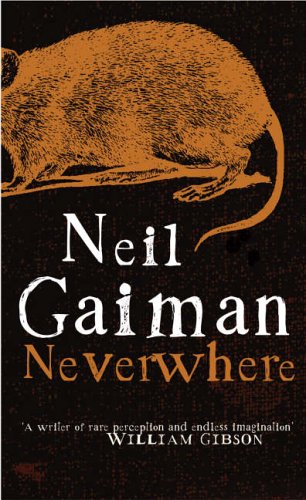
Neverwhere

Category Eii: Wide reading
More generally, I aim to read books in various genres, including non-fiction (aiming for one travel, one biography, one history book and one literary criticism.) Also, books from all over the world, as most that I read seem to be written by authors from and set in the USA or England. This year I'm after books from or about Australia, Canada, Ireland, Africa, Asia and historical USA.

Finally, I intend to have less unread books on my shelves by the end of the year than I have at the moment. To read more than I buy new.

Now, I'm sure this is several reading challenges rolled into one. I don't even know if it would be physically possible to read and reread all that I've planned, but I'll give it my best shot. And if New Year's Eve comes along and I'm only half done, then I'll give myself another year. Or two.

In the meantime, I'd better get back to my book.

2009: an overview in books.

For 2009, I set myself the personal challenge of reading 100 books which I'd never read before, of which I managed 82. A couple were cheats, being unabridged versions of old books, another was one I knew I'd read long ago, but couldn't remember a thing about it. 13/82 were non-fiction, against 69 fiction. 14 kids' books, if we use the term loosely, and 68 adult.

The year's highlights for me were:

The Guernsey Literary and Potato Peel Pie Society
The Little Stranger
The Book of Tomorrow
Being Emily
and The Earth Hums in B Flat. One set in Guernsey, one very, very English, one Irish, one Scottish and one Welsh.

The books I'd always intended to read and finally got around to it in 2009 were:
Gone with the Wind,
Wyrd Sisters (I had seen an animated adaptation but never read the book)
and Brideshead Revisited.

The disappointments were:
Confessions of a Fallen Angel, which I had completely forgotten I'd read until I saw it on the list.
Dance with Wings.
The Believers. There was not one character there that I liked.
Undead and Unwed. Too much like chick-lit, with fangs.
The Birthing House. Yes, it scared me, but although I wanted to know what would happen, I had to skim-read it because if I'd put the book down, I'd never have picked it up again.

The books I started but didn't finish:
Spitfire Women of World War 2. I intend to pick it up again in 2010.
Revolutionary Road (it came immediately after The Believers and I suspected it was another book without sympathetic or likeable characters. I didn't want two in a row like that.)
Small Island. Again, intend to pick up again.
Finally, oddly, Rilla of Ingleside. I just felt too unhappy to carry on with it.

Sunday, 20 December 2009

Film: The Twilight Saga: New Moon

I deliberately waited a month after this film came out before going to see it, and even after the month passed I wasn't sure I could face it. However, being someone who doesn't like to start something and leave it unfinished, I decided to go through with it. And it was a quiet screening, with only a few couples and groups, and thankfully no screaming teenagers.

Twilight is billed as being this great, timeless, boundless romance, but that does not ring true to me. I did not sense the chemistry of "true love" between Edward and Bella, rather the rather nauseating romance of a pair of teenagers in their first romance. And for that, it is very believable. On Bella's side, it is her first love, she is head-over-heels, and she is a teenager. Edward has less of an excuse - he's about a hundred years old. Still, it is his first love too.

Early on in the film are references to Romeo and Juliet, which is what their high school literature class are studying. And certainly within this story there are parallels with that Great Romance. (Notably, that when Edward thinks Bella is dead, he attempts suicide. The difference being that Bella, unlike Juliet, gets there in time to save him. Unfortunately, the crueler critics may say.) However, call me cynical, but I see Romeo and Juliet as unconvincing a love story as I see the Twilight saga, between two naive, soppy fools.

The one act of truly sacrificial love that I see between Edward and Bella, is in Edward's decision to leave Bella, for her own protection. At that point in the film, I felt both of their pain - because I had read the books, I knew Edward meant what he said, that he wanted her to be safe. That was the only part of their relationship that stirred any emotions in me. And of course I relived the pain of having been dumped by my own vampire, almost a year ago. The scenes showing her staring out of the window as the months passed by, I confess, moved me almost to tears, even though there was a cheesy voiceover of her dictating an email to Alice exploring her feelings. (N.B. That happens a lot in that film. Show, not tell, people!) The equivelent pages in the book, with just a blank page with the month printed in the middle, moved me only to scorn. Pur-lease! And those blank pages were a very useful guide to how not to behave when you get dumped. Perhaps because of my own experiences, I felt a little more sympathy this time around - though I still found her a bit of a mopey drip. But hey, perhaps I was a mopey drip while I was getting over my ex-vampire (please don't comment.)

The central part of the film was quite watchable. Coincidentally (?) that was the part when Edward Cullen, who shall henceforth be known by the name by which my sister christened him, Mr Sparkle, was not on the screen, save as a memory. This part showed Bella discovering life again, building a close friendship, and the tentative possibility of something more, with Jacob Black. It is awkward, and uncomfortable, but it shows the natural development of someone moving on. Firstly she starts inviting danger, to maintain her link with Edward's memory (because whenever she does anything reckless, she imagines him there telling her not to, and generally coming across as an overprotective and possessive creep. But she doesn't mind, because at least, for the moment, it's like he's there.) So it starts off with Bella spending time with Jacob so that he can fix up a motorbike for her, so she can continue to chase the elusive wraith of Mr Sparkle. But she likes his company, and he really likes hers.

And then, and this is the part that I found the most painful (in an emotive way rather than the usual "this is really bad" way) Jacob starts acting strange. First he won't come out or answer the telephone, supposedly because he's too ill. But when she goes to see him, he seems fine, fit and healthy, and running around in the rain in just his shorts. But he tells her they can't be friends any more. That he's not safe to be around. She's heard that one before! But he can't keep it up, and comes back to see her, dropping hints about what he can't say out loud - that he's a werewolf. So Bella gets drawn into this new world, and though she's still sad about Edward, she seems to be living again. She's getting there. And how I wished that she'd get together with Jacob.

But then, Mr Sparkle's sister, who I will have to call Miss Sparkle, comes to call (after a run-in with some evil vampires who want to kill Bella) and whisks her off to Rome because, as I mentioned before, Mr Sparkle thinks Bella's dead and doesn't want to live any more and they have to save her!) Here, we meet real vampires who seem a lot more like the sort of vampires we know and love (ie, whose identifying feature is that they drink human blood, rather than having applied too much body glitter.) They wear fancy, old-fashioned outfits, have long hair and you think you might be in Anne Rice territory. They might sparkle in the sun, but they don't go on about it. Anyway, Mr Sparkle decides to get them to rip his head off by exposing his sparkliness to the humans, the vampires' one no-no. Bella gets there in time - although not in time to prevent him from taking his shirt off, which is not a pretty sight.

And boom! All the good work done by Jacob and the werewolves and time is undone, just like that. He declares his undying (or is that undead) love for her, she announces her wish to have undead love for him, and to be a vampire so they can live together for ever and ever and ever! Mr Sparkle, thinking that vampires have no souls, is unwilling to take her soul by making her a vampire. By the way, I do not count Bella wishing to sacrifice her soul and her humanity as a selfless sacrifice. It's not, "I'll become a vampire so that you'll never have to be without me and never have to worry about me." It's, "Pfftt... who needs a soul? I wanna be a vampire like you so I don't grow old and you don't fall out of love with me when I look like my granny and hey, it's not so bad. What do you know? You've only been a vampire ninety years. I say it'll be a doddle." She reminds me of the interviewer in Interview with the Vampire, who listens to Louis's story and dismisses it because he thinks he knows better than the person who's actually lived the life. Except, he's supposed to be an idiot. Bella's meant to be romantic.

Like Juliet.


For the review of the first two books, please click here:
http://katiesbookblog.blogspot.com/2008/11/twilight-and-new-moon-stephenie-meyer.html
Related Posts Plugin for WordPress, Blogger...