Monday, 21 October 2013

Star Trek II: The Wrath of Khan

Contains spoilers, if of the "Rosebud Was His Sled" variety.

From the very first moments of the title credits, The Wrath of Khan promises to be the Star Trek motion picture that, um, Star Trek: The Motion Picture never was. The Motion Picture was released a couple of years after a certain other space science fiction film with the word "Star" in the title, (and many, many terrible copies) and allegedly wanted to remind filmgoers that there was more than one type of science fiction movie, being the 2001: A Space Odyssey of the '70s. The Wrath of Khan is, right from the beginning, much more user-friendly. Its title sequence may evoke the Star Wars-type crowd-pleaser, with its starry screen, and James Horner's combination of the classic series theme tune and a new, jaunty, adventurous and hummable melody, but that's not a terrible thing. Perhaps, by 1982, the bad Star Wars knock-offs had begun to die out somewhat, or perhaps the producers were less concerned about VERY MUCH NOT BEING LIKE STAR WARS, NO SIR. This new score sets the tone for the film, and does not disappoint.


The movie opens by plunging straight into an action scenario, with the crew of the USS Enterprise in the middle of a crisis. A large crisis, with a magnificent entrance hall, carpeting throughout, 24-hour portage and an enormous sign on the roof saying This Is A Large Crisis. (Er, sorry) Captain Kirk is nowhere to be seen; instead, in the chair is a young Vulcan officer named Saavik (subsequently referred to as "Mister" Saavik, though she is about as un-Misterish as you can get.) Saavik is faced with a deadly dilemma. There are explosions, and bodies strewn all across the bridge. (You may wish to observe and take note that in the new Starfleet uniforms, everyone is dressed in red.) But wait! If the melodramatic line-delivery of certain crew members did not strike you as suspicious, at the height of the death and destruction, a door opens, and Admiral James T. Kirk enters. It was all a test: the Kobayashi Maru; a test of an officer's character when faced a no-win scenario. Don't feel cheated, though. It may be a fake-out dramatic opening, but the Kobayashi Maru is something that resonates through the entire movie.

My main criticism of The Motion Picture was the under-use of the series' beloved characters. The Wrath of Khan brings them right back, recognisable but not unchanged. After deciding that the robotic life was not for him, Mr Spock has mellowed. The inner conflict between his human and Vulcan side seems to have been resolved, and he has become more relaxed and likeable. We see him express concern for his captain's wellbeing, and speaking frankly and unsentimentally about the importance of their friendship. He even gives Kirk a birthday present: a beautiful copy of Charles Dickens' A Tale of Two Cities. And though he and Dr. "Bones" McCoy still have their heated arguments, the edge of cruelty that so often came into their rivalry of head and heart before, has gone.


Captain - sorry, Admiral - Kirk, too, has changed. It is his birthday, and it is making him feel gloomy - perhaps one of the Big Ones, probably fifty. Also, he has apparently had a bad perm. Still, it takes very little in the way of plot manoeuvres before he has once more commandeered his beloved Enterprise, full of new recruits, and is heading off into an epic adventure. Soon, he is reunited with two people from his past: old flame Carol Marcus (plus son who also has very, very curly hair. Hmmm...) and Kirk's old enemy and rival to the title of Largest Ham In The Galaxy: Khan Noonian Singh. Or, as he's better known:

"KHAAAAAAAAAN!"
With the arrival of Khan, Star Trek gets much darker than it has been before. Sure, the series has never been short of death, torture, betrayal and other perils, but in the series, you always knew it was going to be all right in the end. As a viewer, you never really feared for the characters' lives. James Kirk acknowledges this himself, when he admits that when he took the Kobayashi Maru test, he cheated, because he doesn't believe in a no-win scenario. "I haven't faced death," he admits, at last. "I've cheated death. I've tricked my way out of death and patted myself on the back for my ingenuity." We may joke about the fates of the expendable redshirts, and though Kirk may have suffered agonising guilt and grief at their loss, to a certain extent it's all been part of the day's work. It's fairly standard, family-friendly sort of violence. The Wrath of Khan shows a more horrifying brutality, with the gruesome use of Ceti Eels as a means of mind control, and the carnage found aboard the space station that the Enterprise did not get to until Khan had been there first. Khan, though often deliciously melodramatic, is a formidable foe, obsessed by his hatred, in a plot heavily influenced by Moby-Dick. (A book I have never read, nor particularly wanted to, but one I ought to educate myself on so that I can understand references to it in other works.)

"Do you know the old Klingon proverb that tells us
revenge is a dish that is best served cold?
It is very cold... in space."
But, for all that, The Wrath of Khan is an epic swashbuckler of a space movie, regaining the element of fun and adventure that was, if not missing in The Motion Picture, secondary to being Serious Science Fiction That We Must Take Seriously. There are battles and revenge and double-crossing, and more explosions, and action, action, action! Then Scotty has to race against time to fix the warp drive down in engineering. But, you know Scotty! He can do it! Give him four minutes to do something that requires an hour, and he'll bodge it somehow.

Right?

Chances are, you know the answer to that one. Even before I watched Star Trek, I knew how the Enterprise would be saved, and at what cost. But that did not stop the ending from being any more heartbreaking. The moment at which I saw the look of understanding and decision cross Spock's face, I flashed back to another moment in fiction. I remembered that horrified dawning realisation of what a very different character was planning, the very first time I read... now which book was it Spock bought Kirk for his birthday?

Now, William Shatner has certainly earned his reputation for overacting, which perhaps makes Kirk's reaction to Spock's sacrifice all the more devastating. Even being prepared, even knowing that the next film is called The Search for Spock, does not protect the viewer's heart from being ripped out by the friends' farewell, unable to reach each other, divided by a pane of glass. And Kirk's utter brokenness at being unable to do anything for his friend would bring a Vulcan to tears. (See Saavik in the funeral scene.)

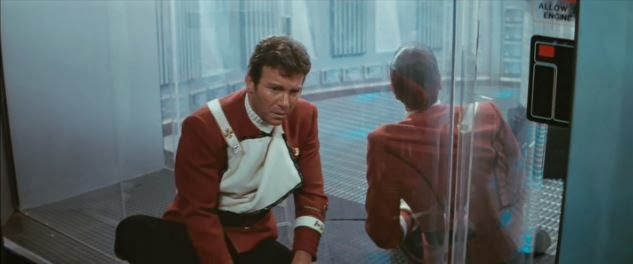

The film does not let up in the aftermath to the famous death scene. First, witness Kirk trying not to break down as he delivers Spock's eulogy. As if that was not upsetting enough, Scotty gets out the bagpipes to send Spock off! Kirk briefly interrupted my grieving process by quoting Sydney Carton's last lines in A Tale of Two Cities - and getting the wording wrong, which caused my brain to itch. But I had barely enough time to compose myself before the famous "Space, the final frontier" voice-over begins, and it's Leonard Nimoy's voice! WHY WOULD YOU DO THAT? 

Thankfully, I know that the story is not over for everyone's favourite "pointy-eared hobgoblin," but at the time, when The Wrath of Khan could have marked the end of Star Trek, what a downer-ending that would have been. I must think myself fortunate that I have come to Star Trek late in the game, because to leave it on that note must have been unendurable.

Sunday, 20 October 2013

Sunday Summary

Looking back over the last few months of blogging, I was horrified at how few book reviews I've posted. I've read plenty, but I haven't necessarily been reading analytically, with enough to say to write a full review. So I thought I'd try out a new weekly feature, where I can talk informally about my week in reading (also TV, films, book shopping and other news.)

This week has felt like a looooong one. Work has not been terrible, but I'm starting to feel a little bit run down, and finding it more exhausting than sometimes having to be friendly and welcoming all the time. Little things that really ought not to bother me for more than a moment are chipping away at my peace of mind, and I am feeling very much in need of a holiday. Perhaps that is why I seem to have acquired 10 books in the past 8 days, by various means...


Last week, I spent an evening at the home of some new friends, with good food, good company and a hysterical game of Cards Against Humanity. It is good to meet new people with similar geeky interests, especially in a small community like the Isle of Wight, where most people seem to be remarkably ordinary. Jamie and his wife Chrissie have wonderfully chaotic and geeky bookshelves - I know I've met a kindred spirit when the first book I notice on someone's shelves is a copy of Brewer's Dictionary of Phrase and Fable. Jamie lent me a book called "Mindstar Rising," which he described as a "detective story set in the future." I look forward to reading this one. Also, some time back, my friend and I battled it out for a copy of Paolo Bacigalupi's The Windup Girl in the Waterstone's clearance. She won, but agreed to pass it on to me when she was done.


Then, of course, was my Ninja Book Swap parcel from Ellie Warren, containing Perfect and Shades of Grey (Any number below 49 or above 51.) I've made a start on reading Perfect, a story which follows an imaginative boy worrying about an additional two seconds added into the day, and the difference which two seconds can make. The chapters alternate between the boy, Byron, in the 1970s, and Jim in the present day, battling with crippling obsessive-compulsive disorder, and though it is simply written, it gives a powerful insight into a child's mind. I'm only a few chapters in so far, but as well as the main topic of perfection (if there can be such a thing,) I've noticed secondary themes about class and prejudice, and how money cannot buy a happy family. 


Thursdays are late-night opening at my local library, which was a good thing as I kept on forgetting (or being too lazy) to return my library books on my lunch break, but after work I popped in to take them back... and ended up picking up two more. I've been meaning to read Slaughterhouse 5 for a long time, (thanks to Hanna I am prepared for the sneaky aliens) so was pleased to find it in stock for once! I also picked The Night Strangers up from the "returns" shelf, which follows a family moving into a new house, to find a door in the basement locked with 39 locks... the same number as those who died in a plane crush, piloted by the father of the house. It looks rather creepy!


On Friday, I was in town with my best friend Judi, and we just happened to notice the gluten-free cake-and-quiche stall in the Farmers' market, and it would have been rude for her not to support a company that provides for her dietary needs. And once we'd gone through the market, we ended up going past the Oxfam bookshop and picking up two or three books apiece. As you do. I read the first of Iain M. Banks' Culture novels in the summer, which, if I'm honest, I was not enamoured of. I didn't want to give up on him, however. I later discovered that Phlebas is considered atypical of the series, and that The Player of Games was a better introduction to Banks' universe. I also remembered my friend Clare recommending me The Beginner's Goodbye, and once I'd decided to buy a book, what difference would another one make?


...Or another three, as it happened. I was feeling a little glum this morning, and as I passed The Works, it started to rain. Obviously, that was nature's way of telling me to go and have a look at the 3 for £5 section. As well as a present for a friend, I discovered Pretty Girl Thirteen, a book about, as I understand it, a teenage girl with a multiple-personality disorder who turns up at home after being missing for three years. I've also been feeling an itch in my brain to read another Stephen King, so From a Buick 8 completed the three.

I've acquired 10 books this week, but how many have I actually read? 

I had two books left over from my last library splurge: Heart-Shaped Bruise by Tanya Byrne, and Dolly by Susan Hill. Heart-Shaped Bruise is presented as a notebook found in a former young offenders' home, a letter-slash-diary-slash-confession of a teenage girl awaiting trial for an undisclosed terrible crime. 

Dolly is a ghost story from the writer of The Woman in Black, and is very similar in feel. Both are set in big, misty old houses in the middle of nowhere. Its setting lends a wonderfully creepy atmosphere to the story, which is a classic ghost story rather than a fully-developed novel; the sort of story that would not be out of place being told by torchlight at a Halloween sleepover. A quick read; I think I got through it in about two hours.

I made a start on Let The Right One In by John Avijde Lindqvist, a Swedish vampire story that has been sitting on my pile for well over year. Whether it was because I was reading it on my lunch break and feeling distracted, or because this book is not for me, I haven't got very far in it and am unsure whether I should continue. For now, I have put it to one side, and if I don't pick it up within, say, a month, I may bid it farewell. (It was a free World Book Day copy, so I could not in all conscience give it to a second-hand bookshop to sell, but a couple of coffee shops in town have book-swaps, so perhaps it may end up there.)

As it is autumn, which I find quite stressful at work, I decided to reread the Harry Potter books as a bit of escape at bedtime, and this week I got up to The Chamber of Secrets. I've read that series so many times, and yet I still notice odd little moments that I've never picked up on before, such as Fred Weasley dropping a stack of books on his twin brother's head (on the last page.) And, as already mentioned, I started reading Perfect yesterday. 

Thursday, 17 October 2013

Trick Or Treat Ninja Book Swap: I've got presents!

After a long day at work, which left me feeling a little bit weary of people, I arrived home to find a great big box addressed to me. Last month I signed up for Bex and Hanna's Trick or Treat Ninja Book Swap, and sent off my parcel with plenty of time to spare, but it still took me by surprise to find a great big box waiting for me with my name on it.


My gift was from Ellie of Curiosity Killed the Bookworm. As a "trick," a surprise book from my chosen genre (science fiction) she sent me Jasper Fforde's Shades of Grey. (A book which has been around far longer than that book of an unfortunately similar title.) I loved his Thursday Next books, but have not yet read this one, though my best friend loves it. I've no excuse now!

Ellie also sent me a few treats:

From my books wishlist: Perfect by Rachel Joyce
A bar of Montezuma's "Eton Mess" chocolate and some "Halloweenies" (seasonal Cadbury animals.)
A chunky ball of wool (It's all multi-coloured and so shimmery! What shall I make with it? Something toasty warm, because winter is coming. Maybe a scarf?)
And a little skull-and-crossbones tote bag (Arrr!), just the right size to take a book for a walk.

Tomorrow is my day off, which I had already planned for a duvet-day, so I shall get stuck into one of my new books and demolish some of that chocolate. So thank you Ellie, and thank you to Hanna and Bex for organising the ninja book swap.

Friday, 11 October 2013

Star Trek: The Motion Picture (1979)

I didn't mean for this to happen. I only watched the 2009 Star Trek movie on TV this year so that I wouldn't be completely lost when my friends organised a trip to see Into Darkness at the cinema. But something about the USS Enterprise and her crew caught at my imagination, and I'd be at work on a quiet day and find myself staring into space, thinking about Spock and Kirk and all the rest. No! I told myself, There is a line, and once you've crossed it, once you've got into Star Trek, there's no going back. Yet I went to my friend Sam, who has always been a bit of a Trekkie and conveniently owns most of the boxsets, and borrowed the first Original Series season. I planned to watch the first Original Series, and the first Next Generation series, and maybe a few odd episodes she could recommend for me, just to get an overview of the story. And then, somehow I found myself watching all three seasons in as many months. Perhaps part of me, subconsciously, always knew I could not watch Star Trek casually, because for me there are no half measures: I am either indifferent to a story world or utterly engrossed in it. And in Star Trek, there are a lot of worlds to get engrossed in.


It was my birthday last week, and one of my presents from my parents was the boxset of the first ten Star Trek movies. (6 with the original cast, 3 with the Next Generation cast, and Generations, which features both.) I don't plan to rush through the films as I did with the series, because I have become very attached to Kirk, Spock, McCoy, et al, and though I'm excited about getting to know Captain Picard (do I need to know anything other than that he is Patrick Stewart?) and crew, I don't feel quite ready to see the Enterprise without the characters I've grown to love.


The Motion Picture opens several years after we last met Kirk and the crew. In the TV series, not a lot changed from week to week; you could watch the episodes in any order, as the status quo was always restored by the end of the story, no matter who got married, wounded or fatally ill. (Except for the fallen redshirts, who tended to remain dead, Jim! So it is interesting to come back to the 'verse some time after the five-year mission has ended. The central trio of the cast have all gone their separate ways. James T. Kirk has been promoted to Admiral, and yet his heart still belongs to the Enterprise. (I felt that there was a sort of sadness in this renowned officer yearning for his past glories.) Spock has returned to his home planet of Vulcan, where he is attempting to get rid of those pesky things called emotions once and for all. But something calls to him from among the stars, and apparently he is not as coldly detached as he'd let on. Also, he is in serious need of a haircut.

One can only hope there is a decent Starfleet barber, because Spock is not alone in needing his services. Doctor "Bones" McCoy makes his first appearance with a pretty terrible beard. For reasons undisclosed, McCoy has put his Starfleet days behind him, where he wants them to stay. It was hinted in some episodes that McCoy's life was not what he had hoped for. He did his duty as ship's chief medical officer, uncomplaining (well... often complaining, but not feeling sorry for himself) yet never really happy. I suppose his friendship with Jim (and, though he'd never admit to it, Spock) made life aboard the Enterprise more tolerable, but they have since taken different paths. It is not long, however, before the old crew are all back together - Scotty, Uhura, Sulu and Chekov are all right where we left them, and they head off out into the stars to face an unknown foe known as V'Ger, which threatens Earth. It's familiar territory for Star Trek, but the story's conclusion surprised and awed me. It was definitely a story of its era, and I imagine it would have been even more thrilling to have watched at the height of the space age in the 1970s. (This month, too, was a pretty appropriate time to watch the movie for the first time.)

I had been warned that odd-numbered Star Trek films are (to put it politely) not as good as the even-numbers. The Motion Picture was certainly somewhat strange, felt very, very different from the series, and had some strange special effects. I read that it was intended to be a 2001: A Space Odyssey for the 1970s. There are some striking similarities, notably the looooong, indulgent shots of space scenery with grand music (though no monkeys and no freaky giant space baby!) It is more atmospheric than plot-driven. Yes, it is slow, but watching it while knitting at the end of a long day, I found it almost soothing. But I felt that the characters were underused; the relationships between the central trio were strained and awkward, perhaps because they had been apart for so long.

When Spock returned to the Enterprise, you could cut the atmosphere with a knife. Instead of his usual cold disdain, Spock seemed almost angry to be there. The banter between him and McCoy fell flat. Perhaps it was that the characters had to get used to each other after a long time apart. It had been a while since Spock had been among humans and their strange ways, and maybe their illogical ways reminded him of his recent failure. But upon discovering what a purely logical existence is like, Spock acknowledges and accepts that he does have emotions, and that the Vulcan ideal towards which he has been striving his whole life is not what he wants after all. Which emotions, specifically? Which "simple feeling?" It is most unlike Spock to be so vague, but then, so is speaking of emotions as anything other than a failing of character. It is not a subject that comes easily to him, while clasping Kirk's hand and looking into his eyes... Subtext? No. Not this time.

Reading up on Star Trek: The Motion Picture online, I was not surprise to find that it is widely disliked. Its 2001-esque pacing verges on the ridiculous at times, and I really missed the depth of character from the TV series. I found it interesting in an experimental sort of way, and quite watchable for a lazy evening, but I would be disappointed if all the films were in this style. Next up: The Wrath of Khan. I have high expectations for that one. Also tissues.

Sunday, 29 September 2013

Half-Sick of Shadows - David Logan


When Edward Pike and his sister Sophia were five years old, Sophia made a promise to their severe and intimidating father that she would never abandon her mother, and never leave home. And so, she never does, inferring something terrible must happen if she ever breaks her word. Even when the memory of the promise has faded, Sophia will not leave the Manse (which is a misnomer; there is no church for miles, although the house backs onto a graveyard); not to go to the next village, or to school, or visiting. At five, perhaps that is little sacrifice. As far as the twins are concerned, the Manse is the world, and the family are its people. But soon, the twins are parted when Edward is sent to boarding school. Here, he excels academically, if not socially, but the thought of Sophia and her self-imposed "curse" is never far from his mind.

What struck me most about Half-Sick of Shadows was that time does not seem to fit properly. Edward's childhood memories of the Manse read rather like a country childhood at some point in the early twentieth century. The Manse is vividly brought to life as a grim, gloomy stone house, freezing cold with no electricity and no plumbing; an isolated place miles from anywhere. Progress does come as Edward grows up, with the building of a motorway, colour television and popular culture references - but even these contain curious anachronisms, not quite fitting into a single time. Decades seem to pass in the space of ten or fifteen years of Edward's life, and I'm not convinced they can be entirely explained by the Manse being horribly old-fashioned.
"As a child, I never knew whether the world lay east, west, north or south of the Manse; I only knew that the Manse never seemed to me like part of it."
Half Sick of Shadows was the joint winner of the Terry Pratchett prize or, to give its full title, the Terry Pratchett "Anywhere but here, Anywhen but now" prize. That seems to describe the Manse's setting perfectly: it is a world that is not quite the world we know, although I would be hard pressed to explain exactly why. Pratchett even drops hints (or outright spoilers) in his foreword that David Logan's novel is indeed set in an alternative universe - though "the people on an alternate Earth don't know that they are; after all, you don't." 

And then you remember the strange encounter of the very first chapter, in which Edward meets a man in a so-called time machine, and wonder how you could forget such a fantastical scene which doesn't seem to lead anywhere in this brooding story about childhood, family, home, and the loss of innocence. The event lingers as a shadowy memory, another example of something uncanny about Edward's world, but as you read about his ordinary life, his family, his schooldays and aspirations and everyday struggles, like him, you almost forget.
"The mystery of the stranger and his time machine puzzled me for as long as the memory of it lasted, which, when you're stupidly young, isn't long. I'd more or less forgotten about it by strawberry jam on toast and sweet tea time."
Half-Sick of Shadows defies genre classification, containing some elements of science fiction and horror, but not enough of either to describe it accurately. The story's potential overflows out of the 363 pages which make up the novel. Whole chapters, perhaps even more volumes, could be filled with the subplots and almost-unanswered questions. Logan divides Edward's life into three segments: "Before Alf," "The Alf Years" and "Alf Unleashed" - Alf being Edward's mysterious schoolfellow that only he seems able to see, and who might or might not be exactly real. As far as the narrative is concerned, Alf is the defining feature of Edward's childhood and youth, but Edward himself does not seem to notice him until the final section, when his role in Edward's life is revealed.

I felt that the novel was let down a little by its final hundred pages or so. The story seemed to get a little carried away, as Edward and his family get embroiled deeper and deeper in too many macabre plot turns, which were rushed through at top speed. It was all a bit too much. Aside from that quibble, Half-Sick of Shadows is a gothic masterpiece: shifting, shadowy, unsettling and occasionally shocking. It is beautifully written, poignant and poetic, and really captures a child's understanding of the world, which, though it may not be informed by the necessary knowledge to be quite accurate, is logical in its own way, and makes perfect sense to the perceiver.


If you enjoyed this, you might like:

The Ocean at the End of the Lane - Neil Gaiman
The Earth Hums In B Flat - Mari Strachan

Thursday, 12 September 2013

A-Z bookish survey

I've seen this questionnaire doing the rounds on several blogs lately, and couldn't resist having a go myself. I personally "borrowed" it from Susan, Laura and Sarah, but it originated from Jamie the Perpetual Page Turner. And now it's my turn:

Author you’ve read the most books from: In my lifetime, almost certainly Enid Blyton. Her books take up most of a crate under my spare bed: Famous Five, Malory Towers, Secret Seven, etc. etc. As a teen or adult - probably Terry Pratchett, though I haven't even read all of the Discworld series.


Best Sequel Ever: Um... most of my favourite books are stand-alones, or series which I love equally. Perhaps Catching Fire.


Currently Reading: Quiet by Susan Cain and The Shining Girls by Lauren Beukes. One is a psychology book about introverted people and how we are going to stealthily take over the world, and the other is a thriller about a time-travelling serial killer.


Drink of Choice While Reading: Coffee, in a big mug, though lately I've been switching to tea as an attempt to cut down on caffeine.


E-reader or Physical Book? Physical book all the way. I can see the uses of e-readers, but I can't love them.


Fictional Character You Probably Would Have Actually Dated In High School: You think anyone would have dated me at high school? Maybe Neville Longbottom?


Glad You Gave This Book A Chance: Ready Player One by Ernest Cline. Everyone was telling me to read it, but I wasn't convinced... till I started reading it.


Hidden Gem Book: Tell The Wolves I'm Home by Carol Rifka Brunt. A book I picked up because I liked the cover; it just happened to be the book I needed to read at that time.


Important Moment in your Reading Life: Being given a copy of Anne of Green Gables for my eighth birthday. Anne Shirley was the first person I encountered in a book who just seemed to get what it was like to be me: to be scatty and accident-prone and living more in the world of the imagination than reality.


Just Finished: Harry Potter and the Philosopher's Stone - though "just" is stretching it a bit. I've been on my current books for a while.


Kinds of Books You Won’t Read: Romance (except occasionally), misery memoirs, any of those books with black and grey covers.


Longest Book You’ve Read: Les Miserables or Gone with the Wind.


Major book hangover because of: A Tale of Two Cities. First time I read it, I was in a coffee shop, and then I went into Borders (RIP) and just wandered around in a daze.


Number of Bookcases You Own: 3: One small, one big, one fancy one with glass doors. (Plus all the books that are packed into cupboards, boxes, piles and wherever else I can stash them.)


 One Book You Have Read Multiple Times: Lord of the Rings.


Preferred Place To Read: In bed!


Quote that inspires you/gives you all the feels from a book you’ve read: "Of course it is happening inside your head, Harry, but why on earth should that mean that it is not real?" - Dumbledore.


Reading RegretSo far I have been unable to get into the Gormanghast stories, though I keep the book on my shelf in hope that one day I'll manage it.

Series You Started And Need To Finish(all books are out in series): Probably the Sherlock Holmes books - I've read them all except the last one or maybe two.


Three of your All-Time Favorite Books: Anne of Green Gables by L. M. Montgomery, Lord of the Rings by J. R. R. Tolkien, and Neverwhere by Neil Gaiman


Unapologetic Fangirl For: Neil Gaiman!


Very Excited For This Release More Than All The Others: I may or may not have done a Gollum impression when I opened up a box at work to see Mr Gaiman's latest kids' book: Fortunately the Milk. Also, I love Cecelia Ahern (my exception to my fluff aversion) and am very much looking forward to her new book, despite its title How to Fall in Love.


Worst Bookish Habit: Reading in the bath.


X Marks The Spot: Start at the top left of your shelf and pick the 27th book: Pink by Lili Wilkinson


Your latest book purchase: Ketchup Clouds by Annabel Pitcher and Fried Green Tomatoes at the Whistle-Stop Cafe by Fannie Flagg


ZZZ-snatcher book (last book that kept you up WAY late): The Call of Cthulhu and Other Weird Stories by H. P. Lovecraft.

Sunday, 8 September 2013

15 Day Book Blogger Challenge: Days fourteen and fifteen


Day 14: What are your deal breakers?

What will make me put a book straight back on the shelf without a second glance?


  • Stories about adultery/affairs. Especially if the book is from the point of view of the person having the affair. I'd find it very difficult to respect such a protagonist or have any sympathy for them.
  • Narrators describing their appearance in the mirror. "I stare into the glass, and a twenty-something year old woman looks back at me, her brown straight hair framing a round face with an overlarge nose, and eyes that were somewhere between blue and grey." Bleugh! No one thinks like that. It's lazy writing, and it shows that the first thing the writer wants you to know about your heroine (and it's always a woman) is every last detail of what she looks like, because that's the most important thing about a female lead. Don't ever do that. Ever.
  • Telling, not showing. I have a thing called the "Danielle Steel test," where I pick up a book, open it at random, and see how far I can read without wanting to hurl it across the room. Generally this is due to descriptions such as: "Jane thought that Kevin was being very unfair." "Sarah might not show it but really she was very fond of her sister." "James wished he could control his temper." Show me, then. Make me believe it.
  • Multi-volume novels. Trilogies are in vogue at the moment, particularly in the teen fantasy genre, but I wonder how many are necessary, and how many could, with a bit of editing, be condensed into a single book. If I begin a story, I want to see it through to the end - but if I'm not sure whether I'll like it or not, and if I have to wait three years to reach the end, I'll think twice about whether I'm prepared to commit to the story. I'd prefer series which are one book = one story; related and in order, sure, but which work as stand-alone novels. This one is a difficult thing to categorise, though, because there are some really engrossing series out there, which are worth the years of commitment. (Harry Potter, A Song of Ice and Fire, The Hunger Games.) But if I've read a hundred books since the last installment of the Fairypocolypse Chronicles, will I still care enough to carry on with book 2?
  • Books with grey and black minimalist covers, usually featuring ribbons, jewellery, rippling fabric or the like.  You know the ones. It's not prudishness on my part - it's boredom. Less is more.

Day 15: Who are your book blogging mentors?

Anna, Ginger and Smash have been very influential when I found myself becoming involved in the book blogging community, in particular as adult readers of YA fiction. They have run some great regular features, discussion posts and memes, and inspired me to think up new ideas for the blog aside from just the book reviews. (I hadn't actually visited Smash Attack Reads in a while: it now appears to be a collaborative blog with not one but FOUR fantastic bloggers.) Meanwhile, Ellie and Hanna have a more informal approach to blogging, with eclectic mixtures of book reviews and personal posts, which have encouraged me to be more relaxed about blogging even if I don't feel inspired to write a structured review. Rants and reading-journal-format posts also make great blogging. And I've only recently started following Laura and Sarah, whose reviews have inspired me to want to take out my credit card and buy ALL the books.

Friday, 30 August 2013

15 Day Book Blogger Challenge: Day Thirteen


Day 13: Describe one underappreciated book EVERYONE should read.

This is a difficult one. Everyone? I am well aware how different everyone's reading tastes are, so instead I will offer two.


Tell The Wolves I'm Home by Carol Rifka Brunt quietly slipped into the bookshops and libraries earlier this year with the minimum of fuss, but really deserves to have been noticed. It's a quiet sort of story about a teenage girl coming to terms with the death of her beloved uncle. It is a thoughtful, very honest story about family, loneliness, art, unrequited love and growing up, with a family portrait as the centrepiece.


Redshirts by John Scalzi is a must-read for Star Trek fans, or indeed anyone familiar with the trope of the expendable extra whose only function in a story is to die horribly in order to give a sense of peril to the plot. This is their story. The tagline on the front cover reads: "They were expendable... until they started comparing notes."

Warning: this book causes idiotic giggling. Read in public at your own peril! Redshirts is a wonderful parody, "recursive and meta" and completely annihilates the Fourth Wall. I'm not sure if it's objectively good, or whether I enjoyed it because I stumbled upon it at the same time I found myself inadvertantly and bewilderedly falling in love with Star Trek, but it is very clever and the most fun I've had from a book in a long time.

Sunday, 25 August 2013

Bout of Books 8.0: Sunday

Bout of Books


This morning was a grey, dull day and impossible to wake up. A single coffee wasn't enough, and unfortunately I've been feeling and acting somewhat like a she-Hulk this morning. Sincere apologies to those who were on the receiving end. Have a Nutella cupcake as a peace offering. She-Hulk likes baking cake, apparently.


I haven't done a lot of reading, again, today, because I got stuck writing a new scene for my Rilla of Ingleside adaptation. (Actual writing, guys! Two days in a row!) Where yesterday's work involved a lot of typing up from the original work, reworking speeches and scenes, today I had to use my imagination to flesh out characters who are important in the series but don't have an awful lot of on-screen time in the novel. In particular, though this is the story of the younger generation, I wanted to make Anne and Gilbert still recognizable as the characters countless readers have fallen in love with. In Rilla, they are mostly just Doctor Blythe and his wife: wise and patient and lacking the spark that makes their personalities so, well, them. 

I'm up to the 19th century in Necropolis, which has described the shift in people's attitudes to death over the years, from pragmatic acceptance to sentimentality, from memento mori to lavish memorials. The book also, briefly, told of 23-year-old Jane Webb, author of a book
Set in 2126, in an England that had reverted to absolute monarchy, this featured prototypes for espresso machines, air-conditioning and, most prophetically, 'a communication system that permitted instant world dissemination of news.'
This chick predicted the internet. Why have we never heard of her? And they say there's no place for women in science fiction!

I don't expect to finish Necropolis tonight. I plan to watch a couple of episodes of one of my many box sets, then have an early night. (It may be a bank holiday tomorrow, but I still have to work. Here's hoping for a sunny day so that everyone'll go to the beach and let me make a start on my huge list of things to be done this week.)

All in all, it's been a good readathon. I didn't expect to read all of the books on my list - Cuckoo's Calling and Perdido Street Station are still outstanding - but my to-read pile is starting to look like it's getting under control now. I must rectify that.

Saturday, 24 August 2013

Bout of Books 8.0: Saturday

9PM

After a lovely - but too quick - day off with plenty of reading, I was back at work today, where I spent much of the time manning the front till. This is not one of my favourite jobs as I'm not allowed to wander off and get anything productive done, but just have to stand there and serve customers. Most are friendly or neutral - I haven't had any really unpleasant people for a while - but smiling at everyone is tiring. Still, the coming week has plenty of other work to do, and I spent the last part of the afternoon making lists with bullet-points, trying to organise every small detail of what I have to do on each day. (I am a fervent believer in lists. They make the jobs feel less overwhelming, and it is a nice feeling to cross items off.)

I couldn't get to sleep for ages last night, for no one's fault but my own. I tell myself that the computer must go OFF at 10PM on a work night, and that I must wind down with a book for half an hour to an hour before switching off the light, but that time crept to 10.20... 10.30... 10.45... I was in bed by about 11, but my mind was still whirring. So I made a start on my next read: Necropolis by Catharine Arnold. It is a beautifully macabre history of London, the people who died there and the burial rites throughout the centuries. I continued with this book at lunch time, and have got up to the various plague epidemics before the Great Fire of London. Having lived in London for a few years, I do love to find out about the stranger things in its history. It is a very strange city.


I had intended to read more when I got into work, but instead, inspired by the video I watched and shared yesterday, of Neil Gaiman's advice for budding writers, I brushed the cobwebs off an old project: a screenplay adaptation of L. M. Montgomery's Rilla of Ingleside. My recent "work" on this project has been a scene-by-scene outline, but though I hadn't finished the planning, I felt it was time to jump in and actually do some writing. First drafts can be edited, but blank pages can't.
Related Posts Plugin for WordPress, Blogger...