Sunday, 3 November 2013
Sunday Summary: Wilkie, NaNoWriMo and light reading.
It's been a busy old week this week, and though I got off to a good start on Sunday and Monday by making a nest and ignoring the world in favour of books, blankets and biscuits, one week on I am only half-way through Cathy Kelly's latest book, The Honey Queen. I decided to read this one as a bit of fluff after the short but heavy-going Slaughterhouse 5. Slaughterhouse 5 was an interesting read, but one which I think I would actually enjoy more if I were studying it, reading and rereading and taking notes. Though quite simply written, there is so much beneath the surface about humanity, war, death and time, that I don't think you can really appreciate the full impact on a first read.
It's a funny thing, but I often find "light" reading to be harder work than more "literary" or bulky novels. Although I am enjoying The Honey Queen, which reads rather like a miniature soap opera, focusing on the lives of various inhabitants of a small Irish town, it seems to be taking a long time to read. I have read just over 200 pages in a week. Is it because there are a lot of characters to keep track of, or because it is a character-based rather than plot-driven narrative? Is it because my inner critic finds more to say about the writing style, or perhaps it's just not all that exciting? I don't know. It's certainly not badly written, although I do find that what Ms Kelly tells us about some of her main characters doesn't seem to tally with what she shows us. And it is a very warm, cosy community to lose myself in. But something about this book makes reading it a much more drawn-out process than logic dictates it should be.
November marked the beginning of NaNoWriMo (National novel-writing month) which I decided to participate in out of a feeling of desperation. All my life, my writing has been the thing that has most defined me, but lately I haven't written very much aside from this blog. I'm terrified that I've lost the knack or the drive or the ability, and so I'm using NaNoWriMo to re-teach myself the art of Making Things Up And Writing Them Down. I got off to a good start on Friday, but yesterday I went out for a family meal after work, and I only managed a couple of hundred words scribbled in a notebook on my lunch break. But I don't mind too much if I don't reach the target of fifty thousand words this year, as long as I keep going and create a story.
Also, on a whim, I signed up to Ellie's "Read Wilkie" readalong of The Moonstone, which I am enjoying very much, though I have not got very far into it. It's a nice, laid-back readalong, so one I should be able to fit in alongside NaNoWriMo and any other books I have on the go at any one time. This afternoon, I'm meeting an old school friend for coffee, then afterwards I'm going to see the sequel to Thor at the cinema.
Have a good week, everyone!
Labels:
#readwilkie,
chick-lit,
detective,
nanowrimo,
readalong,
sunday summary,
writing
Saturday, 2 November 2013
Star Trek IV: The Voyage Home (The One With The Whales)
After the emotional rollercoaster ride that was the last two installments in the Star Trek movie series, The Voyage Home comes as something of a relief. Films two to four form a sort of trilogy within the wider series, each with its own plot within a wider story arc of loyalty, sacrifice and friendship. The films differ in tone and style as vastly as any three episodes in the original series. The Wrath of Khan is a swashbuckling epic, The Search for Spock a high-stakes quest driven by desperation. Part Four, generally referred to as The One With The Whales, is utterly heartwarming, sheer comedy to be rivalled only by the season two episode, "The Trouble with Tribbles."
The crew of the Enterprise return to Earth, with a newly resurrected Captain Spock aboard, to face the consequences of all the crimes they committed to save him. Only problem is, they can't get home. Earth is under threat by a strange, alien presence which will stop at nothing to make contact with humpback whales. Unfortunately, the whales were wiped out two hundred years previously! It is up to Kirk and the Enterprise crew, aboard an unfamiliar Klingon (or possibly Romulan) ship to save the day, thus:
McCoy: "You're proposing that we go backwards in time, and find humpback whales, bring them forward in time, drop them off, and hope to hell they tell the probe what to go do with itself?"After a surreal dream-sequence, Kirk, Spock and the others find themselves in 1980s San Francisco, and this is where the fun really starts. As the team try to fit into a very '80s Earth, I was reminded of nothing so much as the Back to the Future films (released around the same time.) Spock's concession to blending in with people who have never seen an extra-terrestrial consists of ripping a piece of material off his Vulcan robes and using it as a headband.
Kirk: "That's the general idea."
McCoy: "Well, that's crazy!"
Kirk: "You got a better idea, now's the time."
Every member of the cast gets a chance to shine in this film, and they do not disappoint. Highlights include the Russian Chekov asking random passers-by where he might find "nuclear wessels," (remember, this was during the cold war), Scotty's first attempts to use an early computer ("Hello, computer!") Doctor McCoy in a twentieth-century hospital, and Spock knocking out an obnoxious punk with a nerve-pinch, earning a round of applause from all the other passengers. Actually, shall we just say everything Spock does in this film? His logic and intelligence are as sharp as ever, but he is lovably bewildered about the social ways of humans. Fortunately he has Kirk on hand to try to guide him, and their scenes together are simply adorable, with Kirk all the while trying to get Spock to address him not as "Admiral" but as "Jim." (The scene in which Kirk and Spock argue about whether or not they like Italian food reminded me of nothing so much as an old family story about my grandparents on honeymoon, pretending to be a long-married couple!)
Unlike the last two installments, the tone is too light to really convince us that there's any real danger. The earth may be at risk, and at one point a member of the crew is considered to be fatally wounded, but we feel quite secure that, this time it will all be all right in the end. Of course the crew manage to get back to their century, complete with two humpback whales named George and Gracie. Yes, Kirk and crew still have to face trial for their actions, but considering that they just saved the world from destruction, Starfleet's idea of punishment is to demote Kirk back to the rank of Captain, and give him a shiny new starship - another Enterprise, in fact. As the shuttle approached the starship, and her name and license number (same as before with an extra A on the end) were revealed, I may or may not have been pulling some strange expressions, because I was not going to cry, not at such a happy moment. Such expressions of emotion would be illogical.
I've said before that I generally dislike the use of a "reset button" story, but once more, I'll let it pass. After all, would Star Trek be as charming if it wasn't a bit cheesy from time to time? The three-part story which began with The Wrath of Khan (following on from The Motion Picture) reaches a natural ending here, and instead of dragging it out too long, the series can pick up from the familiar territory of the Enterprise without having to invent yet more convoluted excuses to get our old friends back together.
The Voyage Home is perhaps less powerful as The Search for Spock or The Wrath of Khan, but not every story has to tear its viewers' emotions to shreds. After the turmoil experienced while watching the previous two movies, I certainly felt that we had earned a happy, fun and amusing story, and The One With The Whales is most definitely that.
Labels:
humour,
star trek,
the reluctant trekkie,
whales
Friday, 1 November 2013
Readalong: The Moonstone, Wilkie Collins
November. The beginning of the busiest time of year for anyone who works in retail. The clocks have gone back, it is dark when you leave work, but the Christmas lights have not yet gone on to cheer you up. And for many of a literary bent, it is also National Novel Writing Month, or NaNoWriMo for short, a project I attempt most years as a desperate bid to hold on to the part of me that neither my employers, the approaching winter, nor the people I deal with every day have claimed as their own, and try to get fifty thousand words of continuous fiction onto paper in a month. So it would be absolutely ridiculous to sign up for a bloggers' readalong on top of all that, right?
Ellie, not to be confused with that Ellie, or the other Ellie, is hosting a month-long readalong of Wilkie Collins' The Moonstone, which is generally considered the first example of detective fiction. After reading other bloggers excitedly blogging and tweeting about this readalong, I trundled along to the library after lunch, and lo and behold, there were two copies sitting there in the classics section. Surely, it was meant to be!
| And the prize for the least-exciting edition of this book goes to the Everyman's Library edition. But it's what's inside that counts. |
This is to be a very laid-back readalong, allowing an entire month to read the novel, updating once at the midway point around the 16th November, and once more at the end of the month. There will also be an ongoing twitter discussion of the book at #readwilkie.
Collins writes in his preface that this is a novel designed to "trace the influence of character on circumstance," promising a character-driven plot full of interesting, proactive people who do more than simply allow things to happen to them.
I'm only a couple of chapters in so far, but I am already enjoying the narration of Gabriel Betteridge, an elderly steward to a well-to-do family involved many years ago in a mystery surrounding a missing, allegedly cursed, Indian diamond. Betteridge is a warm, good-humoured narrator, constantly rambling off on tangents which flesh out the facts of the plot with depth of character and background, while being brought back on-topic by his daughter.
"In answer to an improvement on this notion, devised by myself, namely, that she should tell the story instead of me, out of her own diary, Penelope observes, with a fierce look and a red face, that her journal is for her own private eye, and that no living creature shall ever know what is in it but herself. When I inquire what this means, Penelope says, "Fiddlesticks!" I say, Sweethearts.
Tuesday, 29 October 2013
Perfect - Rachel Joyce
In 1972, two seconds were added to time. Could this be to blame for what happened next? Eleven-year-old Byron Hemming thinks so. Byron is a bright, imaginative child, and he worries about the effects that could come of humans meddling with something so constant as time. When his mother, running late on the school run, takes them on a detour, something terrible happens, and with his friend's help, Byron hatches Operation Perfect, a plan to put everything right. But can perfection be achieved - and if so, at what cost?
Viewed from the outside, Byron's family life might appear perfect. He lives in a big house, is sent to an exclusive public school, and his father has just bought his mother a swanky new Jaguar. But money cannot buy happiness. Rachel Joyce presents the Hemming family as viewed through the eyes of a child on the edge of adolescence, narrating what he sees and leaving the reader to understand what is shown and not told. Byron's father, Seymour, lives away from home during the week, working hard to earn piles of money, shower his wife Diana with gifts which he then uses as power over her. Diana acts the part of the dutiful wife, but this fancy lifestyle is not suited to her nature. We see Diana only from her son's perspective, but her character is brought to life as much by what is concealed as what is shown: the hints and secrets of the past of which she can never quite let go.
Perfect is a very British novel, examining attitudes towards class and social mobility, and making the reader think very carefully about their own preconceptions. We see this in the aftermath of the accident, when Diana befriends Beverley from the dreaded Digby Road, who seems to be exploiting Diana's feelings of guilt for her own gain. But I didn't feel quite comfortable to accept this interpretation of Beverley's behaviour, expecting the author to throw in a plot twist that declared: "Aha! You're just as prejudiced as Seymour and Diana and the other mothers!" On the other hand, is it completely patronising to refuse to accept that a lower-class person can be a scheming, conniving piece of work just as much as a wealthy person? Either way, the relationship between Beverley and Diana is completely toxic, and as the book progressed, I felt the absolute certainty that the plot was building up to something dreadful. Rachel Joyce teases us with the idea that a conflict was resolved, more or less, before opening up another can of worms.
Between the chapters about Byron's summer of 1972 are those of another story. Set in the present day, this other story follows a man called Jim, who has spent his entire adult life in hospital being treated for obsessive-compulsive disorder and possibly other mental disorders. Jim is now in his fifties, living in a van and working in a supermarket cafe cleaning tables. His days are dictated by rituals, and he still lives in the shadow of a terrible event of his youth, which could be connected to the something dreadful of Byron's summer. It seems clear where Jim's story fits beside Byron's, if not the details of how, but somewhere near the end started to question my assumption. The story as I understood it did not quite gel, and there came a powerful dawning realisation before the big revelation came. The novel is made all the more poignant by the joining of the two halves. I cried.
Deceptively simple in style, Rachel Joyce's prose is powerful and hard-hitting, yet it is not without hope or beauty. Perfect leaves the reader with a lot to think about and to feel, concerning family, class and mental illness, the power of friendship, the nature of time and the struggle for an impossible perfection.
Sunday, 27 October 2013
Sunday Summary: A storm is coming!
On this grey and windy Sunday afternoon, I have built a nest of pillows and blankets on the spare bed in my room, and here I intend to stay until the predicted storm has passed. Supposedly, this evening, the wind and rain are to be on a par with the infamous storm of 1987, and it is not just the Daily Express that is saying this, so it's wise to take notice for once. Now, I was only a toddler in the autumn of '87, and have no memories of that freak weather, but of course I've seen the pictures and heard the horror stories. My dad received a desperate phone call in the middle of the night from our next-door neighbour, an elderly woman who lived alone, demanding that he remove our fence from her kitchen window. Now, we are British, a nation famed for fussing about the weather - perhaps to compensate for the lack of interesting or extreme weather that actually hits our isles. Still, it was generally considered unreasonable to expect a man to go out in that storm at 3AM in his pyjamas, even for the sake of a fence being blown through a window, which gives me an idea of what to expect tonight. Thankfully today and tomorrow are my days off this week, and I intend to ignore the outside world as best I can. I am stocked up with books, knitting, large cups of tea and coffee, and I have restocked my Tardis-shaped biscuit jar (which is, alas, not bigger on the inside, but big enough.)
The storm comes as a fitting end to a pretty dreadful week. I spent the first few days troubled with an unusually strong anxiety, of the sort that if I couldn't think of a reason to worry, I would be worrying about what I'd forgotten. This all came to a head on Tuesday night and Wednesday, culminating in a worse-than-usual migraine. I have become resigned to the fact that, although I take two different kinds of daily medication, my migraines are always hovering around me, and I should expect to have either a vague pain, blurry vision, dizziness or dopey disconnectedness most of the time. But Wednesday, exacerbated by the anxiety, thundery weather and lack of sleep, I had to call in sick to work for the first time in over two years.
On Friday, I was greeted by my colleague with: "I hope your head is not too heavy this morning, because we've had a flood." The shop where I work has a flat roof, and seagulls insist on nesting there, which clogged up the drains, and caused the roof to leak in several different places. Thankfully, the leaks missed most of the book stock, but we had to empty some displays and put down buckets in three places to catch the drips, which are not great things to have all over a shop. We called someone out to see to the roof, and we can only hope that it'll do the job tonight.
Because of migraines and work, I haven't read a lot this week. I spent most of the week reading Perfect, my ninja book-swap gift from Ellie Warren. It is a simply-written novel, but thought-provoking and emotionally gripping. (A review is forthcoming.) I've also continued with my Harry Potter reread - or rather, I have let Stephen Fry do the reading for me, on my Prisoner of Azkaban audiobook. I'd love to get the whole set on CD - Mr Fry has just the right sort of voice and personality for these quintessentially English stories, and they are very soothing to listen to when ill, or on my CD alarm clock when I wake up. I think he is the closest thing the muggles have to a real-life Dumbledore. Finally, I started to read Slaughterhouse 5, by Kurt Vonnegut. It reminds me in many ways of Catch-22; both are American cult classics dealing with the second world war, and both have a juxtaposition of light tone on grim subject matter (though Catch-22, in my recollection, had no time travel or aliens.) It is a short book, and easier to read than the other Vonnegut book I've read, Cat's Cradle, but all in all, I think it is a book I'll be glad to have read, rather than one I will love reading. Once I've finished that, The Honey Queen by Cathy Kelly looks to be a good contrast, light and fluffy, with a 27-year-old protagonist who opens up a knitting shop. As a young knitter myself, it's good to see a bit of representation in literature.
I've also been carrying on my Trekkie adventures, and last night watched Star Trek IV: The One With The Whales, in which Kirk, Spock et al have to travel back to the 1980s. Hilarity ensues. Again, a review is to follow later in the week.
The storm comes as a fitting end to a pretty dreadful week. I spent the first few days troubled with an unusually strong anxiety, of the sort that if I couldn't think of a reason to worry, I would be worrying about what I'd forgotten. This all came to a head on Tuesday night and Wednesday, culminating in a worse-than-usual migraine. I have become resigned to the fact that, although I take two different kinds of daily medication, my migraines are always hovering around me, and I should expect to have either a vague pain, blurry vision, dizziness or dopey disconnectedness most of the time. But Wednesday, exacerbated by the anxiety, thundery weather and lack of sleep, I had to call in sick to work for the first time in over two years.
On Friday, I was greeted by my colleague with: "I hope your head is not too heavy this morning, because we've had a flood." The shop where I work has a flat roof, and seagulls insist on nesting there, which clogged up the drains, and caused the roof to leak in several different places. Thankfully, the leaks missed most of the book stock, but we had to empty some displays and put down buckets in three places to catch the drips, which are not great things to have all over a shop. We called someone out to see to the roof, and we can only hope that it'll do the job tonight.
Because of migraines and work, I haven't read a lot this week. I spent most of the week reading Perfect, my ninja book-swap gift from Ellie Warren. It is a simply-written novel, but thought-provoking and emotionally gripping. (A review is forthcoming.) I've also continued with my Harry Potter reread - or rather, I have let Stephen Fry do the reading for me, on my Prisoner of Azkaban audiobook. I'd love to get the whole set on CD - Mr Fry has just the right sort of voice and personality for these quintessentially English stories, and they are very soothing to listen to when ill, or on my CD alarm clock when I wake up. I think he is the closest thing the muggles have to a real-life Dumbledore. Finally, I started to read Slaughterhouse 5, by Kurt Vonnegut. It reminds me in many ways of Catch-22; both are American cult classics dealing with the second world war, and both have a juxtaposition of light tone on grim subject matter (though Catch-22, in my recollection, had no time travel or aliens.) It is a short book, and easier to read than the other Vonnegut book I've read, Cat's Cradle, but all in all, I think it is a book I'll be glad to have read, rather than one I will love reading. Once I've finished that, The Honey Queen by Cathy Kelly looks to be a good contrast, light and fluffy, with a 27-year-old protagonist who opens up a knitting shop. As a young knitter myself, it's good to see a bit of representation in literature.
I've also been carrying on my Trekkie adventures, and last night watched Star Trek IV: The One With The Whales, in which Kirk, Spock et al have to travel back to the 1980s. Hilarity ensues. Again, a review is to follow later in the week.
Friday, 25 October 2013
Star Trek III: The Search for Spock
Nobody warned me about this one. I went into The Wrath of Khan with a fairly good idea of the main plot, and with detailed knowledge about the major shock event that concludes the story. Admittedly, that still did not prepare me, but at least I had an idea of what I was letting myself in for. My knowledge of The Search for Spock before watching it was the following: The crew of the Enterprise search for Spock, because he's not as dead as they originally thought. I thought to myself: this film is the one to heal all the emotional trauma suffered in the last one.
HA HA HA no.
| In case you needed reminding of where we left off... |
After its emotional start, I was pleasantly surprised to find myself laughing out loud in one scene. After Kirk requests and is refused permission to go back to find Spock's body, and take it home to Vulcan... he goes anyway, with the help of the bridge crew. Scotty, Sulu and Uhura collaborate to help Kirk steal the enterprise, coming out of the background and being both hilarious and awesome. Their loyalty to their commanding officer is heartwarming, and you see how well beloved Spock is, that the bridge crew risk their lives and careers to save him without a second thought.
Meanwhile, on Genesis, the new planet created in The Wrath of Khan, Kirk's son David, and Vulcan officer Saavik, investigate an unknown lifeform, and find that Spock's body has regenerated into that of a child: alive, but empty, and rapidly aging. It is not long before the Spocklet is all grown up and suffering from Ponn Farr (um... this is to do with Vulcan biology...the biology of Vulcans) but fortunately there is a nice Vulcan lady conveniently there for him. Cue the most awkward sexy-time ever shown on a 12-rated film.
But all is not well on Genesis. The exciting new technology developed by Kirk's former lover and their son has gone wrong, and the planet is going to blow up! All that wonderful but dangerous power at the heart of The Wrath of Khan has revealed itself to be just dangerous.
Just as the Enterprise with her five-man crew arrives, they are faced with another danger: the Klingons. This proud warrior race doesn care that the Genesis technology doesn't work; all they see is a weapon, and they don't care what they destroy to get their hands on it. We've met Klingons before (even if their appearance has changed somewhat since the original series) but don't let that fool you into a false sense of security. This lot, particularly Commander Kruge (played by Christopher Lloyd) are not to be trifled with. Kruge may appear to be an entertainingly dramatic villain of the week, but all that changes when he gives the order to execute one of the three people held captive on Genesis: Saavik, the young Spockless Spock, or Kirk's son David. The tension is high. Surely, he wouldn't really do it?
And then David flings himself at the Klingon, interrupting the planned execution. For a moment, I let out my breath... but too soon.
"Admiral, David is dead."
NO! We'd hardly got to know David well enough to grow attached to him, but isn't Kirk broken enough by the loss of his best friend? How much more pain can one man endure? And then, while we're still reeling from this shock, the Klingons command the surrender of the Enterprise. Kirk and the crew start speaking instructions into the ship's computer. I recognised the sequence from a third season episode, and started shouting at the TV in horror. No! You can't do this. And I'll admit to it: I shed more tears at this point than at the death of Spock in the last film. I'd known Spock would die, and I also knew that he would return. But no one had warned me of this. For the code Kirk, Scotty and Chekov activated before beaming down to Genesis was the Enterprise's self-destruct sequence. And this time, they weren't bluffing.
To give the effects team their due, the Enterprise goes up with an impressive bang, a death scene worthy of a spaceship that has been as much a character in the series as any of her crew (and more than most.) It was as awesome and devastating as the finale of the V for Vendetta adaptation.
It's probably not much of a spoiler here to reveal that they do manage to resurrect Spock, whose absence has been felt throughout the film. Before they arrive back on Vulcan, there is a touching scene where Dr McCoy, alone with the empty body of his old colleague, confesses: "I'm gonna tell you something that I never thought I'd hear myself say. It seems I've missed you, and I don't know if I could stand to lose you again." They may spend all their time together arguing, but in some ways Spock and McCoy represent two halves of a whole, the head and the heart, emotions and logic. After all they've been through together, there is a deep affection between the two men that goes far beyond their external differences. When warned that the ritual to get Spock's Spock-ness out of McCoy's head and back into Spock's could be dangerous, McCoy doesn't hesitate. "I choose the danger!" At least this time he has warning and a chance to back out, should he so choose. Last time they were on Vulcan, in season 2's "Amok Time," Kirk agreed to fight Spock, before being told, "Oh, by the way, this fight is to the death!" (Needless to say, neither died that time.)
Dangerous it may be, but though you can't take anything for granted in the new, higher-stakes version of Star Trek, after a lot of Vulcan ritual and ceremony and holding of breath from all watching, of course McCoy and Spock come out unharmed, though Spock looks confused and almost shy walking among all these half-familiar people watching him intently. Not an enviable position, I think, when he's been mostly-dead for so long. It is when he starts speaking to Kirk, that his memories start to return, in fragments. "Jim," he says at last. "Your name is Jim." Not Captain, or Admiral, simply Jim. First and foremost his friend. And with that friendship reestablished, we know that despite all that has happened up to this point, it's going to be all right.
Tuesday, 22 October 2013
Top Ten Tuesdays: 10 best character names in books (and 5 worst.)
![]() |
| Thanks to the ladies of The Broke and the Bookish for coming up with this feature. |
10. Scarlett O'Hara - Gone With the Wind by Margaret Mitchell. Not the most likeable of characters, perhaps, but her name is full of romance: huge dresses, windswept hair and a great American epic.
9. Gilbert Blythe - Anne of Green Gables by L. M. Montgomery. Just the right mixture of suave charm and best friend.
8. Caddy Jellyby - Bleak House by Charles Dickens. One of many brilliant names from Dickens (along with Ebeneezer Scrooge, Philip Pirrip, Nicholas Nickleby and the like.)
7. Effie Trinket - The Hunger Games by Suzanne Collins. You just know she's going to be as fluffy and insubstantial as cotton candy!
6. Granny Weatherwax - The Discworld series from Terry Pratchett. You know that this is a woman who can't be havin' with any nonsense.(See also Nanny Ogg, Nobby Nobbs, Cheery Littlebottom, Havelock Vetinari... the list goes on... and on... and on... and on...)
5. Bilbo Baggins - The Hobbit by J. R. R. Tolkien. (Also: Eomer son of Eomund, Arwen Undomiel, many of the Elvish names. Of course, the Elvish language was created to sound as beautiful as possible.)
4. Lettie Hempstock - The Ocean at the End of the Lane by Neil Gaiman.
3. Draco Malfoy - the Harry Potter series. J. K. Rowling is second only to Dickens for her skill in naming. (a sample: Albus Dumbledore, Mundungus Fletcher, Severus Snape, Dolores Umbridge, Filius Flitwick, Nymphadora Tonks...)
2. Eustace Clarence Scrubb - The Chronicles of Narnia by C. S. Lewis. It is a most unfortunate name, but, as Lewis writes, "he almost deserved it."
1. Tuppy Glossop - The Jeeves and Wooster series by P. G. Wodehouse. Doesn't it just roll off the tongue? Possibly the most fun you can have with combining two words. Tuppy. Glossop.
And the worst:
5. Tris - Divergent by Veronica Roth. Sorry, Divergent fans, but I just don't like the name. It seems to be lacking something, somehow. Feels unfinished.
4. Patch - Hush, Hush by Becca Fitzpatrick. Sounds like a puppy, not a bad-boy fallen angel.
3. Fitzwilliam. Mr Darcy's first name in Pride and Prejudice. Jane Austen creates the most lusted-after fictional man in the history of the world, and saddles him with the first name Fitzwilliam. Most unfortunate.
2. Joffrey - A Song of Ice and Fire by George R. R. Martin. The brat didn't stand a chance, really, did he?
1. Renesmee - Breaking Dawn by Stephenie Meyer. Try as I may, I cannot pronounce this hybrid of her grandmothers' names Renee and Esmee as anything other than "Renny-smee." Which is just ridiculous. Ick.
Labels:
characters,
list,
meme,
names,
top ten tuesday
Monday, 21 October 2013
Star Trek II: The Wrath of Khan
Contains spoilers, if of the "Rosebud Was His Sled" variety.
From the very first moments of the title credits, The Wrath of Khan promises to be the Star Trek motion picture that, um, Star Trek: The Motion Picture never was. The Motion Picture was released a couple of years after a certain other space science fiction film with the word "Star" in the title, (and many, many terrible copies) and allegedly wanted to remind filmgoers that there was more than one type of science fiction movie, being the 2001: A Space Odyssey of the '70s. The Wrath of Khan is, right from the beginning, much more user-friendly. Its title sequence may evoke the Star Wars-type crowd-pleaser, with its starry screen, and James Horner's combination of the classic series theme tune and a new, jaunty, adventurous and hummable melody, but that's not a terrible thing. Perhaps, by 1982, the bad Star Wars knock-offs had begun to die out somewhat, or perhaps the producers were less concerned about VERY MUCH NOT BEING LIKE STAR WARS, NO SIR. This new score sets the tone for the film, and does not disappoint.
The movie opens by plunging straight into an action scenario, with the crew of the USS Enterprise in the middle of a crisis. A large crisis, with a magnificent entrance hall, carpeting throughout, 24-hour portage and an enormous sign on the roof saying This Is A Large Crisis. (Er, sorry) Captain Kirk is nowhere to be seen; instead, in the chair is a young Vulcan officer named Saavik (subsequently referred to as "Mister" Saavik, though she is about as un-Misterish as you can get.) Saavik is faced with a deadly dilemma. There are explosions, and bodies strewn all across the bridge. (You may wish to observe and take note that in the new Starfleet uniforms, everyone is dressed in red.) But wait! If the melodramatic line-delivery of certain crew members did not strike you as suspicious, at the height of the death and destruction, a door opens, and Admiral James T. Kirk enters. It was all a test: the Kobayashi Maru; a test of an officer's character when faced a no-win scenario. Don't feel cheated, though. It may be a fake-out dramatic opening, but the Kobayashi Maru is something that resonates through the entire movie.
My main criticism of The Motion Picture was the under-use of the series' beloved characters. The Wrath of Khan brings them right back, recognisable but not unchanged. After deciding that the robotic life was not for him, Mr Spock has mellowed. The inner conflict between his human and Vulcan side seems to have been resolved, and he has become more relaxed and likeable. We see him express concern for his captain's wellbeing, and speaking frankly and unsentimentally about the importance of their friendship. He even gives Kirk a birthday present: a beautiful copy of Charles Dickens' A Tale of Two Cities. And though he and Dr. "Bones" McCoy still have their heated arguments, the edge of cruelty that so often came into their rivalry of head and heart before, has gone.
Captain - sorry, Admiral - Kirk, too, has changed. It is his birthday, and it is making him feel gloomy - perhaps one of the Big Ones, probably fifty. Also, he has apparently had a bad perm. Still, it takes very little in the way of plot manoeuvres before he has once more commandeered his beloved Enterprise, full of new recruits, and is heading off into an epic adventure. Soon, he is reunited with two people from his past: old flame Carol Marcus (plus son who also has very, very curly hair. Hmmm...) and Kirk's old enemy and rival to the title of Largest Ham In The Galaxy: Khan Noonian Singh. Or, as he's better known:
With the arrival of Khan, Star Trek gets much darker than it has been before. Sure, the series has never been short of death, torture, betrayal and other perils, but in the series, you always knew it was going to be all right in the end. As a viewer, you never really feared for the characters' lives. James Kirk acknowledges this himself, when he admits that when he took the Kobayashi Maru test, he cheated, because he doesn't believe in a no-win scenario. "I haven't faced death," he admits, at last. "I've cheated death. I've tricked my way out of death and patted myself on the back for my ingenuity." We may joke about the fates of the expendable redshirts, and though Kirk may have suffered agonising guilt and grief at their loss, to a certain extent it's all been part of the day's work. It's fairly standard, family-friendly sort of violence. The Wrath of Khan shows a more horrifying brutality, with the gruesome use of Ceti Eels as a means of mind control, and the carnage found aboard the space station that the Enterprise did not get to until Khan had been there first. Khan, though often deliciously melodramatic, is a formidable foe, obsessed by his hatred, in a plot heavily influenced by Moby-Dick. (A book I have never read, nor particularly wanted to, but one I ought to educate myself on so that I can understand references to it in other works.)
But, for all that, The Wrath of Khan is an epic swashbuckler of a space movie, regaining the element of fun and adventure that was, if not missing in The Motion Picture, secondary to being Serious Science Fiction That We Must Take Seriously. There are battles and revenge and double-crossing, and more explosions, and action, action, action! Then Scotty has to race against time to fix the warp drive down in engineering. But, you know Scotty! He can do it! Give him four minutes to do something that requires an hour, and he'll bodge it somehow.
Right?
Chances are, you know the answer to that one. Even before I watched Star Trek, I knew how the Enterprise would be saved, and at what cost. But that did not stop the ending from being any more heartbreaking. The moment at which I saw the look of understanding and decision cross Spock's face, I flashed back to another moment in fiction. I remembered that horrified dawning realisation of what a very different character was planning, the very first time I read... now which book was it Spock bought Kirk for his birthday?
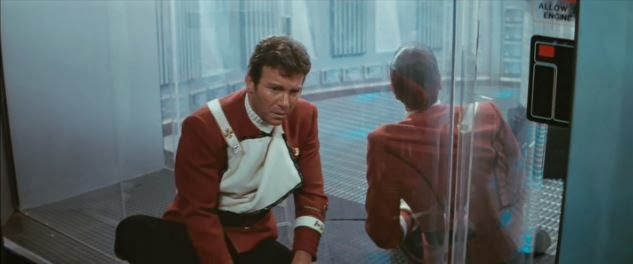
Now, William Shatner has certainly earned his reputation for overacting, which perhaps makes Kirk's reaction to Spock's sacrifice all the more devastating. Even being prepared, even knowing that the next film is called The Search for Spock, does not protect the viewer's heart from being ripped out by the friends' farewell, unable to reach each other, divided by a pane of glass. And Kirk's utter brokenness at being unable to do anything for his friend would bring a Vulcan to tears. (See Saavik in the funeral scene.)
The film does not let up in the aftermath to the famous death scene. First, witness Kirk trying not to break down as he delivers Spock's eulogy. As if that was not upsetting enough, Scotty gets out the bagpipes to send Spock off! Kirk briefly interrupted my grieving process by quoting Sydney Carton's last lines in A Tale of Two Cities - and getting the wording wrong, which caused my brain to itch. But I had barely enough time to compose myself before the famous "Space, the final frontier" voice-over begins, and it's Leonard Nimoy's voice! WHY WOULD YOU DO THAT?
Thankfully, I know that the story is not over for everyone's favourite "pointy-eared hobgoblin," but at the time, when The Wrath of Khan could have marked the end of Star Trek, what a downer-ending that would have been. I must think myself fortunate that I have come to Star Trek late in the game, because to leave it on that note must have been unendurable.
From the very first moments of the title credits, The Wrath of Khan promises to be the Star Trek motion picture that, um, Star Trek: The Motion Picture never was. The Motion Picture was released a couple of years after a certain other space science fiction film with the word "Star" in the title, (and many, many terrible copies) and allegedly wanted to remind filmgoers that there was more than one type of science fiction movie, being the 2001: A Space Odyssey of the '70s. The Wrath of Khan is, right from the beginning, much more user-friendly. Its title sequence may evoke the Star Wars-type crowd-pleaser, with its starry screen, and James Horner's combination of the classic series theme tune and a new, jaunty, adventurous and hummable melody, but that's not a terrible thing. Perhaps, by 1982, the bad Star Wars knock-offs had begun to die out somewhat, or perhaps the producers were less concerned about VERY MUCH NOT BEING LIKE STAR WARS, NO SIR. This new score sets the tone for the film, and does not disappoint.
My main criticism of The Motion Picture was the under-use of the series' beloved characters. The Wrath of Khan brings them right back, recognisable but not unchanged. After deciding that the robotic life was not for him, Mr Spock has mellowed. The inner conflict between his human and Vulcan side seems to have been resolved, and he has become more relaxed and likeable. We see him express concern for his captain's wellbeing, and speaking frankly and unsentimentally about the importance of their friendship. He even gives Kirk a birthday present: a beautiful copy of Charles Dickens' A Tale of Two Cities. And though he and Dr. "Bones" McCoy still have their heated arguments, the edge of cruelty that so often came into their rivalry of head and heart before, has gone.
Captain - sorry, Admiral - Kirk, too, has changed. It is his birthday, and it is making him feel gloomy - perhaps one of the Big Ones, probably fifty. Also, he has apparently had a bad perm. Still, it takes very little in the way of plot manoeuvres before he has once more commandeered his beloved Enterprise, full of new recruits, and is heading off into an epic adventure. Soon, he is reunited with two people from his past: old flame Carol Marcus (plus son who also has very, very curly hair. Hmmm...) and Kirk's old enemy and rival to the title of Largest Ham In The Galaxy: Khan Noonian Singh. Or, as he's better known:
| "KHAAAAAAAAAN!" |
| "Do you know the old Klingon proverb that tells us revenge is a dish that is best served cold? It is very cold... in space." |
Right?
Chances are, you know the answer to that one. Even before I watched Star Trek, I knew how the Enterprise would be saved, and at what cost. But that did not stop the ending from being any more heartbreaking. The moment at which I saw the look of understanding and decision cross Spock's face, I flashed back to another moment in fiction. I remembered that horrified dawning realisation of what a very different character was planning, the very first time I read... now which book was it Spock bought Kirk for his birthday?
Now, William Shatner has certainly earned his reputation for overacting, which perhaps makes Kirk's reaction to Spock's sacrifice all the more devastating. Even being prepared, even knowing that the next film is called The Search for Spock, does not protect the viewer's heart from being ripped out by the friends' farewell, unable to reach each other, divided by a pane of glass. And Kirk's utter brokenness at being unable to do anything for his friend would bring a Vulcan to tears. (See Saavik in the funeral scene.)
Thankfully, I know that the story is not over for everyone's favourite "pointy-eared hobgoblin," but at the time, when The Wrath of Khan could have marked the end of Star Trek, what a downer-ending that would have been. I must think myself fortunate that I have come to Star Trek late in the game, because to leave it on that note must have been unendurable.
Sunday, 20 October 2013
Sunday Summary
Looking back over the last few months of blogging, I was horrified at how few book reviews I've posted. I've read plenty, but I haven't necessarily been reading analytically, with enough to say to write a full review. So I thought I'd try out a new weekly feature, where I can talk informally about my week in reading (also TV, films, book shopping and other news.)
This week has felt like a looooong one. Work has not been terrible, but I'm starting to feel a little bit run down, and finding it more exhausting than sometimes having to be friendly and welcoming all the time. Little things that really ought not to bother me for more than a moment are chipping away at my peace of mind, and I am feeling very much in need of a holiday. Perhaps that is why I seem to have acquired 10 books in the past 8 days, by various means...
Last week, I spent an evening at the home of some new friends, with good food, good company and a hysterical game of Cards Against Humanity. It is good to meet new people with similar geeky interests, especially in a small community like the Isle of Wight, where most people seem to be remarkably ordinary. Jamie and his wife Chrissie have wonderfully chaotic and geeky bookshelves - I know I've met a kindred spirit when the first book I notice on someone's shelves is a copy of Brewer's Dictionary of Phrase and Fable. Jamie lent me a book called "Mindstar Rising," which he described as a "detective story set in the future." I look forward to reading this one. Also, some time back, my friend and I battled it out for a copy of Paolo Bacigalupi's The Windup Girl in the Waterstone's clearance. She won, but agreed to pass it on to me when she was done.
This week has felt like a looooong one. Work has not been terrible, but I'm starting to feel a little bit run down, and finding it more exhausting than sometimes having to be friendly and welcoming all the time. Little things that really ought not to bother me for more than a moment are chipping away at my peace of mind, and I am feeling very much in need of a holiday. Perhaps that is why I seem to have acquired 10 books in the past 8 days, by various means...
Last week, I spent an evening at the home of some new friends, with good food, good company and a hysterical game of Cards Against Humanity. It is good to meet new people with similar geeky interests, especially in a small community like the Isle of Wight, where most people seem to be remarkably ordinary. Jamie and his wife Chrissie have wonderfully chaotic and geeky bookshelves - I know I've met a kindred spirit when the first book I notice on someone's shelves is a copy of Brewer's Dictionary of Phrase and Fable. Jamie lent me a book called "Mindstar Rising," which he described as a "detective story set in the future." I look forward to reading this one. Also, some time back, my friend and I battled it out for a copy of Paolo Bacigalupi's The Windup Girl in the Waterstone's clearance. She won, but agreed to pass it on to me when she was done.
Then, of course, was my Ninja Book Swap parcel from Ellie Warren, containing Perfect and Shades of Grey (Any number below 49 or above 51.) I've made a start on reading Perfect, a story which follows an imaginative boy worrying about an additional two seconds added into the day, and the difference which two seconds can make. The chapters alternate between the boy, Byron, in the 1970s, and Jim in the present day, battling with crippling obsessive-compulsive disorder, and though it is simply written, it gives a powerful insight into a child's mind. I'm only a few chapters in so far, but as well as the main topic of perfection (if there can be such a thing,) I've noticed secondary themes about class and prejudice, and how money cannot buy a happy family.
Thursdays are late-night opening at my local library, which was a good thing as I kept on forgetting (or being too lazy) to return my library books on my lunch break, but after work I popped in to take them back... and ended up picking up two more. I've been meaning to read Slaughterhouse 5 for a long time, (thanks to Hanna I am prepared for the sneaky aliens) so was pleased to find it in stock for once! I also picked The Night Strangers up from the "returns" shelf, which follows a family moving into a new house, to find a door in the basement locked with 39 locks... the same number as those who died in a plane crush, piloted by the father of the house. It looks rather creepy!
On Friday, I was in town with my best friend Judi, and we just happened to notice the gluten-free cake-and-quiche stall in the Farmers' market, and it would have been rude for her not to support a company that provides for her dietary needs. And once we'd gone through the market, we ended up going past the Oxfam bookshop and picking up two or three books apiece. As you do. I read the first of Iain M. Banks' Culture novels in the summer, which, if I'm honest, I was not enamoured of. I didn't want to give up on him, however. I later discovered that Phlebas is considered atypical of the series, and that The Player of Games was a better introduction to Banks' universe. I also remembered my friend Clare recommending me The Beginner's Goodbye, and once I'd decided to buy a book, what difference would another one make?
...Or another three, as it happened. I was feeling a little glum this morning, and as I passed The Works, it started to rain. Obviously, that was nature's way of telling me to go and have a look at the 3 for £5 section. As well as a present for a friend, I discovered Pretty Girl Thirteen, a book about, as I understand it, a teenage girl with a multiple-personality disorder who turns up at home after being missing for three years. I've also been feeling an itch in my brain to read another Stephen King, so From a Buick 8 completed the three.
I've acquired 10 books this week, but how many have I actually read?
I had two books left over from my last library splurge: Heart-Shaped Bruise by Tanya Byrne, and Dolly by Susan Hill. Heart-Shaped Bruise is presented as a notebook found in a former young offenders' home, a letter-slash-diary-slash-confession of a teenage girl awaiting trial for an undisclosed terrible crime.
Dolly is a ghost story from the writer of The Woman in Black, and is very similar in feel. Both are set in big, misty old houses in the middle of nowhere. Its setting lends a wonderfully creepy atmosphere to the story, which is a classic ghost story rather than a fully-developed novel; the sort of story that would not be out of place being told by torchlight at a Halloween sleepover. A quick read; I think I got through it in about two hours.
I made a start on Let The Right One In by John Avijde Lindqvist, a Swedish vampire story that has been sitting on my pile for well over year. Whether it was because I was reading it on my lunch break and feeling distracted, or because this book is not for me, I haven't got very far in it and am unsure whether I should continue. For now, I have put it to one side, and if I don't pick it up within, say, a month, I may bid it farewell. (It was a free World Book Day copy, so I could not in all conscience give it to a second-hand bookshop to sell, but a couple of coffee shops in town have book-swaps, so perhaps it may end up there.)
As it is autumn, which I find quite stressful at work, I decided to reread the Harry Potter books as a bit of escape at bedtime, and this week I got up to The Chamber of Secrets. I've read that series so many times, and yet I still notice odd little moments that I've never picked up on before, such as Fred Weasley dropping a stack of books on his twin brother's head (on the last page.) And, as already mentioned, I started reading Perfect yesterday.
Thursday, 17 October 2013
Trick Or Treat Ninja Book Swap: I've got presents!
After a long day at work, which left me feeling a little bit weary of people, I arrived home to find a great big box addressed to me. Last month I signed up for Bex and Hanna's Trick or Treat Ninja Book Swap, and sent off my parcel with plenty of time to spare, but it still took me by surprise to find a great big box waiting for me with my name on it.
My gift was from Ellie of Curiosity Killed the Bookworm. As a "trick," a surprise book from my chosen genre (science fiction) she sent me Jasper Fforde's Shades of Grey. (A book which has been around far longer than that book of an unfortunately similar title.) I loved his Thursday Next books, but have not yet read this one, though my best friend loves it. I've no excuse now!
Ellie also sent me a few treats:
From my books wishlist: Perfect by Rachel Joyce
A bar of Montezuma's "Eton Mess" chocolate and some "Halloweenies" (seasonal Cadbury animals.)
A chunky ball of wool (It's all multi-coloured and so shimmery! What shall I make with it? Something toasty warm, because winter is coming. Maybe a scarf?)
And a little skull-and-crossbones tote bag (Arrr!), just the right size to take a book for a walk.
Tomorrow is my day off, which I had already planned for a duvet-day, so I shall get stuck into one of my new books and demolish some of that chocolate. So thank you Ellie, and thank you to Hanna and Bex for organising the ninja book swap.
My gift was from Ellie of Curiosity Killed the Bookworm. As a "trick," a surprise book from my chosen genre (science fiction) she sent me Jasper Fforde's Shades of Grey. (A book which has been around far longer than that book of an unfortunately similar title.) I loved his Thursday Next books, but have not yet read this one, though my best friend loves it. I've no excuse now!
Ellie also sent me a few treats:
From my books wishlist: Perfect by Rachel Joyce
A bar of Montezuma's "Eton Mess" chocolate and some "Halloweenies" (seasonal Cadbury animals.)
A chunky ball of wool (It's all multi-coloured and so shimmery! What shall I make with it? Something toasty warm, because winter is coming. Maybe a scarf?)
And a little skull-and-crossbones tote bag (Arrr!), just the right size to take a book for a walk.
Tomorrow is my day off, which I had already planned for a duvet-day, so I shall get stuck into one of my new books and demolish some of that chocolate. So thank you Ellie, and thank you to Hanna and Bex for organising the ninja book swap.
Subscribe to:
Posts (Atom)